16MnCr5 Steel Standard for Industrial Buyers: What the Specification Covers
📑 Table of Contents
- 🔍 1. Which Standard Covers 16MnCr5 Steel?
- 📋 2. 16MnCr5 Grade Designation and Material Number
- 🧪 3. Chemical Composition Requirements
- ⚙️ 4. Delivery Conditions and Hardness
- 🔥 5. Case Hardening and Heat-Treatment Requirements
- 📐 6. Product Forms, Dimensions and Tolerances
- 🔬 7. Inspection, Testing and Material Certificates
- 🏭 8. Applications and Material Selection
- 🛒 9. What Industrial Buyers Should Specify
- 🏢 Otai Special Steel Advantages
- ❓ FAQ About the 16MnCr5 Steel Standard
🔍 1. Which Standard Covers 16MnCr5 Steel?
16MnCr5 is a European alloy case-hardening steel commonly identified by material number 1.7131. Its traditional reference standard is EN 10084, while EN ISO 683-3 is the later standard reference for case-hardening steels. The applicable edition depends on the product specification, contract and purchasing requirements.
These standards describe requirements relevant to steel grade identification, chemical composition, delivery conditions and other technical characteristics. However, a grade name alone does not define every requirement for a finished component. Buyers also need to identify the product form, dimensional range, supply condition, inspection requirements and intended heat-treatment process.
EN 10084 versus EN ISO 683-3
EN 10084 is frequently cited in older drawings, specifications and material certificates. And EN ISO 683-3 is a later reference used for case-hardening steels. Because technical documents and supplier datasheets may cite different editions, procurement teams should not automatically assume that every reference to EN 10084 is equivalent to a requirement under a newer edition.
| Reference | Purpose | Buyer consideration |
|---|---|---|
| EN 10084 | Traditional European standard for case-hardening steels | Check the edition cited in the drawing or contract. |
| EN ISO 683-3 | Later standard reference for case-hardening steels | Confirm the required edition and product scope. |
| EN 10277 | Product requirements for bright steel products | Relevant when ordering covered bright products rather than assuming hot-rolled requirements apply. |
| EN 10132-2 | Technical delivery conditions for covered cold-rolled narrow strip for heat treatment | Relevant to the specified strip product form. |
For procurement, the safest approach is to state the exact standard and edition required in the purchase order. If a supplier proposes a different edition or product standard, request a technical comparison before accepting the substitution.
📋 2. 16MnCr5 Grade Designation and Material Number
The designation 16MnCr5 identifies an alloy steel designed primarily for case hardening. Its relatively low carbon content supports a tougher core, while manganese and chromium contribute to hardenability. During carburizing and subsequent heat treatment, the component develops a carbon-enriched surface that can achieve high hardness and wear resistance.
| Identification item | Description |
|---|---|
| Steel grade | 16MnCr5 |
| Material number | 1.7131 |
| Steel category | Alloy case-hardening steel |
| Primary treatment route | Carburizing followed by hardening and tempering as specified |
| Typical component requirements | Hard, wear-resistant surface with a comparatively tough core |
Why the material number matters
International buyers often receive quotations from suppliers in different countries. Some documents emphasize the grade name, while others use the material number. Including both identifiers in the inquiry and purchase order helps reduce confusion during quotation, inspection and receiving.
Nevertheless, matching the designation and material number is only the first step. The same grade can be supplied in different product forms, dimensions and delivery conditions. A plate ordered for machining may need different dimensional and inspection requirements from bright steel used to manufacture precision components.
Do not assume that similar grades are interchangeable
Grades such as 20MnCr5 and other manganese-chromium case-hardening steels may appear in similar applications, but their specified chemistry and performance requirements can differ. A replacement should not rely only on a supplier’s equivalence chart. Compare the applicable standards, hardenability, section size, heat-treatment route and component performance requirements before approving a change.
🧪 3. Chemical Composition Requirements
Chemical composition is a central part of the 16MnCr5 steel standard because it influences carburizing response, hardenability, machinability and the properties obtainable after heat treatment. The following table presents commonly published composition limits for 16MnCr5 under EN ISO 683-3-related technical data. Buyers should verify the exact limits and analytical rules in the standard edition specified for their order.
| Element | Commonly published range or limit, wt.% | Role in the steel |
|---|---|---|
| Carbon (C) | 0.14–0.19 | Supports a tough core before carburizing and permits surface carbon enrichment during treatment. |
| Silicon (Si) | Maximum 0.40 | Acts as a deoxidizing element and influences steel properties. |
| Manganese (Mn) | 1.00–1.30 | Contributes to hardenability and strength. |
| Phosphorus (P) | Maximum 0.025 | Controlled as an impurity because excessive levels can adversely affect toughness. |
| Sulfur (S) | Maximum 0.035 | Affects machinability and inclusion characteristics; contract limits may be tighter. |
| Chromium (Cr) | 0.80–1.10 | Contributes to hardenability and wear-related performance after appropriate treatment. |
| Copper (Cu) | Maximum 0.40 in commonly published data | Controlled as part of the specified chemical analysis. |
Standard limits, typical analysis and actual MTC values
Procurement teams should distinguish three kinds of chemistry data. Standard limits define the permitted range or maximum for the applicable standard. A mill’s typical analysis describes representative production and does not replace the standard. The actual heat analysis on the Material Test Certificate (MTC) reports the measured chemistry for the supplied heat, subject to the relevant acceptance rules.
For example, a supplier may advertise a typical carbon value within the specified range. That value alone does not prove that a particular shipment complies. The buyer should review the actual MTC and compare its results with the agreed standard and purchase-order requirements.
Why chemistry affects purchasing decisions
Two heats can both meet the 16MnCr5 standard while showing different actual values within the permitted limits. This variation is normal within a specification, but it can matter when a component has tight heat-treatment or performance requirements. For critical parts, buyers should discuss hardenability, section size and process controls with the steel supplier and heat-treatment provider instead of relying on grade name alone.
⚙️ 4. Delivery Conditions and Hardness
The 16MnCr5 standard framework addresses delivery conditions as well as chemical composition. The delivery condition affects how easily the material can be cut, machined and prepared for later heat treatment. Therefore, specifying only “16MnCr5” may leave important purchasing details unresolved.
| Condition designation | General meaning | Purchasing consideration |
|---|---|---|
| +A | Soft annealed | Often selected to support machining before final heat treatment. |
| +FP | Treated to a ferrite-pearlite structure | Confirm the required hardness and applicable product standard. |
| +N | Normalized | Check whether this condition is available and specified for the ordered product. |
| +TH | Treated to a hardness range | The required range and testing basis should be stated clearly. |
These designations are not a substitute for the full delivery specification. Availability and requirements vary with product form and the applicable standard. Buyers should also avoid assuming that every condition listed in a general datasheet applies to every thickness or product type.
What hardness should buyers expect?
Soft-annealed 16MnCr5 datasheets commonly specify a maximum hardness around 207 HBW, while other delivery conditions can have different limits or ranges. This figure is a reference, not a universal guarantee for every shipment. The applicable standard, product form, thickness and agreed condition determine the acceptance requirement.
More importantly, delivery hardness is not the same as the final surface hardness after carburizing and hardening. If a component drawing requires a specified surface hardness, case depth or core hardness, those requirements must be defined in the heat-treatment and component specifications. The steel grade by itself does not guarantee the finished result.
Choose the condition to suit the next process
If the material will undergo substantial machining before carburizing, buyers should confirm that the delivery hardness supports their machining process. If the supplier provides a different condition from the one requested, ask for the relevant hardness results and written confirmation before acceptance. This step can prevent unexpected tool wear, machining delays and extra processing costs.
🔥 5. Case Hardening and Heat-Treatment Requirements
16MnCr5 is designed for applications that require a wear-resistant surface and a comparatively tough core. Carburizing adds carbon to the surface, after which hardening and tempering can produce the required surface and core characteristics. This makes the grade useful for gears, shafts, pinions and other components subject to contact stress and repeated loading.
The standard does not replace the component heat-treatment specification
Although the material standard establishes grade requirements, the finished properties also depend on component geometry, carburizing conditions, quenching, tempering and process control. Consequently, two components made from compliant 16MnCr5 steel may not achieve identical case depth or hardness if their treatment routes differ.
For procurement, the drawing or technical specification should define the relevant finished-component requirements, such as:
- Target surface hardness and the test method.
- Effective or total case depth, with the measurement definition stated.
- Core hardness or other core-property requirements where applicable.
- Permitted distortion, dimensional changes and finishing allowance.
- Any requirements for microstructure, surface condition or post-treatment inspection.
Heat-treatment temperatures are process-dependent
Carburizing, hardening and tempering temperatures should come from a qualified heat-treatment procedure suitable for the component and the selected steel. A temperature copied from a general online chart should not be treated as a mandatory value in EN ISO 683-3 or as a guaranteed recipe for every part.
Buyers should ask the heat-treatment provider to confirm the process window, expected case depth, quenching method and dimensional-control measures. For complex or precision parts, a trial run may help establish whether the proposed treatment meets the drawing requirements before full production.
Hardenability is not the same as surface hardness
Hardenability describes the ability of steel to harden through a section under defined conditions. Surface hardness describes the hardness measured at a surface, while case depth describes how far the hardened case extends into the material. These properties are related, but they are not interchangeable.
For that reason, buyers should not select 16MnCr5 solely because a datasheet lists a high achievable surface hardness. Component size, geometry, treatment parameters and the required core properties all influence suitability. Where a design imposes demanding requirements, obtain engineering confirmation before approving the grade.
📐 6. Product Forms, Dimensions and Tolerances
A steel standard must be interpreted alongside the product form being purchased. Hot-rolled plate, bar, bright steel and cold-rolled strip can fall under different product-specific requirements. The standard that covers the steel grade does not automatically define every dimension, surface finish or tolerance for every form.
Specify the dimensions that affect production
For plate purchases, provide the required thickness, width, length, quantity and cutting dimensions. If the steel will be machined into precision components, also specify the machining allowance and the dimensional tolerances needed after cutting. A supplier should confirm which tolerances it can achieve for the requested size and condition.
| Requirement | What to state in the inquiry | Why it matters |
|---|---|---|
| Product form | Plate or another specifically required form | Determines the relevant product requirements and available supply route. |
| Dimensions | Thickness, width, length and quantity | Supports accurate stock checks, cutting plans and quotation. |
| Tolerance | Required dimensional tolerance or governing tolerance standard | Helps prevent disputes about acceptable dimensions. |
| Surface condition | As supplied, machined or another defined finish | Affects machining allowance, inspection and preparation. |
| Testing | Required certificate, hardness test or additional inspection | Makes acceptance criteria clear before shipment. |
Confirm dimensional standards separately
When a drawing specifies a product standard and a separate dimensional tolerance standard, both requirements should appear in the purchase documents. Do not assume that compliance with the steel-grade standard automatically confirms tight cutting tolerances or a particular surface finish.
For plate cut to customer dimensions, confirm whether the quoted dimensions describe the raw material or the finished cut pieces. Buyers should also discuss edge condition, cutting method, marking and packaging when these factors affect subsequent machining or receiving inspection.
🔬 7. Inspection, Testing and Material Certificates
Compliance should be verified through the agreed documents and inspection process, not through a grade label alone. A Material Test Certificate helps connect the supplied material to its heat or batch and provides test results relevant to the purchase specification.
What to check on the MTC
Before approving shipment or closing receiving inspection, check the certificate for the following information, where applicable to the order:
- Steel grade and material number.
- Referenced standard and edition, when stated or contractually required.
- Heat or batch identification that matches the supplied material markings.
- Actual chemical analysis and comparison with the specified limits.
- Delivery condition and hardness results where required.
- Product dimensions and other inspection results required by the purchase order.
- Certificate type and traceability details required by the buyer.
Understand certificate types
EN 10204 defines types of inspection documents commonly used for metallic products. A purchase order may require a specific document type, such as a 3.1 inspection certificate, depending on the buyer’s quality system and application. The required certificate should be agreed before production or shipment rather than requested only after the material arrives.
A certificate type does not, by itself, prove that every additional requirement has been met. If the buyer requires ultrasonic testing, third-party inspection, additional hardness measurements or a special test report, specify the applicable method, acceptance criteria and reporting requirements in advance.
Traceability matters after cutting
When a plate is cut into several pieces, material identification can become harder to maintain unless the supplier uses a clear marking and traceability process. For critical components, agree how heat numbers or other identification will transfer to cut pieces and how the documents will identify the supplied quantity.
Inspection planning should also distinguish between material acceptance and finished-component acceptance. An MTC can support verification of the incoming steel, but it does not replace dimensional inspection or post-heat-treatment testing required for the finished part.
🏭 8. Applications and Material Selection
16MnCr5 is commonly used for components that need a hard, wear-resistant case and a tougher core. Typical applications include gears, pinions, shafts, transmission parts and selected machine components. Its suitability depends on the part’s loading, geometry, heat-treatment design and operating environment.
Match the material to the component requirements
For a gear, surface contact stress and wear resistance may dominate the design. For a shaft or pinion, core toughness, fatigue performance, dimensional stability and the required case depth can be equally important. The same grade may work well for one component and prove unsuitable for another if the loading or section size differs.
Before specifying 16MnCr5, engineers should review:
- Surface contact pressure, wear and fatigue requirements.
- Core strength and toughness needed under service loading.
- Component dimensions and section size.
- Required case depth and final hardness after heat treatment.
- Machining route, finishing allowance and dimensional tolerances.
- Inspection criteria and the consequences of component failure.
Compare alternatives carefully
Another case-hardening grade may offer different hardenability or chemical composition. A higher-alloy steel may be appropriate for a demanding section size or performance target, but it may also affect cost, processing and availability. Conversely, a lower-cost alternative should not be selected unless it satisfies the design and treatment requirements.
For international procurement, compare more than the quoted price per tonne. Include cutting, material yield, machining allowance, inspection, packaging, freight and any additional heat-treatment costs. A material that arrives in the correct dimensions with traceable documentation may reduce total production cost even if its initial unit price is not the lowest.
🛒 9. What Industrial Buyers Should Specify
A clear inquiry helps suppliers quote the correct 16MnCr5 material and reduces the risk of receiving steel that meets the grade name but not the full production requirement. Procurement teams should put the key technical and commercial details into one specification.
Purchase-order checklist
- Grade: 16MnCr5, material number 1.7131.
- Standard: State the required standard and edition; confirm the product-specific standard where applicable.
- Product form: Identify plate or the other required product form.
- Size and quantity: Include thickness, width, length, number of pieces and total weight if known.
- Delivery condition: Specify the required condition, such as +A, where applicable.
- Dimensional tolerance: State the required tolerance and any cutting or machining allowance.
- Inspection documents: Define the MTC type and any additional testing or third-party inspection.
- Traceability: State marking and identification requirements for full plates and cut pieces.
- Packaging: Specify anti-rust protection, bundling, wooden cases or other export packaging as needed.
- Delivery terms: Confirm lead time, shipment terms and destination requirements.
Ask for confirmation before approving a substitute
If the supplier proposes a different standard edition, delivery condition or similar grade, request written confirmation of the differences. The review should cover chemistry, product form, dimensions, hardness requirements, inspection documents and suitability for the planned heat-treatment process.
Likewise, if the material will be carburized after machining, make sure the supplier understands the intended application. This does not replace the heat-treatment provider’s responsibility, but it helps the supply chain align the incoming material with the finished component’s needs.
A complete specification improves quotation accuracy, inspection efficiency and delivery planning. It also gives both parties a clear basis for resolving discrepancies before the steel enters production.
🏢 Otai Special Steel Advantages
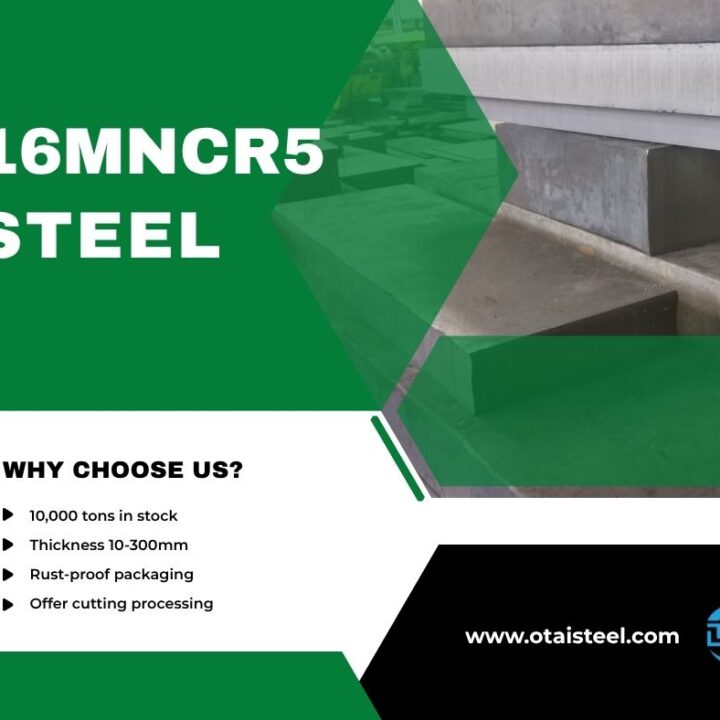
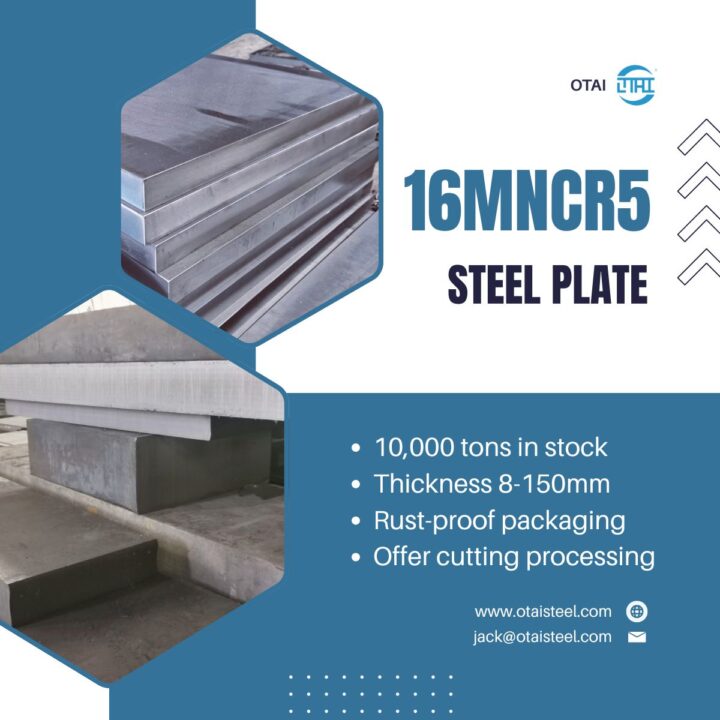
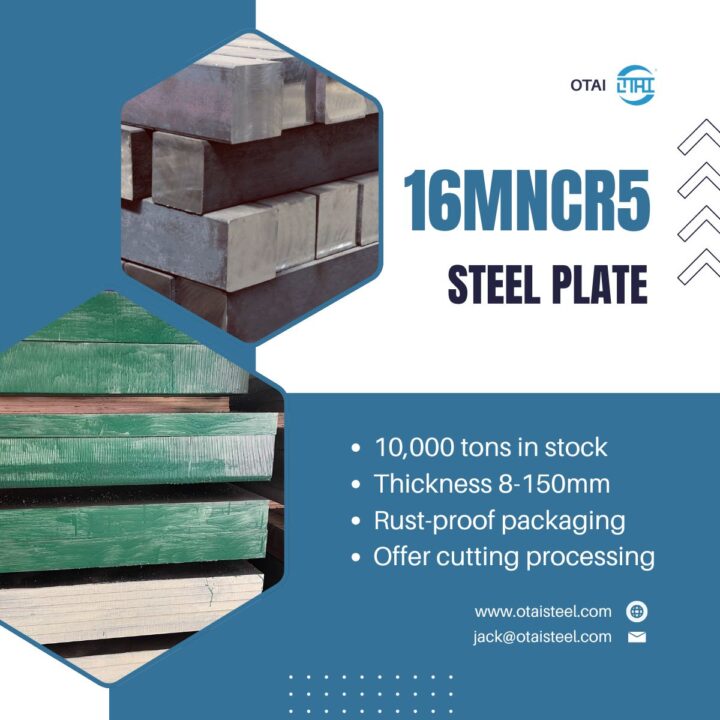
- 16MnCr5 steel plate in stock: Thickness range of 8–150 mm. Confirm the exact dimensions, quantity and delivery condition required for your project.
- Large inventory capacity: More than 10,000 tons of steel stock across the company’s product range.
- Cutting capability: 20 saw-cutting machines support cutting services based on customer dimensions and project requirements.
- Custom processing: CNC machining, grinding and customized size or tolerance services can help buyers reduce unnecessary processing steps.
- One-stop service: Support for material selection, cutting, processing coordination, inspection arrangements and export packaging.
- Quality documentation: Material test certificates and additional inspection support can be discussed according to the order specification.
- Export experience: Supplying international customers in more than 54 countries since 1999.
- Export packaging: Bundling, anti-rust protection and wooden-case packaging can be arranged according to shipment needs.
When requesting a quotation for 16MnCr5, provide the required standard, dimensions, delivery condition, inspection documents and destination. This allows the team to check availability and confirm the appropriate supply arrangement for your application.
❓ FAQ About the 16MnCr5 Steel Standard
1. What is the standard for 16MnCr5 steel?
EN 10084 is the traditional reference for 16MnCr5 case-hardening steel. EN ISO 683-3 is a later standard reference for this steel category. Always confirm the applicable edition and product-specific requirements in the purchase contract.
2. What is the material number of 16MnCr5?
The material number is 1.7131. Buyers should include both 16MnCr5 and 1.7131 in inquiries and purchase documents to reduce identification errors.
3. What is the chemical composition of 16MnCr5?
Commonly published ranges include carbon at 0.14–0.19%, manganese at 1.00–1.30% and chromium at 0.80–1.10%. Silicon is commonly limited to 0.40% maximum, phosphorus to 0.025% maximum and sulfur to 0.035% maximum. Confirm the exact requirements against the specified standard edition and verify the actual heat analysis on the MTC.
4. Does the 16MnCr5 standard guarantee final surface hardness?
No. The steel-grade specification does not by itself guarantee a finished component’s surface hardness or case depth. These depend on the component design, carburizing and hardening procedures, quenching, tempering and the acceptance criteria defined for the finished part.
5. What documents should I request when buying 16MnCr5 steel plate?
Specify the required Material Test Certificate, grade and material number, standard edition, heat traceability, actual chemical analysis and any required hardness or additional inspection results. If the project needs ultrasonic testing or third-party inspection, state the method and acceptance criteria before placing the order.