Rockwell Hardness of 4140 Steel: What HRC Range Can 4140 Steel Achieve?
📑 Table of Contents
🔍 1. Rockwell Hardness of 4140 Steel: What Does It Mean?
🧪 2. 4140 Steel Hardness in Different Conditions
📊 3. Rockwell Hardness of 4140 Steel: HRC and Brinell Comparison
🔥 4. How Heat Treatment Changes 4140 Hardness
⚙️ 5. 4140 Hardness After Quenching and Tempering
🛠️ 6. Induction Hardening and Surface Hardness of 4140
🏭 7. 4140 Hardness for Shafts, Gears and Machine Parts
💡 8. What Rockwell Hardness Should You Choose for 4140?
🔍 1. Rockwell Hardness of 4140 Steel: What Does It Mean?
The Rockwell hardness of 4140 steel depends strongly on its heat-treatment condition. Unlike a material with one fixed hardness value, 4140 can reach a wide range of hardness levels through annealing, normalizing, quenching and tempering, or surface hardening.
4140 is a chromium-molybdenum alloy steel with medium carbon content. This chemistry gives the steel a useful balance of strength, toughness, hardenability, and wear resistance. As a result, manufacturers use it for shafts, axles, gears, bolts, studs, spindles, and other heavily loaded machine components.
When buyers ask about 4140 steel HRC, they should first identify the material condition. Annealed 4140 has a very different hardness from quenched-and-tempered 4140. Similarly, induction-hardened 4140 can have a much harder surface than its core.
| 4140 Condition | Typical Hardness Range | Typical Purpose |
|---|---|---|
| Annealed | Approximately 180–220 HB | Machining and fabrication |
| Normalized | Approximately 200–250 HB | Improved strength and structure |
| Quenched and tempered | Commonly selected around 28–50 HRC | Strength and toughness |
| Induction hardened surface | Can reach approximately 50–60 HRC | Wear and contact resistance |
These ranges are general engineering references rather than guaranteed values for every section size. Actual hardness depends on the specification, dimensions, heat-treatment parameters, and testing location.
Therefore, a good material inquiry should state both the 4140 grade and the required hardness condition.
🧪 2. 4140 Steel Hardness in Different Conditions
The hardness of 4140 steel changes according to its metallurgical condition. Before heat treatment, manufacturers often supply the material in annealed or normalized conditions to make cutting and machining easier.
Annealed 4140 hardness
Annealed 4140 generally has lower hardness and better machinability than hardened material. This condition is useful when the customer needs to turn, mill, drill, or cut the steel before final heat treatment.
The exact annealed hardness depends on the specification and processing history. Buyers should use the supplier’s material certificate when a specific hardness limit is required.
Normalized 4140 hardness
Normalizing refines the microstructure and can provide somewhat higher strength and hardness than a typical annealed condition. It can also create a useful starting condition before subsequent machining or heat treatment.
Quenched and tempered 4140 hardness
Quenching and tempering provides the broadest practical range of mechanical properties. The manufacturer can adjust the tempering process to balance hardness, tensile strength, yield strength, and toughness.
For this reason, 4140 steel hardness after heat treatment should always be discussed together with the required mechanical properties.
| Condition | Relative Hardness | Machinability | Typical Use |
|---|---|---|---|
| Annealed | Low to moderate | Good | Machining and fabrication |
| Normalized | Moderate | Good | General engineering |
| Quenched and tempered | Moderate to high | Lower than annealed | High-strength components |
| Surface hardened | Very high at surface | Requires appropriate finishing | Wear-resistant components |
The important point is that there is no single universal Rockwell hardness for 4140 steel. The selected condition should match the component’s actual service requirements.
📊 3. Rockwell Hardness of 4140 Steel: HRC and Brinell Comparison
Brinell and Rockwell are two common hardness measurement systems used for steel. Rockwell C, or HRC, is particularly useful when testing hardened steel, while Brinell hardness, expressed as HB or HBW, is commonly used for softer or medium-hard steel products.
The conversion between hardness scales is approximate. Different materials, test conditions, surface conditions, and standards can affect the relationship between HRC and HB.
| Approx. 4140 Hardness | Approx. Rockwell | Approx. Brinell | General Condition |
|---|---|---|---|
| 180 HB | Below HRC range | 180 HB | Soft/annealed |
| 200 HB | Below HRC range | 200 HB | Annealed or normalized |
| 250 HB | Approximately 24 HRC | 250 HB | Moderately hardened |
| 300 HB | Approximately 31 HRC | 300 HB | Higher strength condition |
| 350 HB | Approximately 37 HRC | 350 HB | Quenched and tempered |
| 400 HB | Approximately 43 HRC | 400 HB | High-strength condition |
| 450 HB | Approximately 46 HRC | 450 HB | High hardness |
The values above should be treated as approximate conversions, not substitutes for direct hardness testing. When a purchase specification requires a particular HRC value, the supplier should perform the specified test directly.
What is a good HRC for 4140?
A good HRC value depends on the application. A shaft requiring high toughness may use a lower tempered hardness, while a wear-resistant component may require a higher hardness.
For many engineering components, a quenched-and-tempered hardness in the approximate range of 28–32 HRC provides a useful balance of strength and toughness. Other applications may specify 35 HRC, 40 HRC, or higher.
Engineers should therefore avoid selecting 4140 based on hardness alone. Tensile strength, impact toughness, fatigue loading, section size, and operating conditions also matter.
🔥 4. How Heat Treatment Changes 4140 Hardness
Heat treatment has a major influence on the Rockwell hardness of 4140 steel. The same grade can behave very differently depending on austenitizing temperature, quenching medium, section size, tempering temperature, and cooling conditions.
Quenching
During quenching, 4140 transforms from austenite into harder structures such as martensite. A faster cooling rate generally promotes higher hardness, although excessive thermal stress can increase the risk of distortion or cracking.
Tempering
Tempering follows quenching in many 4140 applications. The process reduces internal stresses and adjusts the balance between hardness and toughness.
As tempering temperature increases, hardness generally decreases while toughness improves. Therefore, the final HRC value should be selected according to the service requirements rather than simply maximizing hardness.
| Heat-Treatment Stage | Effect on 4140 | Main Objective |
|---|---|---|
| Austenitizing | Creates austenitic structure | Prepare steel for hardening |
| Quenching | Raises hardness significantly | Develop hard transformation products |
| Tempering | Reduces brittleness and adjusts hardness | Balance strength and toughness |
| Induction hardening | Hardens selected surface areas | Improve surface wear resistance |
| Stress relieving | Reduces residual stress | Improve dimensional stability |
For large 4140 sections, hardenability becomes especially important. The surface may cool more quickly than the center, creating a hardness gradient through the cross-section.
That is why section thickness and diameter should be included when specifying the required 4140 HRC hardness.
⚙️ 5. 4140 Hardness After Quenching and Tempering
Quenched-and-tempered 4140 is one of the most common conditions for demanding mechanical components. This treatment gives manufacturers flexibility to select a practical hardness level according to the application.
For example, a component designed for impact and fatigue loading may benefit from a moderate tempered hardness rather than the maximum achievable hardness. On the other hand, components exposed to surface wear may require higher hardness.
4140 at around 30 HRC
Around 30 HRC, 4140 can provide a useful combination of strength and toughness. This condition is often attractive for shafts, axles, pins, and machinery components that experience substantial mechanical loads.
At around 40 HRC
At around 40 HRC, the material provides higher hardness and strength, but the increase in hardness can reduce ductility and toughness. Engineers should verify that the component design can tolerate this trade-off.
4140 at higher hardness
4140 can reach higher hardness levels after suitable hardening, particularly near the surface or in smaller sections. However, maximum hardness is not always the best engineering solution.
The correct 4140 steel HRC range should therefore come from the required mechanical properties and service conditions.
| Approx. Hardness | General Performance | Potential Application |
|---|---|---|
| 20–25 HRC | Moderate strength, better toughness | General machinery components |
| 28–32 HRC | Good balance of strength and toughness | Shafts, axles, pins |
| 35–40 HRC | Higher strength and wear resistance | Loaded mechanical components |
| 40–50 HRC | High hardness and strength | Selected wear-resistant applications |
| 50–60 HRC | Very hard surface | Surface-hardened components |
These values provide general engineering guidance. Actual achievable hardness depends on the product size, heat-treatment process, steel chemistry, and testing method.
🛠️ 6. Induction Hardening and Surface Hardness of 4140
Induction hardening provides another way to increase the surface hardness of 4140. Instead of hardening the entire component, the process rapidly heats a selected surface region and then cools it to create a hardened layer.
This approach works particularly well when a component needs a wear-resistant working surface but still requires a tougher core.
4140 induction hardening
4140 responds well to induction hardening because its carbon content supports the formation of a hard martensitic surface. The final hardness can often reach approximately 50–60 HRC, depending on the process and material condition.
The actual surface hardness depends on heating temperature, frequency, heating time, quenching conditions, prior microstructure, and component geometry.
Surface hardness vs core hardness
A surface-hardened 4140 component should not be evaluated only by its surface HRC. The core hardness remains important because it supports the hardened layer during impact and cyclic loading.
For example, a shaft may need a very hard surface to resist wear while retaining sufficient core toughness to prevent cracking under bending loads.
| Hardening Method | Surface Hardness | Core Condition | Typical Purpose |
|---|---|---|---|
| Quench and temper | Moderate to high | Hardened and tempered | Uniform strength |
| Induction hardening | Very high | Tougher relative to surface | Wear resistance |
| Flame hardening | High | Relatively tough core | Localized surface hardening |
| Annealing | Low | Soft condition | Machining |
For components requiring both high surface hardness and good core properties, surface hardening can be a practical alternative to hardening the entire section.
🏭 7. 4140 Hardness for Shafts, Gears and Machine Parts
The appropriate hardness for 4140 depends on the component’s operating conditions. A shaft, gear, bolt, and hydraulic component may require different hardness levels even when they use the same steel grade.
| Component | Typical Hardness Approach | Important Considerations |
|---|---|---|
| Shafts | Quenched and tempered or surface hardened | Strength, fatigue and toughness |
| Gears | Through-hardened or surface hardened | Wear and contact fatigue |
| Axles | Quenched and tempered | Impact and bending loads |
| Bolts and studs | Quenched and tempered | Tensile strength and toughness |
| Spindles | Quenched and tempered or induction hardened | Wear, strength and dimensional stability |
| Hydraulic components | Heat treated according to design | Strength and surface durability |
4140 for shafts
4140 is a popular choice for shafts because it can combine high strength with useful toughness after quenching and tempering. When a shaft also needs strong resistance to surface wear, induction hardening can provide a harder working layer.
For gears
4140 can also be used for gears, especially when the required loading and wear conditions fall within its capabilities. However, the designer should compare it with case-hardening grades when the gear requires an extremely hard carburized surface.
4140 for general machine parts
The broad heat-treatment range of 4140 makes it practical for many machine components. Buyers can select a material condition that matches machining requirements before final treatment.
Therefore, the Rockwell hardness of 4140 steel should always be connected to the component rather than viewed as an isolated number.
💡 8. What Rockwell Hardness Should You Choose for 4140?
There is no single ideal hardness for every 4140 application. Instead, engineers should determine the required combination of strength, toughness, wear resistance, fatigue performance, and machinability.
Choose lower hardness when:
- The component needs higher toughness.
- Impact loading is significant.
- Machining requirements are important.
- The component does not require extreme surface wear resistance.
- A moderate strength level is sufficient.
Choose higher hardness when:
- The component experiences significant surface wear.
- Contact stress is high.
- Induction hardening is part of the design.
- Higher tensile and yield strength are required.
- The component can tolerate the associated reduction in ductility.
| Design Requirement | Potential 4140 Condition |
|---|---|
| Easy machining | Annealed |
| General engineering | Normalized or moderately hardened |
| Balanced strength and toughness | Quenched and tempered around 28–32 HRC |
| Higher strength | Quenched and tempered at a higher hardness level |
| High surface wear resistance | Induction hardened |
When ordering 4140, buyers should clearly state the required hardness, tolerance, product dimensions, and delivery condition. This helps the supplier select the appropriate manufacturing and heat-treatment route.
For buyers comparing 4140 steel hardness HRC values, the most important question is not simply “How hard can 4140 get?” Instead, ask “What hardness does this component actually require?”
📦 9. Otai Special Steel Advantages
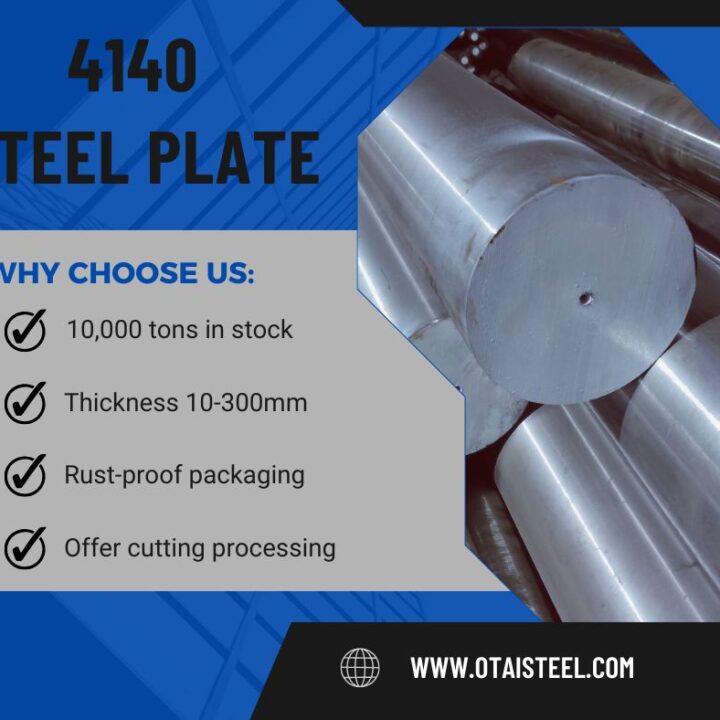
- 4140 steel round bar stock: Otai Special Steel provides 4140 steel round bars with diameters of 14–500 mm available in stock for machining, forging, and industrial component manufacturing.
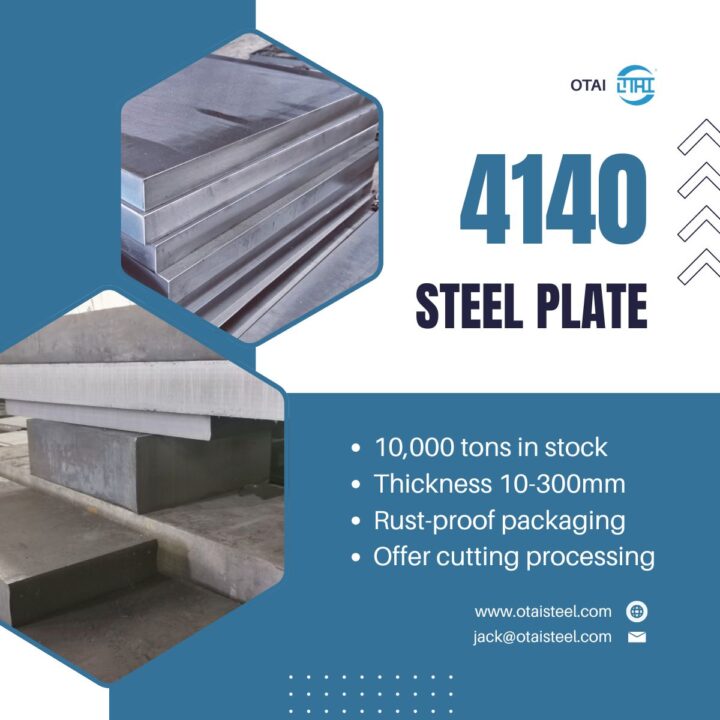
- 4140 steel plate stock: We supply 4140 steel plates with thicknesses of 13–200 mm available in stock to meet different fabrication and heavy-duty application requirements.
- Different dimensions: We can supply different diameters, thicknesses, widths, and lengths according to customer requirements.
- Cutting service: Precision cutting and custom-size cutting can be arranged according to drawings and specified dimensions.
- Heat treatment: Annealing, normalizing, quenching, tempering, and other suitable heat-treatment services can be arranged according to technical requirements.
- Quality inspection: Ultrasonic testing and third-party inspection support are available for orders with specific quality requirements.
- Export packaging: Anti-rust packaging, steel strapping, and wooden cases help protect steel products during international transportation.
- International supply experience: Otai Special Steel supplies tool steel and alloy steel to international industrial customers with demanding technical requirements, including Fortune Global 500 companies.
If you need 4140 with a specific Rockwell hardness, provide the required HRC range, dimensions, quantity, delivery condition, and application. Otai Special Steel can help arrange suitable 4140 material and processing according to your project requirements.
❓ 10. Frequently Asked Questions
1. What is the Rockwell hardness of 4140 steel?
The hardness depends on the material condition. Annealed 4140 is commonly around 180–220 HB, while quenched-and-tempered 4140 can commonly fall within approximately 28–50 HRC depending on the treatment. Surface-hardened 4140 can reach approximately 50–60 HRC at the hardened surface.
2. What HRC is 4140 steel normally?
There is no single normal HRC value for every 4140 product. For many quenched-and-tempered applications, approximately 28–32 HRC provides a useful balance of strength and toughness, while other applications may require higher or lower hardness.
3. Can 4140 reach 60 HRC?
Yes, the surface of suitably induction-hardened 4140 can reach approximately 50–60 HRC depending on the material condition and hardening process. The core will normally have a different hardness.
4. Is 4140 harder than mild steel?
Yes. 4140 generally has substantially higher strength and hardness potential than ordinary mild steel, particularly after suitable quenching and tempering or surface hardening.
5. What 4140 products does Otai Special Steel have in stock?
Otai Special Steel provides 4140 steel round bars with diameters of 14–500 mm available in stock and 4140 steel plates with thicknesses of 13–200 mm available in stock. Cutting, machining, heat treatment, ultrasonic testing, third-party inspection support, and export packaging can also be arranged according to customer requirements.