16MnCr5 Rate per Kg: Price Factors, Steel Properties, Applications and Buying Tips
📑 Table of Contents
🔍 1. 16MnCr5 Rate per Kg: Why Does the Price Matter?
📊 3. 16MnCr5 Chemical Composition and Material Properties
💰 4. What Determines the 16MnCr5 Price per Kg?
⚙️ 5. 16MnCr5 Weight, Size and Price Calculation
🔥 6. How Heat Treatment Affects 16MnCr5 Cost
🏭 7. 16MnCr5 Applications and Purchasing Requirements
💡 8. How to Get a Better 16MnCr5 Rate per Kg
🔍 1. 16MnCr5 Rate per Kg: Why Does the Price Matter?
When buyers search for the 16MnCr5 rate per kg, they usually want more than a simple material price. The actual purchasing cost depends on steel size, quantity, condition, processing, heat treatment, inspection, and delivery requirements.
16MnCr5 is an alloy case-hardening steel commonly selected for gears, shafts, pinions, bushings, and other components that require a hard wear-resistant surface with a tough core. Because the material often goes through machining and carburizing, the steel price represents only one part of the final component cost.
For example, a buyer may receive two quotations for 16MnCr5 steel with different prices per kilogram. One supplier may quote basic material only, while another quotation may include cutting, testing, heat treatment, anti-rust protection, and export packaging.
Therefore, buyers should compare the complete quotation rather than selecting a supplier solely according to the lowest 16MnCr5 price per kg.
| Price Factor | Effect on Final Cost | Why It Matters |
|---|---|---|
| Raw steel price | High | Directly affects the base material cost |
| Material size | Medium to high | Large or unusual sizes may require special production |
| Order quantity | Medium | Larger orders can improve purchasing efficiency |
| Cutting | Additional | Custom dimensions require processing |
| Heat treatment | Additional | Carburizing and other treatments add processing cost |
| Inspection | Additional | UT and third-party inspection may increase the total quotation |
| Packaging and shipping | Additional | Export orders require suitable protection and logistics |
The most useful approach is to ask for a quotation based on the complete technical specification. This gives buyers a much clearer picture of the real cost per kilogram.
🧪 2. What Is 16MnCr5 Steel?
16MnCr5 is a low-carbon alloy case-hardening steel specified under the EN material system and commonly identified as 1.7131. Its chemical design supports carburizing, which allows manufacturers to create a hard surface while maintaining a relatively tough core.
The steel contains manganese and chromium as important alloying elements. These elements improve hardenability and support the performance required for carburized components.
Unlike medium-carbon steels that normally rely on through-hardening, 16MnCr5 is particularly useful when the component needs different properties at the surface and in the core.
16MnCr5 for case hardening
During carburizing, carbon enters the surface layer of the steel at elevated temperature. After quenching, the enriched surface can reach high hardness, while the lower-carbon core remains tougher and more resistant to sudden failure.
This combination explains why engineers frequently select 16MnCr5 for transmission components and other parts exposed to repeated contact loading.
| Material Feature | Typical Characteristics of 16MnCr5 |
|---|---|
| Material number | 1.7131 |
| Steel type | Low-carbon alloy case-hardening steel |
| Main alloying elements | Manganese and chromium |
| Typical treatment | Carburizing, quenching and tempering |
| Surface performance | High hardness and good wear resistance after case hardening |
| Core performance | Good toughness and load-bearing capability |
| Common product forms | Round bars, plates, forgings and machined components |
For buyers, understanding the material grade helps explain why a 16MnCr5 steel price may differ from the price of more general-purpose alloy steels.
📊 3. 16MnCr5 Chemical Composition and Material Properties
The chemical composition of 16MnCr5 plays a major role in its response to carburizing and heat treatment. Carbon remains relatively low in the base material, while manganese and chromium improve hardenability.
| Element | Typical Range | Main Function |
|---|---|---|
| Carbon (C) | Approx. 0.14–0.19% | Supports case hardening and core properties |
| Silicon (Si) | Approx. 0.15–0.40% | Deoxidation and strength contribution |
| Manganese (Mn) | Approx. 1.00–1.30% | Hardenability and strength |
| Chromium (Cr) | Approx. 0.80–1.10% | Hardenability and wear performance |
| Phosphorus (P) | Controlled low level | Limited because excessive levels can reduce toughness |
| Sulfur (S) | Controlled according to specification | Influences machinability and cleanliness |
Exact composition limits can vary according to the applicable standard, product form, and supply condition. Buyers should always check the material certificate when the chemical analysis is critical.
16MnCr5 hardness before and after treatment
The hardness of 16MnCr5 depends strongly on its condition. In the untreated or annealed state, the material remains relatively machinable. After carburizing and quenching, the surface becomes significantly harder.
This treatment strategy makes the steel suitable for components where the surface handles wear and contact stress while the core absorbs impact and cyclic loads.
Consequently, the 16MnCr5 material properties should always be evaluated together with the intended heat-treatment condition.
💰 4. What Determines the 16MnCr5 Price per Kg?
There is no universal fixed 16MnCr5 rate per kg. Steel prices change with market conditions, order specifications, dimensions, processing requirements, and delivery terms.
Raw material and market conditions
Steelmaking costs influence the base quotation. Energy, alloying elements, production capacity, transportation, and market demand can all affect the final price.
Chromium and manganese contribute to the alloy design of 16MnCr5. Therefore, its price can differ from that of plain carbon steel or lower-alloy grades.
Product dimensions
Size also matters. Standard dimensions are often easier to source than unusual thicknesses or diameters. A supplier may need additional production or cutting work when the requested size falls outside regular stock.
Quantity
Order volume can influence the commercial quotation. Large industrial orders may allow suppliers to optimize production, cutting, packaging, and transportation.
Processing requirements
A buyer who needs saw cutting, precision cutting, machining, heat treatment, or special inspection should expect a higher total cost than a buyer purchasing untreated material only.
| Purchasing Option | Cost Level | Typical Situation |
|---|---|---|
| Standard raw material | Lower | Buyer handles further processing |
| Cut-to-size material | Moderate | Supplier performs dimensional cutting |
| Machined material | Higher | Supplier provides additional machining |
| Heat-treated material | Higher | Specified mechanical or surface properties required |
| Inspected and export-packed material | Depends on requirements | Industrial international shipment |
For this reason, buyers should compare quotations on the same basis. Ask suppliers whether the quoted 16MnCr5 rate per kg includes cutting, testing, heat treatment, packaging, and delivery.
⚙️ 5. 16MnCr5 Weight, Size and Price Calculation
Weight calculation helps buyers estimate the material quantity before requesting a quotation. For steel, the commonly used density for calculation is approximately 7.85 g/cm³.
For a rectangular plate, the approximate weight can be calculated using:
Weight (kg) = Length (m) × Width (m) × Thickness (mm) × 7.85
For example, a 2 m × 1 m × 20 mm steel plate has an approximate theoretical weight of:
2 × 1 × 20 × 7.85 = 314 kg
The final commercial weight can vary according to actual dimensions, tolerances, cutting allowances, and the supplier’s weighing method.
Round bar weight calculation
For round bars, buyers can use the approximate formula:
Weight (kg/m) = Diameter² (mm) × 0.006165
For example, a 50 mm diameter round bar has an approximate theoretical weight of:
50² × 0.006165 ≈ 15.41 kg/m
| Product | Example Size | Approx. Weight |
|---|---|---|
| Plate | 2000 × 1000 × 10 mm | 157 kg |
| Plate | 2000 × 1000 × 20 mm | 314 kg |
| Plate | 2000 × 1000 × 30 mm | 471 kg |
| Round bar | Ø30 mm | Approx. 5.55 kg/m |
| Round bar | Ø50 mm | Approx. 15.41 kg/m |
| Round bar | Ø100 mm | Approx. 61.65 kg/m |
Once the estimated weight is known, buyers can multiply it by the supplier’s current price per kilogram to estimate the material value. However, the final quotation should also account for processing, packaging, inspection, and transportation.
This is particularly useful when comparing the 16MnCr5 rate per kg from several suppliers because buyers can place different quotations on a similar weight basis.
🔥 6. How Heat Treatment Affects 16MnCr5 Cost
Heat treatment can significantly affect the final purchasing cost of 16MnCr5. The process adds equipment, energy, labor, inspection, and production time.
For case-hardening applications, carburizing represents an important processing step. The manufacturer controls temperature, carbon potential, holding time, cooling, and subsequent quenching to achieve the required case properties.
After carburizing, quenching and tempering help establish the final combination of surface hardness and core toughness.
Why case depth affects price
A deeper carburized layer generally requires more processing time and tighter process control. Therefore, buyers should specify the required effective case depth instead of simply asking for “hardened 16MnCr5.”
For precision gears, the heat-treatment specification can also influence dimensional control. Carburizing and quenching may introduce distortion, so manufacturers often leave suitable machining allowances for final grinding or finishing.
| Requirement | Potential Cost Impact | Reason |
|---|---|---|
| Annealed condition | Lower | Suitable for many machining operations |
| Normalized condition | Moderate | Additional thermal processing |
| Carburizing | Higher | Requires controlled case-hardening equipment |
| Quenching and tempering | Higher | Additional thermal processing and inspection |
| Specified case depth | Depends on depth | Longer or more controlled treatment may be required |
| Final grinding | Additional | Used when tight dimensions and surface finish are required |
A supplier should therefore quote heat-treated 16MnCr5 according to the actual technical requirement rather than applying one generic treatment price.
🏭 7. 16MnCr5 Applications and Purchasing Requirements
16MnCr5 is widely associated with components that require a hard surface and tough core. Gear manufacturers, machinery producers, and transmission-component suppliers may select this grade for demanding service conditions.
| Application | Why 16MnCr5 Is Used |
|---|---|
| Gears | Hard carburized surface and tough core |
| Pinions | Good resistance to contact stress and wear |
| Shafts | Useful combination of surface hardness and core toughness |
| Bushings | Suitable for wear-resistant surfaces |
| Transmission components | Supports repeated loading and contact stress |
| Machine components | Good balance of machinability and heat-treatment performance |
What should buyers specify?
When requesting a quotation, provide the material grade, product form, dimensions, quantity, delivery condition, heat-treatment requirements, inspection requirements, and packaging requirements.
For example, a clear inquiry could specify 16MnCr5 round bar, required diameter and length, EN specification, annealed condition for machining, ultrasonic testing, and export packaging.
This information allows suppliers to prepare a more accurate quotation and helps avoid misunderstandings about the 16MnCr5 rate per kg.
If the material will later undergo carburizing, buyers should also confirm whether the supplier provides suitable pre-treatment material and whether the certificate includes the required chemical and mechanical information.
💡 8. How to Get a Better 16MnCr5 Rate per Kg
Getting a competitive 16MnCr5 rate per kg does not simply mean choosing the lowest number on a quotation. Instead, buyers should optimize the material specification and purchasing process.
1. Compare identical specifications
Make sure every supplier quotes the same grade, dimensions, delivery condition, tolerances, inspection level, and quantity. Otherwise, a lower quotation may simply represent a different product specification.
2. Ask about stock availability
Stock material can reduce production lead time and may also reduce the cost associated with special manufacturing. However, buyers should confirm the exact available dimensions before placing an order.
3. Combine processing requirements
If you need cutting, machining, testing, or packaging, ask the supplier for a combined quotation. This can simplify procurement and reduce the number of separate suppliers involved in the project.
4. Consider total delivered cost
The material price per kilogram is only one part of the purchase. Freight, packaging, cutting loss, inspection, customs-related charges, and other logistics expenses can affect the final landed cost.
5. Avoid unnecessary specifications
Special dimensions or additional inspection requirements can increase cost. Specify what the component actually requires instead of adding unnecessary processing.
For international buyers, the best quotation balances material quality, availability, processing capability, inspection, delivery time, and total cost.
In other words, the lowest 16MnCr5 steel price per kg is not always the lowest-cost solution. A supplier with ready stock and integrated processing may provide better overall value.
📦 9. Otai Special Steel Advantages
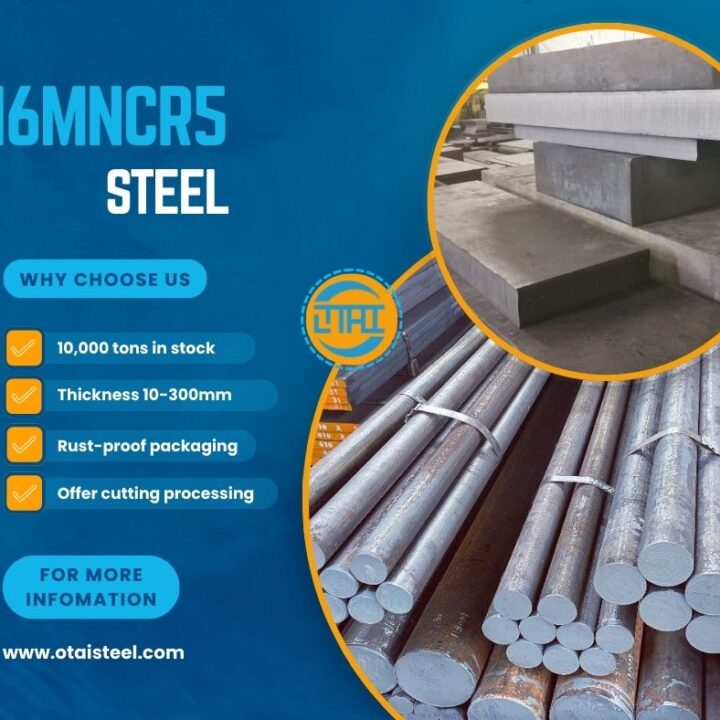
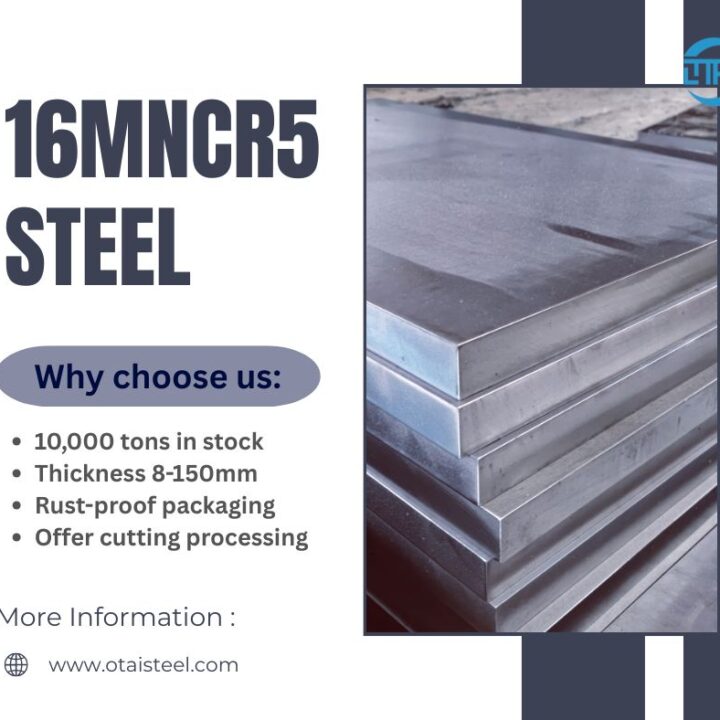
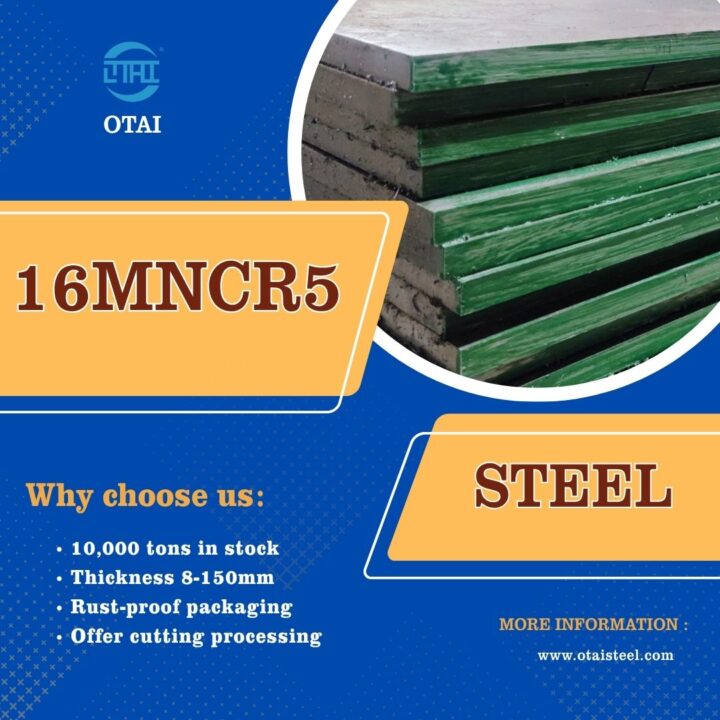
- 16MnCr5 steel plate stock: Otai Special Steel provides 16MnCr5 steel plates with thicknesses from 8–150 mm available in stock for different industrial applications.
- Large inventory: We maintain sufficient stock for different dimensions and support faster shipment according to order requirements.
- Cutting service: We can arrange precision cutting according to customer drawings and specified dimensions.
- Machining service: Additional machining can be arranged when customers require semi-finished or customized steel components.
- Heat treatment: Annealing, normalizing, quenching, tempering, and other suitable heat-treatment services can be arranged according to technical requirements.
- Quality inspection: Ultrasonic testing and third-party inspection support are available for orders with specific quality-control requirements.
- Export packaging: Anti-rust packaging, steel strapping, and wooden cases help protect steel products during international transportation.
- International supply experience: Otai Special Steel supplies tool steel and alloy steel to international industrial customers with demanding technical requirements.
When requesting the current 16MnCr5 rate per kg from Otai Special Steel, buyers can provide the required dimensions, quantity, specification, delivery condition, heat-treatment requirements, and destination. We can then prepare a quotation based on the actual order requirements.
❓ 10. Frequently Asked Questions
1. What is the current 16MnCr5 rate per kg?
The price of 16MnCr5 changes according to steel market conditions, dimensions, quantity, delivery condition, processing, inspection, and shipping requirements. A supplier should provide a current quotation based on the actual order specification.
2. Is 16MnCr5 expensive compared with carbon steel?
16MnCr5 is an alloy case-hardening steel, so its price can be higher than many basic carbon steels. However, the final cost comparison should consider its performance and suitability for carburized components.
3. How do I calculate the weight of 16MnCr5 steel?
For steel plates, you can estimate weight using length × width × thickness × 7.85 when using meters for length and width and millimeters for thickness. For round bars, the approximate weight per meter is diameter² × 0.006165.
4. Does heat treatment affect the 16MnCr5 price?
Yes. Carburizing, quenching, tempering, case-depth control, grinding, and other processing steps add production costs. The final quotation therefore depends on the required delivery condition.
5. What 16MnCr5 products does Otai Special Steel have in stock?
Otai Special Steel provides 16MnCr5 steel plates with thicknesses from 8–150 mm available in stock. We can also arrange cutting, machining, heat treatment, ultrasonic testing, third-party inspection support, and export packaging according to customer requirements.