16MnCr5 Carbon Percentage: Composition, Properties, Hardness and Applications
📑 Table of Contents
🔍 1. 16MnCr5 Carbon Percentage: What Is the Carbon Content?
🧪 2. Chemical Composition of 16MnCr5
📊 3. How Carbon Percentage Affects 16MnCr5 Properties
🔥 4. 16MnCr5 Carbon Percentage and Heat Treatment
⚙️ 5. Carbon Content, Hardness and Carburizing Performance
🛠️ 6. 16MnCr5 Machinability and Manufacturing Considerations
🏭 7. Applications of 16MnCr5 Based on Its Carbon Content
💡 8. Is the 16MnCr5 Carbon Percentage Suitable for Your Application?
🔍 1. 16MnCr5 Carbon Percentage: What Is the Carbon Content?
The 16MnCr5 carbon percentage is typically around 0.14–0.19% under the EN 10084 chemical composition range. This relatively low carbon content gives 16MnCr5 its characteristic behavior as a case-hardening alloy steel.
At first glance, a carbon level below 0.20% may appear too low for a high-strength engineering steel. However, 16MnCr5 does not rely on its original carbon content alone to achieve a hard working surface. Instead, manufacturers can enrich the surface with carbon through carburizing.
This design creates an important combination. The outer layer can achieve high hardness after carburizing and quenching, while the lower-carbon core retains better toughness than a fully high-carbon hardened structure.
As a result, engineers frequently select 16MnCr5 for gears, pinions, shafts, bushes and other components that experience surface wear, contact stress or repeated loading.
| Item | 16MnCr5 |
|---|---|
| Carbon (C) | 0.14–0.19% |
| Steel type | Case-hardening alloy steel |
| Carbon level | Relatively low |
| Main strengthening strategy | Carburizing and hardening |
| Typical use | Gears, pinions, shafts and machine components |
The exact chemistry can vary according to the applicable product specification. Therefore, buyers should use the material certificate to confirm the actual carbon content of a specific heat or product.
Understanding the carbon level is important because it explains why 16MnCr5 behaves differently from medium-carbon grades such as 4140, 1045 or 4340.
🧪 2. Chemical Composition of 16MnCr5
Carbon is only one part of the alloy design. Manganese and chromium also play important roles in the performance of 16MnCr5. Together, these elements support hardenability and help the steel respond effectively to case-hardening processes.
| Element | Typical Content | Main Function |
|---|---|---|
| Carbon (C) | 0.14–0.19% | Supports hardening and carburizing response |
| Silicon (Si) | Up to about 0.40% | Strength and deoxidation |
| Manganese (Mn) | 1.00–1.30% | Strength and hardenability |
| Chromium (Cr) | 0.80–1.10% | Hardenability and wear-related performance |
| Phosphorus (P) | Controlled by specification | Kept at a controlled level for steel quality |
| Sulfur (S) | Controlled by specification | Influences machinability and material quality |
Why carbon is relatively low
The low carbon level serves a practical purpose. If the entire component contained a high carbon concentration, hardening could produce a very hard structure throughout the section. That approach can increase brittleness and reduce the balance between surface durability and core toughness.
16MnCr5 takes another route. The manufacturer can first machine the component and then carburize the surface. This process introduces additional carbon into the outer region.
After quenching, the carbon-enriched case can develop substantially higher hardness than the original material. The core remains much lower in carbon, helping it retain useful toughness.
The role of manganese
Manganese contributes to strength and hardenability. It also supports the response of the steel during quenching.
Because 16MnCr5 combines manganese with chromium, the grade can achieve useful hardening performance despite its relatively low initial carbon content.
The role of chromium
Chromium improves hardenability and contributes to the overall alloy performance. It also makes 16MnCr5 different from plain carbon steels used for simpler mechanical components.
Therefore, the 16MnCr5 chemical composition works as a complete alloy system. Carbon provides the basis for surface enrichment, while manganese and chromium support the hardening response.
📊 3. How Carbon Percentage Affects 16MnCr5 Properties
The carbon content of a steel strongly influences hardness, strength, ductility and heat-treatment behavior. For 16MnCr5, the relatively low carbon percentage creates a useful starting point for case hardening.
In its untreated condition, 16MnCr5 does not have the same through-hardening behavior as a medium-carbon alloy steel. Instead, its value comes from the ability to create different properties between the surface and core.
| Property | Effect of Low Initial Carbon | Effect After Carburizing |
|---|---|---|
| Core hardness | Moderate depending on condition | Remains controlled by core chemistry and treatment |
| Surface hardness | Limited without surface treatment | Can become very high after hardening |
| Core toughness | Good potential | Good when case depth and treatment are properly controlled |
| Wear resistance | Moderate without surface hardening | Excellent at the carburized case |
| Machinability | Generally suitable before hardening | More demanding after case hardening |
| Contact fatigue performance | Depends on material condition | Strong potential for gear applications |
Carbon and hardness
Carbon is a major factor in the hardness that steel can achieve after hardening. However, the relationship is not simply “more carbon means better steel.”
For a gear, excessive hardness throughout the entire component can reduce toughness. A hard tooth surface needs a core that can absorb loads without cracking.
That is why the 16MnCr5 carbon percentage is well suited to case-hardening applications. The manufacturer can modify the surface chemistry without changing the basic low-carbon character of the core.
Carbon and toughness
A lower-carbon core generally provides better ductility and toughness than a high-carbon fully hardened structure. This property becomes valuable when a gear or shaft experiences impact loads.
The final performance still depends on section size, carburizing parameters, quenching conditions, tempering and component design. Material chemistry alone cannot guarantee a particular mechanical property.
Carbon and fatigue resistance
Fatigue failures often begin at highly stressed surfaces. A properly carburized and hardened surface can improve resistance to repeated contact and bending stresses.
For this reason, engineers often consider 16MnCr5 for components that operate under repeated loading. The hard case resists surface damage, while the tougher core supports load transfer.
🔥 4. 16MnCr5 Carbon Percentage and Heat Treatment
Heat treatment determines how the chemical composition translates into actual component performance. For 16MnCr5, manufacturers commonly use carburizing when the application requires a hard surface and tough core.
Carburizing
During carburizing, the component remains at an elevated temperature in a carbon-rich environment. Carbon diffuses into the surface and increases the carbon concentration within the case.
The treatment must provide the required case depth without creating unnecessary distortion or excessive retained austenite. Process control becomes especially important for precision gears.
Quenching
After carburizing, quenching converts the carbon-enriched surface into a hardened structure. The cooling method must match the component geometry and required properties.
Quenching too aggressively can increase distortion or cracking risk. A controlled process therefore matters just as much as the nominal steel grade.
Tempering
Tempering follows quenching in many case-hardening routes. It helps reduce internal stresses and stabilizes the final structure.
| Heat-Treatment Stage | Purpose | Effect on 16MnCr5 |
|---|---|---|
| Preliminary machining | Create the required component geometry | Uses a more machinable starting condition |
| Carburizing | Increase surface carbon | Creates a carbon-enriched case |
| Quenching | Harden the carburized layer | Develops high surface hardness |
| Tempering | Reduce stress and adjust properties | Improves stability and toughness balance |
| Finishing | Reach final dimensions and surface quality | Grinding may be required for precision parts |
The 16MnCr5 heat treatment process should always follow the applicable standard and the requirements of the finished component. A gear and a shaft may require different treatment parameters even when both use the same steel grade.
Buyers should therefore specify the required hardness, case depth, dimensional tolerance and inspection requirements instead of requesting only “heat-treated 16MnCr5.”
⚙️ 5. Carbon Content, Hardness and Carburizing Performance
The most useful way to understand the carbon content of 16MnCr5 is to compare the original material with the carburized surface.
Before carburizing, the steel contains only around 0.14–0.19% carbon. This level supports machining and provides a suitable low-carbon core.
During carburizing, the surface receives additional carbon. The enriched layer can then respond strongly to quenching and develop a high hardness suitable for demanding contact conditions.
| Condition | Carbon Distribution | Typical Purpose |
|---|---|---|
| Original 16MnCr5 | Low and relatively uniform | Starting material |
| After carburizing | Higher carbon near the surface | Prepare a hard case |
| After quenching | Hardened carbon-rich surface | Wear and contact resistance |
| Final component | Hard case with lower-carbon core | Combined surface durability and core toughness |
How deep does the carburized layer go?
Case depth depends on carburizing temperature, time, carbon potential, component geometry and the required final properties. Manufacturers should define effective case depth according to the applicable engineering specification.
A deeper case is not automatically better. The required depth should correspond to tooth size, contact stress, load conditions and expected service life.
Can 16MnCr5 reach high hardness?
Yes, but the location of the hardness matters. The original low-carbon material does not behave like a high-carbon tool steel. After carburizing and hardening, however, the surface can achieve a very high hardness.
This is one reason 16MnCr5 carburizing remains an important process for gear and transmission components.
For buyers comparing hardness values, always ask whether the supplier measured the surface or the core. Comparing these two values directly can lead to an incorrect material assessment.
🛠️ 6. 16MnCr5 Machinability and Manufacturing Considerations
The low initial carbon content of 16MnCr5 contributes to its practical machinability before final hardening. Manufacturers can normally perform turning, milling, drilling and other operations before carburizing.
This production sequence helps protect cutting tools from the extreme hardness that develops after case hardening. It also allows manufacturers to leave appropriate finishing allowances for the final process.
Machining before carburizing
Most major dimensional operations should take place before the component receives its final hardening treatment when the production design permits.
The machinist can establish the basic geometry while the material remains in a more workable condition. Afterward, carburizing and quenching create the required surface properties.
Machining after carburizing
The hardened case becomes considerably more difficult to machine. Precision components may therefore require grinding or other suitable finishing techniques.
This issue matters especially for gears. Tooth profiles and dimensions must remain within tight tolerances after heat treatment.
| Manufacturing Step | Recommended Consideration |
|---|---|
| Cutting | Use a suitable soft or normalized starting condition when possible |
| Turning | Complete major machining before final hardening when practical |
| Drilling | Select tools according to the actual material condition |
| Carburizing | Control case depth and surface carbon carefully |
| Quenching | Balance hardening performance with distortion control |
| Grinding | Use for precision finishing after hardening when required |
The relatively low carbon level makes 16MnCr5 a practical choice for manufacturing complex components that later require case hardening. Nevertheless, production parameters should always match the actual material condition and component geometry.
If the buyer requires a particular machinability level, the delivery condition should be clearly stated on the purchase specification.
🏭 7. Applications of 16MnCr5 Based on Its Carbon Content
The carbon content of 16MnCr5 strongly influences where engineers use the grade. Its low-carbon composition combined with alloying elements makes it especially useful for case-hardened mechanical components.
| Application | Typical Treatment | Reason for Selection |
|---|---|---|
| Gears | Carburizing and hardening | Hard surface and tough core |
| Pinions | Carburizing and hardening | Wear resistance and contact fatigue performance |
| Transmission parts | Case hardening | Suitable for repeated mechanical loading |
| Shafts | QT or case hardening depending on design | Strength, toughness and surface performance |
| Bushes | Case hardening | Hard working surface |
| Machine components | Specified according to application | Balanced engineering performance |
16MnCr5 for gears
Gear teeth experience repeated rolling and sliding contact. Surface damage can gradually develop through wear, pitting or other fatigue mechanisms.
A carburized 16MnCr5 gear can develop a hard surface that resists these conditions. The lower-carbon core provides a different property profile from the hardened case.
16MnCr5 for shafts
Shafts have different requirements depending on their design. Some need strong surfaces because bearings, seals or gears contact them. Others need a good balance of strength and toughness through the section.
For this reason, engineers may select different heat-treatment conditions for different shaft designs. The initial 16MnCr5 carbon percentage gives manufacturers flexibility when they need a case-hardening response.
16MnCr5 in transmission components
Transmission components often experience cyclic loads and surface contact. Material selection therefore requires attention to both wear resistance and core toughness.
The combination of low initial carbon and alloying elements makes 16MnCr5 particularly attractive when the production route includes carburizing.
💡 8. Is the 16MnCr5 Carbon Percentage Suitable for Your Application?
The answer depends on what the component needs from the steel. A low carbon level can be an advantage when the design requires a hard surface but does not want the entire component to behave like a high-carbon hardened steel.
Choose 16MnCr5 when:
- The component requires case-hardening capability.
- You need a hard, wear-resistant working surface.
- The core should retain good toughness.
- You are manufacturing gears, pinions or transmission components.
- The production process includes carburizing and quenching.
- You need an alloy steel with controlled low-carbon chemistry.
Pay attention to other grades when:
- The entire cross-section needs very high hardness.
- The component requires a medium-carbon through-hardening steel.
- The application primarily needs high tensile strength without carburizing.
- The selected manufacturing route does not support case hardening.
| Requirement | 16MnCr5 Suitability |
|---|---|
| Carburized gears | Excellent |
| Hard wear-resistant surface | Excellent after case hardening |
| Tough core | Good potential |
| High surface contact stress | Suitable with proper treatment |
| General through-hardened components | Application dependent |
| Precision transmission parts | Highly suitable after appropriate treatment |
For buyers researching 16MnCr5 carbon content, the most important point is that the nominal carbon percentage describes the starting material, not necessarily the final surface carbon concentration after carburizing.
Engineers should therefore consider the entire material-processing chain. Chemical composition, section size, carburizing parameters, quenching, tempering, case depth and final hardness all influence component performance.
A supplier should also provide a material certificate when precise chemical composition matters. This document allows the buyer to compare the actual heat analysis with the required specification.
In short, the approximately 0.14–0.19% carbon range gives 16MnCr5 its characteristic low-carbon case-hardening design. That balance makes the grade particularly useful when surface durability and core toughness must work together.
📦 9. Otai Special Steel Advantages
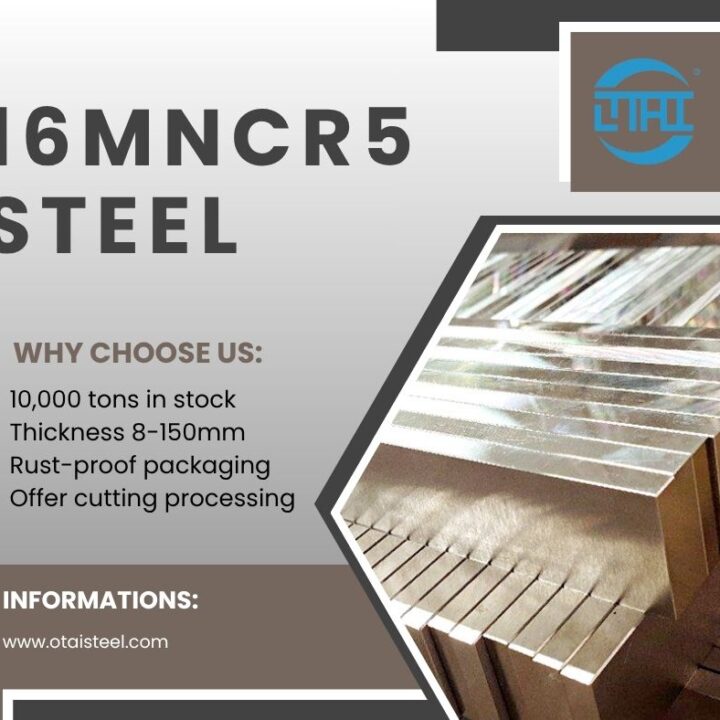
- 16MnCr5 steel plate stock: Otai Special Steel provides 16MnCr5 steel plates with thicknesses of 8–150 mm available in stock for different industrial and machining requirements.
- Different dimensions: We can supply different thicknesses, widths and lengths according to customer requirements and project specifications.
- Cutting service: We can arrange cutting according to customer drawings and specified dimensions.
- Heat treatment: Annealing, normalizing, quenching, tempering and other heat-treatment services can be arranged according to requirements.
- Quality inspection: Ultrasonic testing and third-party inspection can be arranged for orders with specific quality requirements.
- Export packaging: Steel strapping, wooden cases and anti-rust packaging help protect steel products during international transportation.
- International supply experience: Otai Special Steel has supplied steel products to customers with demanding technical requirements, including Fortune Global 500 companies.
If you are sourcing 16MnCr5 for gears, shafts or other case-hardening components, provide the required dimensions, standard, delivery condition, chemical composition requirements and heat-treatment specifications. Otai Special Steel can help confirm suitable material and processing options.
❓ 10. Frequently Asked Questions
1. What is the carbon percentage of 16MnCr5?
The typical carbon content of 16MnCr5 is 0.14–0.19% according to the commonly referenced EN 10084 composition range. The actual value should be confirmed using the material certificate for the specific heat.
2. Is 16MnCr5 a low-carbon steel?
Yes. With approximately 0.14–0.19% carbon, 16MnCr5 has a relatively low carbon content compared with medium-carbon alloy steels. It is designed primarily for case-hardening applications.
3. Why does 16MnCr5 have low carbon content?
The low initial carbon level helps provide a tougher core after case hardening. During carburizing, the surface receives additional carbon and can then achieve high hardness after quenching.
4. Can 16MnCr5 be carburized?
Yes. Carburizing is one of the main reasons engineers select 16MnCr5. The process increases carbon concentration near the surface, allowing the final component to develop a hard wear-resistant case and a relatively tough core.
5. What products does Otai Special Steel have for 16MnCr5?
Otai Special Steel provides 16MnCr5 steel plates with thicknesses of 8–150 mm available in stock. We can also arrange cutting, heat treatment, quality inspection and export packaging according to project requirements.