4140 Steel Wiki: Composition, Properties, Hardness, Heat Treatment and Uses
📑 Table of Contents
🔍 1. 4140 Steel Wiki: What Is 4140 Steel?
🧪 2. 4140 Steel Chemical Composition
📊 3. 4140 Steel Properties and Mechanical Performance
🔥 4. 4140 Steel Hardness and Heat Treatment
⚙️ 5. 4140 Steel Machinability and Fabrication
🦾 7. 4140 Steel Strength, Toughness and Wear Resistance
💡 8. 4140 Steel Advantages and Limitations
🔍 1. 4140 Steel Wiki: What Is 4140 Steel?
The term 4140 steel wiki usually refers to a basic technical overview of AISI 4140 alloy steel, including its chemical composition, mechanical properties, heat treatment, hardness, machinability, and applications.
4140 is a chromium-molybdenum alloy steel with medium carbon content. It is widely used because it combines strength, toughness, hardenability, and wear resistance in one versatile material.
In the United States, the grade is commonly identified as AISI 4140 or SAE 4140. It also appears under ASTM specifications depending on the product form and application. International buyers may encounter related designations such as 42CrMo4, although engineers should always verify the exact applicable standard before treating grades as equivalent.
Unlike low-carbon structural steels, 4140 can achieve substantial hardness through quenching and tempering. The chromium and molybdenum additions improve hardenability, allowing the material to develop useful mechanical properties across a range of section sizes.
| Feature | 4140 Steel |
|---|---|
| Steel type | Chromium-molybdenum alloy steel |
| Carbon level | Medium carbon |
| Common designation | AISI 4140 / SAE 4140 |
| Material characteristics | High strength, toughness and hardenability |
| Typical heat treatment | Quenching and tempering |
| Surface hardening | Induction or flame hardening can be used |
| Common products | Round bar, plate, forgings and machined components |
| Typical applications | Shafts, axles, gears, bolts, machinery parts and tooling components |
One reason engineers continue to select 4140 is its balance of properties. It can support demanding mechanical applications without requiring the highly specialized processing associated with some premium alloy grades.
For buyers researching what is 4140 steel, the most important point is simple: 4140 is a versatile medium-carbon alloy steel designed for components that require a strong combination of strength, toughness, and hardenability.
🧪 2. 4140 Steel Chemical Composition
The chemical composition of 4140 explains much of its performance. Carbon provides hardness and strength, while chromium and molybdenum improve hardenability and support performance after heat treatment.
| Element | Typical 4140 Composition | Function |
|---|---|---|
| Carbon (C) | 0.38–0.43% | Hardness and strength |
| Manganese (Mn) | 0.75–1.00% | Strength and hardenability |
| Silicon (Si) | Max 0.35% | Strength and deoxidation |
| Chromium (Cr) | 0.80–1.10% | Hardenability and wear resistance |
| Molybdenum (Mo) | 0.15–0.25% | Hardenability and temper resistance |
| Phosphorus (P) | Controlled low level | Impurity control |
| Sulfur (S) | Controlled low level | Impurity control and machinability |
Exact limits depend on the relevant standard and product specification. Therefore, a mill certificate remains the correct source for verifying the actual chemical analysis of a specific heat.
Why chromium matters
Chromium increases hardenability and contributes to wear resistance. It helps 4140 develop useful hardness deeper into the section during quenching.
Why molybdenum matters
Molybdenum improves hardenability and helps the steel maintain strength during tempering. It also reduces the risk of certain temper-related embrittlement problems.
Carbon content and performance
The medium carbon level gives 4140 a useful combination of strength and hardness potential. However, carbon also influences weldability. Compared with low-carbon steels, 4140 requires more attention to preheating and post-weld heat treatment when welding thick or highly restrained components.
This chemistry is why 4140 steel composition remains an important reference for engineers selecting the grade for shafts, high-strength machinery components, and heat-treated parts.
📊 3. 4140 Steel Properties and Mechanical Performance
The properties of 4140 depend heavily on its delivery condition and heat treatment. Annealed 4140 behaves very differently from quenched-and-tempered 4140.
For this reason, engineers should always specify the material condition when they compare tensile strength, yield strength, hardness, and elongation.
| Property | Typical Characteristics of 4140 |
|---|---|
| Tensile strength | High after suitable quenching and tempering |
| Yield strength | High in heat-treated condition |
| Hardness | Wide range depending on treatment |
| Toughness | Good with suitable heat treatment |
| Hardenability | Good to very good |
| Wear resistance | Good, especially after hardening |
| Fatigue resistance | Good when properly designed and treated |
| Machinability | Good in annealed or softer conditions |
Tensile strength
4140 can achieve high tensile strength after quenching and tempering. The final value depends on section size, quenching conditions, tempering temperature, and the required balance between strength and toughness.
A higher hardness condition normally provides greater strength, but engineers should not maximize hardness without considering impact toughness and fatigue requirements.
Yield strength
The yield strength of heat-treated 4140 can become substantially higher than that of conventional carbon steels. This makes the material useful for components that experience high tensile, bending, or torsional loads.
Toughness
Strength alone does not explain the popularity of 4140. Properly treated 4140 can maintain good toughness while delivering high strength.
This combination helps shafts, axles, bolts, and machinery components resist sudden loading and cyclic service conditions.
Therefore, 4140 steel mechanical properties should always be evaluated together rather than focusing on tensile strength alone.
🔥 4. 4140 Steel Hardness and Heat Treatment
Heat treatment is one of the main reasons 4140 can serve such a wide range of engineering applications. Manufacturers can modify its hardness and strength to match different component requirements.
| Condition / Process | Purpose | Typical Result |
|---|---|---|
| Annealing | Improve machinability and reduce hardness | Soft and machinable condition |
| Normalizing | Refine structure and prepare material | Balanced mechanical condition |
| Quenching | Increase hardness | High hardness but increased internal stress |
| Tempering | Balance hardness and toughness | Controlled strength and toughness |
| Induction hardening | Harden selected surface areas | Hard surface with tougher core |
| Flame hardening | Localized surface hardening | Improved surface wear resistance |
4140 hardness
There is no single hardness value for all 4140 products. Annealed material can remain relatively soft for machining, while quenched-and-tempered material can achieve much higher hardness.
The final hardness should therefore match the application. Shafts may require a balance between strength and toughness, while wear-focused components may require higher surface hardness.
Quenching and tempering
During quenching, manufacturers heat the steel to an appropriate austenitizing temperature and then cool it rapidly. This produces a hard microstructure.
Tempering follows quenching to reduce brittleness and internal stresses. The tempering temperature determines the final balance of hardness, strength, and toughness.
Surface hardening
Induction hardening can provide a hard surface without hardening the entire component to the same level. This approach works well for shafts, gears, pins, and other parts where surface wear resistance matters.
For customers researching 4140 steel heat treatment, the key consideration is the required final property rather than simply selecting the highest possible hardness.
⚙️ 5. 4140 Steel Machinability and Fabrication
4140 offers good machinability when supplied in a suitable soft condition. Manufacturers can turn, mill, drill, bore, and otherwise machine the material before final hardening.
As hardness increases, machining becomes more difficult. Carbide tooling, controlled cutting parameters, coolant, and suitable machine rigidity may become necessary.
| Manufacturing Operation | 4140 Performance | Important Consideration |
|---|---|---|
| Turning | Good in soft condition | Tool selection and cutting parameters |
| Milling | Good in soft condition | Machine rigidity and tooling |
| Drilling | Suitable | Use appropriate drill geometry and coolant |
| Grinding | Suitable for hardened material | Control heat generation |
| Forging | Suitable with controlled temperature | Avoid overheating and improper cooling |
| Welding | Possible with precautions | Preheating and controlled cooling are important |
4140 steel machinability
4140 steel machinability is generally favorable compared with many harder tool steels, especially when the material remains in an annealed or normalized condition.
Machining after hardening requires more careful process control. Manufacturers may use grinding or other finishing methods when tight tolerances are necessary.
Welding considerations
4140 can be welded, but its medium-carbon chemistry creates a greater risk of cracking than low-carbon structural steels. Preheating, suitable filler selection, controlled heat input, and post-weld treatment can reduce this risk.
For critical components, the welding procedure should follow a qualified welding specification rather than relying on general-purpose welding practices.
Forging
4140 is also suitable for forging when manufacturers control the forging temperature and subsequent cooling process. Forging can produce components such as shafts, gears, couplings, and heavy-duty machinery parts.
🏭 6. 4140 Steel Applications
The broad application range of 4140 comes from its combination of strength, toughness, hardenability, machinability, and heat-treatment flexibility.
| Application | Why 4140 Is Used |
|---|---|
| Shafts | High strength and torsional performance |
| Axles | Good strength and toughness |
| Gears | Suitable strength and surface-hardening options |
| Bolts and studs | High strength after heat treatment |
| Spindles | Good combination of hardness and toughness |
| Hydraulic components | Strength and wear resistance |
| Heavy machinery parts | Versatile heat-treatment response |
| Tooling components | Good strength and toughness |
Automotive applications
Automotive and transportation equipment can use 4140 for shafts, axles, studs, couplings, and other high-stress components. The material works well when the component must withstand repeated mechanical loading.
Industrial machinery
Industrial machinery represents another major application area. Manufacturers can use 4140 for drive shafts, machine components, hydraulic parts, gears, and structural mechanical components.
Oil and gas equipment
4140 also appears in selected oil and gas components where high strength and toughness are required. The final material condition must match the relevant industry specification and service environment.
Tooling and engineering components
Manufacturers can use 4140 for selected tooling components, fixtures, dies, and machine parts. Its machinability before hardening gives manufacturers flexibility during production.
Because the grade supports several heat-treatment routes, 4140 steel applications extend from general industrial machinery to demanding high-strength components.
🦾 7. 4140 Steel Strength, Toughness and Wear Resistance
One of the biggest advantages of 4140 is the balance between strength and toughness. A steel with extremely high hardness may resist wear well but can become more vulnerable to impact or cracking.
4140 allows engineers to select a heat-treatment condition that fits the service requirements. This flexibility makes it useful for components exposed to bending, torsion, impact, and repeated loading.
| Performance Requirement | 4140 Capability | Typical Design Approach |
|---|---|---|
| High tensile strength | Excellent potential | Quench and temper |
| High yield strength | Excellent potential | Controlled hardening and tempering |
| Impact toughness | Good with suitable treatment | Balance hardness and toughness |
| Surface wear resistance | Good to very good | Induction or flame hardening |
| Fatigue resistance | Good potential | Proper heat treatment and surface finish |
| Hardenability | Good to very good | Suitable quenching process |
Is 4140 steel strong?
Yes. 4140 is considered a high-strength engineering alloy steel when supplied and heat treated appropriately. Its strength can exceed that of many common carbon steels.
However, the exact strength depends on the material condition. A buyer should not use one tensile-strength value to represent every 4140 product.
4140 steel fatigue strength
Fatigue performance depends on much more than the steel grade. Surface finish, stress concentration, residual stress, heat treatment, inclusions, component geometry, and loading conditions all influence fatigue life.
Properly heat-treated 4140 can provide good fatigue performance in rotating and cyclically loaded components such as shafts and axles.
Wear resistance
4140 provides good wear resistance, particularly after suitable hardening. When a component needs a harder working surface, induction hardening can improve surface performance while keeping the interior comparatively tougher.
This makes 4140 a practical option when the application requires both high mechanical strength and reasonable surface durability.
💡 8. 4140 Steel Advantages and Limitations
4140 is popular because it provides a practical balance of performance and processing flexibility. However, it is not the best material for every application.
Main advantages of 4140
- High strength after suitable heat treatment.
- Good toughness and impact resistance.
- Good hardenability compared with many carbon steels.
- Good machinability in softer conditions.
- Suitable for quenching and tempering.
- Suitable for induction and flame hardening.
- Available in many industrial product forms.
- Suitable for shafts, gears, axles, bolts, and machinery components.
Potential limitations
- Welding requires more precautions than low-carbon steels.
- Higher hardness makes machining more difficult.
- Heat treatment can cause distortion and dimensional changes.
- It may not provide the same corrosion resistance as stainless steels.
- It may not be the ideal choice when a specialized case-hardening grade is required.
The correct selection therefore depends on the complete engineering requirement. For a high-strength shaft, 4140 can be an excellent choice. For a component requiring corrosion resistance, a stainless grade may be more appropriate.
Likewise, a highly specialized gear may require a dedicated carburizing grade rather than 4140. Material selection should always consider load, hardness, toughness, fatigue, wear, manufacturing method, and service environment.
For buyers researching 4140 steel wiki, the main takeaway is that 4140 is not simply a “strong steel.” Its value comes from the balance between strength, toughness, hardenability, machinability, and heat-treatment flexibility.
📦 9. Otai Special Steel Advantages
- 4140 steel round bar stock: Otai Special Steel provides 4140 steel round bars with diameters of 14–500mm available in stock for machining, forging, and industrial component manufacturing.
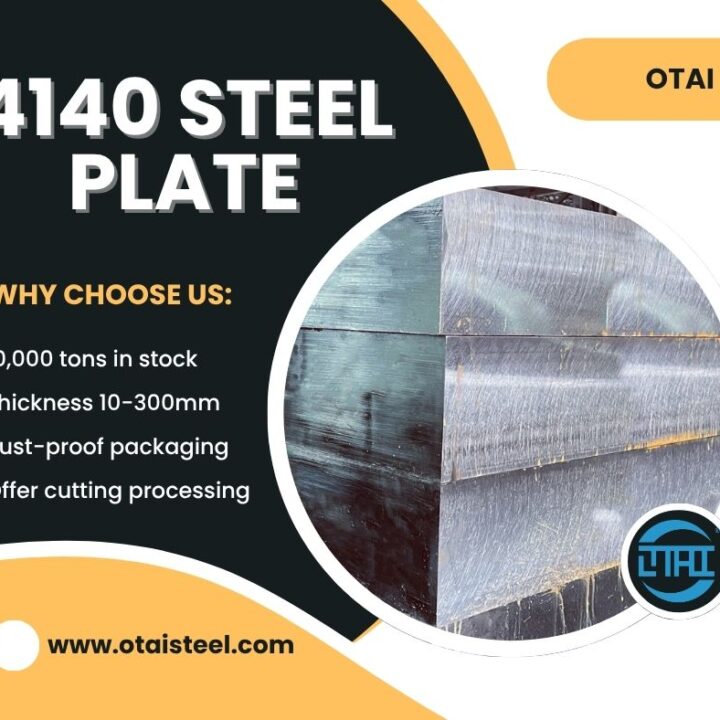
- 4140 steel plate stock: We supply 4140 steel plates with thicknesses of 13–200mm available in stock to meet different fabrication and heavy-duty application requirements.
- Different dimensions: We can supply different diameters, thicknesses, widths, and lengths according to project requirements.
- Cutting service: We can arrange cutting according to customer drawings and specified dimensions.
- Heat treatment: Annealing, normalizing, quenching, tempering, and other heat-treatment services can be arranged according to requirements.
- Quality inspection: Ultrasonic testing and third-party inspection can be arranged for orders with specific quality requirements.
- Export packaging: Steel strapping, wooden cases, and anti-rust packaging help protect steel products during international transportation.
- International supply experience: Otai Special Steel has supplied steel products to customers with demanding technical requirements, including Fortune Global 500 companies.
If you are looking for 4140 steel for a specific project, provide the required dimensions, material condition, heat-treatment requirements, mechanical properties, and quantity. Otai Special Steel can help confirm suitable 4140 material and processing options.
❓ 10. Frequently Asked Questions
1. What is 4140 steel?
4140 is a chromium-molybdenum alloy steel with medium carbon content. It is widely used for high-strength engineering components because it offers good strength, toughness, hardenability, and heat-treatment flexibility.
2. Is 4140 steel strong?
Yes. Properly heat-treated 4140 can achieve high tensile and yield strength while maintaining useful toughness. The exact values depend on the material condition, section size, and heat-treatment process.
3. What is 4140 steel used for?
Common applications include shafts, axles, gears, bolts, studs, spindles, hydraulic components, heavy machinery parts, tooling components, and other high-stress engineering components.
4. Can 4140 steel be hardened?
Yes. 4140 can be hardened through suitable quenching and tempering. Manufacturers can also use induction or flame hardening when a harder surface is required.
5. What 4140 products does Otai Special Steel have in stock?
Otai Special Steel provides 4140 steel round bars with diameters of 14–500mm available in stock and 4140 steel plates with thicknesses of 13–200mm available in stock. Cutting, heat treatment, inspection, and export packaging can also be arranged according to project requirements.