 16MnCr5 vs 100Cr6: Differences in Composition, Hardness, Properties and Applications
📑 Table of Contents
🔍 1. What Are 16MnCr5 and 100Cr6 Steel?
📋 2. 16MnCr5 vs 100Cr6 Chemical Composition Comparison
⚙️ 3. Mechanical Properties Comparison of 16MnCr5 and 100Cr6
🔥 4. Hardness and Heat Treatment Differences
📊 5. Physical Properties Comparison
🛠️ 6. Machinability and Manufacturing Performance
🏭 7. Applications: Gear Steel vs Bearing Steel
🔄 8. Which Steel Should You Choose?
🔍 1. What Are 16MnCr5 and 100Cr6 Steel?
16MnCr5 and 100Cr6 are both important alloy steels used in mechanical engineering, but they are designed for completely different purposes. Understanding the difference between these two materials is essential when selecting steel for gears, bearings, shafts, and precision components.
The comparison of 16MnCr5 vs 100Cr6 is not simply about which steel is stronger. The correct choice depends on the working conditions, required hardness, wear resistance, toughness, and manufacturing process.
16MnCr5 is a low-carbon chromium-manganese alloy steel mainly used as a carburizing gear steel. It provides a hard wear-resistant surface after carburizing while maintaining a tough internal core. This combination makes it ideal for gears, transmission parts, and automotive components.
100Cr6, also known as bearing steel, is a high-carbon chromium steel widely used for bearings, rollers, and precision wear-resistant components. Its high carbon and chromium content allows it to achieve extremely high hardness after heat treatment.
| Feature | 16MnCr5 | 100Cr6 |
|---|---|---|
| Steel Type | Case-hardening alloy steel | High-carbon chromium bearing steel |
| Main Purpose | Gear and transmission components | Bearings and wear-resistant parts |
| Carbon Content | Low carbon | High carbon |
| Hardening Method | Carburizing + quenching | Through hardening + tempering |
| Main Advantage | Hard surface + tough core | Extreme hardness and wear resistance |
The key difference between these two steels is their design concept. 16MnCr5 focuses on surface hardening performance, while 100Cr6 focuses on overall hardness and rolling contact fatigue resistance.
Therefore, engineers should evaluate application requirements carefully instead of replacing one material with the other directly.
📋 2. 16MnCr5 vs 100Cr6 Chemical Composition Comparison
Chemical composition is one of the most important factors affecting steel performance. The differences in carbon and chromium content explain why these two grades behave differently during heat treatment and service.
The following table shows the typical 16MnCr5 vs 100Cr6 chemical composition.
| Element | 16MnCr5 (%) | 100Cr6 (%) |
|---|---|---|
| Carbon (C) | 0.14–0.19 | 0.95–1.10 |
| Silicon (Si) | ≤0.40 | ≤0.35 |
| Manganese (Mn) | 1.00–1.30 | ≤0.45 |
| Chromium (Cr) | 0.80–1.10 | 1.30–1.65 |
| Phosphorus (P) | ≤0.025 | ≤0.025 |
| Sulfur (S) | ≤0.035 | ≤0.025 |
Carbon Content Difference
The carbon content difference creates the biggest performance gap between 16MnCr5 and 100Cr6.
16MnCr5 contains relatively low carbon, allowing it to maintain excellent toughness in the core after carburizing. The surface absorbs additional carbon during carburizing, creating a hard outer layer.
100Cr6 contains approximately 1% carbon, allowing the entire material to achieve very high hardness after quenching. This makes it suitable for bearing applications where wear resistance is critical.
Chromium Content Difference
100Cr6 contains more chromium than 16MnCr5, which improves hardenability and wear resistance. However, 16MnCr5 uses chromium together with manganese to achieve balanced carburizing performance.
This difference explains why 100Cr6 bearing steel characteristics are different from 16MnCr5 gear steel properties.
⚙️ 3. Mechanical Properties Comparison of 16MnCr5 and 100Cr6
Mechanical properties determine how steel performs under stress, impact, friction, and repeated loading. The difference between these two materials becomes especially clear after heat treatment.
| Property | 16MnCr5 | 100Cr6 |
|---|---|---|
| Tensile Strength | Approx. 650–900 MPa | Approx. 700–1100 MPa |
| Yield Strength | Approx. 400–600 MPa | Higher after hardening |
| Hardness Before Treatment | Approx. 170–220 HB | Approx. 190–240 HB |
| Final Hardness | 58–62 HRC surface hardness after carburizing | 60–66 HRC after hardening |
| Toughness | Excellent core toughness | Lower toughness compared with carburizing steel |
| Wear Resistance | Very good after carburizing | Excellent |
16MnCr5 Mechanical Performance
16MnCr5 provides a combination of surface hardness and internal toughness. This makes it suitable for components exposed to impact loads and repeated stress.
100Cr6 Mechanical Performance
100Cr6 provides extremely high hardness and excellent resistance to rolling contact fatigue. This makes it the preferred choice for bearings and precision wear components.
The 16MnCr5 and 100Cr6 hardness comparison shows that 100Cr6 achieves higher overall hardness, while 16MnCr5 provides better toughness balance.
🔥 4. Hardness and Heat Treatment Differences
Heat treatment creates the biggest performance differences between 16MnCr5 and 100Cr6. Although both steels can achieve high hardness, their hardening methods and final structures are completely different.
16MnCr5 is designed for carburizing treatment. During carburizing, carbon is added to the surface layer, creating a hard wear-resistant case while maintaining a tough low-carbon core.
100Cr6 is a high-carbon bearing steel that is normally hardened throughout the entire section. Its high carbon and chromium content allows it to achieve excellent hardness and dimensional stability.
| Heat Treatment | 16MnCr5 | 100Cr6 |
|---|---|---|
| Main Process | Carburizing + quenching + tempering | Hardening + tempering |
| Hardening Method | Surface hardening | Through hardening |
| Typical Heating Temperature | 880–950°C carburizing | 830–870°C hardening |
| Final Surface Hardness | 58–62 HRC | 60–66 HRC |
| Core Structure | Tough low-carbon core | High-hardness martensitic structure |
Carburizing Performance of 16MnCr5
The biggest advantage of 16MnCr5 is its ability to create a hard surface while maintaining excellent impact resistance inside the component.
This structure is ideal for gears because gear teeth require high surface hardness against wear, while the core must absorb shock loads during operation.
Hardening Performance of 100Cr6
100Cr6 achieves outstanding hardness throughout the material. This makes it suitable for rolling contact applications where continuous pressure and friction exist.
For this reason, 100Cr6 is widely used in bearings, rollers, and precision mechanical parts.
The 16MnCr5 and 100Cr6 hardness comparison shows that both steels provide excellent hardness, but they achieve it through different metallurgical approaches.
📊 5. Physical Properties Comparison of 16MnCr5 and 100Cr6
Physical properties influence machining, thermal behavior, dimensional stability, and performance under different operating conditions.
Although 16MnCr5 and 100Cr6 are both alloy steels, their different carbon and chromium levels create differences in microstructure and physical behavior.
| Physical Property | 16MnCr5 | 100Cr6 |
|---|---|---|
| Density | Approx. 7.85 g/cm³ | Approx. 7.81 g/cm³ |
| Thermal Conductivity | Approx. 42–46 W/m·K | Approx. 40–45 W/m·K |
| Elastic Modulus | Approx. 210 GPa | Approx. 210 GPa |
| Thermal Expansion Coefficient | Approx. 11.5–12.5 ×10⁻⁶ /°C | Approx. 12 ×10⁻⁶ /°C |
| Melting Temperature | Approx. 1450°C | Approx. 1420–1460°C |
Thermal Behavior Difference
The thermal conductivity difference between 16MnCr5 and 100Cr6 is relatively small. However, their heat treatment response and operating conditions are different.
16MnCr5 is commonly heated during carburizing processes, where controlled heat transfer is important for achieving uniform case depth.
100Cr6 is often used in precision components where dimensional stability after hardening is more important.
Therefore, physical properties should always be evaluated together with application requirements.
🛠️ 6. Machinability and Manufacturing Performance
Machinability is another important factor when comparing 16MnCr5 vs 100Cr6. The manufacturing process, cutting conditions, and final application requirements influence the best material choice.
| Factor | 16MnCr5 | 100Cr6 |
|---|---|---|
| Machining Before Heat Treatment | Excellent | Good |
| Machining After Hardening | Requires special tools | Difficult due to high hardness |
| Forming Performance | Good | Limited compared with low-carbon steels |
| Welding Performance | Better with proper control | More difficult |
Machining Advantages of 16MnCr5
Because of its lower carbon content, 16MnCr5 can be machined efficiently before carburizing. Manufacturers can produce complex gear shapes and mechanical components with good dimensional accuracy.
After carburizing and hardening, the surface provides the required wear resistance.
Machining Characteristics of 100Cr6
100Cr6 provides outstanding wear resistance but becomes more difficult to machine after hardening due to its high hardness.
Manufacturers usually perform machining before final heat treatment and use grinding processes for precision finishing.
The choice between these materials depends on whether the priority is toughness and manufacturing flexibility or maximum hardness and wear resistance.
🏭 7. Applications: Gear Steel vs Bearing Steel
The biggest difference between 16MnCr5 and 100Cr6 is their application field. One is mainly a gear steel, while the other is mainly a bearing steel.
| Application | 16MnCr5 | 100Cr6 |
|---|---|---|
| Gears | Excellent choice | Limited use |
| Bearings | Not recommended | Excellent choice |
| Transmission Parts | Widely used | Sometimes used |
| Rolling Components | Not ideal | Preferred material |
| Automotive Components | Gears, shafts, drive parts | Wheel bearings and rollers |
16MnCr5 Gear Steel Applications
16MnCr5 is widely used in automotive transmissions, industrial gear systems, shafts, and mechanical components requiring high surface hardness and impact resistance.
100Cr6 Bearing Steel Applications
100Cr6 is mainly used for ball bearings, roller bearings, bearing rings, and precision components requiring excellent fatigue resistance.
The difference between 16MnCr5 gear steel properties and 100Cr6 steel applications shows why these materials serve different engineering purposes.
🔄 8. Which Steel Should You Choose: 16MnCr5 or 100Cr6?
Choosing between 16MnCr5 and 100Cr6 depends on the working environment and required performance.
| Requirement | Recommended Steel | Reason |
|---|---|---|
| Gear manufacturing | 16MnCr5 | Hard surface and tough core |
| Bearing production | 100Cr6 | High hardness and fatigue resistance |
| Impact loading | 16MnCr5 | Better toughness |
| Extreme wear resistance | 100Cr6 | Higher hardness |
| Carburizing applications | 16MnCr5 | Designed for case hardening |
In simple terms, 16MnCr5 is the better choice for gears and transmission components, while 100Cr6 is the better choice for bearings and rolling contact applications.
They are not direct substitutes because they are developed for different engineering requirements.
📦 9. Otai Special Steel Advantages
Otai Special Steel is a professional supplier of 16MnCr5 steel, alloy structural steel, gear steel, and engineering materials. We provide stable material supply, customized processing services, and technical support for customers in automotive, machinery, and industrial sectors.
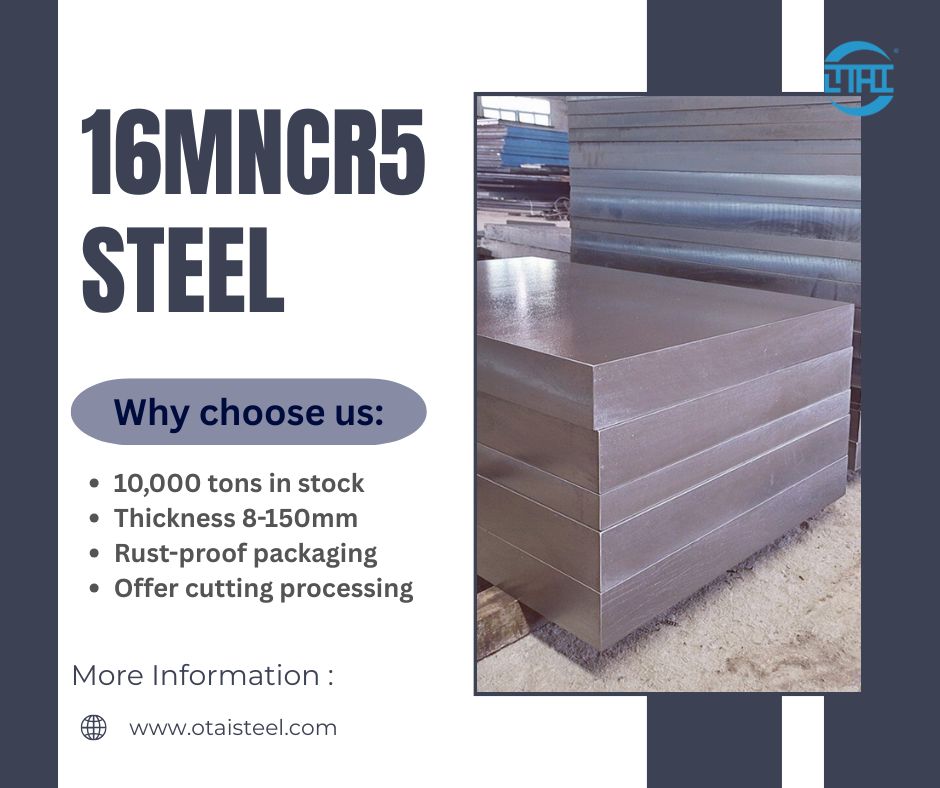
- 16MnCr5 steel plate stock: Otai Special Steel provides 16MnCr5 steel plates with thicknesses of 8–150mm available in stock for different machining and manufacturing requirements.
- Reliable material quality: We supply 16MnCr5 steel with controlled chemical composition, consistent mechanical properties, and complete material certificates.
- Customized cutting service: Steel plates can be cut according to customer drawings, dimensions, and production requirements.
- Heat treatment support: We provide technical assistance for carburizing, quenching, tempering, and other heat treatment processes.
- Professional inspection service: Ultrasonic testing and third-party inspection are available to ensure internal material quality.
- Export packaging solutions: We provide anti-rust protection, steel strapping, and wooden box packaging for international transportation.
- Technical experience: Otai Special Steel has experience supplying alloy steels for gears, shafts, automotive parts, and industrial machinery components.
For customers comparing 16MnCr5 vs 100Cr6, Otai Special Steel can provide technical data, material certificates, and professional recommendations based on the final application.
Our team helps customers choose the right steel grade according to hardness requirements, heat treatment methods, machining processes, and service conditions.
❓ 10. FAQ About 16MnCr5 vs 100Cr6
1. What is the main difference between 16MnCr5 and 100Cr6?
The main difference is their application purpose. 16MnCr5 is a low-carbon carburizing steel mainly used for gears and transmission components, while 100Cr6 is a high-carbon chromium bearing steel mainly used for bearings and rolling components.
2. Which steel has higher hardness, 16MnCr5 or 100Cr6?
100Cr6 generally achieves higher overall hardness because of its higher carbon and chromium content. However, 16MnCr5 provides a better balance between surface hardness and core toughness after carburizing.
3. Can 100Cr6 replace 16MnCr5 for gear manufacturing?
Generally, no. Although 100Cr6 has excellent hardness and wear resistance, it does not provide the same tough core structure required for many gear applications. 16MnCr5 is specifically designed for carburized gears.
4. Is 16MnCr5 equivalent to 100Cr6?
No. These two grades belong to different steel categories. 16MnCr5 is a case-hardening alloy steel, while 100Cr6 is a bearing steel. They have different chemical compositions, heat treatments, and engineering applications.
5. Does Otai Special Steel supply 16MnCr5 steel plates?
Yes. Otai Special Steel supplies 16MnCr5 steel plates with thicknesses of 8–150mm available in stock. We also provide cutting service, heat treatment support, ultrasonic testing, third-party inspection, and export packaging.