 16MnCr5 Flat Bar: Properties, Sizes, Uses and Stock Availability
📑 Table of Contents
🔍 1. What Is 16MnCr5 Flat Bar?
🧪 2. 16MnCr5 Chemical Composition
📊 3. Mechanical Properties of 16MnCr5 Flat Bar
🔥 4. Heat Treatment and Hardness
⚙️ 5. Machining and Fabrication
🏭 6. Applications of 16MnCr5 Flat Bar
🌎 7. 16MnCr5 Equivalent Grades and Selection
🔍 1. What Is 16MnCr5 Flat Bar?
16MnCr5 flat bar is a low-carbon alloy steel product designed mainly for components that need a hard, wear-resistant surface and a tough core. The material belongs to the case-hardening steel family and follows the European EN 10084 specification.
The flat bar shape makes this grade practical for machining blanks, structural components, fixtures, shafts, brackets, gears, and other parts that require a rectangular cross-section. Compared with round bar, flat bar can reduce machining waste when the finished component already has a flat geometry.
The name 16MnCr5 also tells us something about the alloy design. The grade contains a relatively low carbon level together with manganese and chromium. This combination allows the surface to respond well to carburizing while the core retains useful toughness.
That makes 16MnCr5 steel flat bar different from through-hardening grades such as 4140. Engineers usually select 16MnCr5 when surface hardness and wear resistance matter more than achieving very high hardness throughout the entire cross-section.
Why choose a flat bar instead of a round bar?
The answer usually depends on the component geometry. A flat bar already provides two broad parallel faces. Therefore, manufacturers can start with a near-net-shape blank and remove less material during milling.
For example, a machining shop producing brackets, plates, guide components, mounting parts, or rectangular gear blanks may find flat bar more efficient than starting from a large round bar.
However, the buyer should specify the required width, thickness, length, straightness, surface condition, and dimensional tolerance. These details directly affect machining performance and final production cost.
🧪 2. 16MnCr5 Chemical Composition
The chemical composition of 16MnCr5 gives the grade its characteristic case-hardening behavior. Carbon supports the carburizing response, while manganese and chromium improve hardenability and mechanical performance.
| Element | Typical / Standard Range | Main Function |
|---|---|---|
| Carbon (C) | Approx. 0.14–0.19% | Supports carburizing and surface hardening |
| Silicon (Si) | Approx. ≤0.40% | Deoxidation and strength |
| Manganese (Mn) | Approx. 1.00–1.30% | Hardenability and strength |
| Chromium (Cr) | Approx. 0.80–1.10% | Hardenability and wear resistance |
| Phosphorus (P) | Controlled at a low level | Helps maintain steel quality |
| Sulfur (S) | Controlled at a low level | Affects machinability and cleanliness |
The exact limits depend on the applicable standard and product specification. Therefore, buyers should always check the material certificate when they need certified chemical values.
Low carbon, high surface hardness
The relatively low carbon content plays a key role in the performance of this grade. In its untreated condition, the core does not behave like a high-carbon tool steel. Instead, manufacturers can carburize the surface and increase its carbon content before hardening.
This process creates a useful combination: a hard outer layer resists wear, while the lower-carbon core remains tougher. This combination works particularly well for gears, shafts, pins, bushings, and other components exposed to repeated contact.
Chromium and manganese further improve hardenability. As a result, the material can develop a useful hardened case while maintaining a strong supporting core.
📊 3. Mechanical Properties of 16MnCr5 Flat Bar
The mechanical properties of 16MnCr5 flat bar depend strongly on its supply condition and heat treatment. Unlike a conventional structural steel, this grade often reaches its most useful service performance after carburizing and hardening.
| Property | General Characteristics | Practical Importance |
|---|---|---|
| Core strength | Moderate before hardening | Provides toughness after case hardening |
| Surface hardness | Can become very high after carburizing and hardening | Improves wear resistance |
| Hardenability | Good | Supports case-hardening applications |
| Wear resistance | Excellent after suitable case hardening | Useful for contacting components |
| Core toughness | Good when properly treated | Helps resist impact and cyclic loads |
| Machinability | Good in suitable soft condition | Useful before final heat treatment |
Surface hardness versus core toughness
The biggest advantage of 16MnCr5 comes from the difference between the hardened surface and the tougher core. The surface handles friction and contact stress, while the core supports the component against impact and bending loads.
This structure makes the grade particularly attractive for gears. Gear teeth need high surface hardness because they experience repeated contact. At the same time, the teeth and gear body cannot become excessively brittle.
The same principle benefits shafts, pins, rollers, bushings, and other components that experience surface wear together with mechanical loading.
Dimensional stability matters
Heat treatment can cause dimensional changes. Therefore, machining allowances and the final machining sequence require careful planning.
A manufacturer may rough-machine the flat bar first, perform carburizing and hardening, and then finish-machine critical surfaces. The exact sequence depends on the component geometry and dimensional tolerance.
🔥 4. Heat Treatment and Hardness
Heat treatment determines much of the final performance of 16MnCr5. Buyers should distinguish between the hardness of the supplied flat bar and the hardness of the finished carburized component.
Annealing
Annealing reduces hardness and improves machinability. This condition can help manufacturers cut, mill, drill, and shape the material before the final hardening process.
Carburizing
Carburizing introduces additional carbon into the surface. The process creates a carbon-rich outer layer while leaving the original low-carbon core relatively tough.
Hardening and tempering
After carburizing, the component undergoes hardening to develop a hard martensitic case. Tempering then reduces excessive brittleness and helps achieve the required balance between hardness and toughness.
| Condition | Typical Purpose | Effect on Material |
|---|---|---|
| Soft / annealed condition | Machining | Lower hardness and improved machinability |
| Carburized condition | Surface carbon enrichment | Prepares the surface for hardening |
| Hardened case | Wear resistance | High surface hardness |
| Tempered condition | Final performance adjustment | Improves toughness and reduces brittleness |
What hardness should you expect?
The answer depends on whether the buyer refers to the supplied flat bar, the hardened case, or the core. A single hardness number cannot describe every condition of 16MnCr5.
For this reason, purchasing specifications should state the required condition clearly. If the customer needs a carburized component, the specification should also define the required case depth and hardness requirements where applicable.
This approach prevents confusion between the hardness of raw material and the performance of the final component.
⚙️ 5. Machining and Fabrication
16MnCr5 steel flat bar offers good machining potential when supplied in a suitable soft condition. Its rectangular geometry also provides an advantage for milling operations.
Milling
Flat bar naturally provides broad faces for milling. Manufacturers can use these surfaces as reference planes and remove material to achieve the final dimensions.
This can reduce machining time compared with starting from an oversized block. It also helps manufacturers produce rectangular blanks for components that do not require a round cross-section.
Drilling
Drilling performance depends on the hardness and condition of the material. Soft-condition material generally allows easier drilling than carburized or hardened material.
Cutting
Saw cutting, flame cutting, or other cutting methods may suit different thicknesses and production requirements. The selected process should consider the actual supply condition and the customer’s dimensional requirements.
Machining allowance
When the final component will undergo carburizing and hardening, manufacturers should leave suitable machining allowance for finishing operations.
This becomes especially important when the customer requires tight tolerances. Heat treatment may produce dimensional changes, so the machining plan should account for the process from the beginning.
For buyers ordering 16MnCr5 flat bar for machining, providing the final component drawing can help the steel supplier recommend the appropriate dimensions and supply condition.
🏭 6. Applications of 16MnCr5 Flat Bar
The main reason engineers choose this grade is its ability to combine a wear-resistant surface with a tough core. Therefore, 16MnCr5 flat bar applications often involve components exposed to repeated contact, friction, or cyclic loading.
| Application | Why 16MnCr5 Works |
|---|---|
| Gear components | Hard surface and tough core after case hardening |
| Shaft components | Good fatigue and wear performance after treatment |
| Pins | Good surface durability and core toughness |
| Bushings | Suitable for contacting and wear-prone surfaces |
| Machine components | Good combination of machinability and final performance |
| Automotive components | Suitable for many case-hardened parts |
| Industrial transmission parts | Useful where repeated contact loads occur |
Automotive and transmission components
Automotive and transmission systems frequently use case-hardening steels for gears, shafts, and other components. 16MnCr5 can provide the surface durability required for repeated contact while maintaining a tougher core.
Industrial machinery
Industrial machinery can also use this grade for pins, shafts, bushes, and transmission components. The flat bar format is particularly useful when manufacturers need rectangular blanks before machining.
When should you choose another grade?
16MnCr5 is not the best solution for every application. If the component requires high hardness throughout the entire section, a through-hardening steel such as 4140 may provide a more suitable design option.
If the application requires extremely high wear resistance, a tool steel or dedicated wear-resistant grade may perform better.
The right choice therefore depends on whether the component needs case hardening, through hardening, corrosion resistance, high toughness, or exceptional wear resistance.
🌎 7. 16MnCr5 Equivalent Grades and Selection
Buyers often search for a 16MnCr5 equivalent when their local market uses another steel designation. However, an equivalent grade should never be selected from the name alone.
| Grade | Common Standard | General Relationship | Important Note |
|---|---|---|---|
| 16MnCr5 | EN 10084 | Case-hardening alloy steel | European reference grade |
| 1.7131 | EN material number | Material designation for 16MnCr5 | Check the complete specification |
| 16MnCr5 | DIN designation | Common European / German designation | Verify the applicable edition |
The material number 1.7131 is commonly associated with 16MnCr5. Buyers may also search for terms such as 16MnCr5 steel plate, 16MnCr5 bar, or 16MnCr5 flat bar when sourcing different product forms.
Flat bar or plate?
The product form should match the manufacturing process. A flat bar can be convenient when the required cross-section resembles a rectangular bar. A plate may provide better flexibility when the customer needs larger widths or plans to cut several components from one sheet.
Therefore, buyers should compare not only the steel grade but also the available dimensions. A supplier with suitable stock can sometimes reduce both lead time and processing requirements.
What should buyers specify?
- 16MnCr5 grade and applicable standard.
- Flat bar width and thickness.
- Required length.
- Supply condition.
- Dimensional tolerances.
- Surface requirements.
- Ultrasonic testing requirements, if applicable.
- Heat treatment requirements.
- Inspection and certification requirements.
A clear purchasing specification helps the supplier provide the correct product instead of relying on a general grade-equivalent table.
📦 8. Otai Special Steel Advantages
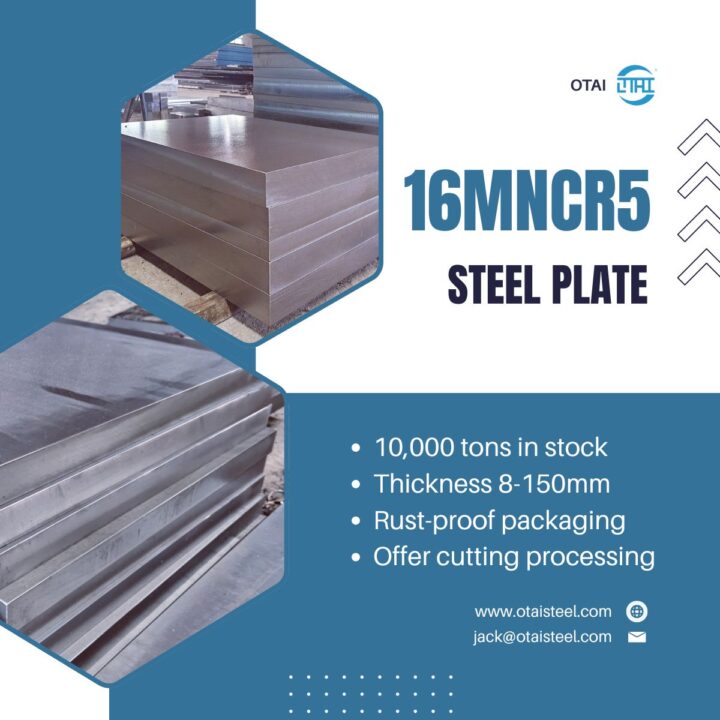
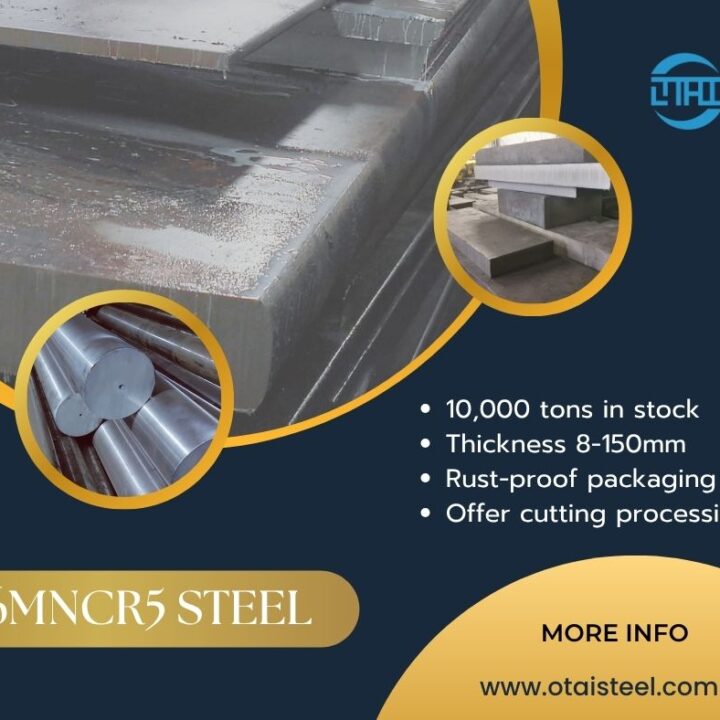
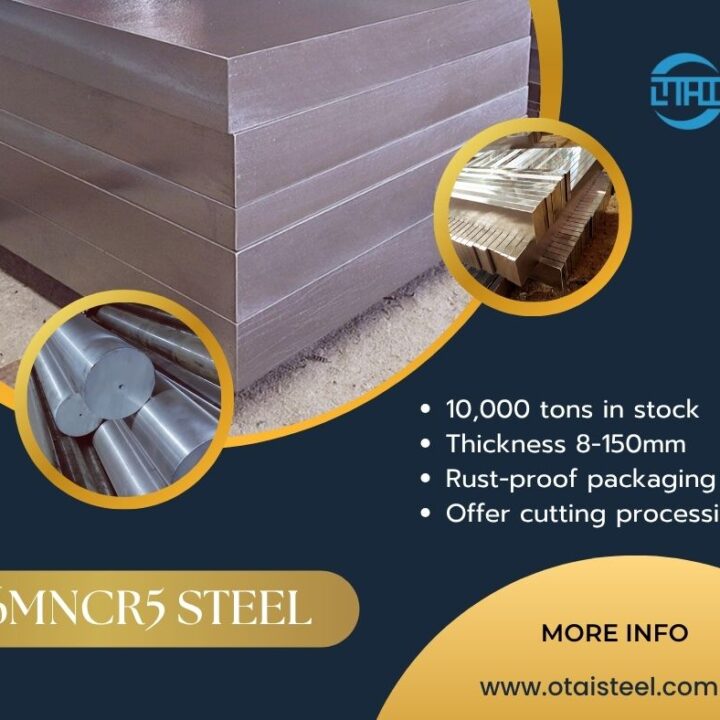
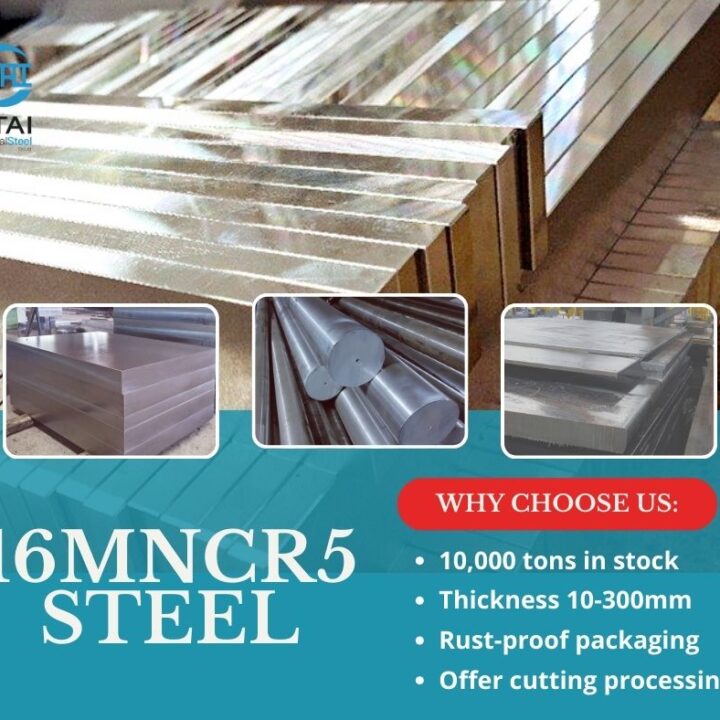
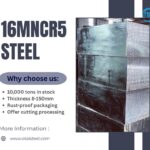
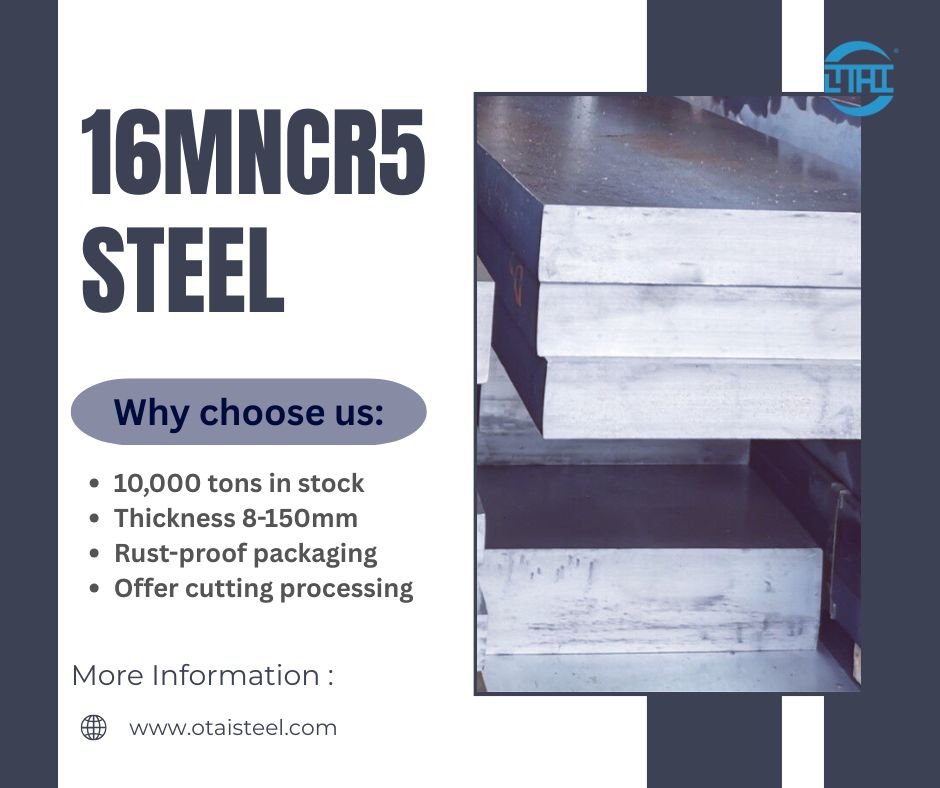
- 16MnCr5 steel plate stock: Otai Special Steel keeps 16MnCr5 steel plates in 8–150 mm thickness available from stock for customers who need common sizes with shorter lead times.
- Multiple product forms: We can help customers source 16MnCr5 in suitable forms according to project requirements, including plates and bar products.
- Cutting service: We can arrange cutting according to customer drawings and required dimensions.
- Heat treatment support: We can arrange annealing, carburizing-related processing, hardening, tempering, and other heat-treatment services according to project requirements.
- Quality control: Ultrasonic testing and third-party inspection can be arranged for orders with specific quality requirements.
- Export packaging: Steel strapping, wooden cases, and anti-rust packaging help protect steel products during international transportation.
- International supply experience: Otai Special Steel has supplied steel to customers with demanding technical requirements, including Fortune Global 500 companies.
If you are looking for 16MnCr5 flat bar, please provide the required width, thickness, length, supply condition, standard, and final application. This information helps us recommend the most suitable material and processing route.
❓ 9. Frequently Asked Questions
1. What is 16MnCr5 flat bar used for?
16MnCr5 flat bar is commonly used for machined components that require a hard, wear-resistant surface and a tougher core after case hardening. Typical applications include gears, shafts, pins, bushings, and industrial machine components.
2. Is 16MnCr5 suitable for machining?
Yes. 16MnCr5 offers good machinability when supplied in a suitable soft or annealed condition. Manufacturers can machine the flat bar before carburizing and final hardening.
3. What is the equivalent of 16MnCr5?
16MnCr5 is commonly associated with material number 1.7131. However, buyers should compare the complete chemical, mechanical, and heat-treatment requirements before accepting another grade as an equivalent.
4. Can 16MnCr5 flat bar be carburized?
Yes. Carburizing is one of the main reasons engineers select 16MnCr5. The process increases carbon at the surface and allows the component to develop a hard case while retaining a tougher low-carbon core.
5. What thickness of 16MnCr5 steel plate is available from Otai?
Otai Special Steel has 16MnCr5 steel plate in 8–150 mm thickness available in stock. Actual availability can vary by size and quantity, so customers should provide their required dimensions when requesting a quotation.