 Stress Relieving 4140 Steel: Temperature, Process and Practical Guide
📑 Table of Contents
🔍 1. What Is Stress Relieving 4140 Steel?
⚙️ 2. Why Does 4140 Steel Need Stress Relief Treatment?
🔥 3. 4140 Steel Stress Relief Temperature and Process
📊 4. Stress Relieving vs Annealing vs Tempering
🛠 5. How to Stress Relieve 4140 Steel Correctly
📈 6. Effect of Stress Relief on 4140 Mechanical Properties
🏭 7. Applications of Stress Relieved 4140 Steel
📦 8. Otai Special Steel Advantages
❓ 9. FAQ About Stress Relieving 4140 Steel
🔍 1. What Is Stress Relieving 4140 Steel?
Stress relieving 4140 steel is a heat treatment process used to reduce internal stresses created during manufacturing processes such as machining, welding, forming and quenching.
AISI 4140 is a chromium-molybdenum alloy steel known for its high strength, toughness and excellent fatigue resistance. However, during production, uneven cooling and mechanical processing can create residual stresses inside the material.
These internal stresses may cause dimensional changes, distortion or even cracking during later machining or service. Stress relieving helps stabilize the steel structure and improves dimensional accuracy.
Unlike full annealing, stress relieving does not aim to completely soften the material. Instead, it reduces internal stress while maintaining most of the original mechanical properties.
For manufacturers working with precision components, understanding the correct 4140 stress relieving heat treatment process is essential for achieving reliable performance.
Basic Information of 4140 Alloy Steel
| Property | Description |
|---|---|
| Steel Grade | AISI 4140 |
| Material Number | 1.7225 |
| Steel Type | Chromium-molybdenum alloy steel |
| Standard | ASTM A29 / SAE 4140 |
| Main Alloy Elements | Carbon, Chromium, Molybdenum, Manganese |
| Main Features | High strength, toughness and fatigue resistance |
| Common Treatment | Quenching, tempering and stress relieving |
Why Is Stress Relieving Important for 4140 Steel?
4140 steel is frequently used for heavy-duty components. These parts often require machining, welding or heat treatment before final assembly.
During these processes, different areas of the steel may expand and contract at different rates. This creates uneven internal forces.
- Reduce distortion: Helps maintain accurate dimensions after machining.
- Improve stability: Prevents unexpected movement during service.
- Reduce cracking risk: Lowers residual stress concentration.
- Improve machining accuracy: Provides better dimensional control.
For precision applications, stress relieving 4140 steel is an important step between manufacturing and final use.
⚙️ 2. Why Does 4140 Steel Need Stress Relief Treatment?
The need for stress relief depends on the manufacturing history and final application of the component.
Although 4140 steel has excellent mechanical properties, residual stress can influence performance if it is not properly controlled.
Common Sources of Internal Stress in 4140 Steel
| Manufacturing Process | Stress Source |
|---|---|
| Machining | Material removal creates uneven stress distribution |
| Welding | Rapid heating and cooling create thermal stress |
| Quenching | Fast cooling produces internal structural stress |
| Forging | Plastic deformation changes internal structure |
| Grinding | Surface heating may create residual stress |
Benefits of Stress Relieving 4140 Steel
| Benefit | Effect |
|---|---|
| Dimensional Stability | Reduces size changes during machining |
| Stress Reduction | Removes internal residual forces |
| Machining Performance | Improves accuracy and consistency |
| Service Reliability | Reduces risk of unexpected failure |
For large 4140 steel plates and complex components, stress relief treatment becomes especially important because thicker sections usually contain higher residual stresses.
Therefore, many manufacturers choose 4140 alloy steel stress relief treatment before precision machining or assembly.
🔥 3. 4140 Steel Stress Relief Temperature and Process
The correct temperature is one of the most important factors in stress relieving 4140 steel. The goal of stress relief is to reduce internal stress while keeping the original strength, hardness and toughness of the alloy steel.
Unlike annealing, stress relieving does not completely change the microstructure. It mainly allows internal stresses to relax through controlled heating and slow cooling.
For most applications, the typical 4140 steel stress relief temperature is below the original tempering temperature to prevent unwanted changes in mechanical properties.
Typical Stress Relief Process for 4140 Steel
| Process Step | Typical Condition | Purpose |
|---|---|---|
| Heating | 540–650°C | Reduce residual stress gradually |
| Holding Time | 1 hour per 25 mm thickness (typical) | Allow temperature uniformity |
| Cooling | Slow cooling inside furnace | Prevent new thermal stress |
| Final Cooling | Air cooling after temperature reduction | Prepare material for machining |
Recommended Stress Relief Temperature Range
| Material Condition | Recommended Stress Relief Temperature |
|---|---|
| Annealed 4140 | Approximately 540–600°C |
| Machined 4140 Components | 540–650°C |
| Welded 4140 Parts | 550–650°C |
| Quenched and Tempered 4140 | Below previous tempering temperature |
Factors Affecting Stress Relief Results
- Material thickness: Larger sections require longer holding times.
- Heating speed: Slow heating reduces additional thermal stress.
- Cooling method: Controlled cooling prevents new stress formation.
- Previous treatment: Heat-treated 4140 requires suitable temperature control.
A properly controlled 4140 stress relieving heat treatment process improves dimensional stability and helps manufacturers achieve more accurate final machining results.
📊 4. Stress Relieving vs Annealing vs Tempering
Many customers confuse stress relieving with other heat treatment processes. Although these treatments involve heating steel, their purposes and effects are different.
Understanding the differences helps engineers select the correct 4140 steel heat treatment process for their applications.
Comparison of Heat Treatment Processes for 4140 Steel
| Process | Main Purpose | Effect on 4140 Steel |
|---|---|---|
| Stress Relieving | Reduce internal stress | Improves dimensional stability while maintaining properties |
| Annealing | Soften steel and improve machinability | Reduces hardness and increases ductility |
| Tempering | Adjust hardness after quenching | Improves toughness and reduces brittleness |
| Quenching | Increase hardness | Creates martensitic structure |
Stress Relieving vs Annealing
| Feature | Stress Relieving | Annealing |
|---|---|---|
| Main Goal | Remove residual stress | Reduce hardness |
| Temperature | 540–650°C | 800–850°C |
| Hardness Change | Small change | Significant reduction |
| Typical Use | After machining or welding | Before machining |
Stress Relieving vs Tempering
| Feature | Stress Relieving | Tempering |
|---|---|---|
| Purpose | Reduce internal stress | Improve toughness after quenching |
| Microstructure Change | Limited | Controlled structural adjustment |
| Mechanical Property Change | Minimal | Significant |
For precision parts, manufacturers often combine different heat treatments. For example, 4140 steel may first receive quenching and tempering, followed by stress relieving after machining.
🛠 5. How to Stress Relieve 4140 Steel Correctly
Correct processing is essential to achieve the best results from stress relieving 4140 steel. Improper heating or cooling can create additional stress instead of removing it.
Step-by-Step Stress Relief Procedure
| Step | Description |
|---|---|
| 1. Material Preparation | Clean the surface and inspect the component condition |
| 2. Controlled Heating | Heat gradually to the target stress relief temperature |
| 3. Holding | Maintain temperature until stress relaxation occurs |
| 4. Furnace Cooling | Cool slowly to avoid thermal shock |
| 5. Final Inspection | Check dimensions and hardness after treatment |
When Should 4140 Steel Be Stress Relieved?
- After heavy machining operations.
- After welding processes.
- Before precision finishing.
- Before final assembly of critical components.
- For large 4140 steel plates requiring dimensional stability.
Following the correct how to stress relieve 4140 steel procedure helps prevent distortion and improves the reliability of finished components.
📈 6. Effect of Stress Relief on 4140 Mechanical Properties
The purpose of stress relieving 4140 steel is not to significantly increase hardness or strength. Instead, it improves stability by reducing internal residual stress while preserving the original mechanical performance.
For precision components, stress relief can improve machining accuracy, reduce distortion and increase reliability during service.
Effect of Stress Relieving on 4140 Steel Properties
| Property | Before Stress Relief | After Stress Relief |
|---|---|---|
| Residual Stress | Higher after machining or welding | Significantly reduced |
| Dimensional Stability | May change during machining | Improved stability |
| Hardness | Maintained | Little change |
| Tensile Strength | Maintained | Generally unchanged |
| Machining Accuracy | Possible deformation | Improved precision |
| Service Reliability | Depends on stress level | Improved fatigue performance |
4140 Steel Properties After Common Heat Treatments
| Condition | Tensile Strength | Hardness | Main Feature |
|---|---|---|---|
| Annealed 4140 | 655 MPa approx. | 197 HB approx. | Excellent machinability |
| Quenched and Tempered 4140 | 850–1000 MPa | 28–36 HRC | High strength and toughness |
| Stress Relieved 4140 | Similar to original condition | Minor change | Reduced internal stress |
Why Stress Relief Improves Machining Results
During machining, removing material changes the balance of internal forces inside steel. If residual stress remains, the component may move or deform after cutting.
Stress relieving helps stabilize the structure before final machining operations, especially for large plates, shafts and precision components.
- Better dimensional accuracy: Reduces unexpected size changes.
- Lower distortion risk: Improves production consistency.
- Higher reliability: Supports long-term service performance.
🏭 7. Applications of Stress Relieved 4140 Steel
Because of its excellent combination of strength, toughness and fatigue resistance, 4140 steel is widely used in demanding industrial applications.
After 4140 stress relieving heat treatment, the material becomes more suitable for precision manufacturing where dimensional stability is important.
Common Applications of Stress Relieved 4140 Steel
| Industry | Components | Reason for Stress Relief |
|---|---|---|
| Automotive | Axles, shafts, transmission parts | Improve dimensional stability |
| Oil & Gas Equipment | Drill components, high-strength parts | Reduce cracking risk |
| Heavy Machinery | Hydraulic components, machine parts | Maintain precision after machining |
| Tool Manufacturing | Fixtures, molds and tooling components | Improve processing accuracy |
| General Engineering | Gears, couplings and shafts | Increase service reliability |
Typical 4140 Components Requiring Stress Relief
| Component | Main Requirement |
|---|---|
| Large Steel Plates | Prevent machining distortion |
| Welded Structures | Reduce welding residual stress |
| Precision Shafts | Maintain straightness and accuracy |
| Heavy Load Parts | Improve fatigue resistance |
For these applications, proper 4140 alloy steel stress relief treatment helps manufacturers achieve stable performance and longer component life.
📏 8. 4140 Steel Plate Supply and Processing Services
Besides selecting the correct heat treatment process, customers also need stable material supply and professional processing support.
4140 alloy steel plates are commonly used for machining, fabrication and heavy-duty engineering applications. Different projects require different thicknesses, sizes and delivery conditions.
4140 Steel Plate Supply Information
| Item | Specification |
|---|---|
| Steel Grade | AISI 4140 / SCM440 / 42CrMo4 |
| Material Type | Chromium-molybdenum alloy steel |
| Stock Thickness | Different sizes available |
| Supply Condition | Annealed, normalized, quenched and tempered |
| Processing | Cutting, machining and heat treatment |
| Inspection | Ultrasonic testing and third-party inspection |
Processing Services Available
- Steel plate cutting: Customized dimensions according to drawings.
- Heat treatment service: Stress relieving, quenching and tempering support.
- Surface processing: Machining and finishing services.
- Quality inspection: UT testing and inspection reports.
- Export packaging: Anti-rust protection and wooden box packaging.
📦 9. Otai Special Steel Advantages
Otai Special Steel supplies 4140 alloy steel plates and provides technical support for customers requiring reliable material performance.
Why Choose Otai Special Steel?
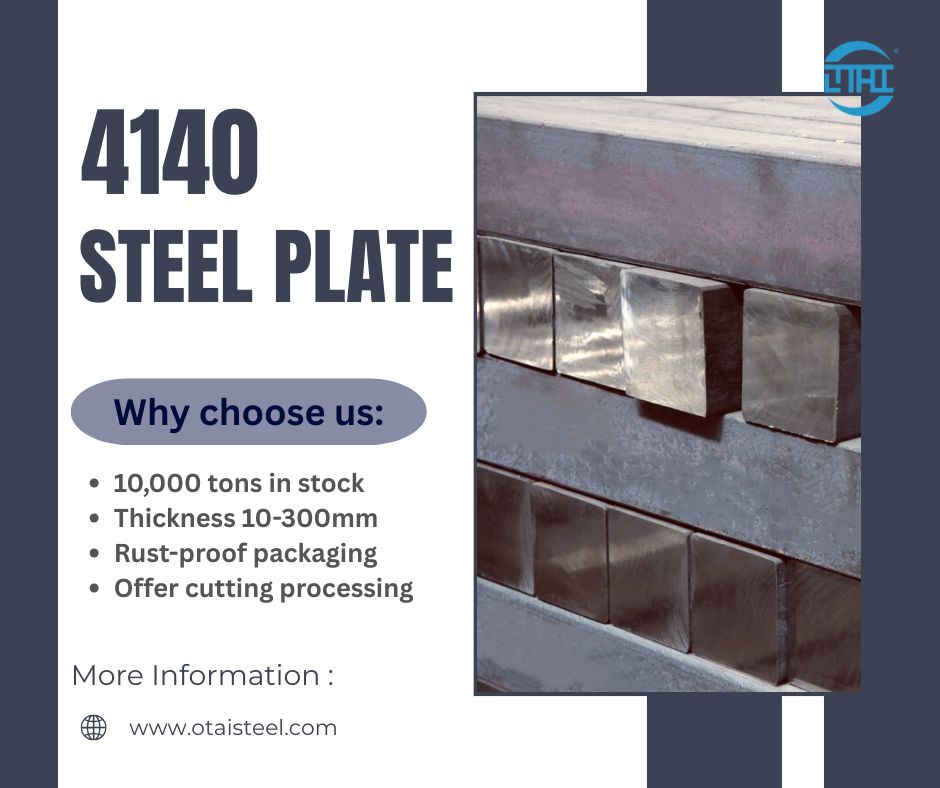
- Large inventory: Otai maintains approximately 10,000 tons of steel stock with different sizes of 4140 alloy steel plates available.
- Professional processing: Cutting and customized machining services are available according to customer requirements.
- Heat treatment support: Stress relieving, quenching and tempering solutions are available.
- Quality assurance: Ultrasonic testing and third-party inspection can be arranged.
- Global supply experience: Serving customers with strict technical standards.
- Safe export packaging: Anti-rust packaging, steel strapping and wooden cases are available.
With experience in alloy steel supply, Otai helps customers select suitable 4140 material conditions and processing methods for different applications.
❓ FAQ About Stress Relieving 4140 Steel
1. What is stress relieving 4140 steel?
Stress relieving 4140 steel is a heat treatment process that reduces internal residual stress caused by machining, welding, forging or heat treatment while maintaining the original properties.
2. What temperature is used for 4140 steel stress relief?
The typical stress relief temperature for 4140 steel is around 540–650°C, depending on the material condition and application.
3. Does stress relieving reduce 4140 steel hardness?
Stress relieving usually causes only a small hardness change because it mainly removes internal stress rather than changing the complete microstructure.
4. What is the difference between stress relieving and tempering 4140 steel?
Stress relieving reduces residual stress, while tempering adjusts hardness and toughness after quenching.
5. Does Otai supply 4140 steel plates?
Yes. Otai supplies 4140 alloy steel plates with different sizes in stock, together with cutting, heat treatment support, ultrasonic testing and customized processing services.