 4140 Steel Normalized: Process, Properties and Applications
📑 Table of Contents
🔥 1. What Is 4140 Steel Normalized Condition?
⚙️ 2. Understanding the Normalizing Process of 4140 Steel
🌡️ 3. 4140 Steel Normalizing Temperature and Cooling Method
📊 4. Normalized 4140 Steel Properties
⚖️ 5. 4140 Steel Normalized vs Annealed
🔥 6. Hardness and Mechanical Performance After Normalizing
🏭 7. Applications and Material Selection
🏭 Otai Special Steel Advantages
❓ FAQ About 4140 Steel Normalized
🔥 1. What Is 4140 Steel Normalized Condition?
When engineers search for 4140 steel normalized, they usually want to understand how normalizing changes the structure, hardness, and mechanical performance of AISI 4140 alloy steel.
Engineers know 4140 steel, a chromium-molybdenum alloy steel, for its excellent combination of strength, toughness, fatigue resistance, and wear resistance.
The normalized condition refers to a heat treatment process that refines the grain structure and improves the overall consistency of the material.
During normalizing, 4140 steel is heated above its critical temperature, held for a specific period, and then cooled in air. This process produces a finer microstructure compared with untreated material.
Compared with other heat treatment conditions, normalized 4140 steel provides a good balance between strength and machinability, making it suitable for many industrial applications.
Basic Information of Normalized 4140 Steel
| Item | Description |
|---|---|
| Steel Grade | AISI 4140 / SAE 4140 |
| Steel Type | Chromium-molybdenum alloy steel |
| Heat Treatment | Normalizing |
| Main Alloy Elements | Chromium and molybdenum |
| Main Features | High strength, toughness, and fatigue resistance |
| Common Applications | Shafts, gears, bolts, machinery parts |
Why Is 4140 Steel Normalized?
| Purpose | Effect |
|---|---|
| Grain Refinement | Creates a more uniform microstructure |
| Stress Reduction | Reduces internal stress from manufacturing |
| Strength Improvement | Improves mechanical consistency |
| Machining Preparation | Provides suitable hardness before further processing |
Manufacturers often select a normalized condition when they need reliable mechanical properties before machining, welding, or additional heat treatment.
⚙️ 2. Understanding the Normalizing Process of 4140 Steel
The normalizing process changes the internal structure of 4140 steel by heating it into the austenitic range and allowing it to transform during air cooling.
Unlike annealing, which uses slow furnace cooling, normalizing uses air cooling to produce higher strength and hardness.
The process improves the distribution of alloying elements and creates a refined ferrite and pearlite microstructure.
Steps of 4140 Steel Normalizing Process
| Step | Process | Purpose |
|---|---|---|
| 1 | Heating | Heat steel above the critical transformation temperature |
| 2 | Holding | Allow uniform temperature throughout the material |
| 3 | Air Cooling | Create refined grain structure |
| 4 | Final Inspection | Check hardness and mechanical properties |
Microstructure Changes During Normalizing
| Before Normalizing | After Normalizing |
|---|---|
| Uneven grain structure | Refined and uniform grains |
| Residual stress | Reduced internal stress |
| Variable mechanical properties | More consistent performance |
| Less stable structure | Improved structural stability |
The refined structure is the main reason why normalized 4140 steel properties are more predictable compared with untreated conditions.
🌡️ 3. 4140 Steel Normalizing Temperature and Cooling Method
The correct temperature control is essential for achieving consistent results when processing 4140 steel.
The typical 4140 steel normalizing temperature is generally around 870–900°C (1600–1650°F), depending on section size and processing requirements.
After reaching the required temperature, the material is held until the entire cross-section becomes uniform before cooling in still air.
Typical Normalizing Parameters for 4140 Steel
| Parameter | Typical Range |
|---|---|
| Heating Temperature | 870–900°C (1600–1650°F) |
| Holding Time | Based on material thickness |
| Cooling Method | Air cooling |
| Final Structure | Fine ferrite and pearlite |
| Main Purpose | Grain refinement and property improvement |
Factors Affecting Normalizing Results
- Material thickness and section size.
- Heating temperature accuracy.
- Holding time control.
- Cooling speed after heating.
- Original steel condition.
Proper normalizing control helps 4140 steel achieve stable hardness, strength, and machining performance.
📊 4. Normalized 4140 Steel Properties
The main purpose of normalizing is to improve the consistency of AISI 4140 steel by refining its grain structure and reducing internal stress.
The final performance of 4140 steel normalized condition depends on chemical composition, section size, heating temperature, and cooling conditions.
Compared with untreated 4140 steel, normalized material usually provides more stable strength, hardness, and machinability.
Typical Normalized 4140 Steel Properties
| Property | Typical Value | Condition |
|---|---|---|
| Tensile Strength | 650–850 MPa | Normalized condition |
| Yield Strength | 400–650 MPa | Normalized condition |
| Elongation | 15–25% | Normalized condition |
| Reduction of Area | 45–60% | Typical range |
| Impact Toughness | Good | Depending on section size |
| Hardness | 200–250 HB | Normalized condition |
Advantages of Normalized 4140 Steel
| Advantage | Explanation |
|---|---|
| Improved Grain Structure | Creates finer and more uniform grains. |
| Better Mechanical Stability | Provides consistent strength throughout the material. |
| Improved Machinability | Makes machining easier before final treatment. |
| Reduced Internal Stress | Improves dimensional stability during processing. |
Manufacturers often select normalized 4140 as a preparation condition before quenching and tempering when they require further heat treatment.
⚖️ 5. 4140 Steel Normalized vs Annealed
One common question is the difference between 4140 normalized vs annealed.
Both processes improve the steel structure, but they create different mechanical properties.
Annealing uses slow furnace cooling, which produces a softer structure with better machinability. Normalizing uses air cooling, creating higher strength and hardness.
4140 Normalized vs Annealed Comparison
| Feature | 4140 Normalized | 4140 Annealed |
|---|---|---|
| Cooling Method | Air cooling | Slow furnace cooling |
| Hardness | Higher | Lower |
| Strength | Higher | Lower |
| Machinability | Good | Excellent |
| Grain Structure | Fine and uniform | Coarser and softer |
| Typical Use | Structural applications | Machining preparation |
When Should You Choose Normalized 4140?
- When higher strength is required.
- When the component needs better fatigue resistance.
- When the material will receive additional heat treatment.
- When dimensional stability is important.
When Should You Choose Annealed 4140?
- When extensive machining is required.
- When maximum softness is needed.
- When reducing cutting tool wear is the priority.
The selection between normalized and annealed conditions depends on whether production requires easier machining or higher mechanical performance.
🔥 6. Hardness and Mechanical Performance After Normalizing
The hardness of normalized 4140 steel is influenced by alloy composition and cooling rate.
Typically, normalized 4140 steel hardness is around 200–250 HB, which provides a good balance between strength and machinability.
4140 Steel Hardness Comparison by Condition
| Condition | Approximate Hardness | Main Characteristics |
|---|---|---|
| Annealed 4140 | 170–220 HB | Soft, excellent machinability |
| Normalized 4140 | 200–250 HB | Higher strength and stable structure |
| Quenched 4140 | 50–55 HRC | High hardness and strength |
| Tempered 4140 | 28–50 HRC | Adjustable toughness and strength |
Normalized 4140 vs Quenched and Tempered 4140
| Property | Normalized | Quenched & Tempered |
|---|---|---|
| Strength | Medium to high | Very high |
| Hardness | Medium | High |
| Toughness | Good | Excellent when properly tempered |
| Machining | Easier | More difficult |
| Application | General engineering parts | Heavy-duty components |
Why Normalize 4140 Steel Before Machining?
Many manufacturers choose normalized 4140 steel because it provides predictable machining performance and reduces problems caused by uneven internal stress.
The refined grain structure improves dimensional accuracy during cutting, drilling, and forming operations.
For parts that require further strengthening, manufacturers can use normalized 4140 as a reliable starting condition before final heat treatment.
🏭 7. Applications and Material Selection
The balanced properties of 4140 steel normalized condition make it widely used in industries that require reliable strength, toughness, and dimensional stability.
Compared with untreated alloy steel, normalized 4140 provides more consistent performance, which makes it suitable for machining, fabrication, and further heat treatment processes.
Common Applications of Normalized 4140 Steel
| Industry | Components | Reason for Selection |
|---|---|---|
| Automotive Industry | Axles, shafts, gears, connecting parts | High strength and fatigue resistance |
| Heavy Machinery | Drive shafts, rollers, pins | Good toughness under impact loads |
| Oil and Gas Equipment | High-strength components and tools | Excellent mechanical reliability |
| Manufacturing Equipment | Machine parts, fixtures, bolts | Good machining and structural stability |
| Tool Manufacturing | Dies, holders, support parts | Good wear resistance after treatment |
AISI 4140 Normalized Condition Selection Guide
The best material condition depends on the final production process and required performance.
| Requirement | Recommended Condition | Reason |
|---|---|---|
| General machining | Normalized 4140 | Good balance between hardness and machinability |
| Maximum machinability | Annealed 4140 | Softer structure for cutting operations |
| High strength components | Quenched and tempered 4140 | Higher hardness and tensile strength |
| Before further heat treatment | AISI 4140 normalized condition | Stable starting structure |
| Large structural parts | Normalized 4140 | Better consistency throughout the section |
4140 Steel Normalized vs Other Conditions
| Condition | Main Advantage | Typical Applications |
|---|---|---|
| Normalized | Balanced strength and machinability | Shafts, machinery parts, structural components |
| Annealed | Excellent machinability | Parts requiring extensive machining |
| Quenched & Tempered | Maximum mechanical strength | Heavy-duty components |
| Stress Relieved | Improved dimensional stability | Precision machined parts |
Why Choose Normalized 4140 Steel?
- Provides consistent mechanical properties.
- Offers better strength than annealed material.
- Maintains good machining performance.
- Creates a stable structure for additional heat treatment.
- Works well for large industrial components.
For engineers looking for a versatile alloy steel condition, normalized 4140 is often an excellent choice because it combines performance, reliability, and processing flexibility.
🏭 Otai Special Steel Advantages
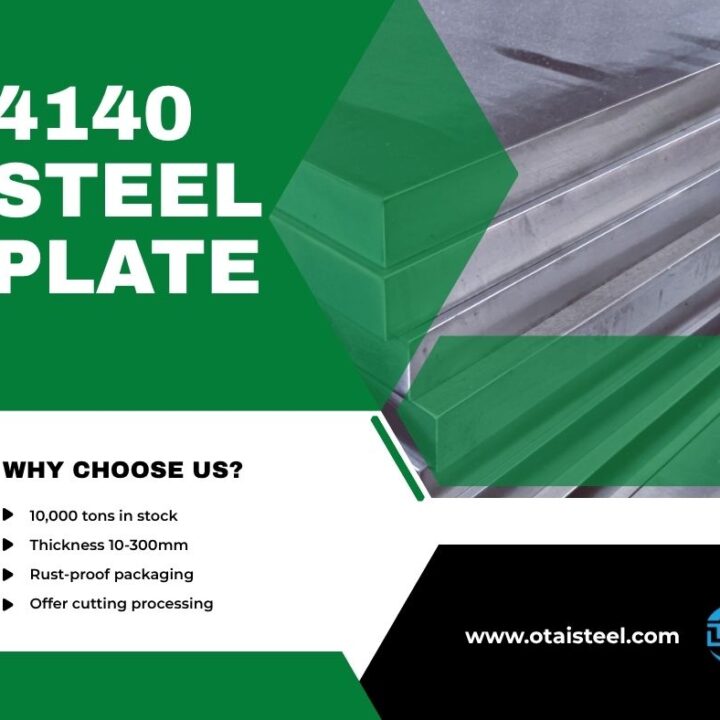
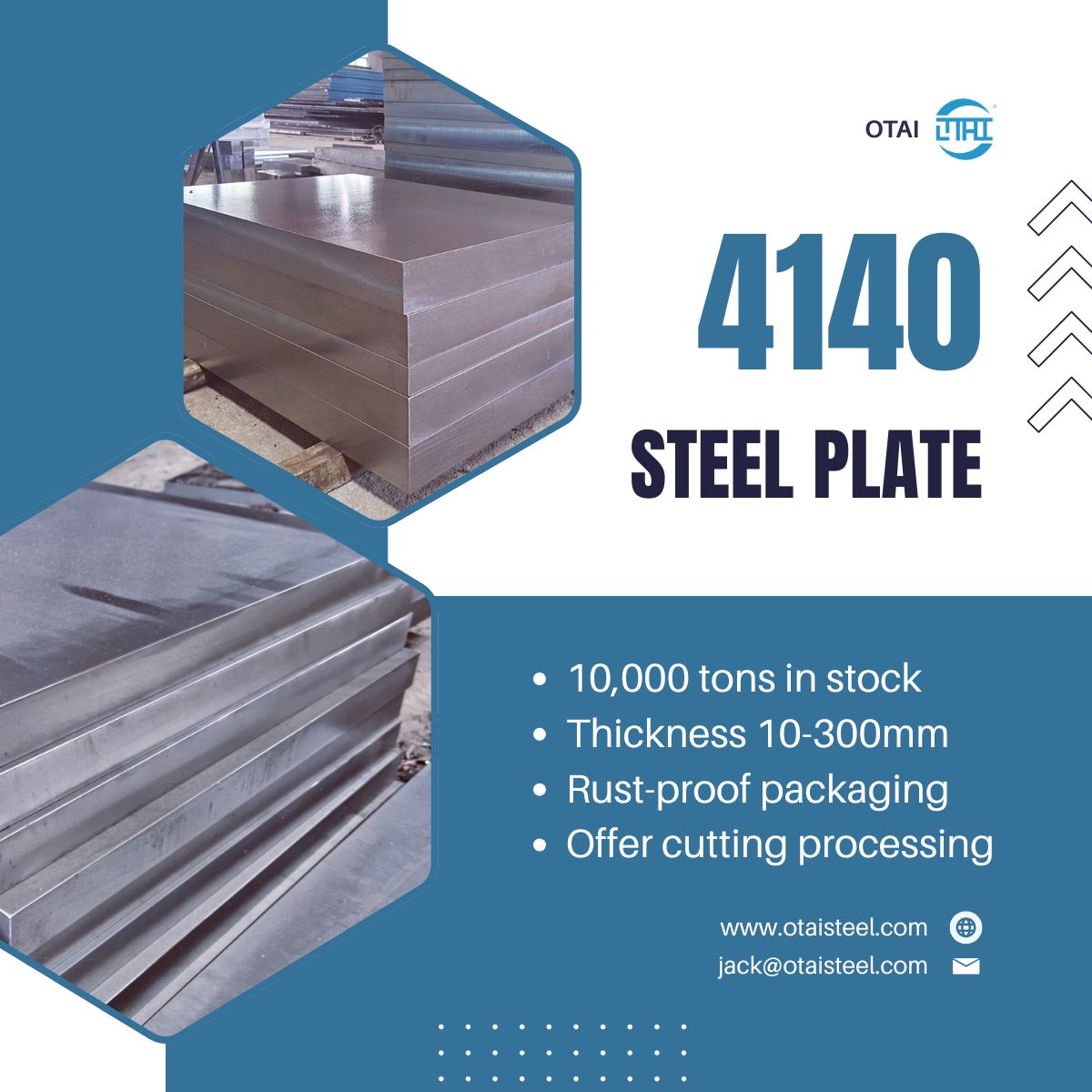
Otai Special Steel supplies high-quality AISI 4140 alloy steel plates and bars for global industrial customers.
- Large inventory: Otai maintains around 10,000 tons of steel inventory with different sizes available in stock to support fast delivery.
- Complete processing service: Cutting, machining, and customized processing services are available according to customer requirements.
- Heat treatment support: We can arrange normalizing, quenching, tempering, and other heat treatment services.
- Quality assurance: Ultrasonic testing and third-party inspection services are available for strict engineering requirements.
- Professional packaging: Anti-rust packaging, steel strapping, and wooden box packaging ensure safe international transportation.
- International supply experience: Otai has experience supplying alloy steel materials to customers with demanding technical standards.
With stable stock availability and professional steel processing capability, Otai helps customers obtain reliable 4140 steel materials for mechanical and industrial applications.
❓ FAQ About 4140 Steel Normalized
Q1: What does normalized 4140 steel mean?
Normalized 4140 steel means manufacturers have heated AISI 4140 alloy steel above its critical temperature and air cooled it to refine the grain structure and improve mechanical consistency.
Q2: What is the normalizing temperature for 4140 steel?
The typical 4140 steel normalizing temperature is around 870–900°C (1600–1650°F), followed by air cooling.
Q3: What hardness is normalized 4140 steel?
The typical normalized 4140 steel hardness is approximately 200–250 HB, depending on material size and processing conditions.
Q4: Is normalized 4140 stronger than annealed 4140?
Yes. Normalized 4140 usually has higher strength and hardness than annealed 4140 because air cooling creates a finer microstructure.
Q5: Can normalized 4140 steel be heat treated again?
Yes. Manufacturers often use normalized 4140 as a preparation condition before quenching and tempering to achieve higher strength.
Q6: Does Otai supply normalized 4140 steel?
Yes. Otai supplies 4140 alloy steel products with inventory availability, cutting service, heat treatment support, and quality inspection options.