 Difference Between 16MnCr5 and 16MnCrS5: Complete Steel Comparison Guide
When engineers search for the difference between 16MnCr5 and 16MnCrS5, they usually want to understand which material is more suitable for their manufacturing requirements.
📑 Table of Contents
🔍 1. Overview of 16MnCr5 and 16MnCrS5 Steel
🧪 2. Chemical Composition Difference Between 16MnCr5 and 16MnCrS5
📊 3. Mechanical Properties Comparison of 16MnCr5 and 16MnCrS5
⚙️ 4. Machinability Difference: 16MnCr5 vs 16MnCrS5
🔥 5. Heat Treatment and Hardness Comparison
🏭 6. Industrial Applications and Material Selection
🌍 7. Equivalent Grades and International Standards
📌 8. How to Choose Between 16MnCr5 and 16MnCrS5
🏭 Otai Special Steel Advantages
❓ FAQ About 16MnCr5 and 16MnCrS5
🔍 1. Overview of 16MnCr5 and 16MnCrS5 Steel
16MnCr5 and 16MnCrS5 are both European carburizing steels commonly used for mechanical components requiring high surface hardness and good core toughness.
They are mainly designed for parts exposed to wear, contact pressure, and repeated loading.
| Feature | 16MnCr5 | 16MnCrS5 |
|---|---|---|
| Steel Type | Low carbon alloy carburizing steel | Low carbon alloy carburizing steel with sulfur addition |
| Standard | EN 10084 | EN 10084 |
| Main Alloy Elements | Manganese and chromium | Manganese, chromium and sulfur |
| Main Advantage | Balanced strength and toughness | Improved machinability |
| Main Application | Gears and transmission parts | Machined carburizing components |
What Is 16MnCr5 Steel?
16MnCr5 is one of the most widely used carburizing steels in Europe.
It provides excellent surface hardness after carburizing while maintaining a tough internal structure.
Typical applications include:
- Automotive gears
- Transmission components
- Pinions
- Shafts
- Mechanical drive parts
What Is 16MnCrS5 Steel?
16MnCrS5 is a modified version of 16MnCr5 with increased sulfur content.
The sulfur addition improves chip breaking during machining.
This makes the steel more suitable for automatic machining operations where productivity is important.
Typical applications include:
- CNC machined components
- Mass production parts
- Precision mechanical components
- Automotive parts requiring machining efficiency
In simple terms:
| Material | Main Characteristic |
|---|---|
| 16MnCr5 | Better overall balance |
| 16MnCrS5 | Better machinability |
This fundamental difference determines how manufacturers select between these two grades.
🧪 2. Chemical Composition Difference Between 16MnCr5 and 16MnCrS5
The chemical composition is the most direct explanation for the difference between these two steels.
Both grades contain similar levels of carbon, manganese, and chromium.
The main difference is sulfur content.
| Element | 16MnCr5 (%) | 16MnCrS5 (%) |
|---|---|---|
| Carbon (C) | 0.14–0.19 | 0.14–0.19 |
| Silicon (Si) | ≤0.40 | ≤0.40 |
| Manganese (Mn) | 1.00–1.30 | 1.00–1.30 |
| Chromium (Cr) | 0.80–1.10 | 0.80–1.10 |
| Sulfur (S) | Low level | Higher controlled content |
| Phosphorus (P) | ≤0.025 | ≤0.025 |
Why Does Sulfur Matter?
Sulfur is usually considered an impurity in steel, but controlled sulfur addition can improve machinability.
During cutting operations, sulfur helps create shorter chips.
This reduces:
- Cutting resistance
- Tool wear
- Machining time
- Production cost
| Element Change | Effect |
|---|---|
| Higher Sulfur | Improves cutting performance |
| Controlled Sulfur | Better chip breaking |
| Excessive Sulfur | May reduce toughness |
Therefore, 16MnCrS5 is specially developed for applications where machining efficiency is more important.
However, the sulfur addition may slightly influence impact toughness compared with standard 16MnCr5.
For this reason, engineers should select the grade based on the final application requirements.
📊 3. Mechanical Properties Comparison of 16MnCr5 and 16MnCrS5
The mechanical properties of 16MnCr5 and 16MnCrS5 are very similar because both materials are designed for carburizing applications.
However, the difference appears mainly in toughness and machining behavior.
| Property | 16MnCr5 | 16MnCrS5 |
|---|---|---|
| Tensile Strength | Similar after heat treatment | Similar after heat treatment |
| Yield Strength | High | High |
| Surface Hardness After Carburizing | 58–62 HRC | 58–62 HRC |
| Core Toughness | Excellent | Slightly lower |
| Machinability | Good | Better |
Performance Comparison
| Requirement | Better Choice |
|---|---|
| Maximum toughness | 16MnCr5 |
| High-volume machining | 16MnCrS5 |
| Gear applications | Both materials |
| Automatic machining production | 16MnCrS5 |
For applications requiring maximum reliability under impact loads, 16MnCr5 is often preferred.
For applications requiring faster machining and lower production costs, 16MnCrS5 provides advantages.
Understanding these differences helps engineers choose the correct carburizing steel for their manufacturing process.
⚙️ 4. Machinability Difference: 16MnCr5 vs 16MnCrS5
Machinability is one of the most important differences between 16MnCr5 and 16MnCrS5.
Although both steels have similar alloy compositions, the additional sulfur content in 16MnCrS5 improves cutting performance.
This difference becomes especially important in high-volume manufacturing where machining efficiency directly affects production costs.
How Sulfur Improves Machining Performance
Sulfur reacts with manganese in steel to form manganese sulfide inclusions.
These inclusions act as internal chip-breaking points during machining.
As a result, cutting operations become smoother and more efficient.
| Machining Factor | 16MnCr5 | 16MnCrS5 |
|---|---|---|
| Chip Formation | Normal chips | Shorter and easier chips |
| Cutting Speed | Standard | Higher possible cutting speed |
| Tool Life | Good | Improved |
| Automatic Machining | Suitable | More suitable |
| Production Efficiency | Good | Higher |
16MnCr5 Machining Characteristics
16MnCr5 provides good machinability before carburizing because of its low carbon content.
Manufacturers can easily perform:
- Turning
- Drilling
- Milling
- Rough machining
However, because it has lower sulfur content, chip control may be less efficient during automatic machining.
16MnCrS5 Machining Characteristics
16MnCrS5 is specifically developed to improve machining productivity.
It is often selected for components requiring large quantities of machining operations.
Typical advantages include:
- Better chip breaking
- Reduced cutting force
- Lower tool consumption
- Higher production speed
| Application Requirement | Recommended Grade |
|---|---|
| Small quantity production | 16MnCr5 |
| Large batch CNC production | 16MnCrS5 |
| Complex machining process | 16MnCrS5 |
| Maximum toughness requirement | 16MnCr5 |
Therefore, when comparing 16MnCrS5 machinability with 16MnCr5, the sulfur-modified grade clearly provides better cutting performance.
However, machinability should not be the only consideration because final component performance also depends on heat treatment and working conditions.
🔥 5. Heat Treatment and Hardness Comparison
Both 16MnCr5 and 16MnCrS5 are carburizing steels.
Their heat treatment processes are very similar because both grades are designed to create a hard surface layer and tough core structure.
Typical Heat Treatment Process
| Process | Purpose | Effect |
|---|---|---|
| Carburizing | Increase surface carbon content | Create hard surface layer |
| Quenching | Transform microstructure | Increase hardness |
| Tempering | Reduce stress | Improve toughness |
Hardness Comparison
| Condition | 16MnCr5 | 16MnCrS5 |
|---|---|---|
| Soft Annealed Condition | Approx. 160–220 HB | Approx. 160–220 HB |
| After Carburizing | 58–62 HRC | 58–62 HRC |
| Surface Wear Resistance | Excellent | Excellent |
| Core Toughness | Slightly better | Good |
Does Sulfur Affect Heat Treatment?
The sulfur addition in 16MnCrS5 mainly affects machining performance rather than carburizing ability.
Both steels can achieve similar surface hardness after proper carburizing and quenching.
However, the sulfur content may slightly influence:
- Impact toughness
- Fatigue behavior under extreme conditions
- Internal cleanliness requirements
For standard gear applications, both materials can provide excellent performance.
Components requiring maximum toughness and shock resistance, engineers often prefer standard 16MnCr5.
For components requiring efficient machining before heat treatment, 16MnCrS5 becomes a better option.
This is why selecting between 16MnCr5 vs 16MnCrS5 depends on the complete production process rather than only mechanical strength.
🏭 6. Industrial Applications and Material Selection
The selection between 16MnCr5 and 16MnCrS5 depends mainly on the application environment and manufacturing method.
Both steels are widely used in mechanical engineering, automotive manufacturing, and transmission systems.
| Industry | 16MnCr5 Applications | 16MnCrS5 Applications |
|---|---|---|
| Automotive | Gears, shafts, transmission parts | Mass-produced automotive components |
| Mechanical Engineering | Precision gears and drive parts | CNC machined mechanical parts |
| Automation Equipment | High-strength components | High-volume production parts |
| Industrial Machinery | Wear-resistant components | Machined transmission parts |
Typical Components Made from 16MnCr5
- Gear wheels
- Pinions
- Transmission shafts
- Drive components
- Machine parts requiring high toughness
Typical Components Made from 16MnCrS5
- CNC machined gears
- Automotive production components
- Precision turned parts
- Automatic lathe components
- Large quantity mechanical parts
Selection Guide
| Project Requirement | Recommended Material |
|---|---|
| Maximum durability | 16MnCr5 |
| High machining efficiency | 16MnCrS5 |
| Heavy impact load | 16MnCr5 |
| Mass production | 16MnCrS5 |
| Carburized gear production | Both grades |
In practical engineering, there is no absolute winner between these two grades.
The best choice depends on whether the priority is:
- Machining efficiency
- Component toughness
- Production volume
- Operating conditions
Understanding the difference between 16MnCr5 and 16MnCrS5 allows engineers to select the most cost-effective material solution.
🌍 7. Equivalent Grades and International Standards
When purchasing alloy steels internationally, engineers often compare equivalent grades from different standards.
Both 16MnCr5 and 16MnCrS5 belong to European carburizing steel families, but their exact equivalents may vary depending on chemical composition and production standards.
| Steel Grade | Material Number | Standard | Main Feature |
|---|---|---|---|
| 16MnCr5 | 1.7131 | EN 10084 | Balanced carburizing performance |
| 16MnCrS5 | 1.7139 | EN 10084 | Improved machinability |
| 8620 | – | AISI/SAE | Similar carburizing steel |
| SCM415 | – | JIS | Similar chromium-molybdenum carburizing steel |
| 5115 | – | AISI | Low alloy carburizing steel |
16MnCr5 Equivalent Grade Characteristics
| Grade | Similarity | Difference |
|---|---|---|
| 16MnCr5 | Original EN grade | Higher toughness balance |
| 16MnCrS5 | Same carburizing family | Higher sulfur content |
| 8620 | Similar application range | Contains nickel and molybdenum |
| SCM415 | Similar carburizing purpose | Different alloy system |
Although some grades are considered similar, engineers should always check:
- Chemical composition requirements
- Mechanical properties
- Heat treatment conditions
- Application environment
A direct replacement between grades should only be made after technical evaluation.
For projects requiring reliable material selection, comparing 16MnCr5 vs 16MnCrS5 with actual working conditions is more important than simply comparing grade names.
📌 8. How to Choose Between 16MnCr5 and 16MnCrS5
Choosing between 16MnCr5 and 16MnCrS5 depends on the balance between machining requirements and final component performance.
Both materials can achieve excellent carburized surface hardness, but they serve different manufacturing priorities.
| Requirement | Recommended Steel | Reason |
|---|---|---|
| High impact resistance | 16MnCr5 | Better toughness balance |
| Large quantity CNC production | 16MnCrS5 | Better machining efficiency |
| Automotive gears | Both | Both provide carburizing performance |
| Precision machined parts | 16MnCrS5 | Improved chip control |
| Heavy-duty mechanical parts | 16MnCr5 | Higher toughness requirement |
Choose 16MnCr5 When:
- The component experiences high impact loads.
- Core toughness is the priority.
- The production volume is moderate.
- Long service life is the main target.
Choose 16MnCrS5 When:
- Machining efficiency is critical.
- Large-scale CNC production is required.
- Reducing tool wear is important.
- Shorter machining cycles are needed.
Engineering Decision Summary
| Priority | Best Choice |
|---|---|
| Overall performance balance | 16MnCr5 |
| Machining productivity | 16MnCrS5 |
| Gear manufacturing | Both materials |
| Automatic production lines | 16MnCrS5 |
The correct material selection can improve manufacturing efficiency while ensuring reliable service performance.
Therefore, understanding the difference between 16MnCr5 and 16MnCrS5 helps engineers avoid unnecessary production costs and performance issues.
🏭 Otai Special Steel Advantages
Otai Special Steel is a professional supplier of alloy steel and special steel materials, supporting customers worldwide with stable inventory and customized services.
- Strong inventory capability: Otai maintains sufficient stock of alloy steel products to support urgent customer requirements and production schedules.
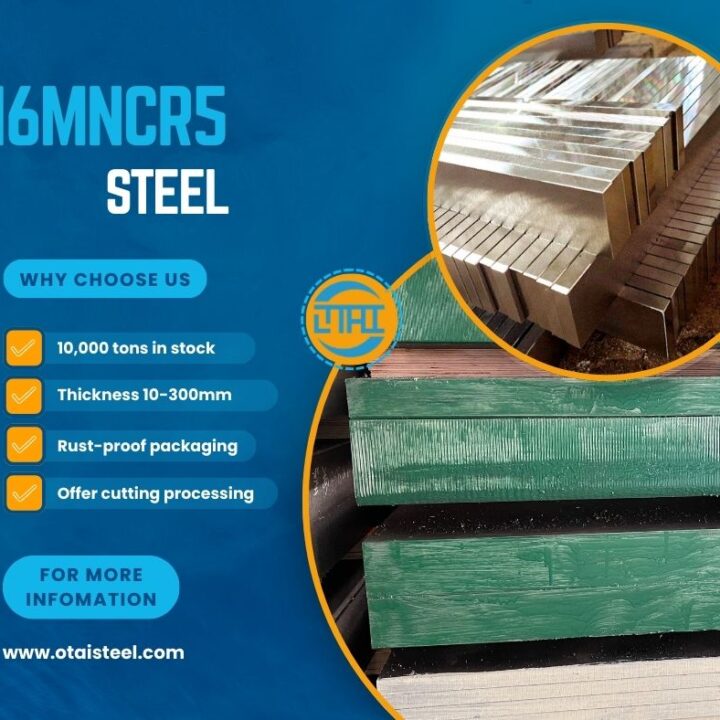
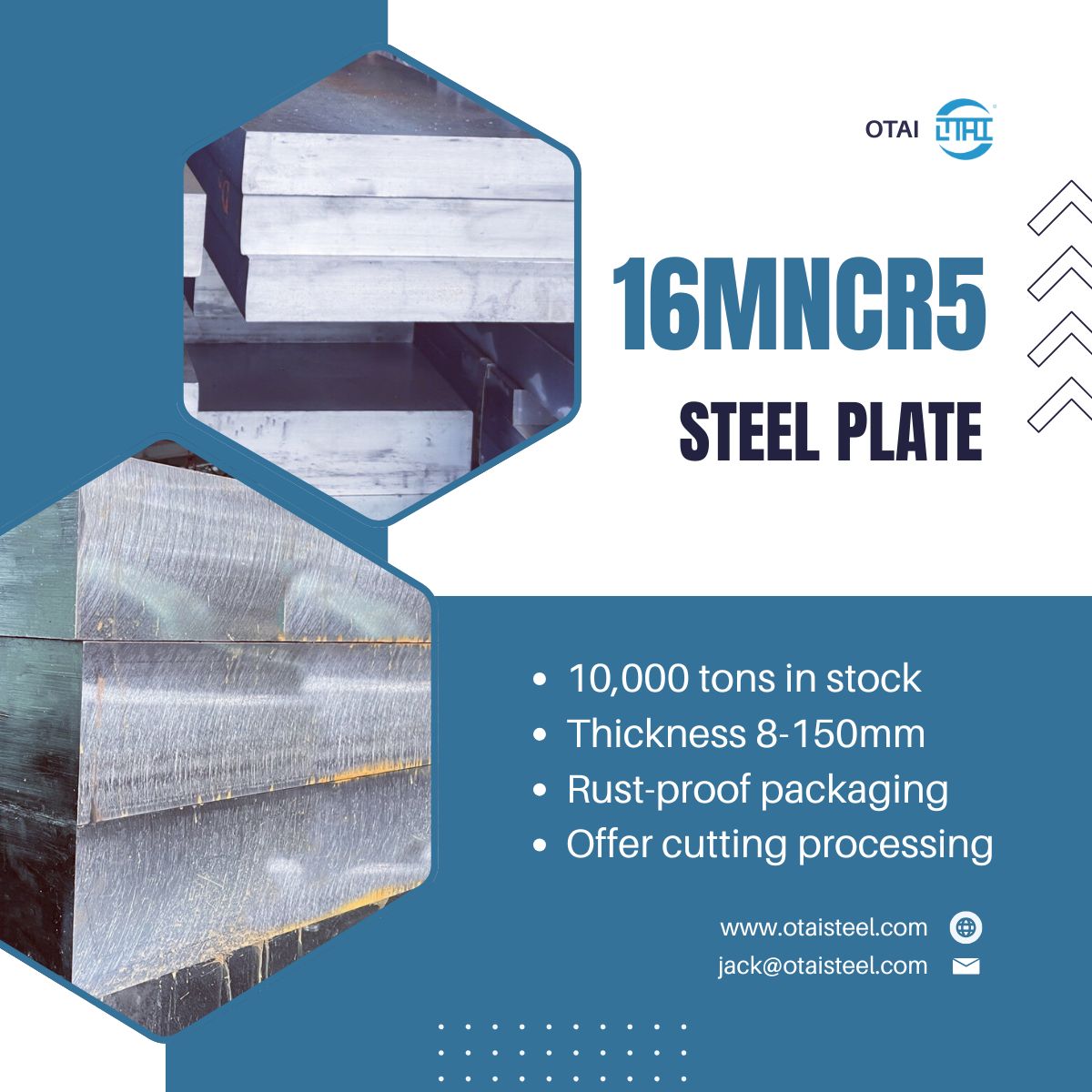
- 16MnCr5 steel plate availability: 8–150mm thickness plates available in stock for different engineering applications.
- Customized processing services: Cutting, machining, heat treatment, and other processing solutions are available according to customer requirements.
- Strict quality control: Ultrasonic testing and third-party inspection services can be provided to ensure material reliability.
- International project experience: Otai has supplied steel materials to Fortune Global 500 companies and meets strict technical specifications.
- Professional export packaging: Anti-rust protection, steel strapping, and wooden box packaging ensure safe international transportation.
Whether customers need 16MnCr5 carburizing steel, 16MnCrS5 materials, or technical advice for material selection, Otai provides reliable steel solutions.
❓ FAQ About 16MnCr5 and 16MnCrS5
Q1: What is the main difference between 16MnCr5 and 16MnCrS5?
The main difference is sulfur content. 16MnCrS5 contains higher controlled sulfur, which improves machinability, while 16MnCr5 provides a better overall toughness balance.
Q2: Is 16MnCrS5 stronger than 16MnCr5?
No. Both steels have similar strength after carburizing treatment. The main advantage of 16MnCrS5 is improved machining performance.
Q3: Which steel is better for gears?
Both grades can be used for gears. 16MnCr5 is preferred when toughness is critical, while 16MnCrS5 is suitable for high-volume gear production.
Q4: Why does sulfur improve machinability?
Sulfur forms manganese sulfide inclusions that help break chips during cutting, reducing tool wear and improving machining efficiency.
Q5: Can 16MnCr5 and 16MnCrS5 receive the same heat treatment?
Yes. Both steels are carburizing grades and can undergo similar carburizing, quenching, and tempering processes.