 16MnCr5 Steel Plate – Complete Guide to Properties and Industrial Applications
In modern mechanical manufacturing, material selection directly affects component performance, service life, and production reliability. Among European alloy steels, 16MnCr5 steel plate is widely recognized as a reliable case-hardening steel for applications requiring excellent wear resistance and fatigue strength.
Unlike ordinary carbon steel plates, 16MnCr5 is specially designed for carburizing treatment. This allows engineers to create a hard surface layer while maintaining a tough internal structure. As a result, the material performs well under repeated loads, impact conditions, and surface contact stress.
The demand for 16MnCr5 steel plate comes mainly from industries such as automotive manufacturing, mechanical transmission, gear production, and industrial equipment. These industries require materials that can provide both durability and stable processing performance.
📑 Table of Contents
🔍 1. What Is 16MnCr5 Steel Plate?
🧪 2. Chemical Composition and Material Characteristics
🔥 3. Heat Treatment and Surface Hardening Performance
⚙️ 4. Mechanical Properties and Engineering Advantages
📏 5. Specifications, Sizes and Standards
🏭 6. Industrial Applications and Material Selection
🌍 7. Choosing a Reliable 16MnCr5 Steel Plate Supplier
📌 8. Buying Considerations for 16MnCr5 Steel Plate
🏭 Otai Special Steel Advantages
🔍 1. What Is 16MnCr5 Steel Plate?
16MnCr5 steel plate is a low-carbon alloy case-hardening steel defined under the European EN standard system. It is commonly identified by the material number EN 1.7131 and is designed for components that require a wear-resistant surface combined with a strong and ductile core.
The name 16MnCr5 describes its chemical design. The number “16” indicates approximately 0.16% carbon content, while manganese and chromium are the main alloying elements that improve hardenability and surface performance.
The main engineering feature of this steel is its response to carburizing. During heat treatment, carbon enters the surface layer and increases hardness. After quenching, the outer area becomes a strong martensitic structure, while the inner area maintains toughness.
| Feature | Description |
|---|---|
| Steel Type | Case-hardening alloy steel |
| Standard | EN 10084 |
| Material Number | EN 1.7131 |
| Main Treatment | Carburizing and quenching |
| Main Advantage | Hard surface with tough core |
Because of this balanced structure, 16MnCr5 carburizing steel plate is suitable for parts that experience continuous friction, repeated loading, and mechanical impact.
Compared with standard structural steel, it provides improved fatigue resistance. Compared with higher alloy steels, it offers a more economical solution for many engineering applications.
🧪 2. Chemical Composition and Material Characteristics
The chemical composition of 16MnCr5 steel plate determines its carburizing performance, toughness, and wear resistance. Each alloy element plays a specific role during manufacturing and heat treatment.
| Element | Typical Content | Function |
|---|---|---|
| Carbon (C) | 0.14–0.19% | Controls surface hardening ability |
| Manganese (Mn) | 0.80–1.10% | Improves hardenability and strength |
| Chromium (Cr) | 0.80–1.10% | Improves wear resistance and hardening depth |
| Silicon (Si) | ≤0.40% | Supports strength stability |
| Phosphorus/Sulfur | Controlled low level | Improves toughness and quality |
The low carbon content is an important design feature. It allows manufacturers to machine the material before heat treatment while still achieving high surface hardness after carburizing.
Manganese improves hardenability, while chromium helps maintain a stable hardened layer. Together, these elements create the performance balance required for gears and transmission components.
For customers purchasing EN 1.7131 steel plate, chemical consistency is essential because small variations may influence heat treatment results and final component performance.
🔥 3. Heat Treatment and Surface Hardening Performance
The most important feature of 16MnCr5 heat treatment is carburizing performance. This process creates the unique surface-core structure that makes the material valuable for demanding mechanical applications.
During carburizing, carbon atoms diffuse into the surface layer at high temperature. After quenching, the enriched surface transforms into high-hardness martensite.
The typical treatment process includes:
- Heating in a carburizing atmosphere
- Carbon diffusion into the surface
- Quenching to increase hardness
- Tempering to reduce internal stress
| Treatment Stage | Main Effect |
|---|---|
| Before carburizing | Good machining performance |
| Carburizing | Creates hardened surface layer |
| Quenching | Forms martensitic structure |
| Tempering | Improves stability |
This structure allows 16MnCr5 steel plate to resist wear while maintaining sufficient toughness inside the component.
Therefore, heat treatment is not simply an additional process. It is a key step that creates the engineering value of this steel grade.
⚙️ 4. Mechanical Properties and Engineering Advantages
The performance advantage of 16MnCr5 steel plate comes from its unique combination of surface hardness and core toughness. This balance allows the material to work effectively under repeated stress, friction, and impact conditions.
Unlike through-hardening steels, 16MnCr5 does not rely on the entire section becoming extremely hard. Instead, it creates a hardened outer layer while keeping the internal structure relatively tough.
This design provides several engineering benefits:
- Excellent wear resistance: The carburized surface protects components against friction and contact damage.
- High fatigue strength: The hardened layer improves resistance against repeated loading cycles.
- Good impact resistance: The tough core helps absorb mechanical shock.
- Stable machining performance: The low-carbon structure allows easier processing before heat treatment.
| Mechanical Property | Typical Value | Engineering Meaning |
|---|---|---|
| Tensile Strength | 600–900 MPa | Provides structural strength |
| Yield Strength | 400–650 MPa | Supports load resistance |
| Surface Hardness | 58–62 HRC after carburizing | Improves wear resistance |
| Core Hardness | 30–45 HRC | Maintains toughness |
Because of these characteristics, 16MnCr5 steel plate application mainly focuses on mechanical parts where both durability and reliability are important.
Typical components include:
- Automotive transmission gears
- Industrial gear systems
- Drive shafts
- Reduction gears
- Mechanical power transmission parts
For manufacturers, selecting the correct steel grade can reduce maintenance frequency and improve the service life of finished products.
📏 5. 16MnCr5 Steel Plate Specifications, Sizes and Standards
When purchasing 16MnCr5 steel plate, specifications are important because dimensions directly affect production efficiency, processing cost, and delivery time.
Different industries may require different thicknesses depending on component design and machining allowance. Therefore, buyers should confirm the required dimensions before ordering.
| Item | Description |
|---|---|
| Steel Grade | 16MnCr5 |
| Material Number | EN 1.7131 |
| Standard | EN 10084 |
| Steel Type | Case-hardening alloy steel |
| Supply Form | Plate, bar, cut pieces |
Common purchasing requirements include:
- Specified thickness and width
- Cutting tolerance requirements
- Ultrasonic testing requirements
- Surface condition requirements
- Heat treatment condition
For international buyers, choosing a supplier with flexible cutting capability can reduce material waste. Instead of purchasing oversized material and processing it internally, customers can receive dimensions closer to final requirements.
A professional 16MnCr5 steel plate supplier should be able to provide accurate dimensions, quality documentation, and technical support according to customer needs.
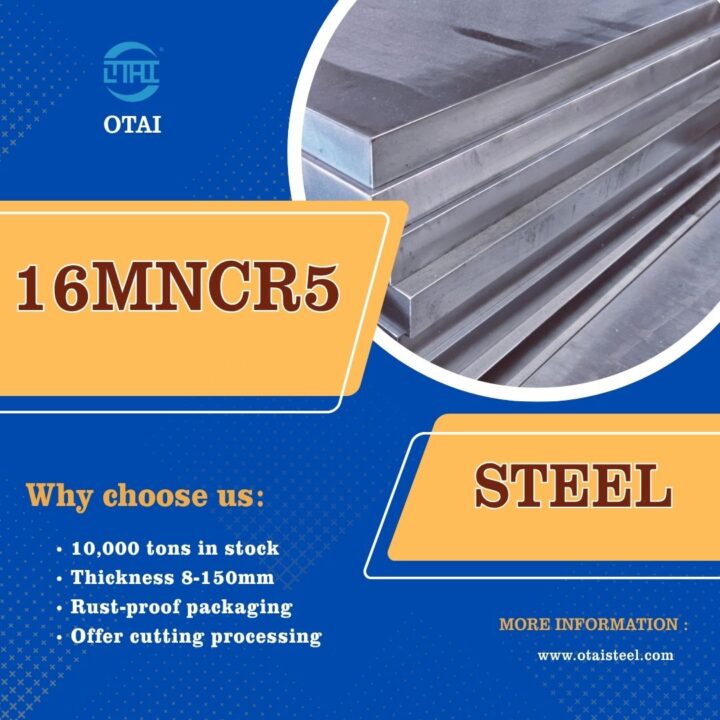
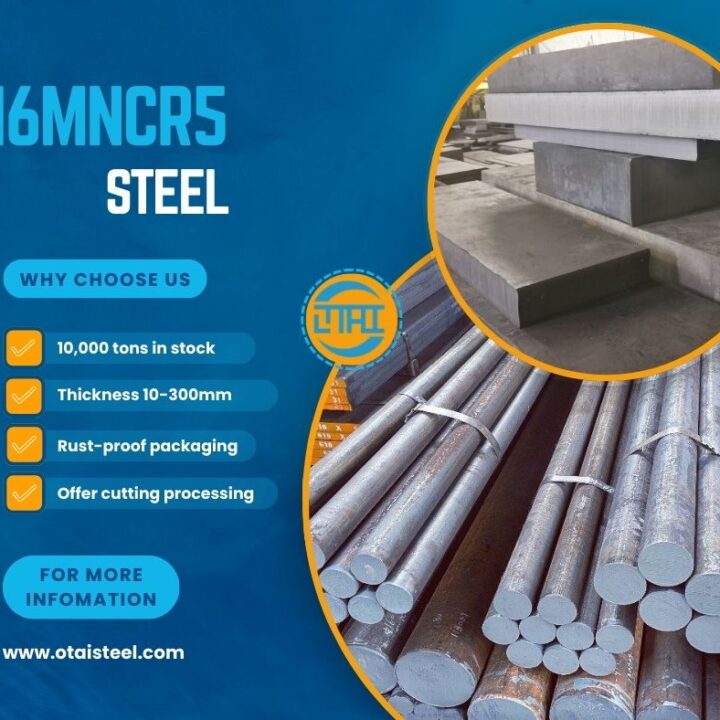
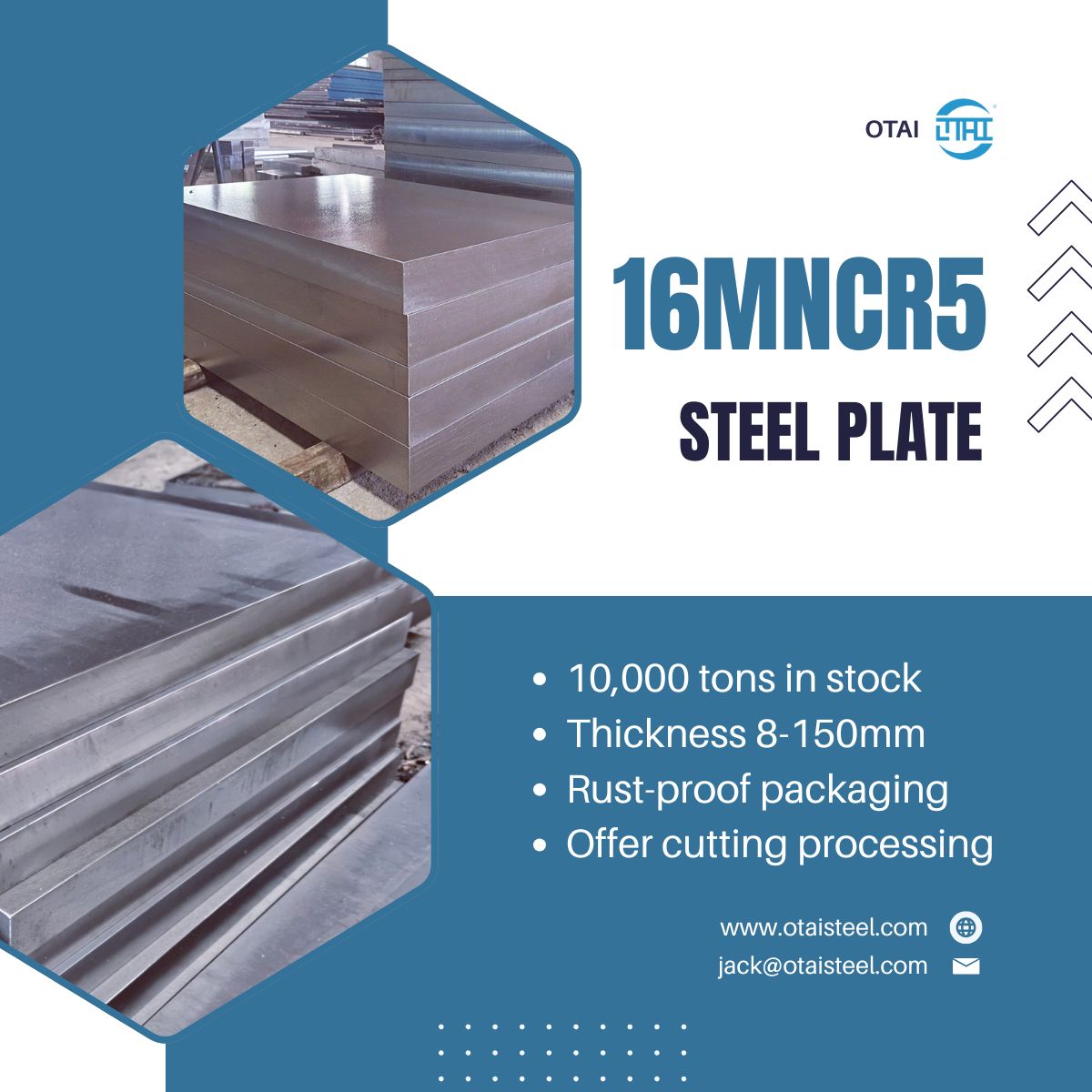
Otai Special Steel supplies 8–150mm thickness 16MnCr5 steel plates in stock, helping customers improve purchasing efficiency and shorten project waiting time.
🏭 6. Industrial Applications and Material Selection Guide
The wide use of 16MnCr5 steel plate comes from its ability to handle demanding working conditions. It is especially suitable for components exposed to continuous rotation, surface pressure, and repeated mechanical loads.
In automotive and mechanical industries, engineers often choose this material because it provides a practical balance between performance and manufacturing cost.
| Industry | Typical Components | Required Performance |
|---|---|---|
| Automotive | Gears, transmission parts | Wear resistance and fatigue strength |
| Industrial Machinery | Reducers and drive systems | Long service life |
| Agricultural Equipment | Shafts and mechanical parts | Impact resistance |
| Power Transmission | Gear systems | Stable operation under load |
The material selection process should consider operating conditions, including:
- Load intensity
- Operating speed
- Wear conditions
- Required service life
- Heat treatment requirements
For example, a gear operating under high contact stress requires excellent surface hardness, while a shaft exposed to impact loads requires stronger core toughness.
This is why 16MnCr5 steel plate remains a popular choice for engineering applications requiring a reliable surface-hardening solution.
🌍 7. Choosing a Reliable 16MnCr5 Steel Plate Supplier
Choosing the right 16MnCr5 steel plate supplier is an important decision for manufacturers because material quality directly affects production efficiency and final component performance.
A professional supplier should not only provide competitive material pricing but also offer stable inventory, technical support, quality inspection, and customized services.
For industrial buyers, several key factors should be evaluated before cooperation:
- Inventory capability: A supplier with available stock can reduce delivery time and help customers respond quickly to production schedules.
- Quality control system: Chemical composition analysis, ultrasonic testing, and inspection reports help ensure material reliability.
- Processing ability: Cutting, machining, and heat treatment services can simplify the customer’s manufacturing process.
- Export experience: International supply experience helps avoid communication and transportation problems.
- Technical understanding: A supplier should understand application requirements instead of only selling materials.
For companies purchasing 16MnCr5 carburizing steel plate, supplier reliability is especially important because these materials are often used in critical mechanical components.
A stable supplier relationship helps manufacturers maintain consistent quality and improve production planning.
📌 8. Buying Considerations for 16MnCr5 Steel Plate
When purchasing 16MnCr5 steel plate, buyers should consider more than material grade and quotation. A complete evaluation helps avoid quality problems and unnecessary production costs.
The following factors are important:
| Buying Factor | Why It Matters |
|---|---|
| Material standard | Ensures correct engineering performance |
| Size accuracy | Reduces machining waste |
| Inspection documents | Confirms material quality |
| Packaging method | Protects steel during transportation |
| Delivery capability | Supports production schedules |
Before ordering, customers should clearly provide:
- Required thickness and dimensions
- Quantity requirements
- Material standard
- Inspection requirements
- Processing requirements
A detailed specification allows suppliers to provide a more accurate solution and avoid misunderstandings during production.
Although price is an important factor, the lowest quotation does not always represent the best value. Material consistency, delivery reliability, and technical service can create greater benefits in long-term cooperation.
Therefore, professional buyers usually focus on total purchasing value rather than only the initial material cost.
🏭 Otai Special Steel Advantages
Otai Special Steel specializes in supplying alloy steels and engineering materials for global industrial customers. We focus on stable inventory, quality assurance, and flexible processing solutions.
- Stock availability: 8–150mm thickness 16MnCr5 steel plates available in stock for faster delivery.
- Large inventory support: Stable material resources help customers handle different project requirements.
- Processing service: Provide cutting service according to customer drawings and size requirements.
- Heat treatment support: Offer heat treatment solutions for different engineering applications.
- Quality inspection: Support ultrasonic testing and third-party inspection to ensure material reliability.
- Export experience: Experienced in supplying international customers with different technical standards.
For customers searching for a reliable 16MnCr5 steel plate supplier, Otai provides not only steel materials but also complete supply support from stock preparation to processing service.
❓ FAQ – 16MnCr5 Steel Plate
Q1: What is 16MnCr5 steel plate?
16MnCr5 steel plate is a low-carbon alloy case-hardening steel designed for carburizing treatment. It provides a hard surface and tough core for mechanical components.
Q2: What is the equivalent material of 16MnCr5?
The common material number is EN 1.7131. It is also compared with similar carburizing steels such as 8620 and 20MnCr5 depending on application requirements.
Q3: What is 16MnCr5 used for?
It is commonly used for gears, shafts, transmission components, reducers, and other parts requiring wear resistance and fatigue strength.
Q4: Can 16MnCr5 steel plate be heat treated?
Yes. Carburizing, quenching, and tempering are commonly applied to improve surface hardness and service performance.
Q5: What thicknesses are available for 16MnCr5 steel plate?
Availability depends on supplier inventory. Otai provides 8–150mm thickness plates in stock.