 16MnCr5 Means – Full Industrial Engineering Definition, Failure Analysis & Global Applications
The term 16MnCr5 means is widely used in metallurgy, mechanical engineering, and global steel procurement. However, in industrial practice, this term does not simply represent a steel grade. It represents a complete engineering system based on carburizing transformation behavior, diffusion-controlled surface hardening, and core toughness design.
In real manufacturing environments such as automotive gearbox production, industrial reducers, and heavy machinery transmission systems, engineers do not interpret 16MnCr5 means as a static material identity. Instead, it is understood as a process-dependent alloy system whose final performance is determined primarily by heat treatment strategy rather than raw chemical composition.
This article provides a deep technical explanation covering metallurgy, thermodynamics, phase transformation, fatigue failure, machining strategy, and industrial selection logic.
🔍 1. What 16MnCr5 Means in Engineering Reality
To fully understand what 16MnCr5 means, we must move beyond textbook definitions and focus on industrial behavior. 16MnCr5 is classified as a carburizing steel under EN 10084 standard and carries the material number 1.7131.
In engineering design, this steel is selected not for its raw strength, but for its ability to transform under heat treatment into a dual-property system: a hardened wear-resistant surface combined with a tough, impact-resistant core.
This duality is the core meaning of 16MnCr5 means in industrial systems.
Unlike structural steels such as S355 or quenched and tempered steels like 4140, 16MnCr5 is not designed for direct load-bearing performance in its delivery state. Instead, its functional value emerges only after carburizing and quenching, where carbon diffusion creates a gradient structure across the cross-section of the material.
This means that when engineers evaluate what 16MnCr5 means, they are actually evaluating a transformation process rather than a static material property set.
⚙️ 2. Naming Logic and Metallurgical Interpretation
The EN naming system behind 16MnCr5 provides direct metallurgical information. Each component of the name has a functional meaning related to composition and behavior.
| Symbol | Meaning | Engineering Role |
|---|---|---|
| 16 | 0.16% carbon content (approx.) | Ensures carburizing capability and low core hardness |
| Mn | Manganese addition | Improves hardenability and core toughness |
| Cr | Chromium alloying | Enhances wear resistance and case stability |
| 5 | Steel group classification | Defines EN material family |
From this structure, we understand that 16MnCr5 means a controlled low-carbon alloy system designed specifically for surface engineering applications. It is not a high-strength steel by default, but a transformation-based material system.
🔥 3. Chemical Composition and Diffusion Behavior
The chemical composition defines the physical and metallurgical meaning of 16MnCr5 means.
| Element | Range | Function in Engineering System |
|---|---|---|
| Carbon (C) | 0.14–0.19% | Provides carburizing potential and surface hardness development |
| Manganese (Mn) | 1.00–1.30% | Improves hardenability and structural stability during quenching |
| Chromium (Cr) | 0.80–1.10% | Enhances wear resistance and delays softening during tempering |
| Silicon (Si) | ≤0.40% | Improves oxidation resistance and deoxidation efficiency |
In carburizing steels like 16MnCr5, carbon does not distribute uniformly. Instead, the heat treatment process intentionally diffuses carbon into the surface layer. Temperature gradients and time-controlled exposure in a carbon-rich environment drive this diffusion process.
This is why 16MnCr5 means a diffusion-dependent engineering system rather than a homogeneous alloy.
🧪 4. Carburizing Heat Treatment Mechanism and Phase Transformation
Heat treatment is the most critical stage in defining what 16MnCr5 means in real industrial applications.
The carburizing process typically occurs at 880–980°C, where the steel is in an austenitic state. In this phase, carbon atoms are able to diffuse into the surface layer of the material.
The process includes several stages:
- Carbon diffusion into austenite lattice
- Formation of carbon gradient profile
- Quenching to form martensitic surface layer
- Tempering to stabilize internal stress
The final result is a composite structure consisting of a hard outer shell and a tough inner core.
This transformation is the physical explanation of 16MnCr5 means.
If carburizing is insufficient, the material will fail in wear conditions. If it is excessive, core toughness will be reduced, increasing fracture risk.
⚙️ 5. Microstructure Evolution and Mechanical Behavior
The microstructure evolution explains the internal meaning of 16MnCr5 means at a metallurgical level.
Before heat treatment, the steel consists of ferrite and pearlite phases. After carburizing and quenching, the structure transforms into three distinct zones.
- Surface zone: high-carbon martensite with high hardness
- Transition zone: bainite and mixed martensite structure
- Core zone: low-carbon ferrite and bainite for toughness
This gradient structure is critical for fatigue resistance. It prevents sudden crack propagation and allows controlled stress distribution across the cross-section.
Therefore, 16MnCr5 means a graded mechanical system rather than a uniform material.
🚗 6. Mechanical Properties and Performance Interpretation
The mechanical performance of 16MnCr5 is strongly dependent on heat treatment conditions and case depth control.
| Property | Typical Range |
|---|---|
| Surface Hardness | 58–62 HRC |
| Core Hardness | 25–35 HRC |
| Tensile Strength | 800–1100 MPa |
| Fatigue Resistance | High (design dependent) |
This confirms that 16MnCr5 means a performance-variable material system, not a fixed-property alloy.
Its real value appears only when heat treatment is correctly controlled.
🛠 7. Industrial Applications and Load Behavior
In industrial systems, 16MnCr5 means reliability under cyclic loading conditions.
It is widely used in:
- Automotive transmission gear systems
- Industrial gearbox reducers
- Drive shafts and pinions
- Agricultural machinery systems
- General power transmission components
These applications require resistance to combined stresses including torsion, bending, contact fatigue, and impact loading.
The reason 16MnCr5 is selected is not maximum strength, but balanced fatigue performance.
⚖️ 8. Failure Mechanisms and Engineering Risks
Understanding failure is essential to understanding what 16MnCr5 means.
Common failure modes include:
- Surface fatigue cracking due to cyclic contact stress
- Wear failure caused by insufficient carburized depth
- Core fracture under overload conditions
- Thermal distortion leading to stress concentration
In most real-world cases, fatigue cracks begin at the surface and propagate inward through the transition zone. Proper carburizing depth significantly delays crack initiation.
This failure behavior explains why process control is more important than nominal composition.
🏭 9. Manufacturing Process and Engineering Workflow
The production workflow defines how 16MnCr5 means in industrial manufacturing environments.
- Initial forging or rolling
- Soft annealing for machinability
- Rough machining in soft state
- Carburizing heat treatment
- Quenching and tempering
- Finish grinding for precision tolerance
This process chain is essential because dimensional changes occur during quenching due to phase transformation and thermal stress.
Therefore, final precision is achieved after heat treatment, not before it.
🏢 10. Industrial Supply System – Otai Special Steel Capability
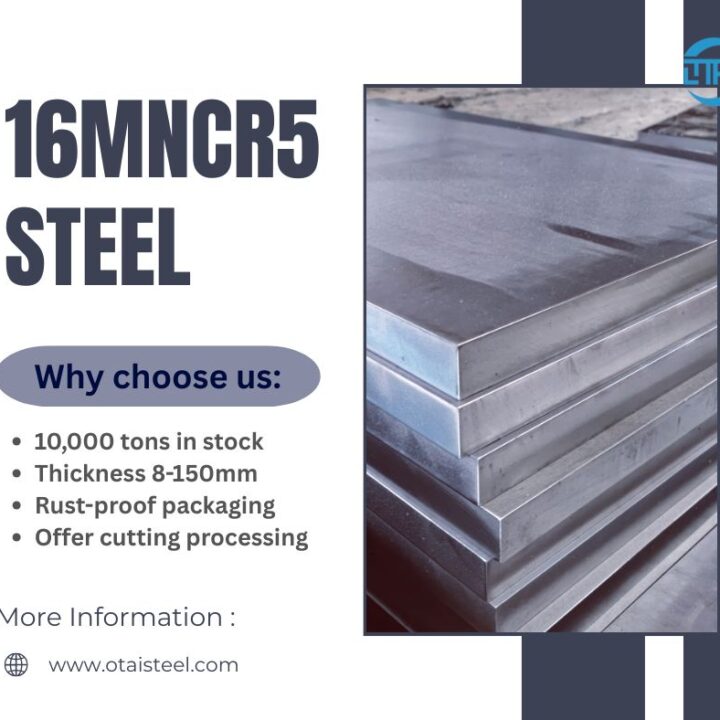
As a professional steel supplier, Otai Special Steel provides stable supply and technical support for 16MnCr5 and related carburizing steels. Meanwhile, we support global customers with flexible processing solutions.
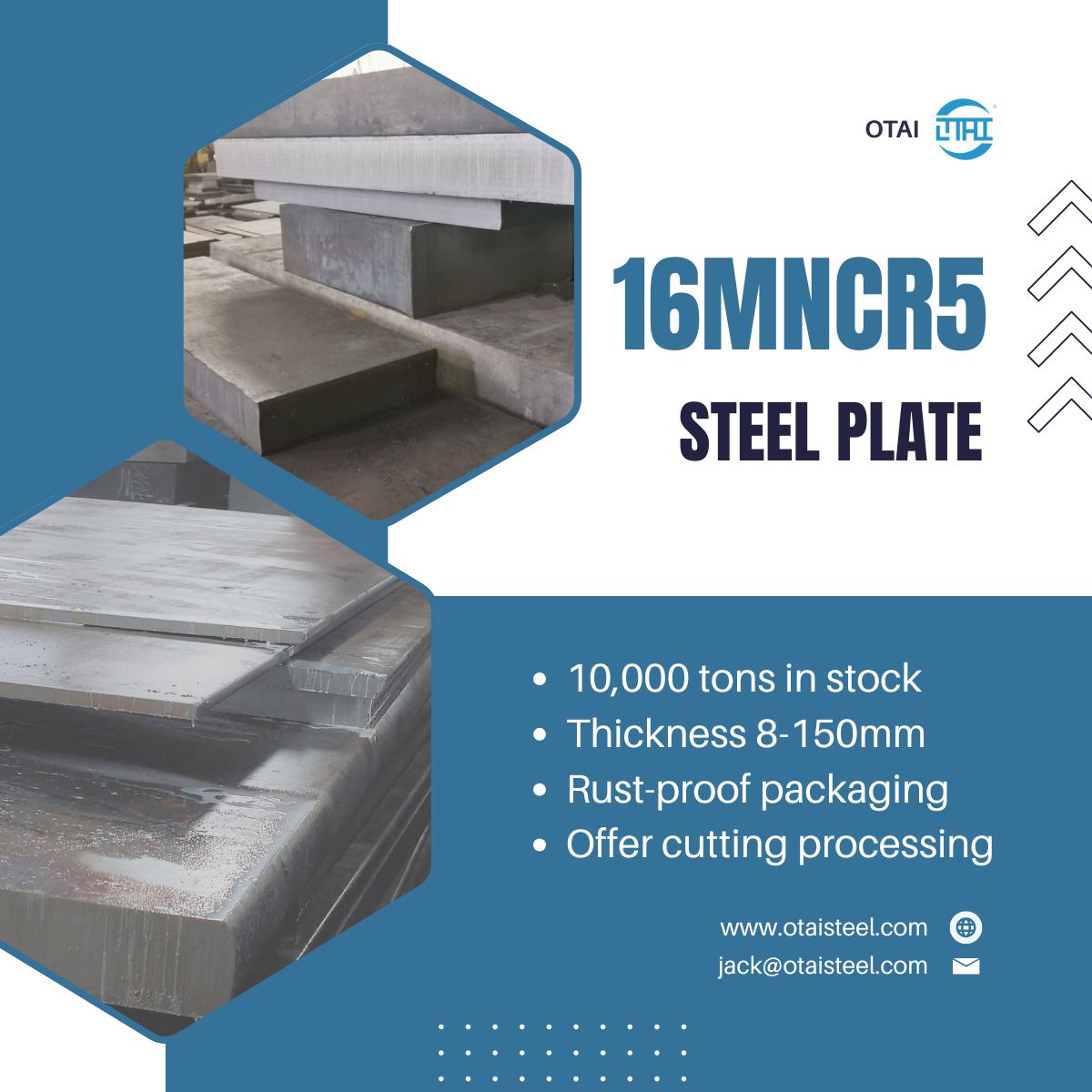
- Large Stock Availability: 10,000 tons inventory with 8–150mm 16MnCr5 plates ready for fast delivery
- Processing Services: Cutting, machining, heat treatment, and customized sizing available
- Quality Control: Ultrasonic testing and third-party inspection supported
- Export Experience: Long-term supply to Europe, USA, and Asia industrial markets
- Stable Supply Chain: Consistent quality for batch production requirements
Therefore, customers can reduce sourcing risk and improve production efficiency when purchasing from a stable supplier.
❓ FAQ – What 16MnCr5 Means
Q1: What does 16MnCr5 means in engineering?
It means a carburizing steel system designed for surface hardness and core toughness through heat treatment.
Q2: Is 16MnCr5 a structural steel?
No, it is a case-hardening steel.
Q3: Why is carburizing necessary?
Because low carbon steel cannot achieve high surface hardness without carbon diffusion.
Q4: What is the main advantage?
Balanced wear resistance and toughness after heat treatment.
Q5: What is the biggest risk?
Improper carburizing depth leading to premature fatigue failure.