 16MnCr5 1.7131 Equivalent – Full EN Standard Mapping & Engineering Selection Guide
The topic 16MnCr5 steel (EN material number 1.7131) is one of the most important carburizing steels in European mechanical engineering systems. It is widely used in automotive transmission, gear manufacturing, heavy machinery, and precision mechanical components.
🔍 1. Engineering Definition of 16MnCr5 Steel (EN 1.7131)
16MnCr5 is a low-carbon chromium-manganese alloy steel designed specifically for carburizing applications under EN 10084 standard. Its primary engineering function is not to achieve high strength in the as-delivered state, but to develop a hardened surface layer after heat treatment while maintaining a tough core.
When engineers search for 16MnCr5 steel, they are usually referring to a material system rather than a simple alloy grade. This system depends heavily on thermal processing and carbon diffusion behavior.
Key engineering characteristics:
- Low carbon base for carburizing capability
- High surface hardness after heat treatment
- Tough and ductile core structure
- Designed for cyclic loading systems
This means 16MnCr5 is a process-dependent engineering material, not a fixed-property steel.
⚙️ 2. Chemical Composition and Metallurgical Function System
The chemical composition of 16MnCr5 defines its carburizing capability and mechanical transformation behavior.
| Element | Typical Range | Engineering Function |
|---|---|---|
| Carbon (C) | 0.14–0.19% | Controls carburized hardness depth potential |
| Manganese (Mn) | 1.00–1.30% | Improves hardenability and core strength |
| Chromium (Cr) | 0.80–1.10% | Enhances wear resistance and case stability |
| Silicon (Si) | ≤0.40% | Improves oxidation resistance and deoxidation |
The combination of low carbon and alloying elements is critical. Carbon provides surface hardening potential, while Cr and Mn stabilize transformation during quenching.
This balance is what makes 16MnCr5 suitable for controlled diffusion engineering.
🔥 3. Carburizing Heat Treatment Mechanism (Core Engineering Logic)
Heat treatment is the most critical stage in the lifecycle of 16MnCr5 steel. Without carburizing, the material does not achieve its designed performance.
Standard industrial process:
- Carburizing: 880–980°C (carbon diffusion into austenite phase)
- Holding time: controls case depth
- Oil quenching: martensite formation
- Tempering: stress relief and toughness adjustment
During carburizing, carbon atoms diffuse into the surface layer, creating a gradient carbon profile. This gradient is essential for fatigue resistance.
Too shallow carburizing leads to early wear failure. Too deep carburizing reduces core toughness. Therefore, engineering control of case depth is essential.
🧪 4. Microstructure Evolution and Phase Transformation System
The microstructure of 16MnCr5 changes significantly during heat treatment. This transformation defines its mechanical performance.
Before heat treatment:
- Ferrite + pearlite structure
After carburizing and quenching:
- Surface: high-carbon martensite
- Transition zone: bainite + martensite mixture
- Core: ferrite + low-carbon bainite
This layered structure is the foundation of fatigue resistance design in mechanical systems.
The gradient structure reduces crack propagation speed and increases service life under cyclic stress.
⚙️ 5. Mechanical Properties and Performance Envelope
The mechanical properties of 16MnCr5 are not fixed values. They depend strongly on heat treatment parameters and case depth control.
| Property | Typical Range |
|---|---|
| Surface Hardness | 58–62 HRC |
| Core Hardness | 25–35 HRC |
| Tensile Strength | 800–1100 MPa |
| Fatigue Resistance | High (case-dependent) |
| Wear Resistance | Excellent (surface layer) |
Engineering interpretation: 16MnCr5 is designed for surface strength + core toughness synergy, not uniform hardness distribution.
🚗 6. Industrial Applications and Load Behavior Analysis
16MnCr5 is widely used in mechanical systems where cyclic loading dominates.
- Automotive gearbox systems
- Transmission shafts and pinions
- Industrial reducers
- Agricultural machinery
- Heavy-duty rotating equipment
These components experience combined stresses:
- Torsional stress
- Bending fatigue
- Contact wear
- Impact loading
Therefore, material selection must consider both surface wear and internal stress distribution.
🛠 7. Machining Strategy and Manufacturing Process Control
Manufacturing 16MnCr5 components requires a controlled process chain.
Typical workflow:
- Soft machining in annealed condition
- Carburizing heat treatment
- Quenching and tempering
- Finish grinding for tolerance control
Important engineering note: final dimensional accuracy is achieved after heat treatment, not before.
This is due to distortion caused by phase transformation during quenching.
⚖️ 8. Comparison with Similar Carburizing Steels
| Steel Grade | Main Feature | Application Focus |
|---|---|---|
| 16MnCr5 | Balanced toughness and wear resistance | General gear systems |
| 20MnCr5 | Higher strength and deeper case capability | Heavy-duty gears |
| 8620 | Good carburizing response | Automotive drivetrain |
Selection depends on load intensity, required case depth, and cost-performance balance.
🧭 9. Failure Mechanisms in Engineering Applications
Understanding failure behavior is critical for real engineering use of 16MnCr5 steel.
Main failure modes:
- Surface fatigue cracking due to contact stress
- Insufficient carburizing depth leading to wear-through
- Overload fracture in core region
- Heat treatment distortion causing stress concentration
Fatigue cracks typically initiate at the surface and propagate inward. Proper carburizing depth significantly delays crack initiation.
🏭 10. Industrial Supply Capability – Otai Special Steel
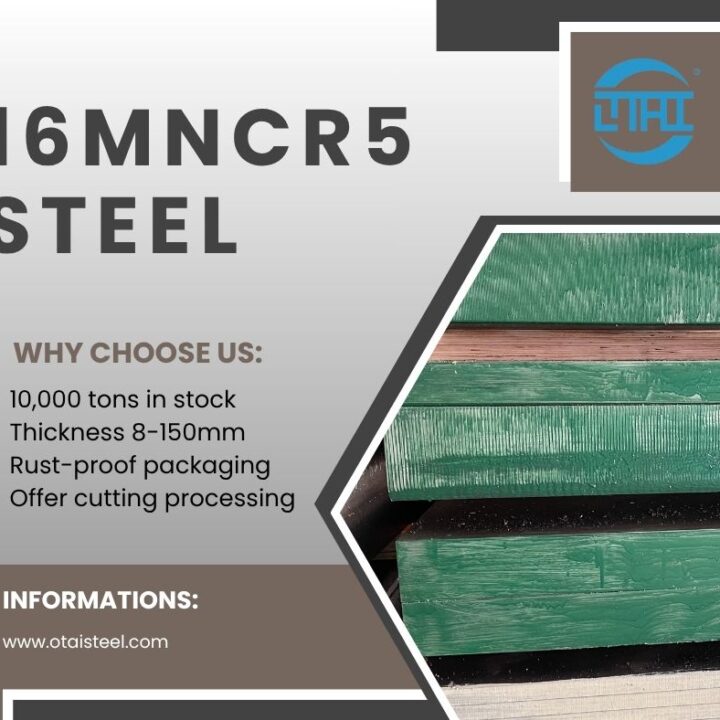
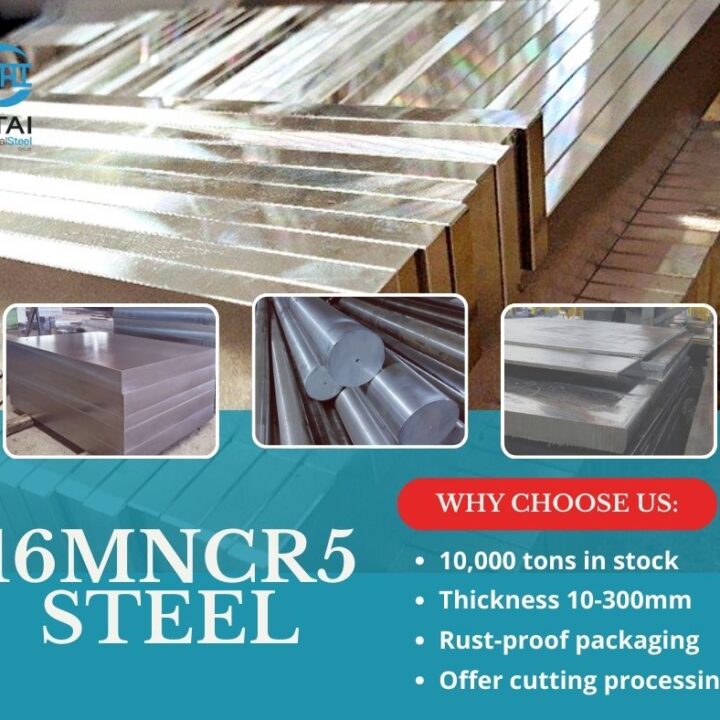
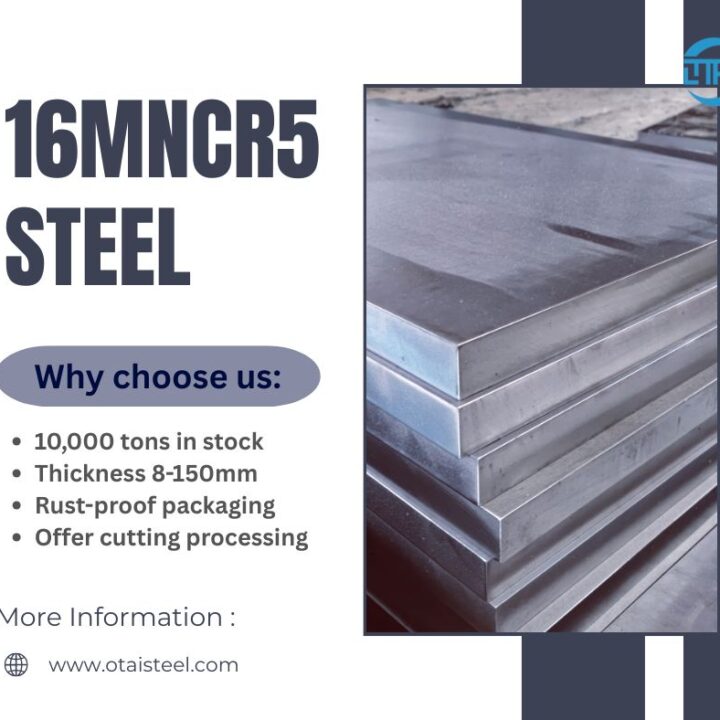
As a professional steel supplier, Otai Special Steel provides stable supply and technical support for 16MnCr5 and related carburizing steels. Meanwhile, we support global customers with flexible processing solutions.
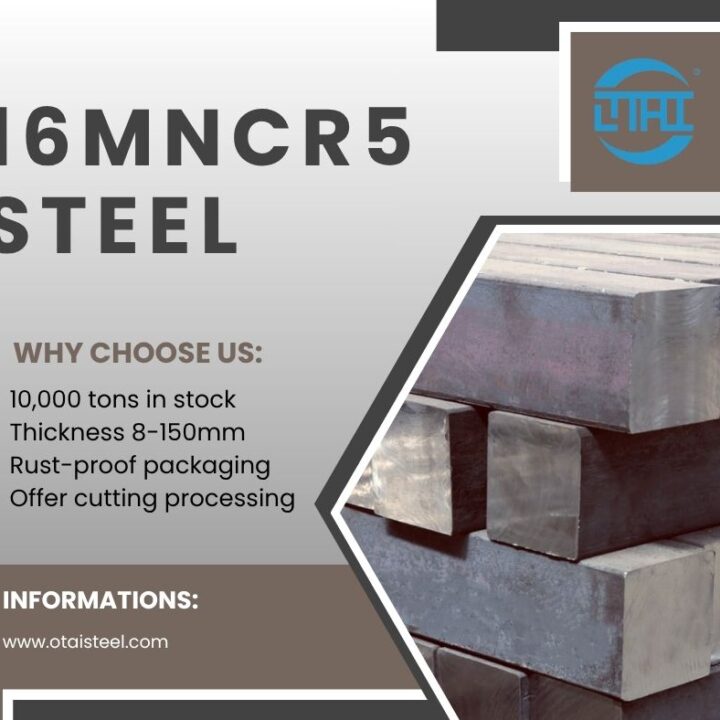
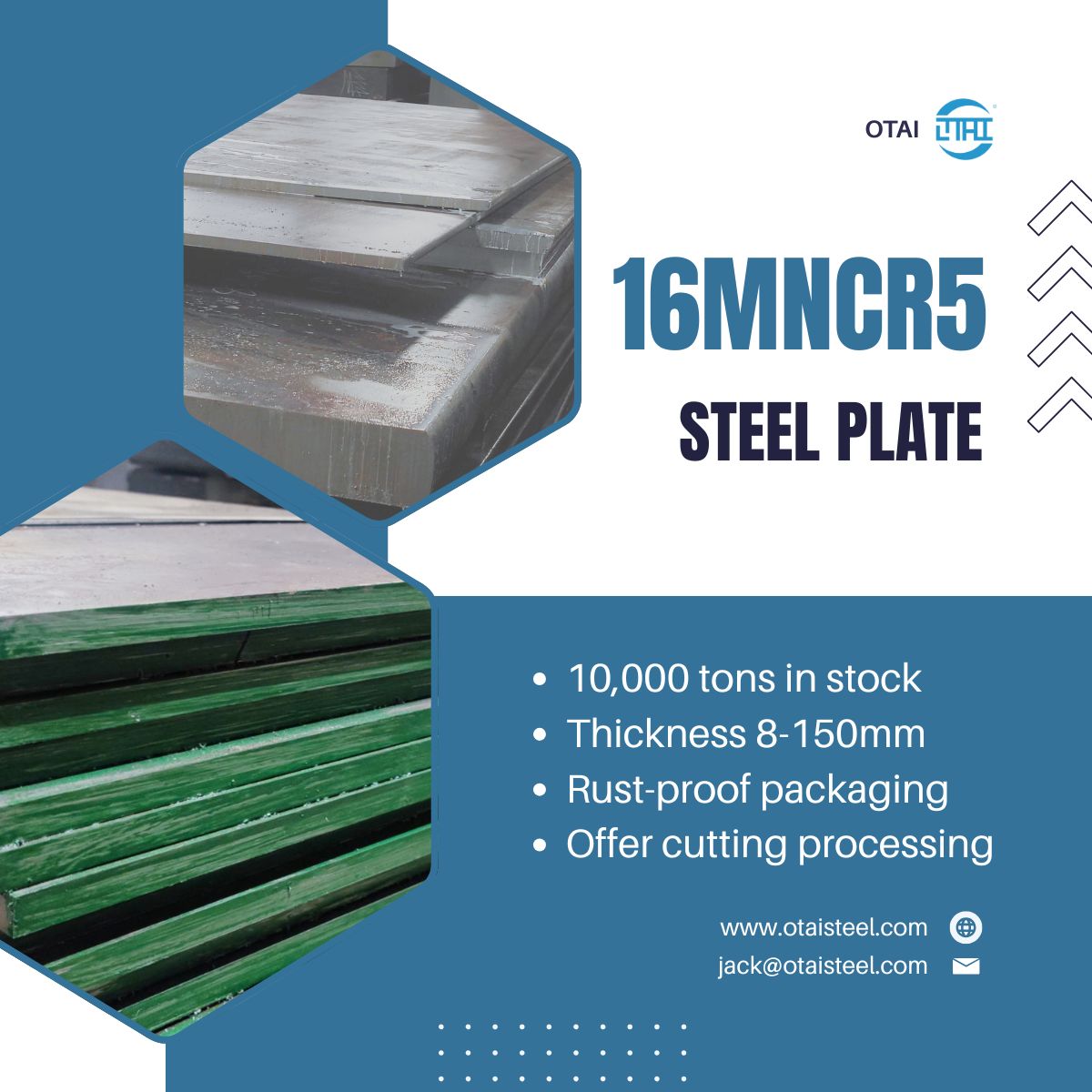
- Large Stock Availability: 10,000 tons inventory with 8–150mm 16MnCr5 plates ready for fast delivery
- Processing Services: Cutting, machining, heat treatment, and customized sizing available
- Quality Control: Ultrasonic testing and third-party inspection supported
- Export Experience: Long-term supply to Europe, USA, and Asia industrial markets
- Stable Supply Chain: Consistent quality for batch production requirements
Therefore, customers can reduce sourcing risk and improve production efficiency when purchasing from a stable supplier.
❓ FAQ – 16MnCr5 1.7131 Equivalent
Q1: What is 16MnCr5 steel mainly used for?
It is used for carburized gears, shafts, and transmission components requiring wear resistance and core toughness.
Q2: Why is carburizing necessary for 16MnCr5?
Because its low carbon base cannot achieve high hardness without carbon diffusion treatment.
Q3: What is the biggest advantage of 16MnCr5?
It provides a strong balance between surface hardness and core ductility.
Q4: What causes failure in 16MnCr5 components?
Most failures come from fatigue cracking, insufficient case depth, or overload stress.
Q5: Is 16MnCr5 suitable for high-load gears?
Yes, but for extremely heavy loads, 20MnCr5 is often preferred.