 What is 16MnCr5 Steel?
The question what is 16MnCr5 steel is one of the most important topics in case-hardening steel selection, especially in automotive gear systems, transmission components, and mechanical engineering design.
16MnCr5 is not just a material grade. When engineers ask what is 16MnCr5 steel, they are usually referring to a carburizing steel system designed to achieve a hard wear-resistant surface while maintaining a tough and ductile core after heat treatment.
This article provides a full engineering breakdown including chemical composition, microstructure evolution, heat treatment response, mechanical performance, applications, and material selection logic.
🔍 1. What is 16MnCr5 Steel in Engineering Terms?
- Designed for carburizing and surface hardening
- Used in gears, shafts, pinions, and transmission parts
- Combines hard surface + tough core structure
Therefore, 16MnCr5 is a process-dependent engineering steel system.
⚙️ 2. Chemical Composition of 16MnCr5 Steel
The chemical composition is the foundation of what is 16MnCr5 steel. Each element plays a specific role in carburizing behavior and mechanical performance.
| Element | Typical Range | Function |
|---|---|---|
| Carbon (C) | 0.14–0.19% | Controls hardness after carburizing |
| Manganese (Mn) | 1.00–1.30% | Improves hardenability and core strength |
| Chromium (Cr) | 0.80–1.10% | Improves wear resistance and case depth stability |
| Silicon (Si) | ≤0.40% | Strength stability and deoxidation |
The low carbon content is critical. It allows carbon diffusion during carburizing, forming a high-hardness surface layer while maintaining a ductile core.
🔥 3. Heat Treatment Process of 16MnCr5 Steel
A key part of answering what is 16MnCr5 steel is understanding its heat treatment behavior. The material is designed for carburizing followed by quenching and tempering.
Typical process:
- Carburizing: 880–980°C (carbon diffusion into surface layer)
- Quenching: oil cooling to form martensite
- Tempering: stress relief and toughness improvement
During this process, carbon concentration increases at the surface while the core remains low-carbon and tough. This creates a gradient structure that is essential for fatigue resistance.
🧪 4. Microstructure Evolution and Metallurgical Behavior
Before heat treatment, 16MnCr5 has a ferrite and pearlite structure. After carburizing and quenching, the surface transforms into high-carbon martensite.
This transformation is central to understanding what is 16MnCr5 steel from a metallurgical perspective.
- Surface layer → high-carbon martensite (high hardness)
- Transition zone → mixed bainite/martensite
- Core → low-carbon ferrite + bainite (toughness)
This layered structure provides a balance between wear resistance and impact resistance.
⚙️ 5. Mechanical Properties After Heat Treatment
The performance of 16MnCr5 depends heavily on heat treatment quality. This is why what is 16MnCr5 steel cannot be answered without considering processing conditions.
| Property | Typical Range |
|---|---|
| Surface Hardness | 58–62 HRC |
| Core Hardness | 25–35 HRC |
| Tensile Strength | 800–1100 MPa |
| Impact Toughness | Good (process dependent) |
The combination of a hard surface and tough core makes it suitable for cyclic loading applications.
🚗 6. Industrial Applications of 16MnCr5 Steel
Understanding what is 16MnCr5 steel also requires looking at real-world applications.
- Automotive transmission gears
- Gear shafts and pinions
- Industrial reducers
- Agricultural machinery components
- General mechanical transmission parts
These applications rely on surface wear resistance and core toughness working together under cyclic loads.
🛠 7. Machinability and Manufacturing Process
In annealed condition, 16MnCr5 has good machinability. This is important in production planning and cost control.
- Rough machining before heat treatment
- Carburizing and quenching process
- Finish grinding for dimensional accuracy
This manufacturing route reflects the engineering logic behind what is 16MnCr5 steel: a process-designed material rather than a fixed-property steel.
🏭 8. Comparison with Similar Carburizing Steels
| Steel Grade | Main Feature | Typical Application |
|---|---|---|
| 16MnCr5 | Balanced toughness and wear resistance | General gears |
| 20MnCr5 | Higher strength and hardness | Heavy-duty gears |
| 8620 | Good toughness and carburizing response | Automotive components |
This comparison helps clarify what is 16MnCr5 steel in relation to similar engineering materials.
🏢 9. Material Supply Capability – Otai Special Steel
As a professional steel supplier, Otai Special Steel provides stable supply and technical support for 16MnCr5 and related carburizing steels. Meanwhile, we support global customers with flexible processing solutions.
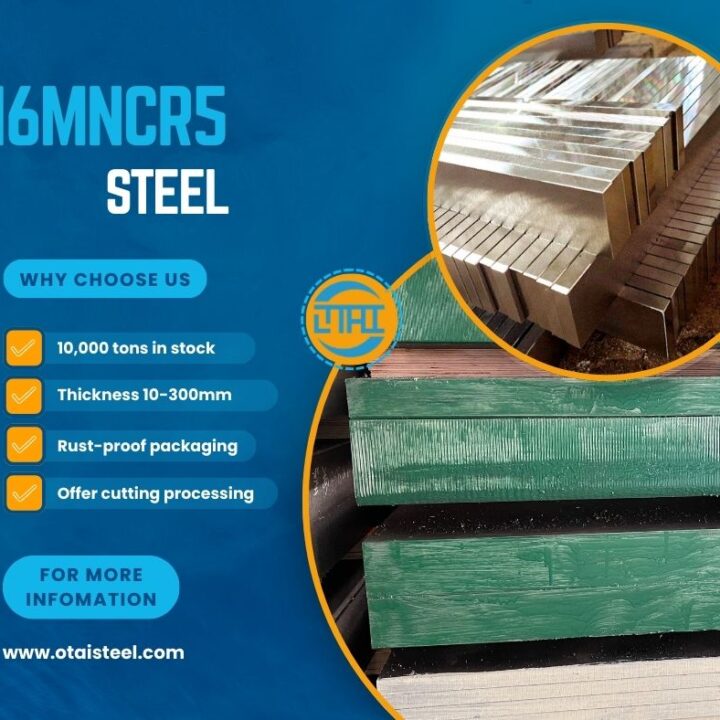
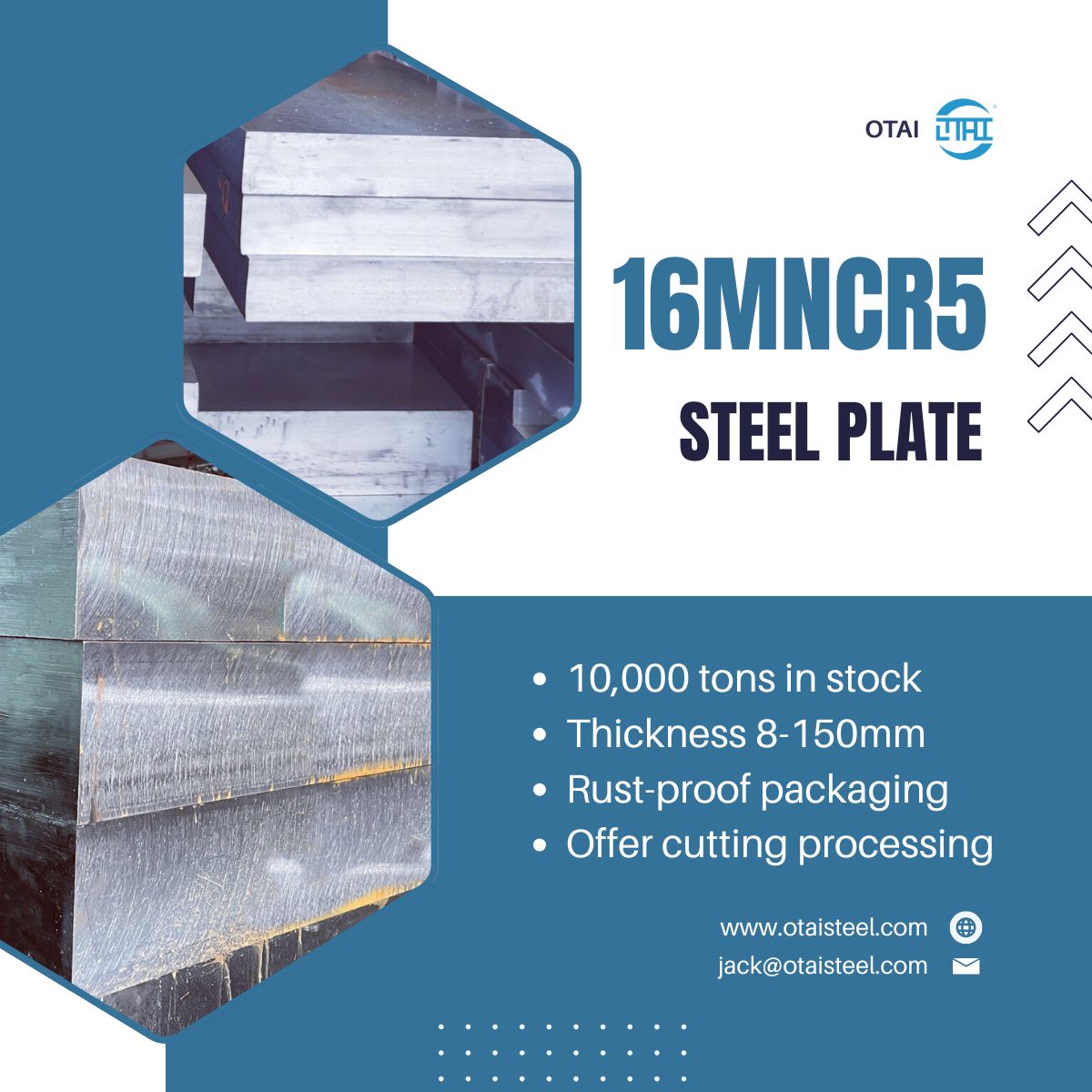
- Large Stock Availability: 10,000 tons inventory with 8–150mm 16MnCr5 plates ready for fast delivery
- Processing Services: Cutting, machining, heat treatment, and customized sizing available
- Quality Control: Ultrasonic testing and third-party inspection supported
- Export Experience: Long-term supply to Europe, USA, and Asia industrial markets
- Stable Supply Chain: Consistent quality for batch production requirements
Therefore, customers can reduce sourcing risk and improve production efficiency when purchasing from a stable supplier.
❓ FAQ – What is 16MnCr5 Steel
Q1: What is 16MnCr5 steel used for?
It is mainly used for carburized gears, shafts, and transmission components.
Q2: Is 16MnCr5 a high strength steel?
It is not high strength in raw state, but gains strength after heat treatment.
Q3: Can 16MnCr5 be welded?
Yes, but preheating and post-treatment are recommended.
Q4: What is the main advantage of 16MnCr5?
Excellent balance between surface hardness and core toughness.
Q5: What industries use 16MnCr5 most?
Automotive, machinery manufacturing, and industrial gear systems.