 16MnCr5 Gear Steel: Engineered for High-Performance Transmission Components
16MnCr5 gear steel is one of the most widely used case hardening steels for manufacturing gears, pinions, shafts, and transmission components that require exceptional wear resistance and fatigue strength. Thanks to its excellent carburizing performance, this low-alloy chromium-manganese steel develops a hard, wear-resistant surface while maintaining a tough and ductile core.
Modern gear systems operate under increasingly demanding conditions, including:
- High rotational speeds
- Heavy torque loads
- Repeated cyclic stress
- Continuous surface friction
- Shock and impact loading
Because of these challenges, manufacturers rely on 16MnCr5 gear steel to improve:
- Gear durability
- Tooth wear resistance
- Fatigue life
- Transmission reliability
- Dimensional stability after heat treatment
This material is widely used in automotive transmissions, industrial gearboxes, agricultural machinery, and heavy-duty mechanical systems.
🔍 What is 16MnCr5 Gear Steel?
16MnCr5 is a low-carbon alloy carburizing steel designed specifically for components that require:
- High surface hardness
- Tough core strength
- Excellent fatigue resistance
- Good machinability before hardening
- Stable heat treatment response
The steel belongs to the EN/DIN standard system and is commonly selected for precision gears because it combines strong mechanical performance with reliable manufacturing characteristics.
Main Features of 16MnCr5 Gear Steel
- Excellent carburizing capability
- High contact fatigue resistance
- Strong wear resistance
- Good impact toughness
- Low distortion after heat treatment
- Suitable for precision-machined gears
These properties make it ideal for both small precision gears and large industrial transmission systems.
⚗️ Chemical Composition of 16MnCr5 Gear Steel
The excellent performance of 16MnCr5 gear steel comes from its balanced alloy composition.
| Element | Content (%) | Function |
|---|---|---|
| Carbon (C) | 0.14 – 0.19 | Enables tough core and hardened surface |
| Silicon (Si) | 0.17 – 0.37 | Improves strength and oxidation resistance |
| Manganese (Mn) | 1.00 – 1.30 | Enhances hardenability and toughness |
| Chromium (Cr) | 0.80 – 1.10 | Improves wear resistance and fatigue strength |
| Phosphorus (P) | ≤ 0.025 | Controlled impurity |
| Sulfur (S) | ≤ 0.035 | Improves machinability |
Engineering Insight: Chromium and manganese significantly improve carburizing performance, allowing gears to achieve a deep hardened layer with excellent fatigue resistance.
📊 Mechanical Properties of 16MnCr5
The mechanical properties depend heavily on the heat treatment condition.
| Property | Annealed Condition | Carburized & Hardened Condition |
|---|---|---|
| Tensile Strength | 550 – 800 MPa | 800 – 1200 MPa |
| Yield Strength | 300 – 500 MPa | 550 – 850 MPa |
| Surface Hardness | 180 HB | 58 – 62 HRC |
| Elongation | 20 – 25% | 12 – 16% |
| Fatigue Resistance | Good | Excellent |
These properties enable gears to withstand repeated mechanical stress without premature wear or cracking.
🔥 Heat Treatment of 16MnCr5 Gear Steel
Heat treatment is the most important step in maximizing gear performance.
🔹 Carburizing Process
Carburizing introduces additional carbon into the surface layer of the steel.
| Parameter | Typical Range |
|---|---|
| Carburizing Temperature | 880 – 980°C |
| Case Depth | 0.8 – 1.5 mm |
| Atmosphere | Carbon-rich atmosphere |
The hardened surface improves resistance to:
- Gear tooth wear
- Surface pitting
- Rolling fatigue
- Contact stress damage
🔹 Quenching Process
After carburizing, the gear is rapidly cooled to form martensite on the surface.
| Quenching Medium | Characteristics |
|---|---|
| Oil | Lower distortion and reduced cracking risk |
| Water | Faster cooling but higher internal stress |
Oil quenching is usually preferred for precision gears because it minimizes distortion.
🔹 Tempering Process
Tempering reduces brittleness while maintaining high hardness.
| Tempering Temperature | Main Effect |
|---|---|
| 150 – 200°C | Maximum surface hardness |
| 200 – 350°C | Improved toughness |
Practical Tip: Automotive gears often use low-temperature tempering to maintain hardness above 58 HRC while improving fatigue resistance.
⚙️ Microstructure of Heat-Treated 16MnCr5
Proper heat treatment creates a dual-structure material ideal for gear applications.
| Region | Microstructure | Benefit |
|---|---|---|
| Surface Layer | Martensite | High wear resistance |
| Core | Tough Ferrite/Bainitic Structure | Shock resistance and load support |
This structure helps prevent:
- Tooth cracking
- Surface spalling
- Fatigue failure
- Premature wear
🚗 Why 16MnCr5 is Popular for Gear Manufacturing
Gear systems experience complex loading conditions involving rolling, sliding, and impact forces. 16MnCr5 gear steel handles these conditions exceptionally well because of its carburized structure.
Key Advantages
| Advantage | Engineering Benefit |
|---|---|
| High Surface Hardness | Reduces gear tooth wear |
| Tough Core | Prevents brittle fracture |
| Excellent Fatigue Resistance | Extends service life |
| Good Machinability | Simplifies gear production |
| Stable Heat Treatment Response | Maintains dimensional accuracy |
These advantages make the material highly reliable in long-term transmission systems.
⚙️ Industrial Applications of 16MnCr5 Gear Steel
16MnCr5 is widely used in industries requiring durable and fatigue-resistant gear systems.
| Industry | Components | Main Benefit |
|---|---|---|
| Automotive | Transmission gears, pinions | Long fatigue life |
| Industrial Machinery | Gearboxes, reducers | High wear resistance |
| Agricultural Equipment | Drive gears, axles | Shock-load durability |
| Heavy Equipment | Large transmission systems | Toughness under heavy loads |
🔹 Automotive Transmission Example
Automotive transmission gears manufactured from 16MnCr5 benefit from:
- Hardened tooth surfaces resisting wear
- Tough internal structure resisting impact
- Long operational life under repeated torque loading
This significantly improves gearbox reliability and reduces maintenance costs.
🌐 Equivalent Grades of 16MnCr5 Gear Steel
Several international grades provide similar carburizing performance.
| Standard | Equivalent Grade |
|---|---|
| AISI / SAE | SAE 5115 |
| JIS | SCM420 |
| GB | 20CrMnTi |
| DIN / EN | 16MnCr5 |
Although similar, slight differences in composition and hardenability may affect final gear performance.
⚖️ 16MnCr5 vs Plain Carbon Gear Steel
Compared with ordinary carbon steels, 16MnCr5 offers substantial advantages for gear manufacturing.
| Property | 16MnCr5 | Plain Carbon Steel |
|---|---|---|
| Hardenability | Excellent | Moderate |
| Surface Hardness | Higher | Lower |
| Fatigue Resistance | Excellent | Moderate |
| Core Toughness | Superior | Lower |
| Gear Service Life | Longer | Shorter |
These advantages explain why many manufacturers choose alloy carburizing steel instead of plain carbon steel for critical transmission systems.
🏭 Company Advantages
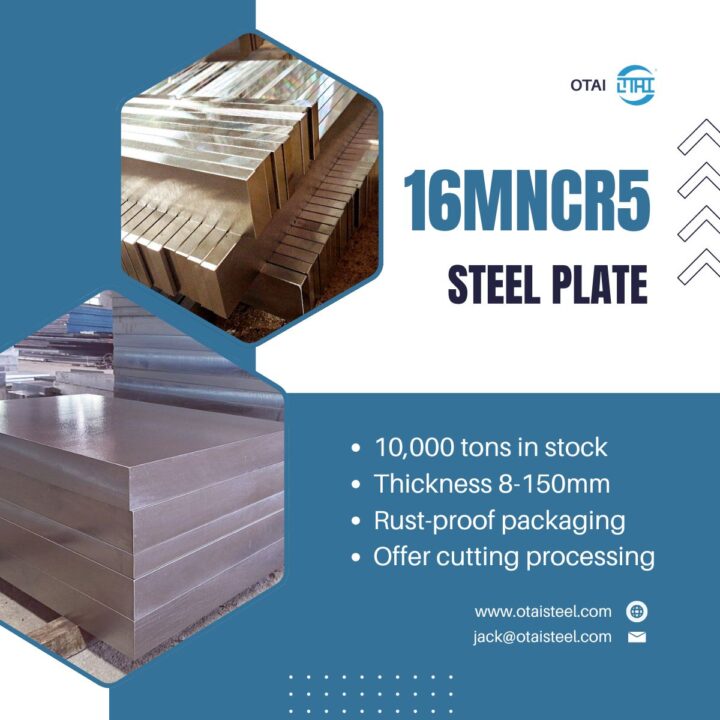
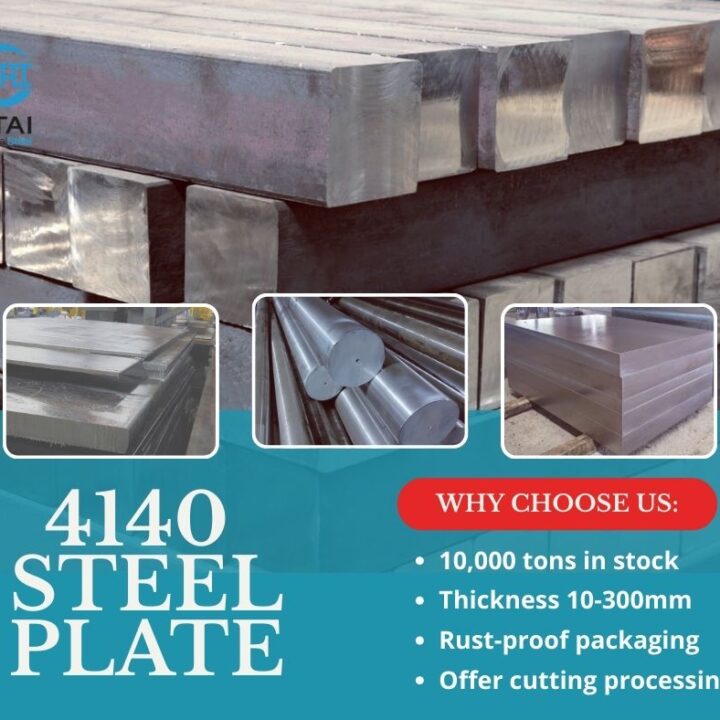
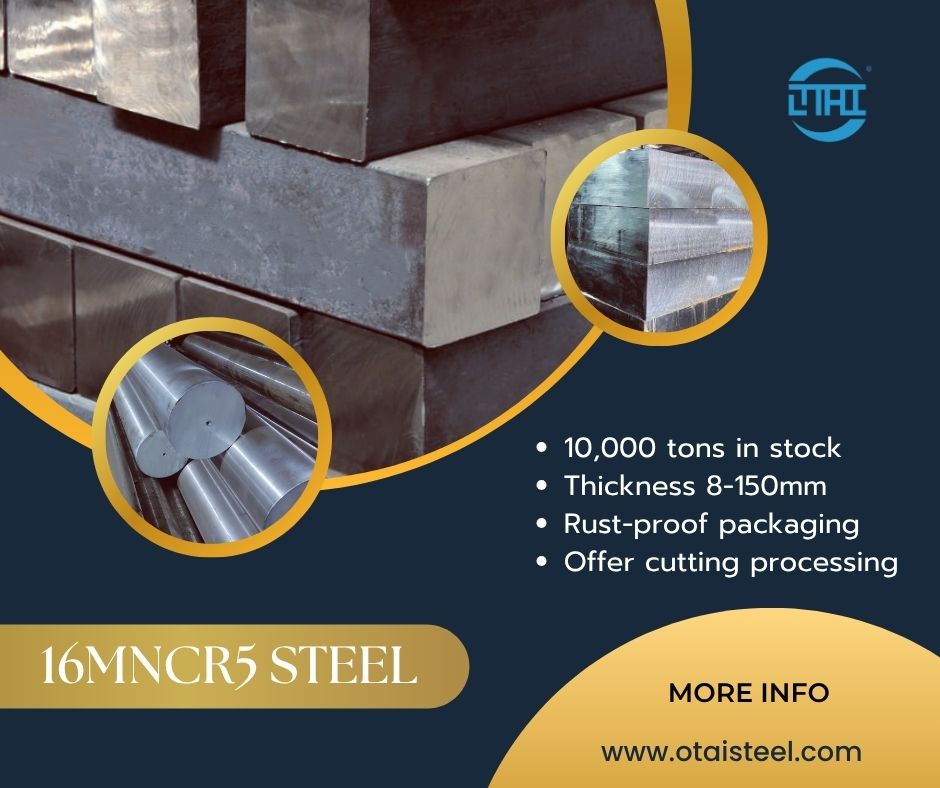
Otai Special Steel supplies premium-quality 16MnCr5 gear steel for demanding industrial and transmission applications.
- Large inventory and stable supply
- 8–150mm thickness plates available in stock
- Custom cutting and heat treatment services
- Ultrasonic testing (UT) and chemical composition verification
- Third-party inspection support (SGS)
- Professional export packaging and logistics support
We support customers in automotive, industrial machinery, agricultural equipment, and precision engineering industries with reliable material quality and technical assistance.
❓ FAQ
Q1: What is 16MnCr5 gear steel mainly used for?
A1: It is mainly used for gears, pinions, shafts, and transmission components requiring high wear resistance and fatigue strength.
Q2: What hardness can 16MnCr5 achieve after carburizing?
A2: Proper heat treatment can achieve surface hardness of approximately 58–62 HRC.
Q3: Why is 16MnCr5 suitable for gears?
A3: Its carburized surface provides excellent wear resistance, while the tough core prevents brittle failure under load.
Q4: Is 16MnCr5 better than plain carbon steel for gears?
A4: Yes. It offers superior hardenability, fatigue resistance, and service life.
Q5: Which industries commonly use 16MnCr5 gear steel?
A5: Automotive, industrial machinery, agricultural equipment, and heavy engineering industries widely use this steel for transmission systems.