 What is the Difference Between 16MnCr5 and 20MnCr5?
The question what is the difference between 16MnCr5 and 20MnCr5 is widely asked in gear manufacturing, automotive transmission systems, and industrial machinery design. Both steels belong to the EN case-hardening steel family and are commonly used for carburized components such as gears, shafts, and pinions.
However, what is the difference between 16MnCr5 and 20MnCr5 is not only a chemical comparison. It directly affects heat treatment response, fatigue life, core strength, machining cost, and final application reliability in real engineering systems.
This article provides a deep engineering breakdown from material science, mechanical behavior, heat treatment mechanism, failure risk, and industrial selection perspective.
🔍 1. Engineering Definition of 16MnCr5 and 20MnCr5
Both steels are carburizing steels designed to achieve a hard surface layer and tough core after heat treatment. They are not used in quenched and tempered condition like 4140 steel, but rely on surface engineering.
To understand what is the difference between 16MnCr5 and 20MnCr5, we must focus on carbon content and hardenability behavior.
- 16MnCr5 → lower carbon steel, optimized for toughness and stable deformation control
- 20MnCr5 → higher carbon steel, optimized for load-bearing and higher surface hardness
Both materials are widely used in gear systems, but they are not interchangeable in high-precision designs without engineering validation.
⚙️ 2. Chemical Composition and Metallurgical Impact
The most direct explanation of what is the difference between 16MnCr5 and 20MnCr5 lies in carbon content variation and its impact on martensite formation after carburizing.
| Element | 16MnCr5 | 20MnCr5 | Engineering Effect |
|---|---|---|---|
| Carbon (C) | 0.14–0.19% | 0.17–0.22% | Controls hardness gradient and surface strength |
| Manganese (Mn) | 1.00–1.30% | 1.10–1.40% | Improves hardenability and core strength |
| Chromium (Cr) | 0.80–1.10% | 0.90–1.20% | Enhances wear resistance and carburized layer stability |
Even a small carbon increase significantly improves final hardness but reduces ductility. This is the core metallurgical trade-off.
🔥 3. Carburizing Heat Treatment Behavior
Both steels rely on carburizing, quenching, and tempering to achieve final performance. However, what is the difference between 16MnCr5 and 20MnCr5 becomes clear during carbon diffusion and phase transformation.
Carburizing typically occurs at 880–980°C, where carbon diffuses into the surface layer forming a high-carbon zone.
- 16MnCr5 → more stable carbon diffusion, lower distortion risk
- 20MnCr5 → deeper carbon penetration, higher surface hardness potential
However, 20MnCr5 requires stricter control during quenching because higher carbon increases crack sensitivity and dimensional distortion risk.
🧪 4. Microstructure Evolution and Phase Transformation
Before heat treatment, both steels consist of ferrite and pearlite microstructure. After carburizing and quenching, the surface transforms into high-carbon martensite while the core remains low-carbon bainite or ferrite-pearlite.
This layered structure explains what is the difference between 16MnCr5 and 20MnCr5 from a metallurgical perspective.
The transition zone plays a key role in fatigue resistance:
- Steep gradient → higher crack risk
- Smooth gradient → better fatigue performance
16MnCr5 generally produces a more ductile core, while 20MnCr5 produces a stronger but slightly less forgiving transition structure.
⚙️ 5. Mechanical Properties After Heat Treatment
The mechanical performance difference is one of the most practical answers to what is the difference between 16MnCr5 and 20MnCr5.
| Property | 16MnCr5 | 20MnCr5 |
|---|---|---|
| Surface Hardness | 58–62 HRC | 60–64 HRC |
| Core Hardness | 25–35 HRC | 30–45 HRC |
| Tensile Strength | 800–1100 MPa | 900–1200 MPa |
| Fatigue Resistance | Good | Better under high torque |
These differences directly affect service life in gear systems and rotating components.
🚗 6. Industrial Application and Load Condition Analysis
In real engineering systems, what is the difference between 16MnCr5 and 20MnCr5 becomes a load-dependent selection problem.
- 16MnCr5 → suitable for light and medium load gears, standard transmission systems
- 20MnCr5 → suitable for heavy load gears, high torque reducers, and industrial machinery
Using 20MnCr5 in low-load systems may increase cost unnecessarily, while using 16MnCr5 in high-torque systems may reduce fatigue life.
🛠 7. Machining Behavior and Manufacturing Cost
Before heat treatment, both steels have good machinability, but differences still exist.
- 16MnCr5 → lower cutting resistance, longer tool life
- 20MnCr5 → slightly higher tool wear due to higher carbon content
From a manufacturing perspective, this affects production efficiency, especially in mass production of gears and shafts.
🏭 8. Engineering Selection Logic (Failure Avoidance Perspective)
Choosing the wrong material can lead to early failure. Understanding what is the difference between 16MnCr5 and 20MnCr5 helps avoid design risks.
| Condition | Recommended Steel | Reason |
|---|---|---|
| High impact load | 16MnCr5 | Better toughness absorption |
| High torque transmission | 20MnCr5 | Higher core strength |
| Cost-sensitive production | 16MnCr5 | Lower machining cost |
| Long service life requirement | 20MnCr5 | Better fatigue resistance |
🏢 9. Material Supply Capability – Otai Special Steel
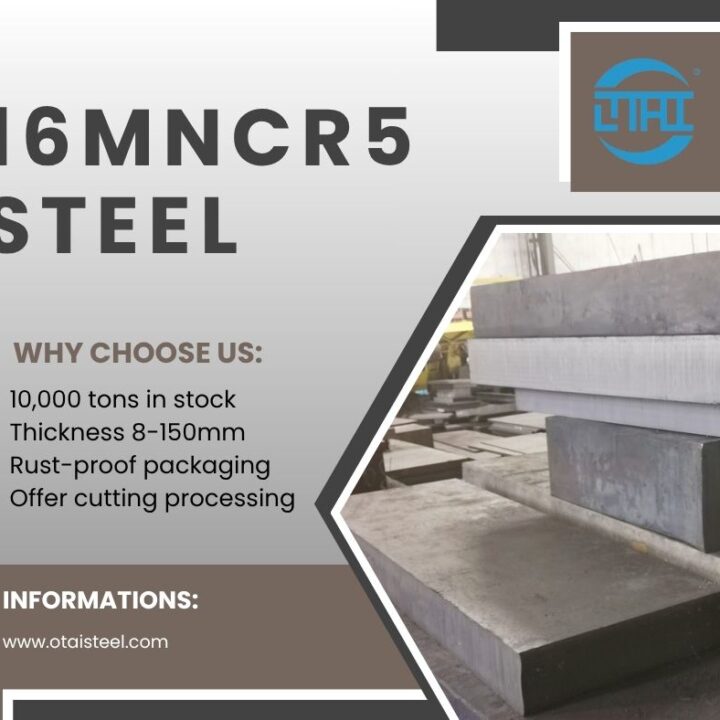
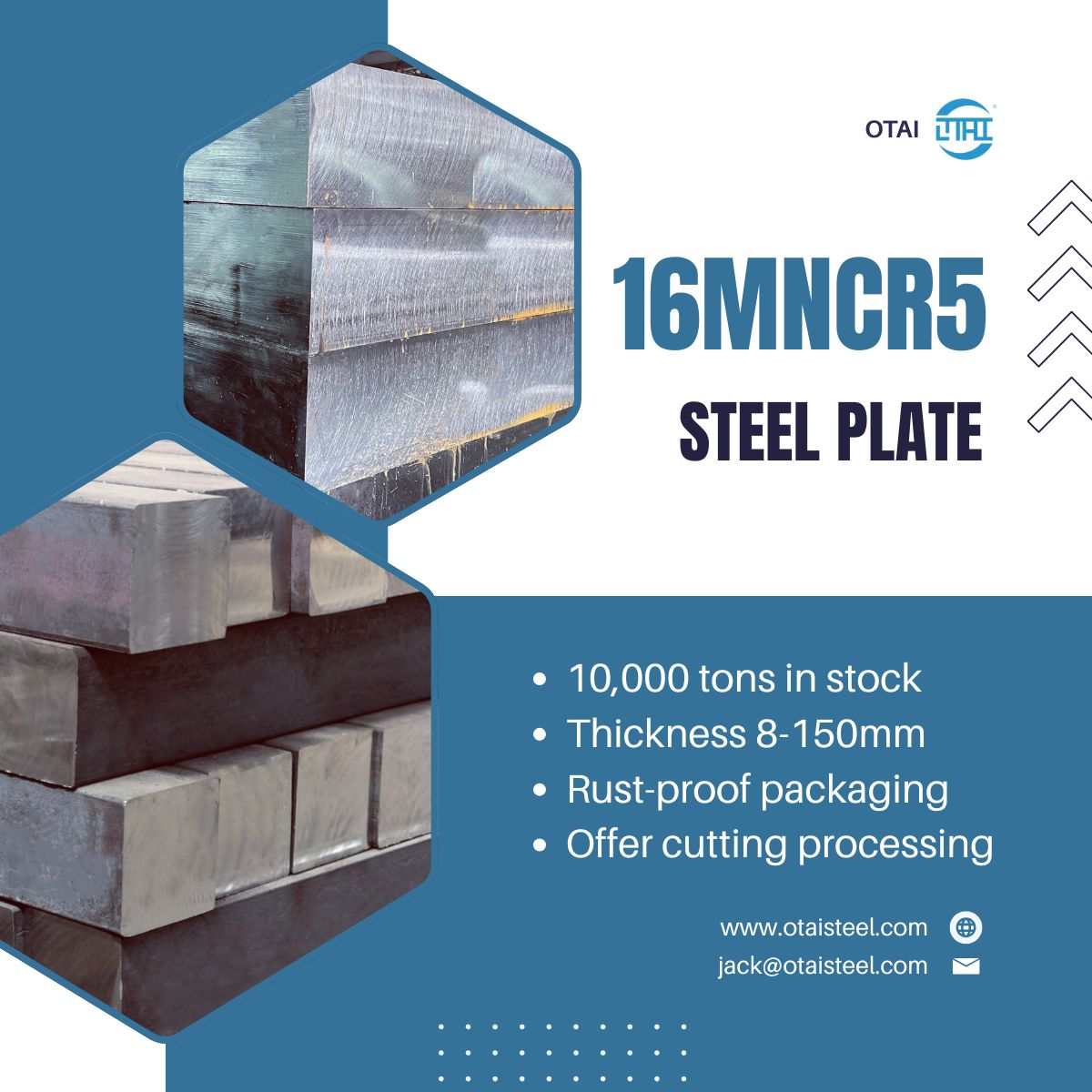
As a professional steel supplier, Otai Special Steel provides stable supply and technical support for 16MnCr5 and related carburizing steels. Meanwhile, we support global customers with flexible processing solutions.
- Large Stock Availability: 10,000 tons inventory with 8–150mm 16MnCr5 plates ready for fast delivery
- Processing Services: Cutting, machining, heat treatment, and customized sizing available
- Quality Control: Ultrasonic testing and third-party inspection supported
- Export Experience: Long-term supply to Europe, USA, and Asia industrial markets
- Stable Supply Chain: Consistent quality for batch production requirements
Therefore, customers can reduce sourcing risk and improve production efficiency when purchasing from a stable supplier.
❓ FAQ – What is the Difference Between 16MnCr5 and 20MnCr5
Q1: What is the main difference?
Carbon content and resulting mechanical strength after carburizing.
Q2: Which steel is stronger?
20MnCr5 has higher strength and hardness.
Q3: Which is easier to machine?
16MnCr5 is easier to machine and process.
Q4: Which is better for gears?
Both are used depending on load conditions.
Q5: Can they replace each other?
Only with engineering validation based on design requirements.