 Material 16MnCr5 Meaning: Complete Engineering and Application Guide
🔍 1. Material 16MnCr5 Meaning in Engineering Context
The material 16MnCr5 meaning refers to a low-carbon alloy case hardening steel designed for components that require high surface hardness combined with a tough and ductile core. It is widely used in automotive transmission systems, industrial gearboxes, and precision mechanical structures.
From an engineering perspective, the material 16MnCr5 meaning is not just a chemical definition. It represents a performance-based steel grade optimized for carburizing heat treatment. The key idea is transformation: the material is relatively soft in delivery condition but becomes extremely hard at the surface after heat treatment.
This behavior makes the material 16MnCr5 meaning closely linked to fatigue resistance, contact stress performance, and long-term reliability under cyclic loading conditions.
Engineers choose this steel when they need predictable carburizing depth, stable dimensional control, and a strong balance between hardness and toughness.
🧪 2. Steel Naming Logic Behind 16MnCr5 Meaning
The material 16MnCr5 meaning follows the European EN steel designation system, which directly reflects its chemical composition and design intent.
- 16 → approximately 0.16% carbon content, indicating low-carbon base structure
- Mn → manganese improves hardenability and toughness of the core
- Cr → chromium improves wear resistance and carburizing response
- 5 → indicates alloy proportion class in EN system grouping
This naming structure explains why the material 16MnCr5 meaning is strongly connected to surface engineering rather than bulk strength design.
Unlike structural steels such as 1045 or 4140, this grade is engineered specifically for case hardening applications where performance is defined after heat treatment rather than in raw condition.
⚙️ 3. Chemical Composition and Metallurgical Design
| Element | Content (%) | Metallurgical Role |
|---|---|---|
| C | 0.14–0.19 | Controls hardness potential after carburizing |
| Si | ≤0.40 | Deoxidation and strength stability |
| Mn | 0.80–1.10 | Improves hardenability and toughness |
| Cr | 0.80–1.10 | Enhances wear resistance and case depth |
| P | ≤0.035 | Impurity control |
| S | ≤0.035 | Machinability control |
This balanced chemical system defines the engineering foundation of the material 16MnCr5 meaning. The relatively low carbon content allows deep carburizing without cracking risk, while chromium ensures stable hardened case formation.
Manganese plays a critical role in maintaining core toughness, especially in thick-section components where internal stress distribution is uneven.
🏭 4. Mechanical Properties and Load Performance Behavior
The mechanical behavior of 16MnCr5 is strongly influenced by heat treatment, which directly defines the real-world interpretation of the material 16MnCr5 meaning.
| Property | Typical Range | Engineering Interpretation |
|---|---|---|
| Tensile Strength | 600–900 MPa | Load carrying capacity |
| Yield Strength | 400–650 MPa | Elastic limit stability |
| Core Hardness | 30–45 HRC | Impact resistance |
| Surface Hardness | 58–62 HRC | Wear resistance layer |
| Elongation | 10–14% | Ductility and deformation capacity |
| Elastic Modulus | ~210 GPa | Stiffness (unchanged by heat treatment) |
The key engineering insight behind the material 16MnCr5 meaning is that strength and hardness are surface-driven, while stiffness remains constant. This makes it highly predictable in structural calculations.
In dynamic systems, this stability ensures consistent gear meshing and reduces vibration-related failure risk.
🔥 5. Heat Treatment Mechanism and Carburizing Process
A central part of the material 16MnCr5 meaning is its carburizing capability. The steel is designed to absorb carbon at high temperature and redistribute it into the surface layer.
- Carburizing: 880–950°C carbon diffusion stage
- Holding stage: carbon penetration depth control
- Oil quenching: martensite transformation on surface
- Tempering: 150–200°C stress relief and toughness recovery
This process creates a gradient structure that defines the engineering identity of the material 16MnCr5 meaning.
The outer layer becomes high-carbon martensite with extreme hardness, while the core remains low-carbon bainite or ferrite structure, ensuring energy absorption under shock loading.
🧬 6. Microstructure Evolution and Material Transformation
Before heat treatment, the microstructure is mainly ferrite + pearlite. This gives good machinability but limited wear resistance.
After carburizing and quenching, the surface transforms into martensite while the core retains ductile phases. This transformation is the scientific core of the material 16MnCr5 meaning.
The gradient structure improves resistance against:
- Contact fatigue in gears
- Surface pitting under rolling load
- Impact loading in transmission systems
🚗 7. Industrial Applications and Real Engineering Usage
The material 16MnCr5 meaning becomes practical in industrial systems where repeated load cycles and surface wear dominate failure mechanisms.
- Automotive gearbox gears and pinions
- Drive shafts and axle components
- Camshaft systems
- Industrial reducers and gearboxes
- Mining machinery transmission parts
- Agricultural equipment drive systems
In these applications, the steel ensures stable torque transfer and long service life under lubrication and cyclic stress conditions.
🛠 8. Machinability and Manufacturing Strategy
In annealed condition, 16MnCr5 provides good machinability, which is essential for precision gear cutting and shaft turning operations.
Manufacturers typically complete machining before carburizing because the hardened surface becomes extremely difficult to process afterward.
This manufacturing strategy is part of the practical engineering logic behind the material 16MnCr5 meaning.
🔄 9. Comparison with Other Engineering Steels
| Steel Grade | Carbon | Key Feature | Application |
|---|---|---|---|
| 16MnCr5 | 0.16% | Balanced carburizing steel | Standard gears |
| 20MnCr5 | 0.20% | Higher hardness potential | Heavy load gears |
| AISI 8620 | 0.20% | Good toughness balance | Automotive parts |
| 4140 | 0.40% | High strength bulk steel | Shafts & structural parts |
This comparison highlights the positioning of the material 16MnCr5 meaning as a carburizing-optimized steel rather than a bulk-strength alloy.
📐 10. Engineering Design Considerations
Design engineers rely on the material 16MnCr5 meaning when calculating gear tooth stress, shaft deflection, and fatigue life.
Key design factors include:
- Contact stress distribution on gear surfaces
- Bending fatigue in rotating shafts
- Dimensional stability after heat treatment
- Surface lubrication performance under load
These factors determine whether the material performs reliably in long-term industrial operation.
🏭 Company Advantages – Otai Special Steel
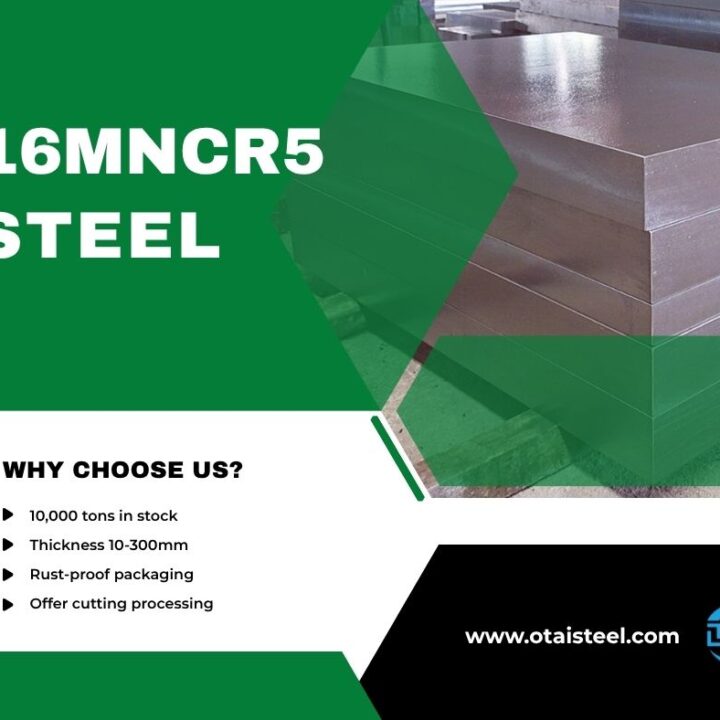
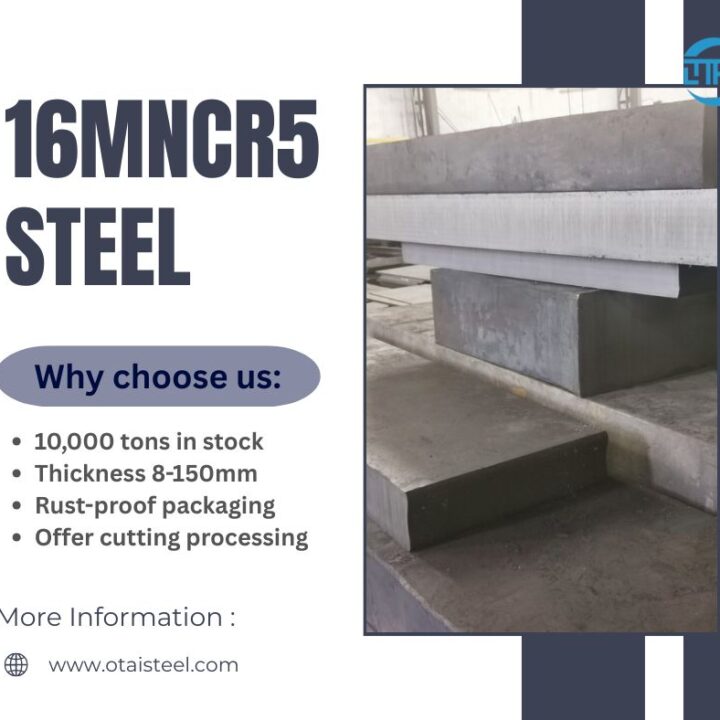
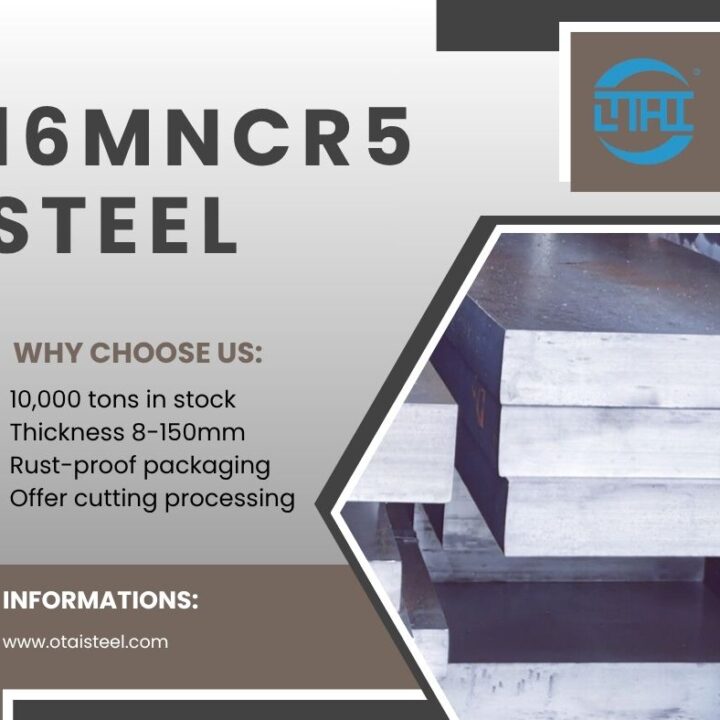
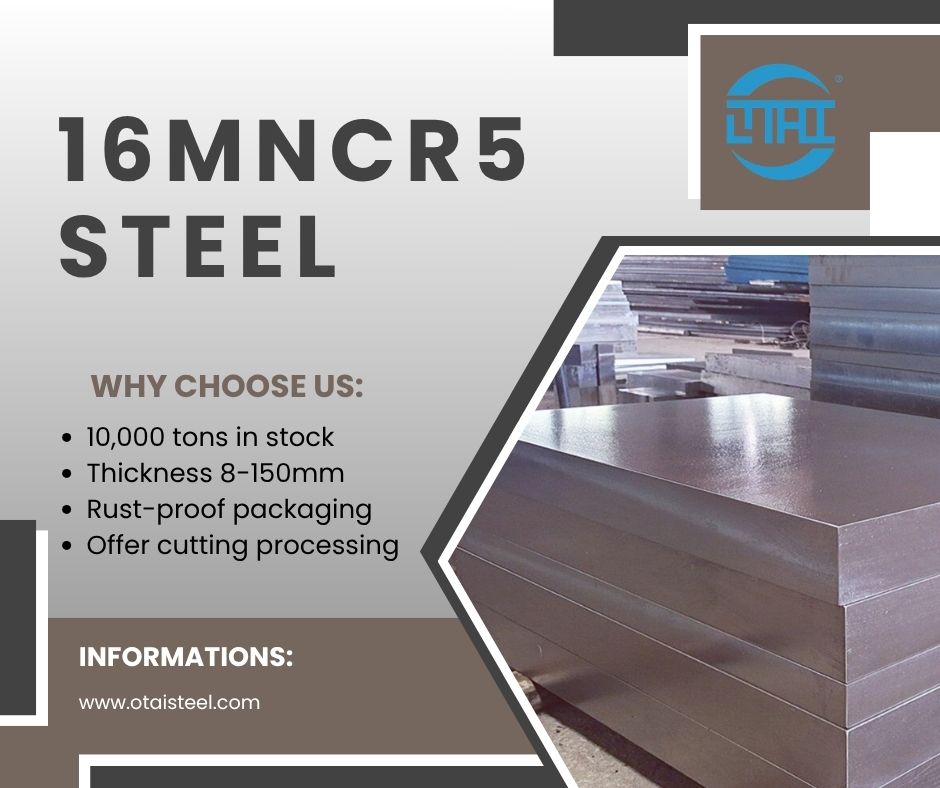
OTAI supplies industrial-grade 16MnCr5 steel with stable stock and processing capability.
- 8–150mm thickness plates available in stock
- Large inventory for fast delivery
- Cutting, heat treatment, machining services
- Ultrasonic testing and third-party inspection
- Global export experience
❓ FAQ – Material 16MnCr5 Meaning
Q1: What is material 16MnCr5 meaning?
It refers to a carburizing alloy steel designed for surface hardened mechanical components.
Q2: Why is it widely used in industry?
Because it offers a balance of machinability, carburizing performance, and fatigue resistance.
Q3: Does heat treatment change stiffness?
No, elastic modulus remains nearly constant.
Q4: What are its main applications?
Automotive, industrial gear systems, and heavy machinery components.
Q5: What is the main engineering advantage?
Hard surface combined with tough core structure for long service life.