 16MnCr5 Heat Treatment Process – How Heat Treatment Improves Strength
The 16MnCr5 heat treatment process plays a vital role in developing the mechanical properties that make this steel a preferred choice for gears, shafts, sprockets, and transmission components. While 16MnCr5 already offers good machinability and alloy hardenability in its supplied condition, heat treatment transforms the material into a high-performance engineering steel capable of handling heavy loads and severe wear conditions.
Manufacturers often use carburizing, quenching, and tempering to create a hard wear-resistant surface while maintaining a strong and ductile core. This unique combination allows components to resist abrasion, contact fatigue, and impact loading over long service periods.
A properly controlled 16MnCr5 heat treatment process not only improves hardness but also increases fatigue strength, dimensional stability, and overall component reliability. These advantages explain why industries such as automotive, agricultural machinery, mining equipment, and industrial power transmission continue to rely on 16MnCr5 steel.
🔵 Overview of 16MnCr5 Steel
16MnCr5 is a low-carbon chromium-manganese alloy steel designed primarily for case hardening applications. The relatively low carbon content keeps the core tough, while the alloying elements improve hardenability and support deep case formation during carburizing.
After a complete 16MnCr5 heat treatment process, the steel develops a hard outer layer and a tough internal structure. This microstructural combination provides excellent performance in components that experience repeated contact stress.
| Property | Typical Performance |
|---|---|
| Carburizing Response | Excellent |
| Wear Resistance | Excellent |
| Fatigue Strength | High |
| Core Toughness | High |
| Machinability | Good |
🟢 Objectives of the 16MnCr5 Heat Treatment Process
Every stage of the 16MnCr5 heat treatment process serves a specific purpose. The overall goal is to maximize wear resistance without sacrificing toughness. Engineers must balance hardness, case depth, residual stress levels, and dimensional accuracy to achieve the desired performance.
For gears and transmission components, the surface must resist wear and pitting while the core absorbs dynamic loads. Heat treatment creates this balance by modifying the steel’s microstructure through controlled heating and cooling cycles.
| Heat Treatment Objective | Result |
|---|---|
| Increase Surface Hardness | Better wear resistance |
| Improve Fatigue Strength | Longer service life |
| Maintain Tough Core | Higher impact resistance |
| Optimize Microstructure | Stable performance |
🟠 Stage 1: Carburizing
Carburizing is the most important step in the 16MnCr5 heat treatment process. During this stage, operators heat the steel in a carbon-rich atmosphere. Carbon atoms diffuse into the surface layer and gradually increase the carbon content near the outside of the component.
The depth of carbon penetration depends on temperature, holding time, and furnace atmosphere control. A deeper carburized layer generally improves wear resistance, but engineers must select the appropriate case depth according to application requirements.
| Parameter | Typical Range |
|---|---|
| Carburizing Temperature | 880–950°C |
| Atmosphere | Carbon-rich gas |
| Holding Time | Several hours |
| Main Purpose | Increase surface carbon |
🟣 Stage 2: Quenching
Following carburizing, quenching converts the high-carbon surface into martensite. This transformation creates the hardness required for demanding wear applications. Oil quenching remains the most common method because it provides a good balance between hardness development and dimensional control.
A properly managed quenching operation forms a uniform hardened case while minimizing distortion. This stage has a major influence on the final effectiveness of the 16MnCr5 heat treatment process.
| Quenching Medium | Application |
|---|---|
| Oil | Standard industrial use |
| Polymer Solution | Controlled cooling |
| Special Quench Systems | Precision components |
🔷 Stage 3: Tempering
Tempering is the final major stage in the 16MnCr5 heat treatment process. After quenching, the surface layer becomes extremely hard, but internal stresses also develop within the material. Tempering reduces these stresses and improves the balance between hardness and toughness.
During tempering, manufacturers reheat the steel to a relatively low temperature and hold it for a controlled period. This treatment stabilizes the martensitic structure and reduces the risk of cracking during service. Engineers often select the tempering temperature according to the required hardness level and application conditions.
For gear manufacturing, a properly tempered component can maintain excellent wear resistance while providing the toughness needed to withstand shock loading and cyclic stress.
| Tempering Parameter | Typical Range |
|---|---|
| Tempering Temperature | 150–200°C |
| Holding Time | 1–3 Hours |
| Main Objective | Stress Relief |
| Result | Improved Toughness |
🔴 Hardness After Heat Treatment
One of the most important outcomes of the 16MnCr5 heat treatment process is the development of a high-hardness surface layer. The carburized case can achieve excellent hardness levels that protect components against wear, abrasion, and surface fatigue.
At the same time, the core remains significantly tougher than the surface. This combination allows the component to handle heavy loads without becoming brittle. As a result, many industries select 16MnCr5 for power transmission parts that operate continuously under demanding conditions.
| Property | Typical Value |
|---|---|
| Surface Hardness | 58–62 HRC |
| Core Hardness | 30–45 HRC |
| Wear Resistance | Excellent |
| Fatigue Performance | High |
⚙️ Effective Case Depth and Performance
Case depth has a direct impact on component performance. Engineers determine the required depth according to the expected load, operating environment, and service life. A deeper case generally improves wear resistance and fatigue performance, but it also increases heat treatment time and production costs.
The 16MnCr5 heat treatment process allows manufacturers to adjust case depth precisely by controlling carburizing temperature and holding time. This flexibility makes the steel suitable for both small precision gears and large industrial transmission components.
| Component Type | Typical Effective Case Depth |
|---|---|
| Small Gears | 0.5–0.8 mm |
| Automotive Gears | 0.8–1.2 mm |
| Industrial Gears | 1.0–1.5 mm |
| Heavy-Duty Components | 1.2–2.0 mm |
📈 Microstructure Developed During Heat Treatment
The microstructure created by the 16MnCr5 heat treatment process determines the final mechanical behavior of the steel. After carburizing and quenching, the outer layer primarily consists of high-carbon martensite. This structure provides exceptional hardness and wear resistance.
The core contains a tougher microstructure with lower carbon content. This internal structure helps absorb impact energy and prevents sudden fracture under heavy loading conditions. Together, these two zones create the performance profile that makes 16MnCr5 one of the most widely used case-hardening steels.
| Region | Typical Microstructure |
|---|---|
| Surface Layer | High-Carbon Martensite |
| Transition Zone | Mixed Structure |
| Core | Tempered Martensite |
| Performance Result | Hard Surface + Tough Core |
🚜 Industrial Applications of Heat-Treated 16MnCr5
A fully optimized 16MnCr5 heat treatment process enables manufacturers to produce highly durable engineering components. The combination of surface hardness, fatigue resistance, and core toughness makes this steel suitable for applications that experience repeated contact loading and severe wear.
Automotive transmissions, agricultural machinery, industrial gearboxes, construction equipment, and mining systems all benefit from heat-treated 16MnCr5 components. Engineers value the material because it offers excellent performance while remaining cost-effective compared with many higher-alloy alternatives.
| Application | Main Benefit |
|---|---|
| Gears | High Wear Resistance |
| Pinions | Improved Fatigue Strength |
| Shafts | Strong Core Toughness |
| Sprockets | Long Service Life |
| Transmission Parts | Reliable Performance |
🏭 Company Advantages – Otai Special Steel
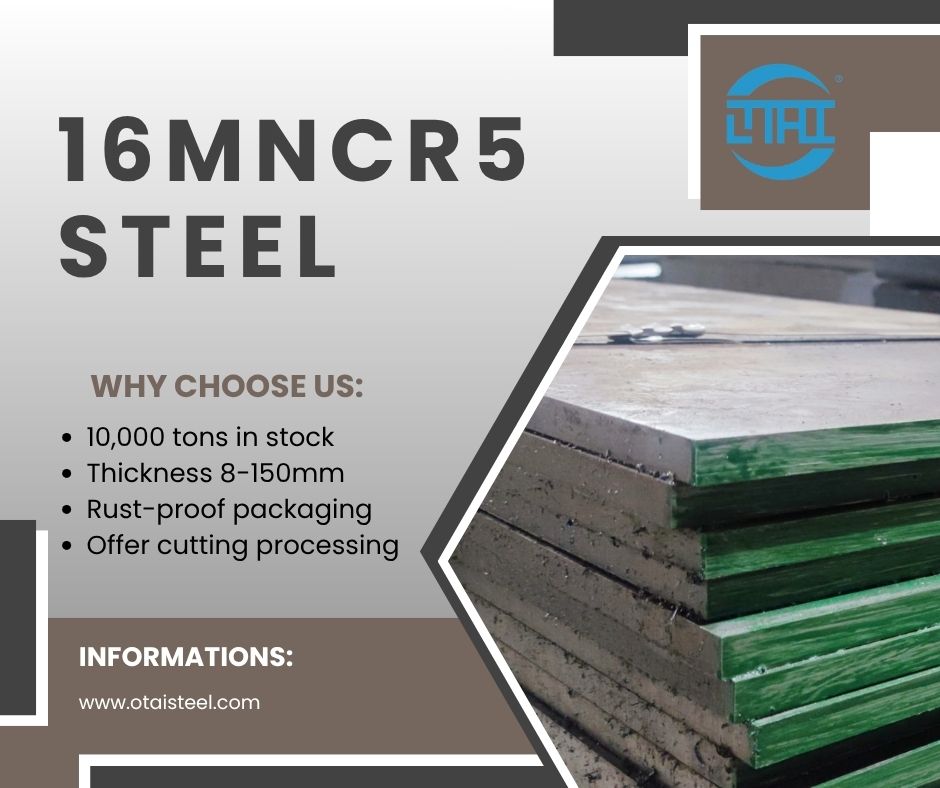
- 📏 16MnCr5 steel plate thickness range: 8–150mm in stock
- 📦 Large inventory available for fast delivery
- ✂️ Precision cutting, machining, and heat treatment services
- 🔬 Ultrasonic testing and third-party inspection support
- 📦 Anti-rust packaging, strap packaging, and wooden box packaging available
- 🌍 Extensive experience serving global industrial customers
❓ FAQ – 16MnCr5 Heat Treatment Process
1. What is the purpose of the 16MnCr5 heat treatment process?
The process improves hardness, wear resistance, fatigue strength, and overall durability while maintaining a tough core structure.
2. Does 16MnCr5 require carburizing?
Yes. Carburizing increases the carbon content at the surface and allows the steel to develop a hard wear-resistant case after quenching.
3. What hardness can 16MnCr5 achieve?
A properly heat-treated component typically reaches a surface hardness of approximately 58–62 HRC.
4. Why is tempering necessary after quenching?
Tempering reduces internal stress, improves toughness, and helps stabilize the microstructure for long-term performance.
5. Which industries commonly use heat-treated 16MnCr5?
Automotive, mining, agriculture, construction equipment, and industrial machinery industries widely use heat-treated 16MnCr5 components.
🏁 Conclusion
The 16MnCr5 heat treatment process combines carburizing, quenching, and tempering to create a unique combination of surface hardness and core toughness. This process significantly improves wear resistance, fatigue strength, and service life, making 16MnCr5 a preferred material for gears, shafts, and other critical transmission components.
By carefully controlling heat treatment parameters, manufacturers can optimize hardness, case depth, and microstructure to meet demanding application requirements. When combined with high-quality material supply and professional processing services, heat-treated 16MnCr5 delivers reliable performance across a wide range of industrial sectors.