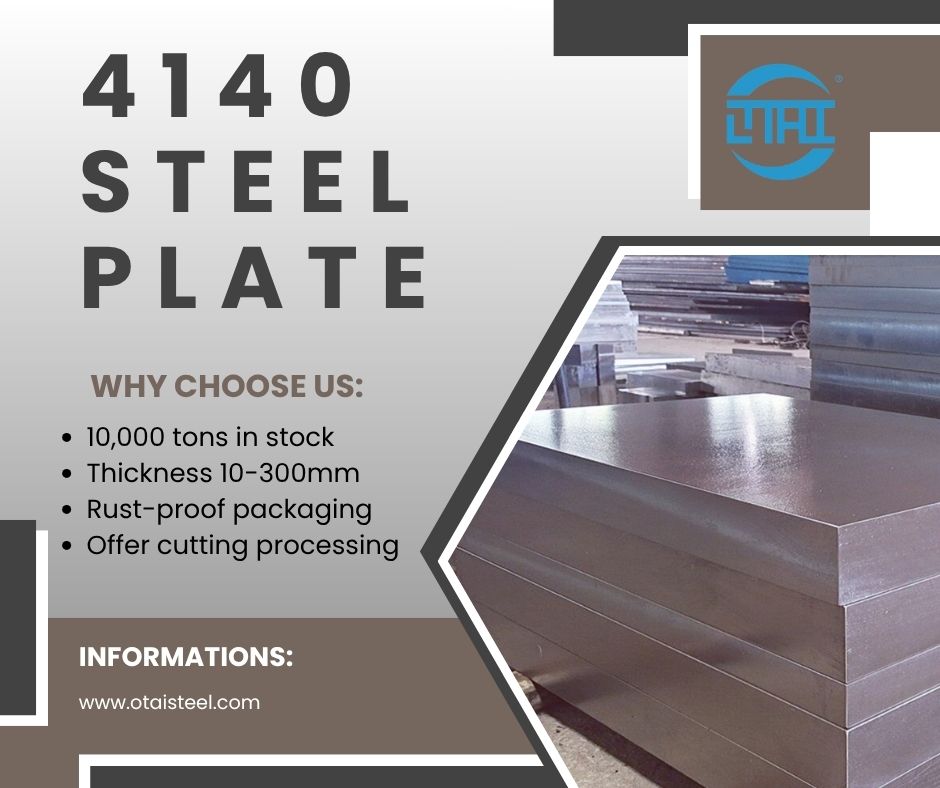
 Alloy Steel 4140 Properties – Strength and Engineering Performance
Understanding alloy steel 4140 properties is essential for engineers, manufacturers, and purchasing professionals who need a material that combines strength, toughness, wear resistance, and reliable heat treatment performance. Among all chromium-molybdenum alloy steels, AISI 4140 remains one of the most popular grades because it performs well in demanding industrial environments while maintaining reasonable manufacturing costs.
The popularity of alloy steel 4140 properties comes from its versatility. Engineers use this steel for gears, shafts, bolts, couplings, hydraulic cylinders, oilfield tools, and heavy machinery components. The material responds exceptionally well to heat treatment, allowing manufacturers to tailor hardness and strength levels according to specific application requirements.
Many buyers searching for alloy steel 4140 properties also want information about 4140 steel tensile strength, 4140 steel hardness, 4140 steel heat treatment, 4140 steel mechanical properties, 4140 steel fatigue strength, and 4140 steel machinability. These long-tail keywords reflect the key performance characteristics that make 4140 one of the most widely specified engineering steels worldwide.
Compared with standard carbon steels, 4140 provides higher hardenability, better fatigue resistance, and improved wear performance. These advantages help industrial users achieve longer service life, lower maintenance costs, and more reliable equipment operation.
🔵 What Is Alloy Steel 4140?
AISI 4140 belongs to the chromium-molybdenum alloy steel family. The steel contains moderate carbon content along with carefully controlled additions of chromium and molybdenum. These alloying elements significantly improve hardenability and mechanical performance compared with plain carbon steels.
Manufacturers often supply 4140 steel in annealed, normalized, pre-hardened, or quenched-and-tempered conditions. This flexibility allows engineers to select the material condition that best matches their production requirements.
Because of its balanced properties, 4140 serves industries ranging from automotive manufacturing to oil and gas exploration. The material performs particularly well in applications where components must withstand repeated loading, impact forces, and abrasive wear.
| Property Category | Performance Level |
|---|---|
| Strength | High |
| Toughness | High |
| Wear Resistance | Good |
| Machinability | Good |
| Heat Treatment Response | Excellent |
🟢 Chemical Composition Behind Alloy Steel 4140 Properties
The excellent alloy steel 4140 properties originate from its carefully balanced chemistry. Each alloying element contributes specific performance advantages that improve overall material behavior.
Carbon provides the foundation for strength and hardness. Chromium improves wear resistance and enhances hardenability. Molybdenum increases toughness while reducing the risk of brittleness during heat treatment. Manganese further improves hardenability and supports uniform microstructure development.
Together, these elements create a steel grade capable of achieving excellent performance across a wide range of engineering applications.
| Element | Typical Content (%) | Primary Function |
|---|---|---|
| Carbon (C) | 0.38–0.43 | Strength and hardness |
| Manganese (Mn) | 0.75–1.00 | Improves hardenability |
| Chromium (Cr) | 0.80–1.10 | Wear resistance |
| Molybdenum (Mo) | 0.15–0.25 | Toughness improvement |
| Silicon (Si) | 0.15–0.35 | Additional strength |
🟠 Mechanical Properties of 4140 Alloy Steel
When engineers discuss alloy steel 4140 properties, mechanical performance usually receives the most attention. The steel combines high tensile strength with excellent toughness and fatigue resistance. This combination allows components to survive demanding service conditions for extended periods.
Mechanical properties vary according to heat treatment condition, section size, and manufacturing process. However, typical values provide a useful baseline for engineering design.
| Mechanical Property | Typical Value |
|---|---|
| Tensile Strength | 850–1100 MPa |
| Yield Strength | 650–950 MPa |
| Elongation | 10–15% |
| Reduction of Area | 45–55% |
| Hardness (QT) | 28–32 HRC |
These values explain why manufacturers use 4140 for crankshafts, transmission shafts, heavy-duty bolts, gears, and industrial couplings. The material maintains structural integrity even under repeated stress cycles.
🟣 Physical Properties of 4140 Steel
Physical characteristics also play an important role when evaluating alloy steel 4140 properties. Engineers consider density, thermal conductivity, elastic modulus, and thermal expansion when designing precision components.
These properties influence dimensional stability, thermal behavior, and overall system performance. For applications involving temperature fluctuations, understanding physical properties becomes especially important.
| Physical Property | Typical Value |
|---|---|
| Density | 7.85 g/cm³ |
| Elastic Modulus | 205–210 GPa |
| Thermal Conductivity | 42–45 W/m·K |
| Thermal Expansion | 12.3 ×10⁻⁶ /°C |
| Specific Heat Capacity | 460 J/kg·K |
🔷 Heat Treatment and Its Influence on Alloy Steel 4140 Properties
One of the biggest advantages of alloy steel 4140 properties is the material’s excellent response to heat treatment. Engineers can significantly modify strength, hardness, toughness, and wear resistance through controlled thermal processing. This flexibility allows manufacturers to optimize the steel for different applications without changing the base material.
Annealing improves machinability and reduces internal stress. Normalizing refines the grain structure and creates more uniform mechanical properties. Quenching increases hardness and strength, while tempering restores toughness and reduces brittleness. By carefully selecting the tempering temperature, engineers can achieve the desired balance between hardness and ductility.
Because of this adaptability, many industries specify quenched and tempered 4140 steel for critical mechanical components. The material performs exceptionally well under cyclic loading and impact conditions after proper heat treatment.
| Heat Treatment Condition | Typical Hardness | Main Advantage |
|---|---|---|
| Annealed | Below 22 HRC | Excellent machinability |
| Normalized | 22–28 HRC | Uniform structure |
| Quenched | Above 50 HRC | Maximum hardness |
| Quenched & Tempered | 28–32 HRC | Balanced performance |
🔴 Advantages of Alloy Steel 4140
The popularity of alloy steel 4140 properties comes from a combination of performance and practicality. Unlike many specialty alloys, 4140 provides excellent mechanical characteristics while remaining widely available and cost-effective.
The steel offers strong fatigue resistance, making it suitable for components that experience repeated loading. It also maintains good toughness after heat treatment, reducing the likelihood of sudden failure under shock conditions. In addition, manufacturers appreciate its good machinability in the annealed condition, which helps reduce production costs.
Another major advantage is versatility. Engineers can use the same material for shafts, gears, couplings, bolts, spindles, and numerous other components simply by adjusting the heat treatment process.
- ✔ High tensile strength
- ✔ Excellent fatigue resistance
- ✔ Good wear resistance
- ✔ Strong hardenability
- ✔ Reliable toughness after tempering
- ✔ Broad industrial availability
⚙️ Common Industrial Applications
Manufacturers rely on alloy steel 4140 properties in a wide range of industries. Automotive companies use the material for crankshafts, axle shafts, steering components, and suspension systems. Oil and gas companies specify 4140 for drilling tools, connectors, and high-strength structural parts.
Heavy equipment manufacturers use 4140 steel for gears, couplings, hydraulic cylinders, and industrial shafts. Construction machinery also benefits from the material’s ability to resist impact and wear in harsh environments.
Because the steel combines strength with toughness, it performs well in both static and dynamic loading conditions. This reliability explains why engineers continue to choose 4140 for demanding applications around the world.
| Industry | Typical Components |
|---|---|
| Automotive | Crankshafts, axles, gears |
| Oil & Gas | Drilling tools, connectors |
| Construction | Pins, shafts, structural parts |
| Industrial Machinery | Couplings, cylinders, gears |
| Mining | Wear-resistant components |
📈 Alloy Steel 4140 vs 1045 Steel
Many engineers compare 4140 with 1045 steel because both materials appear frequently in mechanical engineering projects. However, alloy additions give 4140 significant performance advantages in demanding applications.
While 1045 offers good machinability and lower cost, 4140 delivers higher strength, better hardenability, and superior fatigue resistance. For heavily loaded components, these advantages often justify the higher material cost.
| Property | 4140 Steel | 1045 Steel |
|---|---|---|
| Strength | Higher | Moderate |
| Hardenability | Excellent | Limited |
| Wear Resistance | Better | Good |
| Fatigue Resistance | Higher | Moderate |
| Heat Treatment Response | Outstanding | Basic |
🛠️ Machinability and Fabrication Characteristics
Another reason engineers value alloy steel 4140 properties is the material’s favorable manufacturing characteristics. In the annealed condition, 4140 machines efficiently using standard tooling and machining practices. Manufacturers often perform rough machining before heat treatment and finish machining afterward when tighter tolerances are required.
The steel also responds well to forging and can achieve excellent dimensional stability after proper heat treatment. Welding requires additional precautions because the alloy content increases hardenability. Preheating and post-weld stress relief often help maintain structural integrity.
| Manufacturing Property | Performance |
|---|---|
| Machinability | Good |
| Forgeability | Good |
| Weldability | Moderate |
| Heat Treatability | Excellent |
| Dimensional Stability | Good |
🏭 Company Advantages – Otai Special Steel
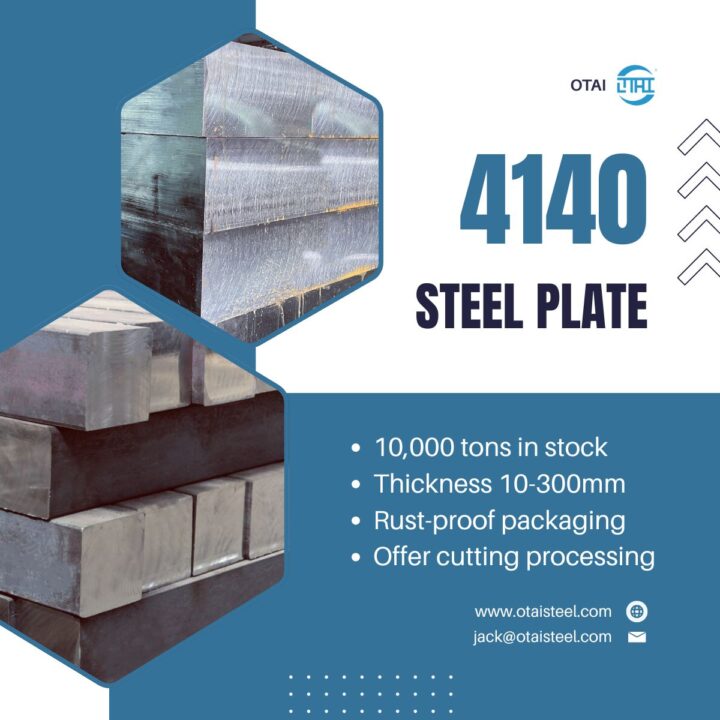
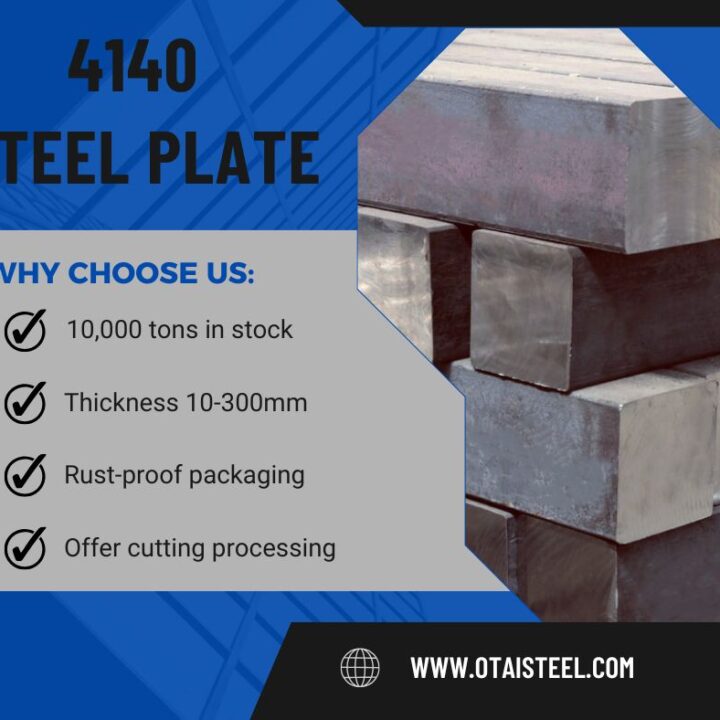
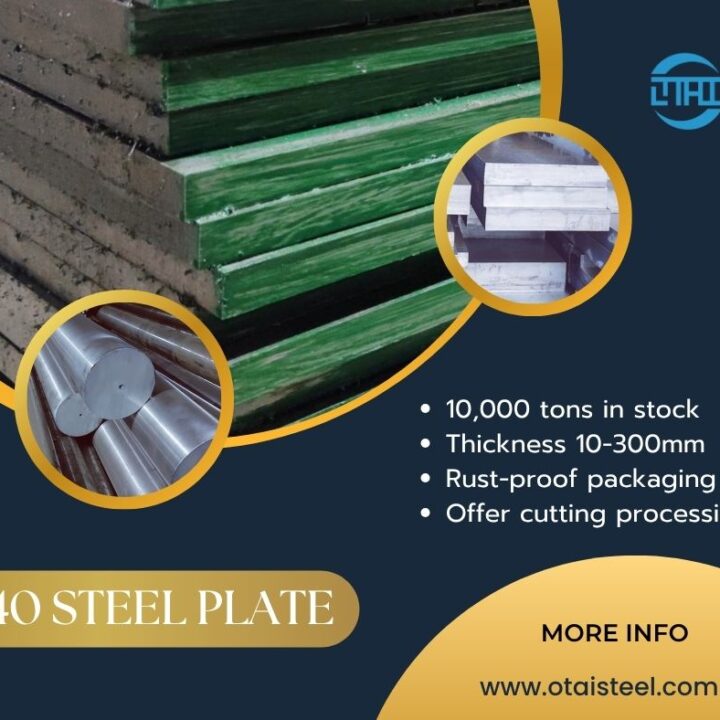
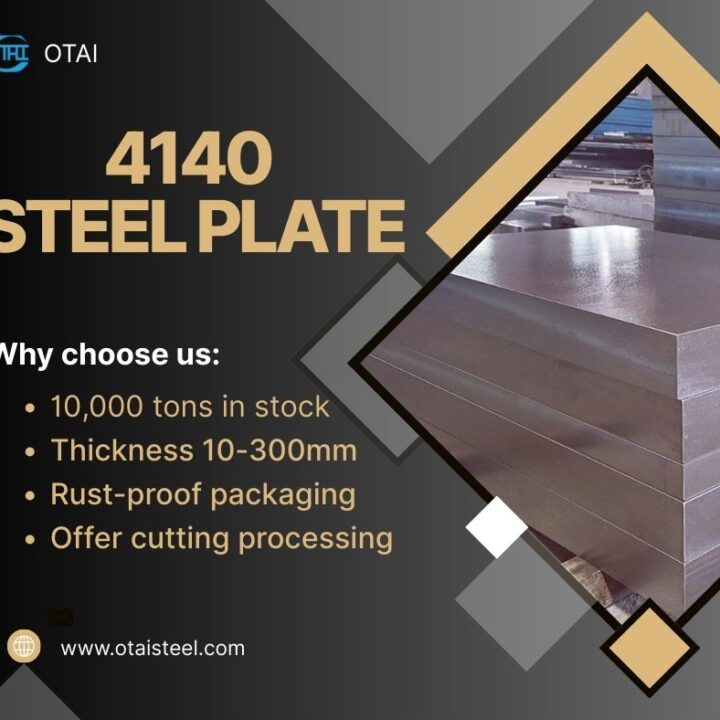
- 📦 More than 10,000 tons of 4140 steel inventory in various dimensions
- 📏 Wide range of 4140 steel plates available from stock
- ✂️ Precision cutting, machining, and heat treatment services
- 🔬 Ultrasonic testing and third-party inspection support
- 🌍 Extensive export experience serving industrial customers worldwide
❓ FAQ – Alloy Steel 4140 Properties
1. What are the most important alloy steel 4140 properties?
The most important properties include high tensile strength, excellent toughness, strong hardenability, and good fatigue resistance.
2. What is the typical hardness of 4140 steel?
In the quenched and tempered condition, hardness typically ranges from 28 to 32 HRC, although different heat treatments can produce higher or lower values.
3. Is 4140 steel stronger than 1045 steel?
Yes. 4140 generally provides higher strength, better hardenability, and improved fatigue resistance than 1045 steel.
4. Can 4140 steel be welded?
Yes. However, preheating and post-weld heat treatment often improve weld quality and reduce cracking risk.
5. What industries commonly use 4140 steel?
Automotive, oil and gas, mining, construction equipment, and industrial machinery manufacturers frequently use 4140 steel.
🏁 Conclusion
The outstanding alloy steel 4140 properties make this material one of the most versatile engineering steels available today. Its combination of strength, toughness, wear resistance, fatigue performance, and heat treatment flexibility allows engineers to meet demanding application requirements across numerous industries.
Whether the application involves gears, shafts, hydraulic systems, drilling equipment, or structural components, 4140 steel continues to deliver reliable performance and long service life. By understanding its composition, mechanical behavior, heat treatment response, and fabrication characteristics, engineers can maximize the benefits of this highly respected alloy steel grade.