 Material 16MnCr5 Equivalent – International Steel Grade Comparison and Substitution Guide
Understanding the material 16MnCr5 equivalent is essential for engineers, buyers, and manufacturers who work with carburizing steels across different international standards. Because 16MnCr5 is a European EN steel grade, many global projects require equivalent grades from ASTM, AISI, JIS, or DIN systems. Without proper equivalency knowledge, procurement teams may select incorrect substitutes, leading to performance issues, heat treatment failures, or unexpected mechanical behavior.
The search for material 16MnCr5 equivalent is especially common in automotive, gearbox manufacturing, heavy machinery, and industrial transmission systems. These industries rely on carburizing steels with controlled core toughness and hardened surface layers. Therefore, selecting the correct equivalent material is not only a technical requirement but also a safety and performance-critical decision.
Engineers often compare terms such as 16MnCr5 equivalent steel grade, 16MnCr5 cross reference, DIN 16MnCr5 equivalent, EN 16MnCr5 substitution steel, and what is 16MnCr5 equivalent in ASTM. These queries reflect the global need for standardized material substitution across different supply chains.
🔵 What Is 16MnCr5 and Why Equivalent Grades Matter
16MnCr5 is a low carbon alloy steel designed for carburizing applications under EN 10084 standard. It provides excellent case hardening capability while maintaining a tough core structure. This combination allows components such as gears, shafts, and pinions to resist wear while absorbing mechanical shocks during operation.
However, global manufacturing systems do not always use the same standard. For example, North American industries follow ASTM or AISI systems, while Japan uses JIS standards. Because of this difference, engineers must identify a material 16MnCr5 equivalent when sourcing from international suppliers.
A correct equivalent ensures similar chemical composition, comparable hardenability, and equivalent mechanical performance after heat treatment. Without proper matching, the final component may fail prematurely due to insufficient surface hardness or low core toughness.
| Standard | Equivalent Grade | Notes |
|---|---|---|
| EN (Europe) | 16MnCr5 | Base reference grade |
| DIN (Germany) | 1.7131 | Direct designation equivalent |
| ASTM (USA) | 5115 / 5120 (approx.) | Similar carburizing behavior |
| AISI (USA) | 5115 / 8620 (partial match) | Depends on application condition |
| JIS (Japan) | SCr420 | Common carburizing substitute |
🟢 Chemical Composition of 16MnCr5 Equivalent Materials
To understand the material 16MnCr5 equivalent, engineers must first compare chemical composition ranges. Although different standards use different naming systems, equivalent steels share similar carbon content and alloying elements such as manganese and chromium.
These elements directly influence hardenability, wear resistance, and carburizing response. Even small variations in composition can significantly affect heat treatment results, especially in precision mechanical components.
| Element | 16MnCr5 Range (%) | Function |
|---|---|---|
| Carbon (C) | 0.14–0.19 | Supports carburized surface hardness |
| Manganese (Mn) | 1.00–1.30 | Improves strength and hardenability |
| Chromium (Cr) | 0.80–1.10 | Enhances wear resistance |
| Silicon (Si) | ≤0.40 | Strengthens matrix structure |
🟠 Mechanical Behavior of Equivalent Grades
When evaluating a material 16MnCr5 equivalent, mechanical properties must be analyzed after heat treatment. Carburized components typically exhibit a hard outer layer and a ductile inner core, allowing them to withstand both abrasion and impact loads.
Equivalent grades may show slight differences in tensile strength or hardness response, but proper heat treatment can align their performance within acceptable engineering ranges. This is why heat treatment control is as important as material selection.
| Property | Typical Range |
|---|---|
| Core Hardness | 20–30 HRC |
| Surface Hardness | 58–62 HRC |
| Tensile Strength | 800–1200 MPa |
| Yield Strength | 600–900 MPa |
| Elongation | 10–15% |
🟣 Why Industries Use 16MnCr5 Equivalent Grades
Global supply chains often require flexibility in material sourcing. When 16MnCr5 is not available, engineers select a material 16MnCr5 equivalent to maintain production continuity. This practice is common in automotive manufacturing, gearbox production, and heavy equipment industries.
Equivalent materials allow manufacturers to avoid delays caused by limited availability or regional standard differences. However, engineers must carefully evaluate heat treatment response to ensure that final mechanical properties meet design expectations.
In many cases, suppliers also recommend specific equivalents based on application type, such as high-load gears or high-speed rotating components. This technical support reduces risk and improves performance reliability.
🔷 16MnCr5 Equivalent vs Direct 16MnCr5 Material
| Aspect | Direct 16MnCr5 | Equivalent Grade |
|---|---|---|
| Standardization | EN 10084 | Multiple standards |
| Consistency | Very stable | Varies by grade |
| Availability | Regional dependent | More flexible |
| Cost | Moderate | Variable |
| Heat treatment response | Optimized | Requires adjustment |
Choosing between direct 16MnCr5 and its equivalent depends on project requirements, cost constraints, and supply availability. In critical applications, engineers often prefer the original grade for maximum reliability.
🏭 Company Advantages – Otai Special Steel
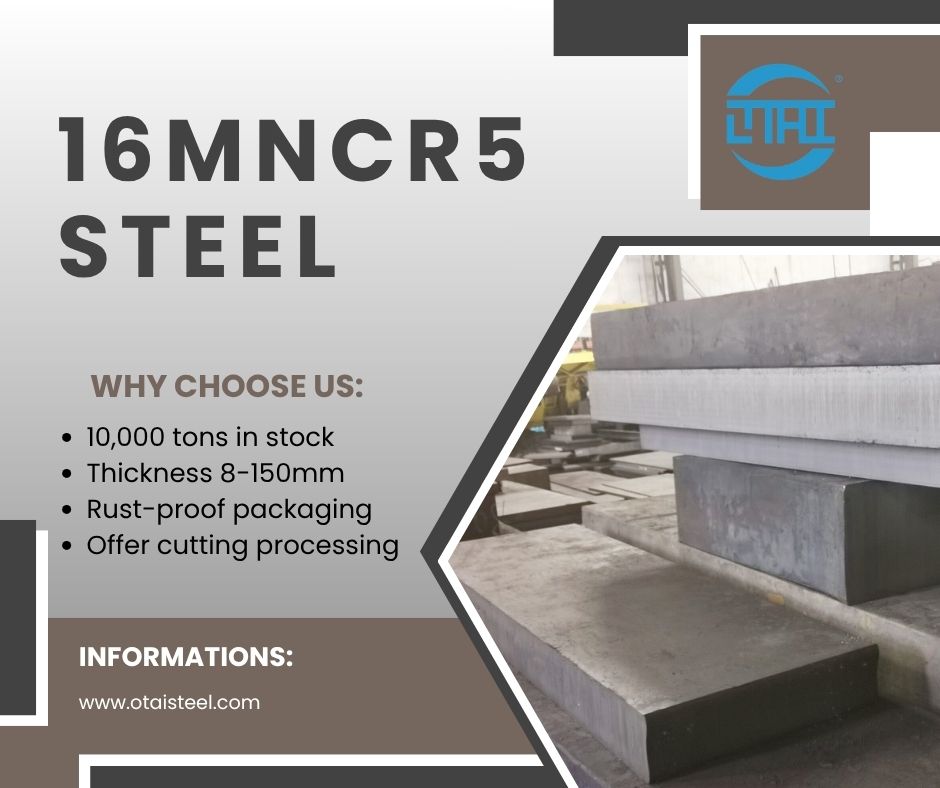
- 📏 16MnCr5 steel plate thickness range: 8–150mm in stock
- 📦 Large inventory for fast global delivery
- ✂️ Cutting, machining, and heat treatment services
- 🔬 Ultrasonic testing and third-party inspection available
- 🌍 Export experience to global industrial markets
❓ FAQ – Material 16MnCr5 Equivalent
1. What is the best material equivalent to 16MnCr5?
Common equivalents include 16MnCr5 DIN 1.7131, JIS SCr420, and ASTM 5115 depending on application requirements.
2. Is 16MnCr5 equivalent to 8620 steel?
They are similar in carburizing behavior, but not identical in composition and should be evaluated case by case.
3. Why are equivalent grades used?
Equivalent grades are used to ensure material availability across different international standards.
4. Can equivalent steel replace 16MnCr5 directly?
In many cases yes, but heat treatment parameters may need adjustment.
5. Which industries use 16MnCr5 equivalent steel?
Automotive, gearbox manufacturing, mining equipment, and mechanical engineering industries.
🏁 Conclusion
Understanding the material 16MnCr5 equivalent is essential for global procurement and engineering design. While several international grades can serve as substitutes, careful evaluation of chemical composition and heat treatment response is necessary to ensure reliable performance.
By selecting the correct equivalent material and working with a professional supplier, manufacturers can maintain production stability while meeting technical performance requirements in demanding industrial applications.