 How to Tell If Steel Is 4140 – Identification Methods, Testing & Material Verification
Determining whether a piece of steel is actually 4140 alloy steel can be challenging, especially when material markings are missing or documentation is unavailable. Many manufacturers, machine shops, and purchasing teams encounter situations where they need to identify unknown steel before machining, welding, or heat treating it.
Understanding how to tell if steel is 4140 helps prevent costly production mistakes. Using the wrong steel grade can lead to machining problems, unexpected heat treatment results, premature component failure, and customer complaints.
Because 4140 steel contains chromium and molybdenum, it offers higher strength and hardenability than common carbon steels such as 1045. However, visual inspection alone cannot accurately identify 4140. Engineers typically combine several testing methods to verify the material.
Common search terms include how to identify 4140 steel, 4140 steel testing methods, how to verify 4140 material, 4140 alloy steel identification, and how to distinguish 4140 from 1045 steel.
🔵 What Is 4140 Steel?
Before discussing identification methods, it is important to understand what makes 4140 steel unique. AISI 4140 is a chromium-molybdenum alloy steel containing approximately 0.40% carbon, along with chromium and molybdenum additions that improve strength, wear resistance, and heat treatment response.
Manufacturers widely use 4140 steel for shafts, gears, hydraulic cylinders, bolts, molds, and heavy-duty machinery components. After quenching and tempering, it achieves excellent mechanical properties while maintaining good toughness.
| Element | Typical Content (%) |
|---|---|
| Carbon (C) | 0.38–0.43 |
| Chromium (Cr) | 0.80–1.10 |
| Molybdenum (Mo) | 0.15–0.25 |
| Manganese (Mn) | 0.75–1.00 |
| Silicon (Si) | 0.15–0.35 |
These alloying elements create characteristics that help distinguish 4140 from many other engineering steels.
🟢 Check Material Certification First
The easiest way to determine whether steel is 4140 is to review the Mill Test Certificate (MTC). Reputable steel suppliers provide documentation showing chemical composition, heat number, mechanical properties, and production standards.
If the material still carries identification markings, compare the heat number on the steel with the heat number listed on the certificate. This method provides the fastest and most reliable verification when documentation remains available.
Unfortunately, many machine shops receive cut pieces or leftover stock without traceable paperwork. In these cases, physical testing becomes necessary.
🟠 Can You Identify 4140 Steel by Appearance?
Many people ask whether they can recognize 4140 steel simply by looking at it. The short answer is no.
4140 steel looks very similar to other alloy steels and carbon steels. Surface color, finish, and scale depend more on manufacturing processes and storage conditions than chemical composition.
Visual inspection may provide clues about whether the material has been heat treated, forged, or machined, but it cannot positively confirm that the steel is 4140.
For this reason, experienced metallurgists rarely rely on appearance when trying to determine how to tell if steel is 4140.
🟣 Spark Testing for Preliminary Identification
Spark testing is one of the oldest methods used to identify steel grades. When a grinding wheel contacts steel, the resulting sparks reveal information about carbon content and alloy composition.
4140 steel typically produces a moderate volume of bright sparks with noticeable branching patterns. Compared with low-carbon steels, the spark stream appears more active and complex.
| Steel Grade | Typical Spark Pattern |
|---|---|
| 1018 Steel | Long, straight sparks with limited branching |
| 1045 Steel | Brighter sparks with moderate branching |
| 4140 Steel | Dense spark stream with branching bursts |
| 4340 Steel | Similar to 4140 but often slightly denser |
Although spark testing provides useful clues, it cannot definitively identify 4140 steel. Different heat treatment conditions can alter spark characteristics, and several alloy steels produce similar patterns.
🔷 Hardness Testing as an Indicator
Hardness testing can provide additional evidence when identifying unknown steel. Annealed 4140 steel usually exhibits hardness around 197–241 HB, while quenched and tempered grades often exceed 28–32 HRC.
If an unknown component shows significantly higher hardness than standard carbon steel, it may indicate the presence of alloy steel such as 4140.
However, hardness alone does not confirm material grade because many alloy steels can achieve similar hardness levels after heat treatment.
⚙️ Positive Material Identification (PMI)
When accuracy matters, Positive Material Identification (PMI) provides one of the most reliable answers to the question of how to tell if steel is 4140. PMI instruments use X-ray fluorescence (XRF) technology to analyze alloying elements directly on the material surface.
A handheld PMI analyzer can quickly detect chromium, molybdenum, manganese, and other alloying elements. Since 4140 steel contains both chromium and molybdenum, PMI testing can often distinguish it from plain carbon steels within seconds.
Many manufacturing facilities, oil and gas companies, and quality inspection organizations use PMI testing because it delivers fast results without damaging the material.
However, standard XRF equipment cannot accurately measure carbon content. As a result, PMI testing works best when combined with other verification methods.
🔴 Optical Emission Spectroscopy (OES)
Optical Emission Spectroscopy represents one of the most accurate methods available for material verification. Unlike PMI equipment, OES can measure carbon content along with other alloying elements.
During testing, a controlled spark excites atoms on the steel surface. The instrument analyzes the emitted light spectrum and calculates the chemical composition.
Because 4140 steel follows strict composition requirements, OES testing can confirm whether the material falls within the required specification range.
| Testing Method | Accuracy | Carbon Detection | Best Use |
|---|---|---|---|
| Visual Inspection | Low | No | Initial evaluation |
| Spark Testing | Moderate | Indirect | Quick shop-floor screening |
| Hardness Testing | Moderate | No | Heat treatment evaluation |
| PMI (XRF) | High | Limited | Alloy identification |
| OES Analysis | Very High | Yes | Full composition verification |
When customers require complete traceability, OES testing often becomes the preferred verification method.
🔹 Chemical Composition Verification
The most reliable way to identify 4140 steel involves comparing the measured chemical composition with the standard specification.
If laboratory analysis shows approximately 0.40% carbon, 0.80–1.10% chromium, and 0.15–0.25% molybdenum, the material likely meets 4140 requirements.
Engineers often compare unknown samples against specification limits before approving materials for production. This approach reduces risk and helps ensure that finished components meet customer expectations.
| Element | 4140 Specification (%) | Identification Importance |
|---|---|---|
| Carbon | 0.38–0.43 | Very High |
| Chromium | 0.80–1.10 | Very High |
| Molybdenum | 0.15–0.25 | Very High |
| Manganese | 0.75–1.00 | High |
| Silicon | 0.15–0.35 | Medium |
A complete chemical analysis removes guesswork and provides confidence that the material truly matches the required grade.
🔬 Metallographic Examination
Metallographic analysis can provide additional information about unknown steel. Technicians prepare polished samples and examine the microstructure under a microscope.
Although microstructure alone cannot positively identify 4140 steel, it often reveals valuable information about heat treatment history and manufacturing condition.
For example, tempered martensite may indicate that the material underwent quenching and tempering. Ferrite-pearlite structures often indicate annealed conditions. Combined with hardness testing and chemical analysis, metallography helps build a complete understanding of the material.
🛠️ How to Distinguish 4140 from 1045 Steel
Many shops confuse 4140 and 1045 because both grades appear similar. However, several important differences help separate them.
| Property | 4140 Steel | 1045 Steel |
|---|---|---|
| Carbon Content | 0.38–0.43% | 0.43–0.50% |
| Chromium | Present | Not Added |
| Molybdenum | Present | Not Added |
| Hardenability | Excellent | Moderate |
| Strength Potential | Higher | Lower |
The presence of chromium and molybdenum provides one of the clearest indicators that a material is 4140 rather than 1045.
📈 Best Practice for Material Verification
When material identification is critical, engineers should avoid relying on a single test method. A combination of documentation review, PMI testing, hardness measurement, and chemical analysis delivers the highest confidence level.
For critical aerospace, energy, mining, and heavy machinery applications, many companies require laboratory verification before approving material for production.
This approach minimizes risk, improves quality control, and helps prevent expensive manufacturing errors.
🏭 Company Advantages – Otai Special Steel
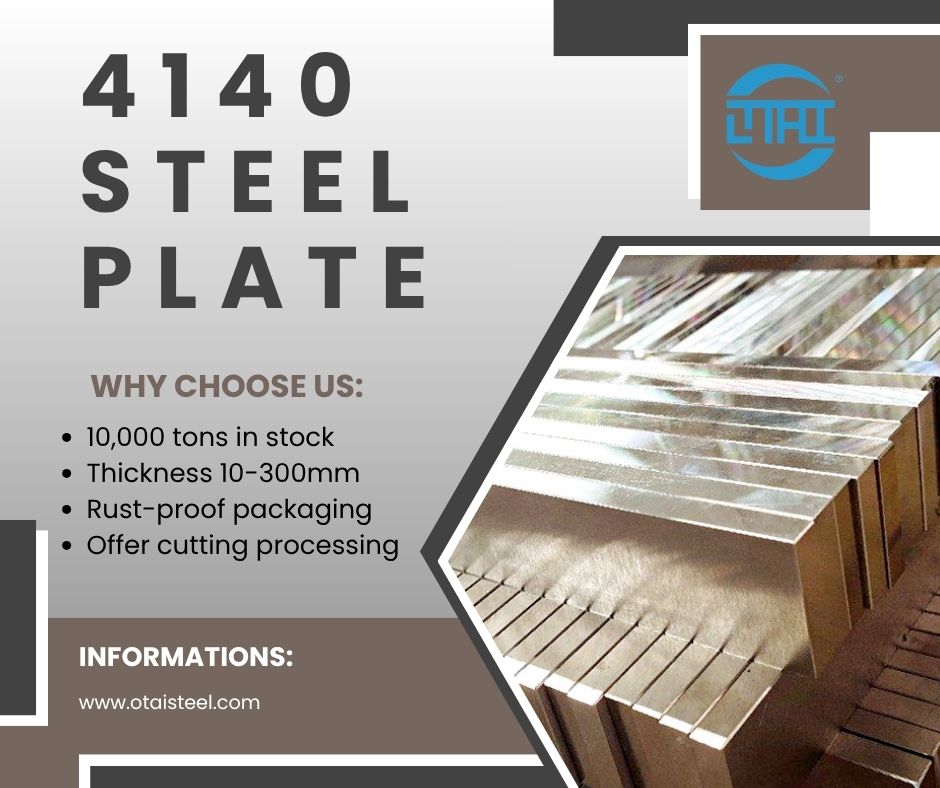
- 📦 Over 10,000 tons of 4140 steel inventory in various sizes
- 📏 Wide range of plate thicknesses and dimensions available
- ✂️ Cutting, machining, and heat treatment services
- 🔬 Ultrasonic testing (UT) and third-party inspection support
- 🌍 Rich export experience serving global industrial customers
- 🏆 Proven supply capability for demanding engineering projects
Otai Special Steel supplies high-quality 4140 steel plates, blocks, and custom-cut materials for customers worldwide. Our extensive inventory and technical support help manufacturers reduce lead times and maintain production efficiency.
❓ FAQ – How to Tell If Steel Is 4140
Q1: Can I identify 4140 steel by appearance alone?
No. Visual inspection cannot reliably distinguish 4140 steel from other alloy or carbon steels.
Q2: Is spark testing accurate enough to confirm 4140 steel?
Spark testing provides useful clues, but it cannot definitively identify 4140. Use it only as a preliminary screening method.
Q3: What is the most accurate method for identifying 4140 steel?
Optical Emission Spectroscopy (OES) provides the most accurate chemical composition analysis and material verification.
Q4: Can PMI testing verify 4140 steel?
PMI testing can identify chromium and molybdenum, making it very useful for alloy verification, although it does not accurately measure carbon.
Q5: How can I distinguish 4140 from 1045 steel?
The easiest way is through chemical analysis. 4140 contains chromium and molybdenum, while 1045 does not.
🏁 Conclusion
Understanding how to tell if steel is 4140 requires more than visual inspection. While spark testing and hardness testing can provide useful clues, the most reliable identification methods include PMI testing, optical emission spectroscopy, and chemical composition analysis.
By combining multiple verification techniques, manufacturers can accurately identify unknown materials, avoid costly mistakes, and ensure that components meet performance requirements. For critical applications, full chemical analysis remains the gold standard for confirming 4140 steel.