 16MnCr5 Steel Density – Weight Calculation & Engineering Applications
The 16MnCr5 steel density is one of the most important physical properties engineers use when designing gears, shafts, pinions, and carburized mechanical components. While many buyers focus on hardness, tensile strength, and heat treatment performance, density plays an equally important role in weight calculation, material estimation, transportation planning, and manufacturing cost control.
As a popular case hardening steel specified under EN 10084, 16MnCr5 offers excellent wear resistance, high fatigue strength, and outstanding carburizing performance. Manufacturers widely use this steel grade in automotive transmission systems, industrial gearboxes, agricultural machinery, and heavy engineering equipment. Understanding the 16MnCr5 steel density helps engineers calculate component weight accurately and optimize product design before production begins.
Many professionals search online for terms such as 16MnCr5 density kg/m3, 16MnCr5 steel weight calculation, density of 16MnCr5 steel, 16MnCr5 material density, and 16MnCr5 steel plate weight. These searches demonstrate how frequently density data influences engineering and purchasing decisions.
🔵 What Is the Density of 16MnCr5 Steel?
The standard 16MnCr5 steel density is approximately 7.85 g/cm³. This value equals approximately 7850 kg/m³ in metric units and about 0.284 lb/in³ in imperial units.
The density remains similar to most carbon and alloy steels because iron constitutes the majority of the material composition. Although manganese and chromium improve hardenability and wear resistance, they represent only a small percentage of the alloy and therefore do not significantly alter the overall density value.
Engineers use this density value when estimating the weight of steel plates, bars, forgings, and finished components. Accurate calculations help reduce material waste, improve procurement efficiency, and support cost control throughout the manufacturing process.
🟢 16MnCr5 Steel Density Conversion Table
| Unit | Density Value |
|---|---|
| g/cm³ | 7.85 |
| kg/m³ | 7850 |
| kg/mm³ | 7.85 × 10⁻⁶ |
| lb/in³ | 0.284 |
| lb/ft³ | 490 |
These conversion values help engineers and purchasing teams communicate across international markets. European manufacturers typically use metric measurements, while North American companies often rely on imperial units.
🟠 Why Does 16MnCr5 Steel Density Matter?
The 16MnCr5 steel density affects much more than simple weight calculations. Engineers use density data during product design, finite element analysis, transportation planning, and inventory management.
For example, automotive transmission designers calculate gear weight to optimize rotational efficiency. Heavy gears increase inertia, requiring more energy during acceleration and deceleration. By understanding material density, engineers can predict system behavior more accurately.
Manufacturers also depend on density calculations when estimating raw material requirements. Accurate weight predictions reduce purchasing errors and help companies maintain efficient production schedules.
In large industrial projects, logistics teams use density values to estimate transportation costs, determine crane capacity requirements, and plan warehouse storage arrangements. Even a small calculation error can create significant cost differences when handling large steel components.
🟣 How to Calculate the Weight of 16MnCr5 Steel
Weight calculations follow a simple engineering formula:
Weight = Volume × Density
Because the standard 16MnCr5 steel density equals 7850 kg/m³, engineers can quickly estimate the weight of any steel plate, round bar, or forging once they determine the volume.
For example, consider a 16MnCr5 steel plate measuring 1000 mm × 1000 mm × 50 mm.
Volume = 1.0 × 1.0 × 0.05 = 0.05 m³
Weight = 0.05 × 7850 = 392.5 kg
Therefore, the estimated plate weight is approximately 392.5 kg.
🔷 Estimated Weight of Common 16MnCr5 Steel Plates
| Plate Size (mm) | Volume (m³) | Weight (kg) |
|---|---|---|
| 1000 × 1000 × 20 | 0.020 | 157 |
| 1000 × 1000 × 50 | 0.050 | 392.5 |
| 1500 × 1000 × 50 | 0.075 | 588.8 |
| 2000 × 1000 × 80 | 0.160 | 1256 |
| 2500 × 1500 × 100 | 0.375 | 2943.8 |
These figures provide a practical reference for procurement teams, warehouse managers, and production planners. Instead of performing calculations repeatedly, engineers can quickly estimate material weight and transportation requirements using standard density values.
⚙️ Chemical Composition of 16MnCr5 Steel
Although engineers often focus on the 16MnCr5 steel density, the material’s excellent performance actually comes from its carefully balanced chemical composition. The combination of carbon, manganese, and chromium allows the steel to achieve outstanding case hardening characteristics while maintaining a tough core structure.
| Element | Typical Content (%) | Main Function |
|---|---|---|
| Carbon (C) | 0.14 – 0.19 | Improves surface hardness after carburizing |
| Manganese (Mn) | 1.00 – 1.30 | Enhances hardenability and strength |
| Chromium (Cr) | 0.80 – 1.10 | Improves wear resistance and fatigue strength |
| Silicon (Si) | ≤ 0.40 | Increases strength and stability |
| Phosphorus (P) | ≤ 0.025 | Controlled impurity |
| Sulfur (S) | ≤ 0.035 | Supports machinability |
Despite the presence of alloying elements, iron still makes up the majority of the material. As a result, the 16MnCr5 steel density remains close to the standard density value found in most engineering steels.
🔴 16MnCr5 Steel Density vs Other Engineering Steels
Many buyers compare 16MnCr5 with other popular alloy steels before selecting a material for gears and transmission components. While density values remain similar, mechanical performance can vary significantly.
| Steel Grade | Density (g/cm³) | Main Advantage |
|---|---|---|
| 16MnCr5 | 7.85 | Excellent carburizing performance |
| 20MnCr5 | 7.85 | Higher core strength |
| 8620 Steel | 7.85 | Popular case hardening steel in North America |
| 4140 Steel | 7.85 | High strength structural applications |
| 1045 Steel | 7.85 | Cost-effective general engineering steel |
The table clearly shows that density alone rarely determines material selection. Engineers usually focus on wear resistance, fatigue strength, toughness, and heat treatment performance when comparing steel grades.
🔹 Applications That Depend on Accurate Density Calculations
Accurate density data supports a wide range of engineering applications. Automotive manufacturers use density values when calculating gear mass and transmission efficiency. Industrial machinery producers calculate shaft weight to improve balance and rotational stability.
Manufacturers of agricultural equipment frequently use 16MnCr5 for gears, sprockets, and drive components because of its excellent wear resistance after carburizing. Density calculations help determine material consumption before production begins.
The aerospace sector also uses density information during component design and stress analysis. Although 16MnCr5 is not a primary aerospace alloy, many supporting mechanical systems still require accurate mass calculations.
Large industrial gearboxes provide another good example. Designers often calculate the total rotating mass of shafts and gears before selecting motors and bearings. Accurate density values improve calculation accuracy and help prevent costly design errors.
🛠️ Benefits of Using 16MnCr5 Steel
The popularity of 16MnCr5 extends far beyond its density value. Manufacturers around the world rely on this steel grade because it delivers an excellent combination of machinability, hardenability, wear resistance, and fatigue strength.
After carburizing, the surface can achieve very high hardness levels while the core remains tough and resistant to impact loading. This combination makes the material particularly suitable for power transmission components.
Key benefits include:
- ✅ Excellent carburizing response
- ✅ High surface hardness after heat treatment
- ✅ Good core toughness
- ✅ Strong fatigue resistance
- ✅ Reliable dimensional stability
- ✅ Excellent performance in gears and shafts
These advantages explain why industries continue to specify 16MnCr5 for critical mechanical applications throughout automotive, industrial machinery, mining, and agricultural sectors.
📈 How Density Influences Material Costs
The 16MnCr5 steel density directly affects material cost calculations because steel suppliers typically quote products by weight. Purchasing managers use density values to estimate the total tonnage required before requesting quotations.
For example, a project requiring several large carburized gears may consume thousands of kilograms of steel. Accurate density calculations help buyers avoid ordering excess material and reduce inventory carrying costs.
Transportation expenses also depend heavily on weight. When exporting steel plates internationally, accurate density data helps logistics teams estimate freight charges and container loading requirements more effectively.
🏭 Company Advantages – Otai Special Steel
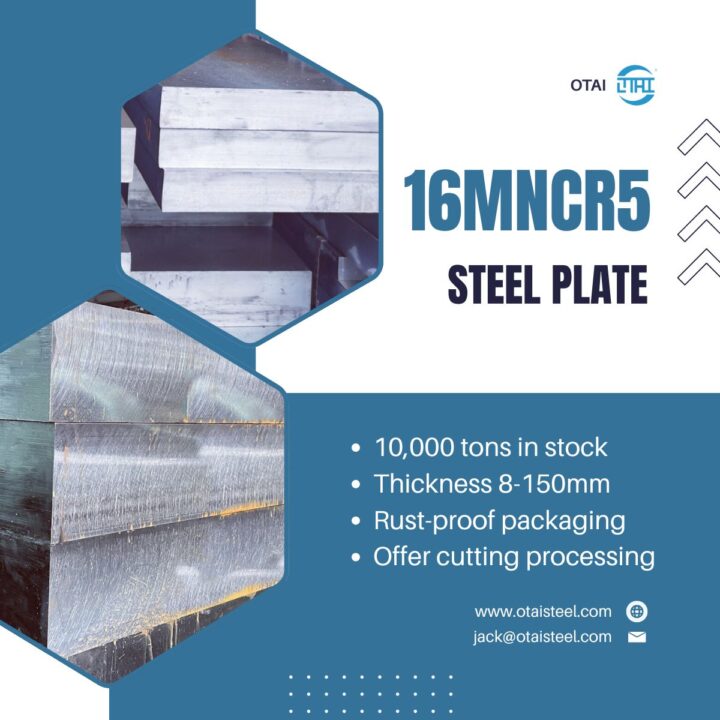
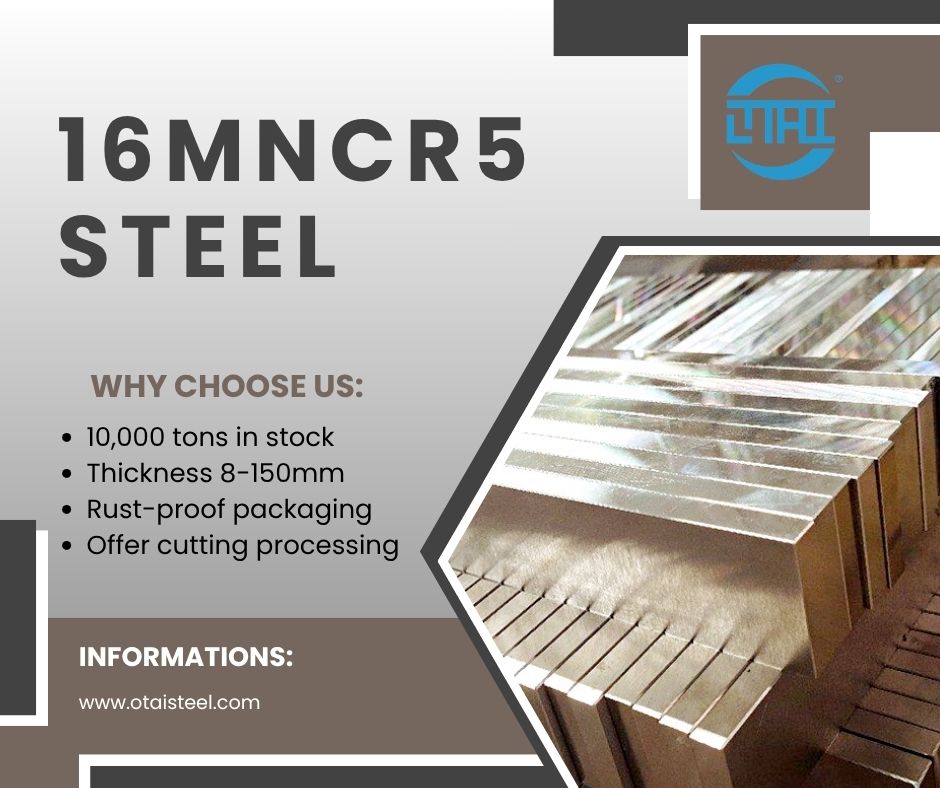
- 📏 16MnCr5 steel plate thickness range: 8–150mm in stock
- 📦 Large inventory available for immediate shipment
- ✂️ Precision cutting, machining, and heat treatment services
- 🔬 Ultrasonic testing (UT) and third-party inspection support
- 🌍 Rich export experience serving global industrial customers
- 🏆 Proven supply experience with demanding engineering projects
Otai Special Steel supplies high-quality 16MnCr5 steel plates and alloy steel products to customers worldwide. Our team supports customized dimensions, processing services, and technical assistance to help customers reduce lead times and improve production efficiency.
❓ FAQ – 16MnCr5 Steel Density
Q1: What is the standard density of 16MnCr5 steel?
The standard density of 16MnCr5 steel is approximately 7.85 g/cm³ or 7850 kg/m³.
Q2: Does carburizing affect the density of 16MnCr5 steel?
Carburizing may cause extremely small changes, but engineers continue using 7.85 g/cm³ for practical calculations.
Q3: How can I calculate the weight of a 16MnCr5 steel plate?
Multiply the plate volume by the standard density value of 7850 kg/m³.
Q4: Is 16MnCr5 denser than 20MnCr5?
No. Both grades have nearly identical density values because their chemical compositions are very similar.
Q5: Why is density important when buying steel?
Density helps determine weight, transportation costs, material consumption, inventory requirements, and overall project budgeting.
🏁 Conclusion
Understanding the 16MnCr5 steel density is essential for engineers, buyers, and manufacturers who work with carburizing steels. The standard density value of 7.85 g/cm³ supports accurate weight calculations, logistics planning, inventory management, and engineering design.
Although many steel grades share similar density values, 16MnCr5 stands out because of its excellent carburizing characteristics, wear resistance, fatigue performance, and dimensional stability. These advantages make it one of the most widely used case hardening steels in the world.
Whether you need to calculate the weight of a steel plate, compare alloy steels, or source material for transmission components, understanding the density of 16MnCr5 provides a solid foundation for better engineering and purchasing decisions.