 16MnCr5 Steel Alternative – Equivalent Grades and Material Selection Guide
Engineers and procurement teams often search for a reliable 16MnCr5 steel alternative when the original grade is unavailable, cost is too high, or regional standards require substitution. This carburizing steel belongs to the EN 10084 standard family, and its performance depends heavily on heat treatment response, core toughness, and surface hardness after carburizing. Because of this, selecting a correct 16MnCr5 steel alternative requires understanding both chemical equivalence and mechanical behavior under service conditions.
Manufacturers typically choose a 16MnCr5 steel alternative when they need similar wear resistance, fatigue strength, and machinability in automotive gears, shafts, and transmission components. However, not every substitute delivers the same carburizing depth or dimensional stability, so engineers must evaluate each candidate carefully before replacement.
🔵 What is 16MnCr5 Steel Alternative?
A 16MnCr5 steel alternative refers to any alloy steel grade that provides similar case hardening performance and mechanical properties after carburizing and quenching. EN 10084 defines 16MnCr5 as a low-carbon manganese-chromium alloy steel designed for surface hardening applications.
When engineers evaluate a 16MnCr5 steel alternative, they focus on three key factors: carbon content compatibility, hardenability behavior, and core toughness after heat treatment. These factors determine whether the substitute can safely replace the original grade in mechanical systems.
🟢 Chemical Comparison – 16MnCr5 Steel Alternative Candidates
| Grade | Carbon (%) | Cr (%) | Mn (%) | Notes |
|---|---|---|---|---|
| 16MnCr5 | 0.14–0.19 | 0.80–1.10 | 1.00–1.30 | Reference grade |
| 20MnCr5 | 0.17–0.22 | 0.80–1.10 | 1.10–1.40 | Higher hardness potential |
| 20CrMnTi | 0.17–0.24 | 0.80–1.20 | 0.80–1.10 | Common Asian equivalent |
| 8620 Steel | 0.18–0.23 | 0.40–0.60 | 0.70–0.90 | Widely used US equivalent |
Engineers compare these grades to determine the most suitable 16MnCr5 steel alternative based on availability, cost, and required case depth performance.
🟠 Mechanical Performance Comparison
| Grade | Surface Hardness (HRC) | Core Toughness | Machinability | Application Suitability |
|---|---|---|---|---|
| 16MnCr5 | 58–62 | High | Good | Standard gears, shafts |
| 20MnCr5 | 60–64 | Medium-High | Good | Heavy load gears |
| 20CrMnTi | 58–62 | Medium | Good | Automotive parts |
| 8620 Steel | 55–60 | High | Very Good | General carburized parts |
Selection of a proper 16MnCr5 steel alternative depends on balancing hardness and toughness. Higher carbon grades increase surface hardness but may reduce impact resistance if not properly heat treated.
🟣 Heat Treatment Behavior of Alternatives
🧪 Carburizing Response Comparison
Manufacturers carburize all 16MnCr5 steel alternative grades within similar temperature ranges (880–950°C), but each grade responds differently to carbon diffusion. 20MnCr5 achieves deeper case depth due to higher carbon potential, while 8620 steel provides more uniform core toughness.
Engineers adjust heat treatment parameters such as carburizing time and quenching medium to optimize performance for each alternative. This ensures that the selected 16MnCr5 steel alternative meets final application requirements.
Proper tempering after quenching improves dimensional stability and reduces brittleness across all alternative grades.
🔷 When to Choose a 16MnCr5 Steel Alternative
Engineers select a 16MnCr5 steel alternative in several practical scenarios:
- Original 16MnCr5 is unavailable in local supply chains
- Cost reduction is required in large-scale production
- Design requires higher case depth (switch to 20MnCr5)
- Improved machinability is needed (switch to 8620 steel)
- Regional standards require substitution (e.g., ASTM or GB standards)
In automotive manufacturing, engineers often replace 16MnCr5 with 20MnCr5 when gear systems require higher load capacity. For general mechanical parts, 8620 steel often serves as a cost-efficient 16MnCr5 steel alternative.
🏭 Company Advantages – Otai Special Steel
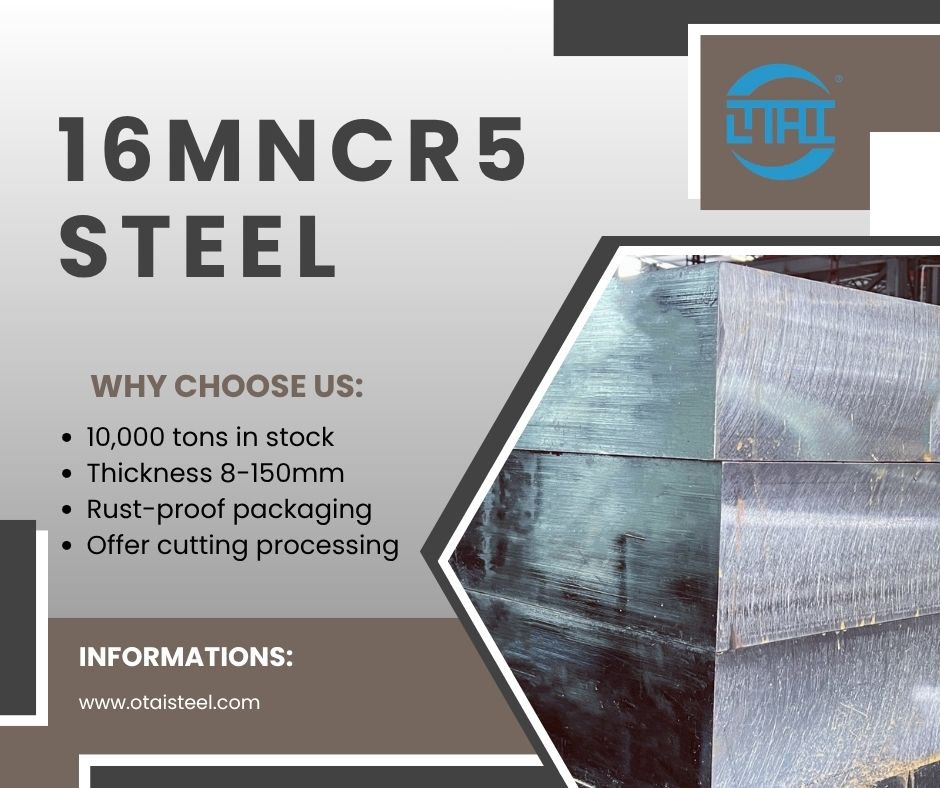
- 📦 10,000+ tons steel stock available year-round
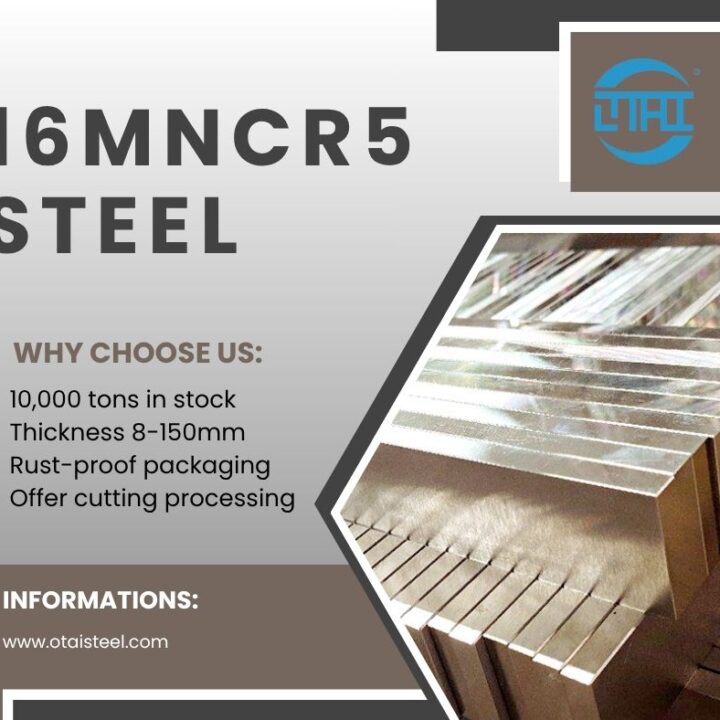
- 📏 16MnCr5 steel plate thickness range: 8–150mm in stock
- ✂️ Cutting, machining, and heat treatment services
- 🔬 UT testing and chemical composition inspection
- 🌍 Global supply for automotive and machinery industries
Otai Special Steel supplies multiple grades that serve as reliable 16MnCr5 steel alternative options. Each batch undergoes strict quality inspection to ensure stable mechanical performance and chemical consistency.
❓ FAQ
Q1: What is the best alternative to 16MnCr5?
20MnCr5 and 8620 steel are commonly used as alternatives depending on hardness and toughness requirements.
Q2: Can 20MnCr5 replace 16MnCr5?
Yes, it can replace it in many applications, especially where higher surface hardness is required.
Q3: Is 8620 steel a good alternative?
Yes, it provides excellent toughness and machinability for general carburized components.
Q4: Do alternatives require different heat treatment?
Yes, carburizing time and temperature may be adjusted depending on the alloy composition.
Q5: Which industry uses these alternatives most?
Automotive, heavy machinery, and power transmission industries use them widely.
Selecting a proper 16MnCr5 steel alternative depends on mechanical requirements, cost considerations, and availability. Engineers must evaluate hardness, toughness, and carburizing behavior before substitution to ensure safe and reliable performance in service conditions.