 16MnCr5 Meaning – Understanding the Steel Grade and Composition
The keyword 16MnCr5 meaning is frequently searched by engineers, purchasing managers, steel distributors, and manufacturing companies that work with carburizing steels. While many users recognize 16MnCr5 as a popular gear steel, fewer understand what the designation actually means and how it helps identify the material’s chemical composition, heat treatment capability, and intended applications.
Understanding the meaning behind a steel grade is important when selecting materials for gears, shafts, pinions, sprockets, and transmission components. The designation provides valuable information about the steel’s carbon content, alloying elements, and expected performance.
This article explains the 16MnCr5 steel meaning, breaks down each part of the designation, examines the chemical composition and mechanical properties, and shows why this steel has become one of the most widely used case-hardening materials in Europe and around the world.
📘 What Does 16MnCr5 Mean?
The designation 16MnCr5 follows the European steel naming system and provides information about the steel’s composition.
| Designation Part | Meaning |
|---|---|
| 16 | Approximately 0.16% carbon content |
| Mn | Manganese alloying element |
| Cr | Chromium alloying element |
| 5 | Approximate chromium content classification in the EN system |
In simple terms, 16MnCr5 is a low-carbon chromium-manganese alloy steel specifically developed for carburizing and case-hardening applications.
Because the base carbon content is relatively low, the material maintains excellent toughness and machinability before heat treatment. After carburizing and quenching, the surface becomes extremely hard while the core remains strong and resistant to impact.
🔬 Why the Number 16 Is Important
Many buyers ask what does 16MnCr5 mean and are particularly interested in the number at the beginning of the designation.
The number “16” indicates a nominal carbon content of approximately 0.16%.
This relatively low carbon content offers several advantages:
- Good machinability before heat treatment
- Excellent toughness in the core
- Reduced risk of cracking during heat treatment
- Good weldability compared with higher-carbon steels
- Excellent response to carburizing processes
If the carbon content were significantly higher, the steel would become harder but less suitable for case-hardening applications where a tough core is essential.
⚙️ The Role of Manganese (Mn)
Manganese is one of the most important alloying elements in 16MnCr5.
Typical manganese content ranges from approximately 1.00% to 1.30%.
Manganese contributes to:
- Improved hardenability
- Higher strength
- Better wear resistance
- Enhanced fatigue performance
- Improved heat treatment response
Without manganese, achieving the desired combination of surface hardness and core strength would be much more difficult.
This is one reason why 16MnCr5 carburizing steel performs so well in heavily loaded transmission systems.
🛡️ The Role of Chromium (Cr)
The “Cr” in the steel designation represents chromium, another critical alloying element.
Chromium typically ranges from 0.80% to 1.10% in 16MnCr5 steel.
Its benefits include:
| Chromium Benefit | Effect on Performance |
|---|---|
| Hardenability | Improves heat treatment effectiveness |
| Wear Resistance | Increases component life |
| Fatigue Strength | Supports cyclic loading |
| Core Strength | Maintains load-bearing capability |
These characteristics make 16MnCr5 particularly suitable for gears, where both wear resistance and fatigue resistance are critical.
🧪 16MnCr5 Chemical Composition
To fully understand the 16MnCr5 steel grade meaning, it is helpful to examine the standard chemical composition.
| Element | Typical Content (%) |
|---|---|
| Carbon (C) | 0.14–0.19 |
| Silicon (Si) | ≤0.40 |
| Manganese (Mn) | 1.00–1.30 |
| Chromium (Cr) | 0.80–1.10 |
| Phosphorus (P) | ≤0.025 |
| Sulfur (S) | ≤0.035 |
The balanced combination of carbon, manganese, and chromium creates a steel that offers excellent carburizing performance and reliable mechanical properties after heat treatment.
“`html
⚙️ 16MnCr5 Material Properties
After understanding the designation, the next step is to examine the actual performance characteristics of the material. The popularity of 16MnCr5 comes from its ability to combine a hard wear-resistant surface with a tough and durable core.
Before carburizing, the steel offers good machinability and dimensional stability. After carburizing, quenching, and tempering, it develops a hardened case that can withstand continuous friction and contact stress.
| Property | Typical Value |
|---|---|
| Density | 7.85 g/cm³ |
| Elastic Modulus | 210 GPa |
| Yield Strength | 700–1100 MPa* |
| Tensile Strength | 900–1300 MPa* |
| Surface Hardness After Carburizing | 58–62 HRC |
| Core Hardness | 30–45 HRC |
*Actual values depend on heat treatment parameters and component dimensions.
This combination of properties explains why engineers frequently choose 16MnCr5 engineering steel for components that require both strength and long-term wear resistance.
🔥 Why Is 16MnCr5 Considered a Carburizing Steel?
Many customers searching for 16MnCr5 meaning also want to understand why this grade is classified as a carburizing steel.
Carburizing is a heat treatment process that introduces additional carbon into the surface layer of a low-carbon steel. The process creates a hard outer shell while maintaining a relatively soft and tough core.
This design provides several important advantages:
- Excellent wear resistance on the surface.
- High fatigue resistance under cyclic loading.
- Strong impact resistance in the core.
- Reduced risk of brittle fracture.
- Longer service life for moving components.
Without carburizing, gears and shafts operating under heavy loads would wear much faster. The low carbon content represented by the number “16” is one of the key reasons why 16MnCr5 responds so effectively to this process.
🌍 16MnCr5 Equivalent Grades Around the World
Global manufacturers often need to compare steel grades from different standards. Although exact chemistry may vary slightly, several international grades are commonly considered equivalents to 16MnCr5.
| Country/Standard | Equivalent Grade |
|---|---|
| EN/DIN | 16MnCr5 |
| Germany (Werkstoff) | 1.7131 |
| USA | 5115 / 5120 (similar application) |
| Japan | SCr420 |
| China | 20CrMnTi (similar use) |
When purchasing internationally, buyers should compare chemical composition, hardenability, and mechanical property requirements rather than relying solely on equivalent grade names.
🏭 Real Industrial Applications of 16MnCr5
The meaning of the grade becomes much clearer when viewed through actual industrial applications.
Because of its excellent carburizing characteristics, 16MnCr5 is widely used in industries where components experience continuous friction, torque transmission, and cyclic loading.
| Industry | Typical Components |
|---|---|
| Automotive | Transmission gears, differential gears, pinions |
| Industrial Gearboxes | Gear wheels, gear shafts |
| Agricultural Machinery | Drive gears, sprockets |
| Mining Equipment | Heavy-duty transmission parts |
| Mechanical Engineering | Bushings, couplings, shafts |
In automotive transmissions, for example, gear teeth must withstand millions of contact cycles during their service life. The hardened case generated through carburizing provides wear resistance, while the tough core absorbs shock loads without cracking.
For industrial gearboxes, the steel offers an ideal balance between cost, durability, and performance, making it one of the most economical material choices for high-volume production.
🔍 How Buyers Use the Grade Name When Sourcing Steel
Experienced purchasing engineers often evaluate a steel grade before even reviewing the full material certificate.
When they see the designation 16MnCr5, they can immediately identify several important characteristics:
- Low-carbon steel suitable for carburizing.
- Manganese-enhanced hardenability.
- Chromium-enhanced wear resistance.
- Excellent gear and shaft material.
- Suitable for case-hardening applications.
- Widely accepted international engineering grade.
This is why understanding the 16MnCr5 material specification and naming system can help buyers make faster and more informed sourcing decisions.
🏆 Company Advantages – Otai Special Steel
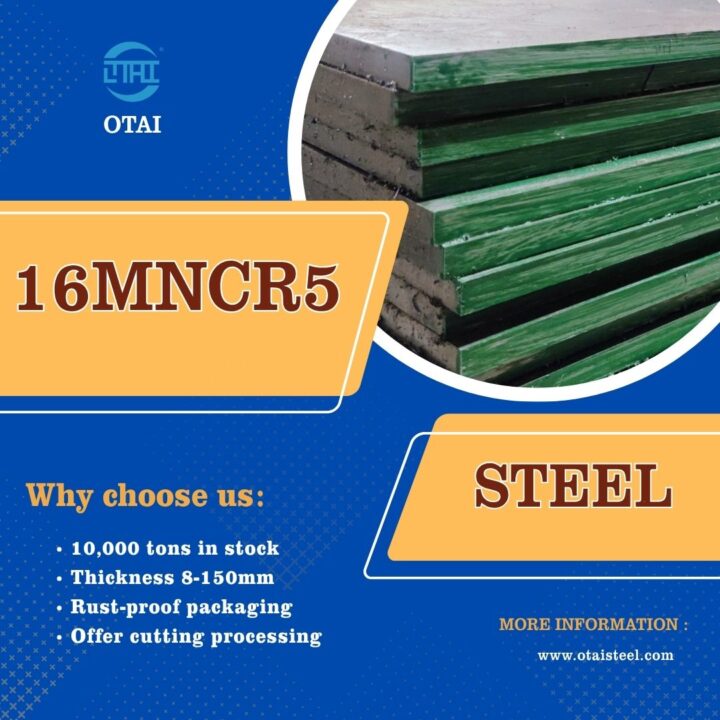
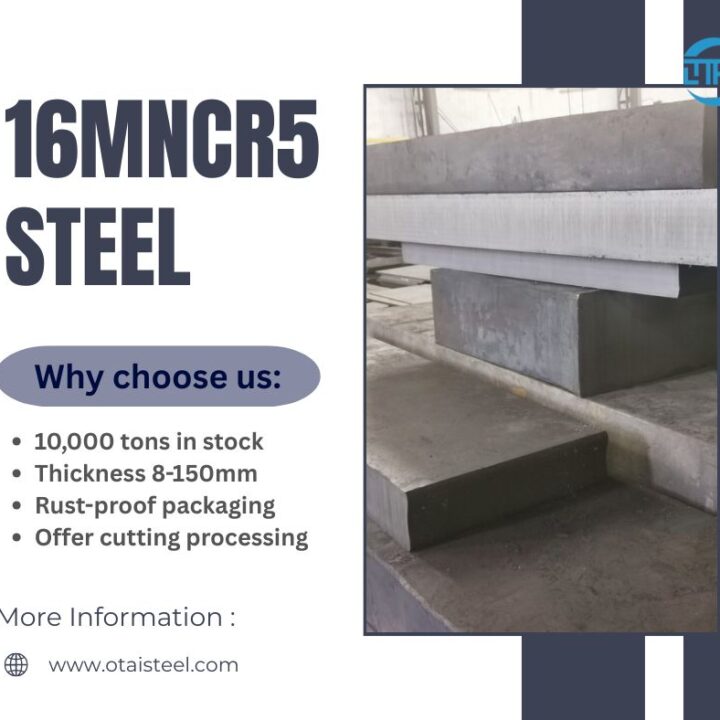
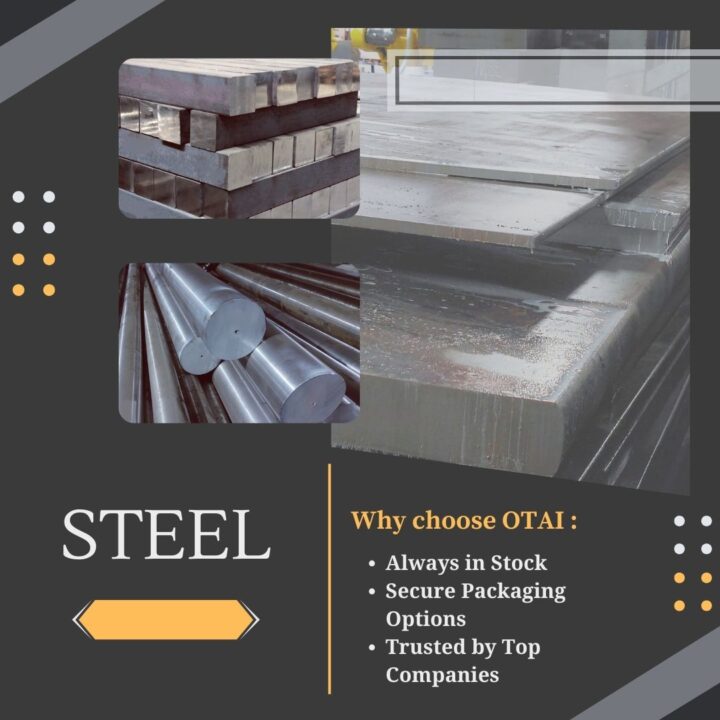
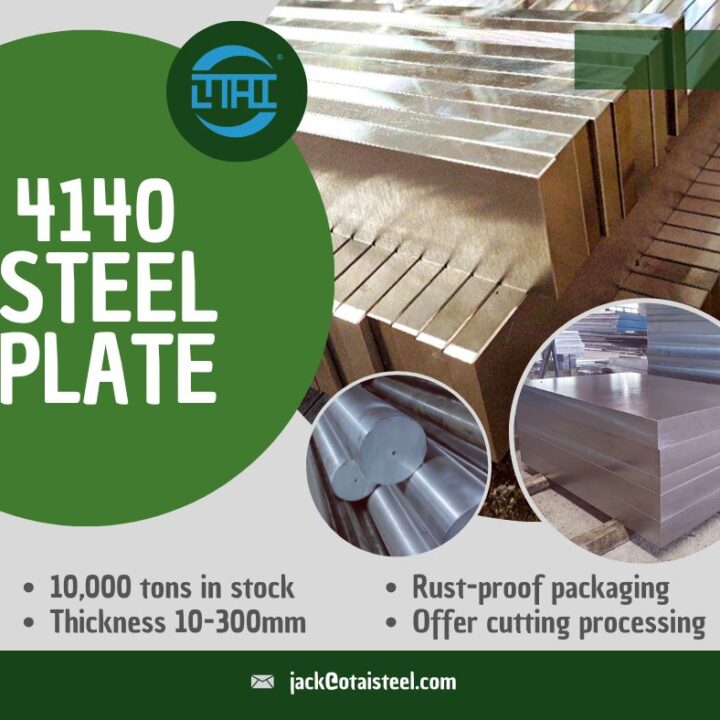
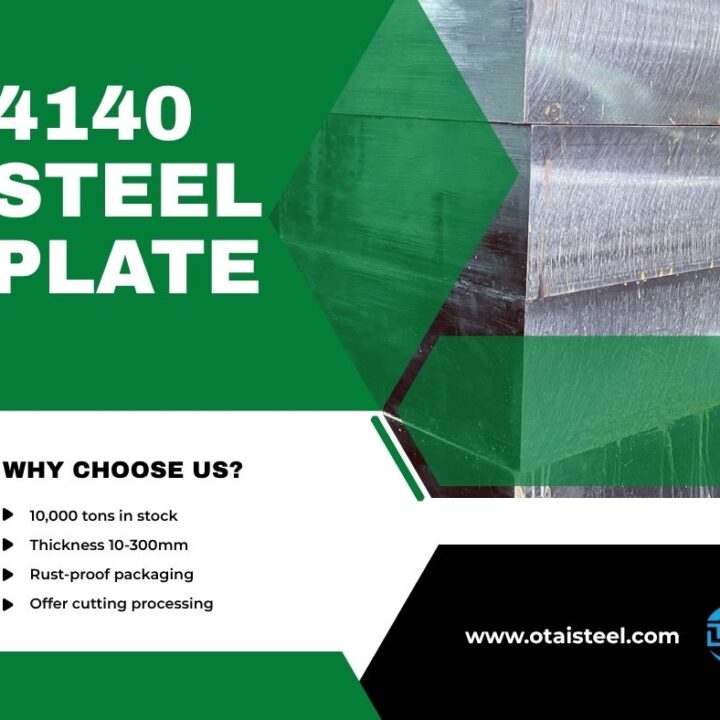
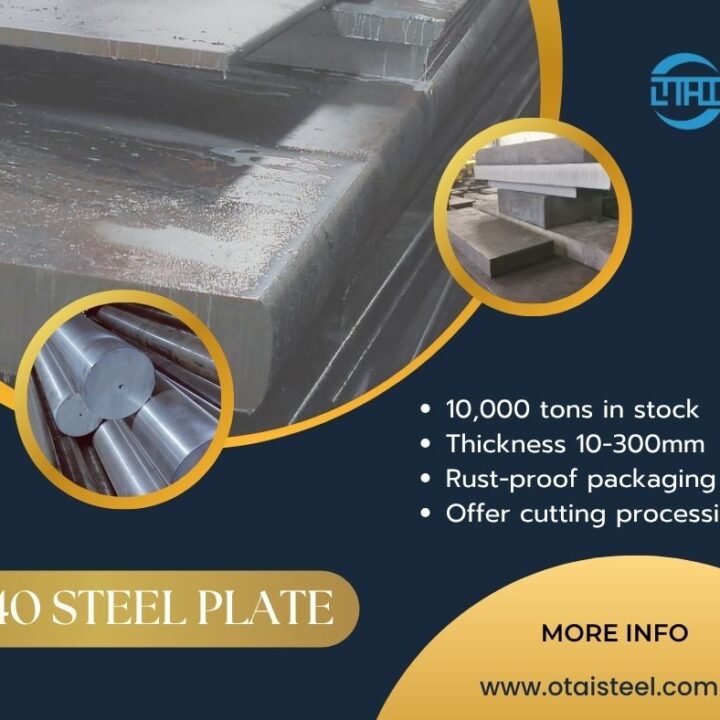
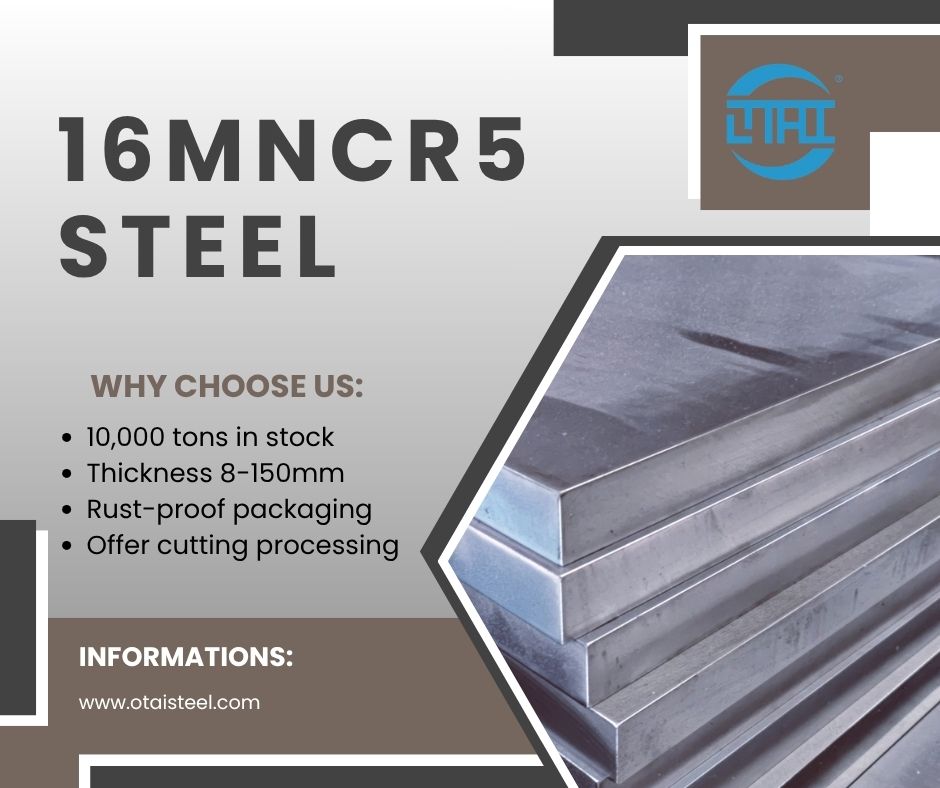
- Professional supplier of 16MnCr5 steel plates, bars, and forgings.
- Sufficient inventory with 8–150 mm thickness plates available in stock.
- Large inventory available for immediate shipment.
- Custom cutting according to customer dimensions.
- Heat treatment support including annealing, carburizing, quenching, and tempering.
- Ultrasonic testing (UT) for internal quality verification.
- Chemical composition and mechanical property testing.
- Third-party inspections including SGS available upon request.
- Stable export supply chain serving customers worldwide.
- Competitive pricing and fast delivery.
📌 FAQ
Q1: What does 16MnCr5 mean?
A: It is a European steel designation indicating approximately 0.16% carbon steel alloyed with manganese and chromium for carburizing applications.
Q2: Is 16MnCr5 a carbon steel or alloy steel?
A: It is a low-alloy case-hardening steel containing manganese and chromium.
Q3: Why is 16MnCr5 widely used for gears?
A: After carburizing, it develops a very hard wear-resistant surface while maintaining a tough core capable of handling shock loads.
Q4: What is the hardness of 16MnCr5 after carburizing?
A: The surface hardness typically reaches 58–62 HRC.
Q5: What is the German material number for 16MnCr5?
A: The commonly used Werkstoff number is 1.7131.