 4140 Steel and 4130 – Key Differences and Complete Selection Guide
The comparison between 4140 steel and 4130 is one of the most important topics in alloy steel selection for engineering, manufacturing, and global procurement. Although both steels belong to the chromium-molybdenum (Cr-Mo) low-alloy steel family, their performance differences become very significant in real industrial applications.
Many buyers only look at chemical composition or basic strength values. However, in real engineering practice, the difference between 4140 and 4130 steel directly affects product lifetime, fatigue resistance, weldability, machining cost, and failure risk in components such as shafts, gears, structural frames, and heavy-duty machinery parts.
This extended guide explains not only material data, but also engineering behavior, failure modes, application selection logic, and purchasing considerations used by real manufacturers.
📘 1. Understanding 4130 and 4140 Steel in Engineering Context
4130 and 4140 steels are both Cr-Mo alloy steels widely used in structural and mechanical systems. Their popularity comes from a balanced combination of strength, toughness, and manufacturability.
| Steel Grade | Engineering Classification | Primary Advantage |
|---|---|---|
| 4130 | Low carbon Cr-Mo steel | Weldability and formability |
| 4140 | Medium carbon Cr-Mo steel | High strength and wear resistance |
The key engineering difference is carbon content, which influences hardenability, strength, and fatigue life under cyclic loading.
🧪 2. Chemical Composition and Its Engineering Impact
The 4140 vs 4130 steel comparison starts with carbon content, which has a direct effect on mechanical performance after heat treatment.
| Element | 4130 | 4140 |
|---|---|---|
| Carbon (C) | 0.28–0.33% | 0.38–0.43% |
| Chromium (Cr) | 0.8–1.1% | 0.8–1.1% |
| Molybdenum (Mo) | 0.15–0.25% | 0.15–0.25% |
Higher carbon in 4140 steel increases hardness potential but reduces weldability. This is the core trade-off between the two materials.
In engineering design, this means:
- 4130 is preferred when fabrication and welding complexity are high
- 4140 is preferred when mechanical load and wear resistance dominate design requirements
⚙️ 3. Mechanical Behavior Under Real Load Conditions
In real industrial environments, materials are not selected based on lab values, but based on failure resistance under load conditions such as torsion, bending, impact, and fatigue.
| Property | 4130 Steel | 4140 Steel |
|---|---|---|
| Tensile Strength | 560–760 MPa | 850–1000 MPa |
| Yield Strength | ~460 MPa | ~655 MPa |
| Hardness (HRC) | 20–28 | 28–32 |
| Fatigue Resistance | Good | Excellent |
In cyclic loading conditions such as rotating shafts or gearbox systems, 4140 shows significantly longer fatigue life due to its higher core strength.
🔥 4. Heat Treatment Behavior and Failure Mechanisms
Heat treatment is the most critical factor affecting performance differences between 4130 and 4140 steels.
4130 steel has lower carbon content, which results in:
- Shallower hardening depth
- Better weldability before heat treatment
- Lower risk of cracking during fabrication
4140 steel provides:
- Deeper hardening during quenching
- Higher surface hardness after tempering
- Better wear resistance in contact surfaces
Common failure modes if incorrectly selected:
- 4130 used in overload shafts: plastic deformation or bending failure
- 4140 used in complex welded structures: welding cracks due to higher carbon sensitivity
🏭 5. Industrial Application Logic (Not Just Lists)
Material selection should always be based on function, not just grade strength.
| Application Area | 4130 Usage Reason | 4140 Usage Reason |
|---|---|---|
| Aerospace tubing | Lightweight and weldable | Too heavy and strong for this purpose |
| Automotive shafts | Used in low-load designs | Preferred for high torque systems |
| Gears | Limited use | Primary material choice |
| Oil & gas equipment | Moderate pressure systems | High pressure and heavy load systems |
⚖️ 6. Engineering Selection Guide (Practical Decision Rule)
Instead of asking “which steel is better”, engineers ask “which steel fits the operating condition”.
Choose 4130 steel when:
- Welding is a critical process
- Weight reduction is important
- Loads are moderate or structural
Choose 4140 steel when:
- High torque or load is expected
- Wear resistance is critical
- Long service life is required
🏭 7. Supplier Capability – Otai Special Steel
- Large inventory of 4130 and 4140 steel
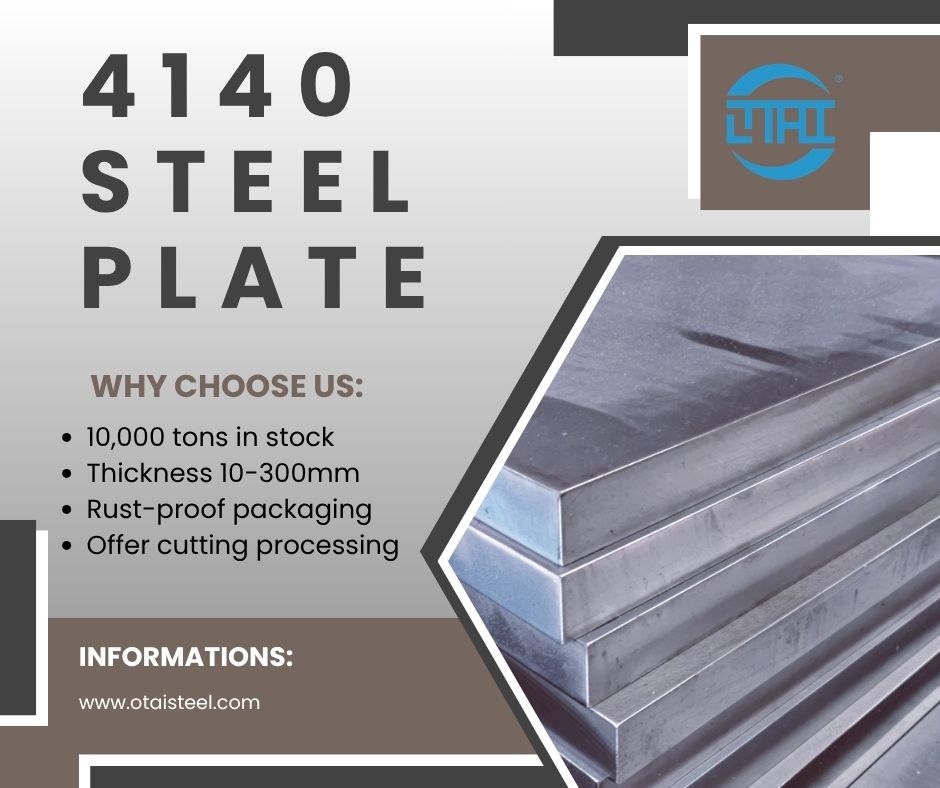
- Round bars, plates, and forged blocks available
- Cutting and machining services
- Heat treatment support (QT condition supply)
- Ultrasonic testing and inspection reports
- Stable export supply chain
📌 8. FAQ
Q1: What is the main difference between 4130 and 4140 steel?
Carbon content and resulting strength difference.
Q2: Is 4140 stronger than 4130?
Yes, 4140 has higher tensile and yield strength.
Q3: Which is easier to weld?
4130 is easier due to lower carbon content.
Q4: Which is better for shafts?
4140 is generally preferred for high torque shafts.
Q5: Can they replace each other?
Only in non-critical or low-load applications.