 Difference Between 4130 and 4140 Steel: Composition and Applications
The difference between 4130 and 4140 steel is an important topic in manufacturing, aerospace, automotive, oil and gas, and heavy engineering industries. Both materials belong to the chromium-molybdenum alloy steel family, but they differ in carbon content, strength, hardness, weldability, and industrial performance.
Manufacturers commonly know 4130 steel for its excellent weldability and good toughness, while they prefer 4140 steel for higher strength and wear resistance applications.
These alloy steels are widely used for:
- Aerospace structures
- Automotive components
- Oil and gas equipment
- Industrial machinery
- Mechanical shafts and gears
- High-strength structural parts
Selecting between 4130 and 4140 steel depends on:
- Required strength level
- Machinability requirements
- Welding performance
- Heat treatment conditions
- Impact resistance
- Cost and service environment
📊 Chemical Composition Comparison
The main difference between 4130 and 4140 steel is the carbon content.
| Element | 4130 Steel (%) | 4140 Steel (%) |
|---|---|---|
| Carbon (C) | 0.28 – 0.33 | 0.38 – 0.43 |
| Chromium (Cr) | 0.80 – 1.10 | 0.80 – 1.10 |
| Molybdenum (Mo) | 0.15 – 0.25 | 0.15 – 0.25 |
| Manganese (Mn) | 0.40 – 0.60 | 0.75 – 1.00 |
| Silicon (Si) | 0.15 – 0.35 | 0.15 – 0.35 |
The higher carbon content in 4140 steel provides higher strength and hardness after heat treatment.
⚙️ Mechanical Properties Comparison
| Property | 4130 Steel | 4140 Steel |
|---|---|---|
| Tensile Strength | 560 – 760 MPa | 655 – 1080 MPa |
| Yield Strength | 460 – 670 MPa | 415 – 930 MPa |
| Hardness | 18 – 32 HRC | 28 – 57 HRC |
| Toughness | Excellent | Very Good |
| Wear Resistance | Moderate | Higher |
4140 steel offers better wear resistance and higher hardness, while 4130 steel provides superior weldability and toughness.
🔥 Heat Treatment Comparison
Both steels respond well to heat treatment, but 4140 steel achieves higher hardness levels due to its higher carbon content.
| Heat Treatment | 4130 Steel | 4140 Steel |
|---|---|---|
| Annealing Temperature | 840 – 870°C | 815 – 870°C |
| Normalizing Temperature | 870 – 925°C | 870 – 925°C |
| Quenching Medium | Oil or water | Oil |
| Tempering Range | 200 – 700°C | 200 – 700°C |
| Maximum Hardness | Lower | Higher |
Engineers commonly select 4140 steel for heavy-duty wear-resistant components, while they prefer 4130 steel for welded structures and lightweight high-strength applications.
🔬 Weldability and Machinability Comparison
The weldability and machinability of 4130 and 4140 steel are important factors in manufacturing and fabrication industries.
| Feature | 4130 Steel | 4140 Steel |
|---|---|---|
| Weldability | Excellent | Good |
| Preheating Requirement | Often unnecessary for thin sections | Usually recommended |
| Post-Weld Heat Treatment | Sometimes required | Frequently required |
| Machinability | Good | Very good in annealed condition |
| Cutting Resistance | Lower | Higher after hardening |
4130 steel is widely used for welded tubing and aerospace structures, while 4140 steel is more suitable for hardened mechanical components.
🏭 Industrial Applications Comparison
| Industry | 4130 Steel Applications | 4140 Steel Applications |
|---|---|---|
| Aerospace | Aircraft tubing and frames | Landing gear components |
| Automotive | Roll cages and chassis | Axles and crankshafts |
| Oil & Gas | Structural tubing | Drill collars and tools |
| Industrial Machinery | Light structural parts | Gears and shafts |
| Racing Industry | High-strength tubing | Heavy-duty drivetrain parts |
4130 steel performs well in lightweight structural applications, while 4140 steel excels in high-load and wear-resistant environments.
💰 Cost and Material Selection
| Selection Factor | 4130 Steel | 4140 Steel |
|---|---|---|
| Material Cost | Lower | Moderate |
| Strength Level | Medium-High | High |
| Wear Resistance | Moderate | Excellent |
| Best Use | Welded structural applications | Heavy-duty mechanical parts |
| Heat Treatment Capability | Good | Excellent |
4130 steel is ideal for lightweight welded structures, while 4140 steel is better for components requiring high hardness and wear resistance.
🌍 International Equivalent Grades
| Steel Grade | DIN / EN Equivalent | JIS Equivalent |
|---|---|---|
| 4130 Steel | 25CrMo4 / 1.7218 | SCM430 |
| 4140 Steel | 42CrMo4 / 1.7225 | SCM440 |
These equivalent grades are widely used in global engineering and manufacturing industries.
🏭 Company Advantages
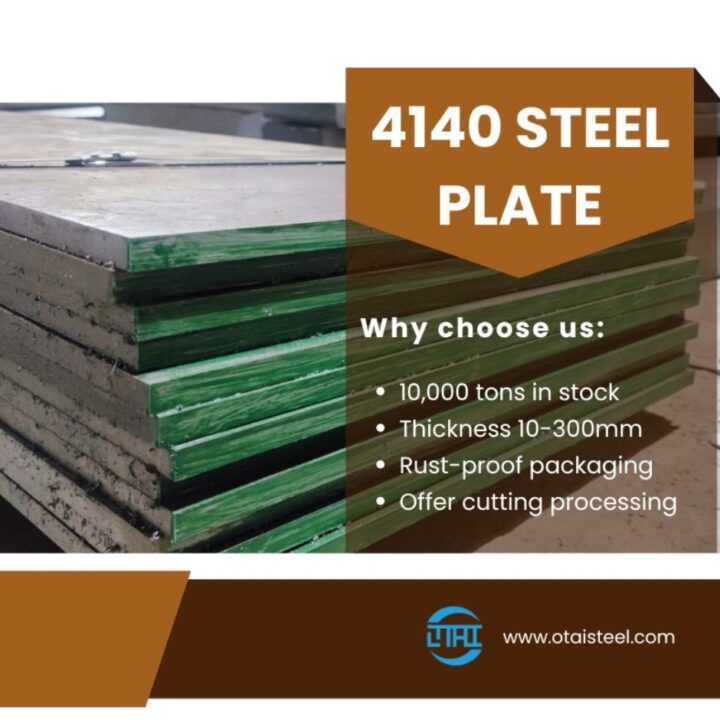
Otai Special Steel supplies high-quality 4130 steel and 4140 alloy steel for aerospace, automotive, oil and gas, industrial machinery, and heavy engineering industries worldwide.
- Large inventory with stable year-round supply
- Round bars, forged blocks, steel plates, and flat bars available
- Thickness range from 6mm to 300mm
- Custom cutting and precision machining services
- Professional heat treatment support
- Ultrasonic testing (UT) available
- Chemical composition verification
- Third-party inspection support including SGS
- Professional export packaging and global shipping
We provide reliable quality, competitive pricing, fast delivery, and customized alloy steel solutions for demanding industrial applications.
❓ FAQ
Q1: What is the main difference between 4130 and 4140 steel?
A1: The main difference is carbon content. 4140 steel contains more carbon, giving it higher hardness and wear resistance.
Q2: Which steel is easier to weld?
A2: 4130 steel offers better weldability and is commonly used for welded tubing and structural applications.
Q3: Which steel is stronger?
A3: 4140 steel generally provides higher tensile strength and hardness after heat treatment.
Q4: Which steel is better for gears and shafts?
A4: 4140 steel is more suitable for gears, shafts, and heavy-duty mechanical components because of its higher wear resistance.
Q5: Is 4130 steel used in aerospace applications?
A5: Yes. 4130 steel is widely used for aircraft tubing, roll cages, and lightweight structural components.