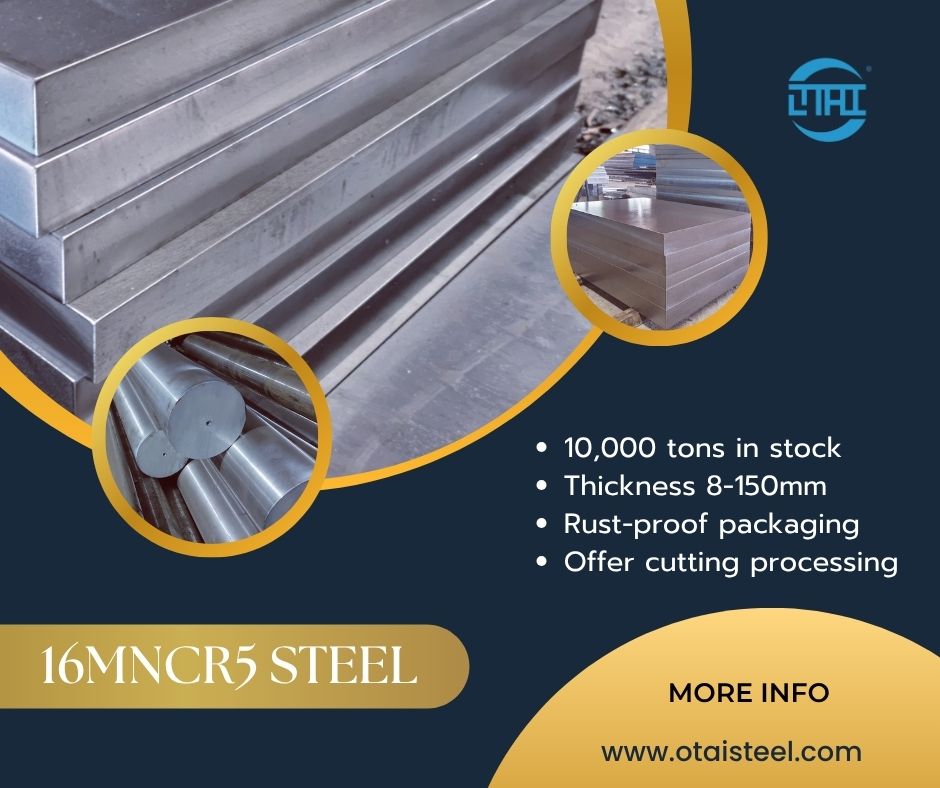
 16MnCr5 Case Hardening Process: Heat Treatment Steps
The 16MnCr5 case hardening process is widely used to improve the surface hardness, wear resistance, and fatigue strength of mechanical components while maintaining a tough and ductile core. 16MnCr5 is a low-carbon chromium alloy steel specifically designed for carburizing and case hardening applications.
After proper heat treatment, the steel develops:
- A hard martensitic surface layer
- Excellent wear resistance
- High contact fatigue strength
- Strong core toughness
- Long service life under heavy loads
Because of these advantages, 16MnCr5 steel is commonly used for:
- Transmission gears
- Pinions
- Shafts
- Gear rings
- Industrial gearbox components
- Automotive drive systems
📊 What Is the 16MnCr5 Case Hardening Process?
Case hardening is a heat treatment method that increases carbon content on the steel surface while keeping the core relatively low in carbon. This process creates a hard outer layer with a strong and impact-resistant inner structure.
The complete 16MnCr5 case hardening process usually includes:
- Preheating
- Carburizing
- Diffusion treatment
- Quenching
- Tempering
These steps significantly improve surface durability and mechanical performance.
⚙️ Typical Case Hardening Process Parameters
The exact process parameters depend on required hardness depth, component size, and final application requirements.
| Process Step | Typical Temperature | Purpose |
|---|---|---|
| Preheating | 600 – 650°C | Reduce thermal stress |
| Carburizing | 880 – 930°C | Increase surface carbon content |
| Diffusion | 840 – 860°C | Equalize carbon distribution |
| Quenching | 780 – 820°C | Form martensitic structure |
| Tempering | 150 – 200°C | Improve toughness |
Careful temperature control is essential for achieving stable hardness and dimensional accuracy.
🧪 Hardness After Case Hardening
The case hardening process dramatically increases the surface hardness of 16MnCr5 steel.
| Property | Typical Value | Benefit |
|---|---|---|
| Surface Hardness | 58 – 62 HRC | Excellent wear resistance |
| Core Hardness | 30 – 45 HRC | High impact toughness |
| Case Depth | 0.5 – 2.0 mm | Longer service life |
| Fatigue Resistance | Excellent | Supports repeated loading |
The hard surface layer protects the component from friction, wear, and surface fatigue during long-term operation.
🔬 Microstructure After Case Hardening
The microstructure developed during the 16MnCr5 case hardening process directly affects hardness, fatigue strength, and wear resistance.
| Microstructure | Location | Performance Advantage |
|---|---|---|
| Martensite | Surface Layer | High hardness and wear resistance |
| Tempered Martensite | Subsurface Area | Improved fatigue resistance |
| Ferrite + Pearlite | Core Structure | Excellent toughness and ductility |
This combination of a hard surface and ductile core gives 16MnCr5 outstanding performance under repeated loading and impact conditions.
⚙️ Advantages of the 16MnCr5 Case Hardening Process
The carburizing and case hardening process significantly improves the engineering performance of 16MnCr5 steel.
| Advantage | Industrial Benefit |
|---|---|
| High Surface Hardness | Improves wear resistance |
| Strong Core Toughness | Reduces cracking risk |
| Excellent Fatigue Strength | Longer service life |
| Good Dimensional Stability | Supports precision components |
| Improved Contact Strength | Ideal for gears and shafts |
These advantages make 16MnCr5 one of the most commonly used carburizing steels in the mechanical transmission industry.
🏭 Industrial Applications After Case Hardening
Case-hardened 16MnCr5 steel is widely used in industries requiring high durability and reliable mechanical performance.
| Industry | Typical Components | Required Performance |
|---|---|---|
| Automotive | Transmission gears | Fatigue resistance |
| Industrial Gearboxes | Gear wheels and pinions | Wear resistance |
| Mining Equipment | Drive shafts | Impact toughness |
| Agricultural Machinery | Transmission systems | Long-term durability |
| Heavy Engineering | Rotating components | High load capacity |
The excellent balance between hardness and toughness allows the material to operate reliably in demanding environments.
🌍 International Equivalent Grades
16MnCr5 steel is recognized globally under several equivalent standards.
| Standard | Equivalent Grade |
|---|---|
| DIN / EN | 16MnCr5 / 1.7131 |
| AFNOR | 16MC5 |
| UNI | 16MnCr5 |
| JIS | Equivalent carburizing alloy steel grades |
These international grades provide similar carburizing performance, hardenability, and mechanical reliability.
🏭 Company Advantages
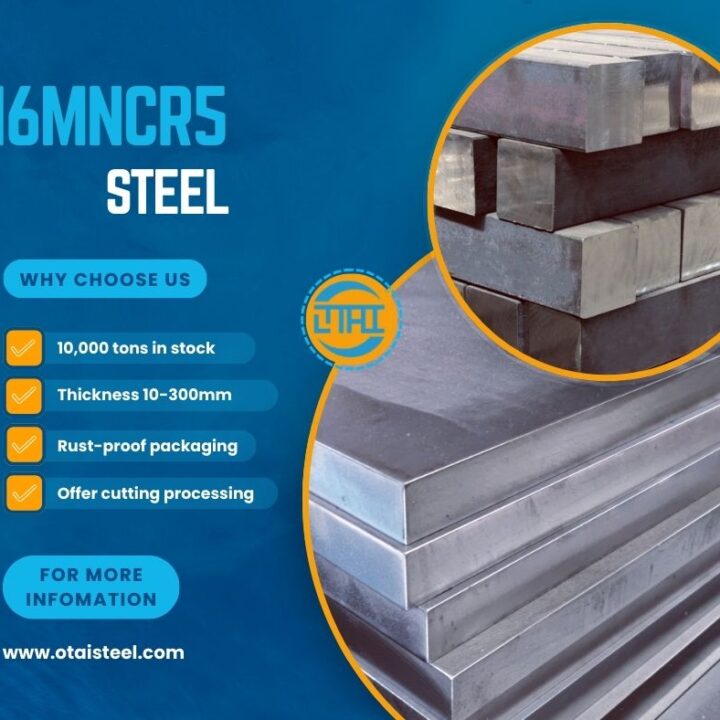
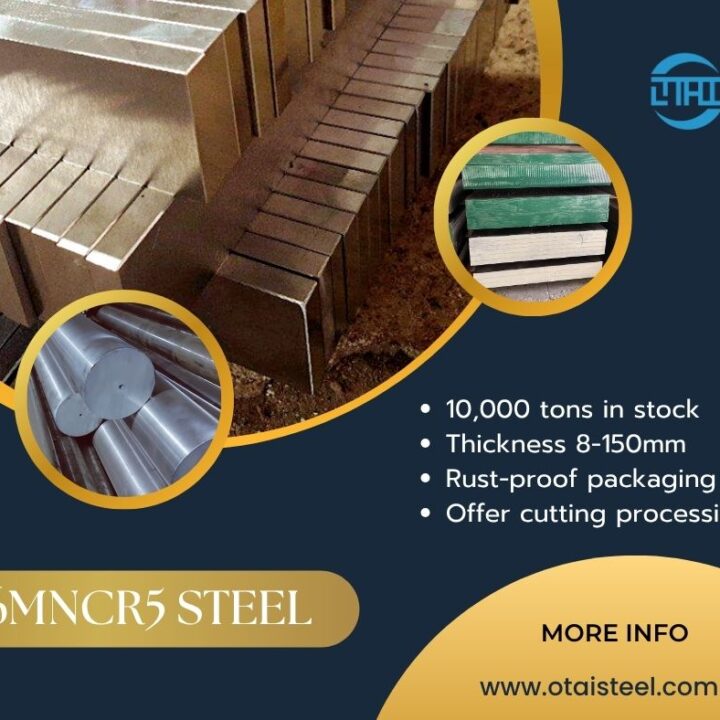
Otai Special Steel supplies premium-quality 16MnCr5 alloy steel for gears, shafts, transmission systems, and heavy-duty engineering applications worldwide.
- Large inventory with stable year-round supply
- 8–150mm thickness plates available in stock
- Round bars, steel plates, forged blocks, and flat bars available
- Custom cutting and precision machining services
- Professional carburizing and heat treatment support
- Ultrasonic testing (UT) available
- Chemical composition verification
- Third-party inspection support including SGS
- Professional export packaging and global shipping
We provide reliable quality, competitive pricing, fast delivery, and customized alloy steel solutions for customers in automotive, mining, industrial machinery, and heavy engineering industries.
❓ FAQ
Q1: What is the 16MnCr5 case hardening process?
A1: It is a carburizing heat treatment process that creates a hard wear-resistant surface while maintaining a tough core structure.
Q2: What hardness can 16MnCr5 achieve after case hardening?
A2: The surface hardness typically reaches 58–62 HRC after carburizing and quenching.
Q3: Why is 16MnCr5 suitable for gears?
A3: The steel provides excellent wear resistance, fatigue strength, and impact toughness, making it ideal for transmission components.
Q4: What is the typical carburizing temperature for 16MnCr5?
A4: The carburizing temperature is generally between 880–930°C.
Q5: Which industries commonly use case-hardened 16MnCr5 steel?
A5: Automotive, mining, industrial gearbox, agricultural machinery, and heavy engineering industries commonly use this material.