 4140 Steel Density kg/m³: Physical Properties and Weight Calculation
The 4140 steel density kg/m³ is an important physical property used in engineering design, machining, structural calculations, and industrial manufacturing. AISI 4140 is a chromium-molybdenum alloy steel widely known for its excellent strength, toughness, wear resistance, and heat treatment capability.
The density of 4140 steel affects:
- Component weight calculations
- Machining cost estimation
- Structural load analysis
- Transportation and shipping weight
- Mechanical system design
- Rotating equipment balance
Because of its high mechanical strength and reliable physical properties, 4140 steel is widely used in:
- Automotive components
- Oil and gas equipment
- Industrial machinery
- Mining systems
- Construction machinery
- Heavy engineering applications
📊 4140 Steel Density Value
The density of AISI 4140 alloy steel remains relatively stable across different heat treatment conditions.
| Property | Typical Value | Unit |
|---|---|---|
| Density | 7,850 | kg/m³ |
| Density | 7.85 | g/cm³ |
| Density | 0.284 | lb/in³ |
The density value may vary slightly depending on alloy composition, heat treatment condition, and manufacturing process.
🧪 Chemical Composition and Density Relationship
The alloying elements in 4140 steel contribute directly to its density and mechanical performance.
| Element | Typical Content (%) | Influence on Material |
|---|---|---|
| Carbon (C) | 0.38 – 0.43 | Improves hardness and strength |
| Chromium (Cr) | 0.80 – 1.10 | Enhances wear resistance |
| Molybdenum (Mo) | 0.15 – 0.25 | Improves toughness and hardenability |
| Manganese (Mn) | 0.75 – 1.00 | Improves hardenability |
| Silicon (Si) | 0.15 – 0.35 | Improves structural stability |
The chromium-molybdenum alloy system gives 4140 steel excellent mechanical performance while maintaining stable density characteristics.
📐 Weight Calculation Formula for 4140 Steel
The density value is commonly used to calculate the weight of steel bars, plates, and forged components.
The standard engineering formula is:
Weight = Volume × Density
For 4140 steel:
Weight (kg) = Volume (m³) × 7,850 kg/m³
| Product Type | Calculation Method |
|---|---|
| Round Bar | π × radius² × length × density |
| Steel Plate | Length × width × thickness × density |
| Forged Block | Length × width × height × density |
Accurate weight calculations are essential for material procurement, machining estimates, and transportation planning.
🔬 Physical Properties of 4140 Steel
In addition to density, 4140 alloy steel offers several important physical properties that influence machining, heat treatment, and engineering performance.
| Physical Property | Typical Value | Unit |
|---|---|---|
| Density | 7,850 | kg/m³ |
| Elastic Modulus | 205 | GPa |
| Thermal Conductivity | 42.6 | W/m·K |
| Specific Heat Capacity | 477 | J/kg·K |
| Thermal Expansion | 12.3 × 10⁻⁶ | /°C |
These physical properties make 4140 steel suitable for high-strength engineering components operating under varying temperatures and heavy mechanical loads.
⚙️ Influence of Density on Industrial Design
The density of 4140 steel plays a major role in engineering calculations and mechanical system performance.
| Engineering Area | Importance of Density |
|---|---|
| Structural Design | Determines total load weight |
| Rotating Equipment | Affects balance and inertia |
| Transportation | Impacts shipping costs |
| Machining | Influences cutting force calculations |
| Heavy Machinery | Supports stability and rigidity |
Accurate density data is essential for safe engineering design and optimized manufacturing processes.
🏭 Industrial Applications of 4140 Alloy Steel
The combination of high strength, stable density, and excellent heat treatment capability makes 4140 steel suitable for many demanding industrial applications.
| Industry | Typical Components | Required Performance |
|---|---|---|
| Oil & Gas | Drill collars and connectors | High strength and toughness |
| Automotive | Axles and shafts | Fatigue resistance |
| Mining | Heavy-duty rotating parts | Wear resistance |
| Industrial Machinery | Spindles and couplings | High load capacity |
| Construction Equipment | Pins and support shafts | Impact resistance |
4140 steel continues to be one of the most trusted alloy steels for heavy engineering and mechanical systems.
🌍 International Equivalent Grades
4140 alloy steel has several internationally recognized equivalent grades used in global engineering industries.
| Standard | Equivalent Grade |
|---|---|
| DIN / EN | 42CrMo4 / 1.7225 |
| JIS | SCM440 |
| GB | 42CrMo |
| BS | 708M40 |
These equivalent grades provide similar density, strength, hardenability, and mechanical performance characteristics.
🏭 Company Advantages
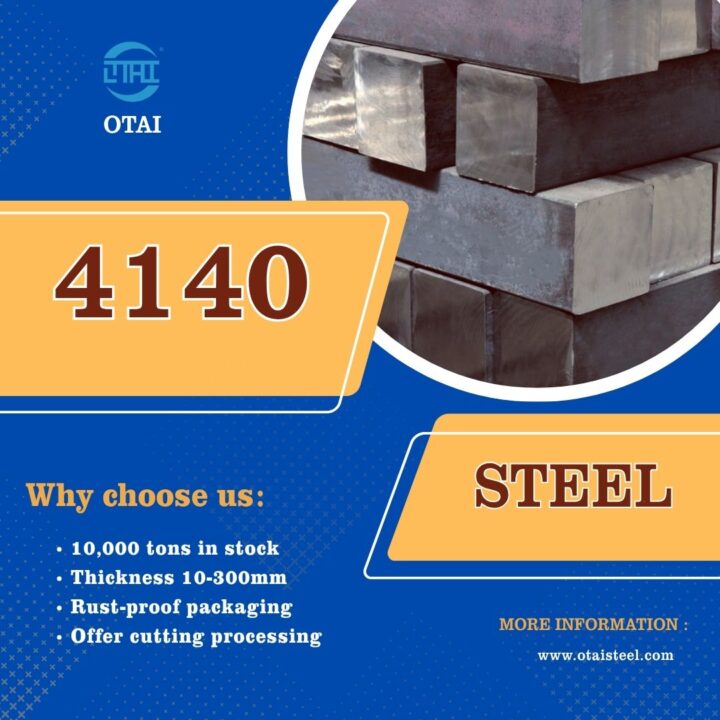
Otai Special Steel supplies premium-quality 4140 alloy steel for oil and gas, automotive, mining, industrial machinery, and heavy engineering applications worldwide.
- Large inventory with stable year-round supply
- Round bars, steel plates, forged blocks, and flat bars available
- Thickness range from 6mm to 300mm available
- Custom cutting and precision machining services
- Professional heat treatment support
- Ultrasonic testing (UT) available
- Chemical composition verification
- Third-party inspection support including SGS
- Professional export packaging and global shipping
We provide reliable quality, competitive pricing, fast delivery, and customized alloy steel solutions for global industrial customers.
❓ FAQ
Q1: What is the density of 4140 steel in kg/m³?
A1: The typical density of 4140 alloy steel is approximately 7,850 kg/m³.
Q2: Does heat treatment change the density of 4140 steel?
A2: Heat treatment may slightly affect the density, but the change is generally very small.
Q3: Why is density important in engineering calculations?
A3: Density is essential for calculating component weight, structural load, shipping weight, and rotational balance.
Q4: What industries commonly use 4140 steel?
A4: Oil and gas, automotive, mining, industrial machinery, and heavy equipment industries widely use 4140 alloy steel.
Q5: Is 4140 steel heavier than carbon steel?
A5: The density of 4140 steel is very similar to most medium-carbon and low-alloy steels.