 4140 Steel Young’s Modulus: Understanding Elasticity and Structural Performance
When engineers design mechanical components, understanding material stiffness is just as important as strength. One of the most critical parameters in this context is Young’s modulus. Many professionals ask about 4140 steel young’s modulus to evaluate how this alloy behaves under elastic deformation.
AISI 4140 is a chromium-molybdenum alloy steel known for its excellent strength, toughness, and wear resistance. However, its stiffness—defined by its modulus of elasticity—plays a key role in applications involving load-bearing, deflection control, and structural stability.
In this article, we will explore the elastic modulus of AISI 4140 steel, its significance, influencing factors, and how it compares to other materials.
🔍 What Is Young’s Modulus?
Young’s modulus, also known as the modulus of elasticity, measures a material’s ability to resist deformation under stress. It represents the ratio of stress to strain within the elastic limit.
The formula is:
E = σ\ε
Where:
- (E) = Young’s modulus
- (σ) = stress
- (ε) = strain
A higher modulus means the material is stiffer and deforms less under load.
Understanding what is the elasticity of 4140 steel helps engineers predict how components behave in real-world applications.
📊 Young’s Modulus of 4140 Steel
The Young’s modulus of 4140 steel value is relatively consistent regardless of heat treatment condition.
| Property | Value |
|---|---|
| Young’s Modulus (E) | 200 – 210 GPa |
| Shear Modulus | ~80 GPa |
| Poisson’s Ratio | 0.27 – 0.30 |
These values indicate that 4140 steel has stiffness comparable to most carbon and low-alloy steels.
Because of this, the 4140 steel modulus in GPa makes it suitable for applications requiring minimal elastic deformation under load.
⚙️ Mechanical Properties and Elastic Behavior
While the modulus of elasticity remains nearly constant, other mechanical properties of 4140 steel can vary significantly depending on heat treatment.
| Property | Typical Range |
|---|---|
| Tensile Strength | 850 – 1000 MPa |
| Yield Strength | 655 – 850 MPa |
| Hardness | 197 – 241 HB (annealed) |
The 4140 steel mechanical properties modulus relationship shows that stiffness does not change much with heat treatment, but strength and hardness do.
This means engineers can improve strength without significantly affecting elastic deformation behavior.
🔩 Factors Affecting Elastic Modulus
Although Young’s modulus is generally stable, several factors can slightly influence measurements of AISI 4140 steel elastic properties:
1. Temperature
As temperature increases, the modulus of elasticity decreases slightly. High-temperature environments reduce stiffness.
2. Microstructure
Changes in microstructure due to heat treatment have minimal effect on modulus but can influence overall mechanical behavior.
3. Alloying Elements
Elements like chromium and molybdenum improve strength and hardenability but have limited impact on elastic modulus.
4. Measurement Conditions
Testing methods and sample conditions can cause small variations in reported values.
Overall, the 4140 steel stiffness and elasticity remain consistent across most industrial conditions.
🏭 Engineering Applications
Because of its stable modulus and high strength, 4140 steel is widely used in structural and mechanical components.
Typical applications include:
- Shafts and axles
- Gears and couplings
- Oil and gas drilling components
- Structural machine parts
- Hydraulic systems
In these applications, knowing the elastic modulus of AISI 4140 steel helps engineers control deflection and ensure dimensional stability under load.
🔍 Comparison with Other Materials
Comparing 4140 steel with other materials helps highlight its performance advantages.
| Material | Young’s Modulus (GPa) |
|---|---|
| AISI 4140 Steel | 200 – 210 |
| Mild Steel | ~200 |
| Aluminum Alloys | ~70 |
| Stainless Steel | 190 – 200 |
Compared to aluminum, 4140 steel is nearly three times stiffer, making it more suitable for high-load structural applications.
🌟 Company Advantages
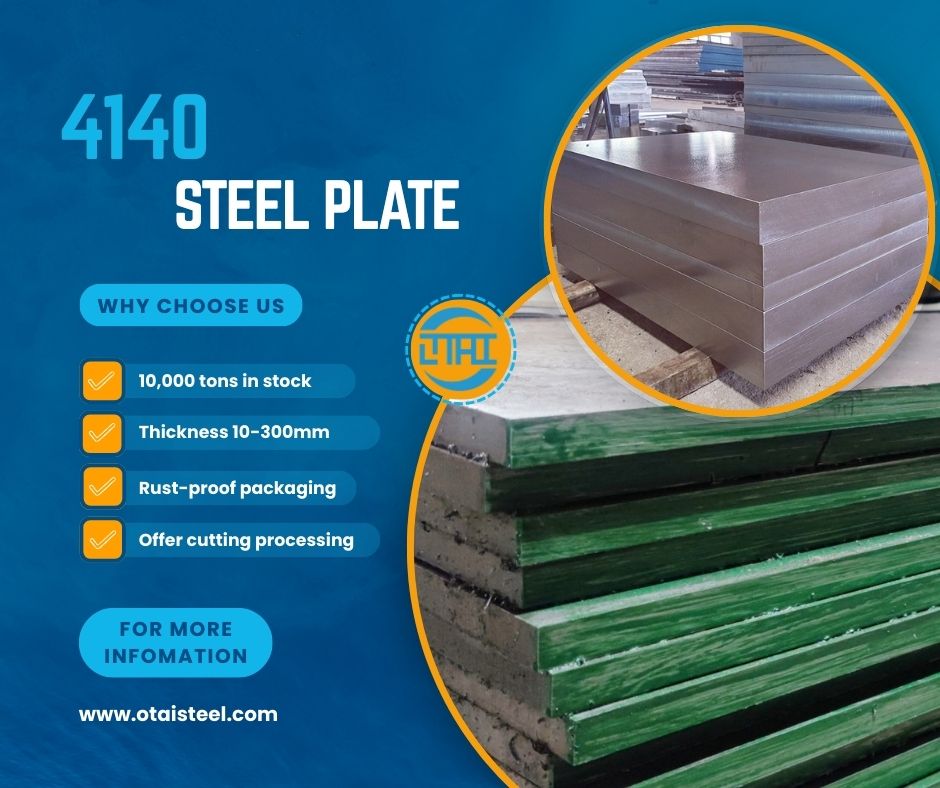
At Otai Special Steel, we provide high-quality AISI 4140 alloy steel tailored for demanding industrial applications.
Our strengths include:
- Over 10,000 tons of ready stock for fast delivery
- Wide thickness range from 6 mm to 300 mm
- Precision cutting and processing services
- Strict ultrasonic testing (UT) for internal quality assurance
- Full chemical composition verification
- Trusted by global companies such as Thyssenkrupp, Borealis, and Schlumberger
We help customers select the right materials based on both strength and elastic performance requirements.
❓ FAQ
1. What is the Young’s modulus of 4140 steel?
The Young’s modulus of 4140 steel is typically 200–210 GPa, indicating high stiffness and low elastic deformation.
2. Does heat treatment affect the modulus of 4140 steel?
No, heat treatment has minimal effect on the modulus of elasticity, although it significantly changes strength and hardness.
3. Why is Young’s modulus important for 4140 steel?
It helps engineers predict how much a component will deform under load, which is critical for precision and structural applications.
4. Is 4140 steel stiffer than aluminum?
Yes, 4140 steel is about three times stiffer than aluminum, making it more suitable for load-bearing structures.