5140 vs 4140 Steel: Which Grade Is Better for Your Application?
📑 Table of Contents
- 🔍 5140 vs 4140 Steel: What Is the Main Difference?
- 🧪 Chemical Composition: How Do the Two Grades Differ?
- ⚙️ Mechanical Properties: Strength, Hardness, and Toughness
- 🔥 Heat Treatment and Hardenability: Which Grade Performs Better?
- 🏭 Applications: Where Should You Use 5140 or 4140?
- 🔧 Machinability and Weldability: What Should Fabricators Consider?
- 🔄 Can 5140 Replace 4140 Steel?
- 🛒 Purchasing 5140 vs 4140: What Should Buyers Check?
- 🏢 Why Source 5140 and 4140 Steel from OTAI?
- ❓ Frequently Asked Questions
🔍 5140 vs 4140 Steel: What Is the Main Difference?
When selecting alloy steel for shafts, gears, machine components, and other load-bearing parts, buyers often compare AISI 5140 and AISI 4140. Both grades contain chromium and have medium-carbon compositions. They can achieve useful strength and hardness through heat treatment. However, their alloying systems are different, and that difference affects hardenability, performance in larger sections, and material selection.
The main difference is molybdenum. AISI 4140 is a chromium-molybdenum alloy steel, while AISI 5140 is generally classified as a chromium alloy steel without the intentional molybdenum addition found in 4140. Molybdenum helps 4140 develop a more uniform hardened structure through thicker sections. As a result, 4140 often offers an advantage when a component needs a combination of strength, toughness, and hardenability.
However, this does not mean 4140 is automatically the better choice for every project. A 5140 component may meet the required mechanical properties, especially when the part has a suitable cross-section and the heat-treatment process is properly controlled. In those cases, choosing 5140 may provide a practical material option.
| Comparison Point | AISI 5140 | AISI 4140 |
|---|---|---|
| Steel classification | Chromium alloy steel | Chromium-molybdenum alloy steel |
| Carbon content | Approximately 0.38–0.43% | Approximately 0.38–0.43% |
| Main alloying elements | Chromium and manganese | Chromium, manganese, and molybdenum |
| Hardenability | Suitable for many medium-section components | Generally higher, especially for larger sections |
| Typical use | Shafts, pins, gears, and general machinery parts | High-load shafts, gears, axles, and machine components |
| Selection priority | Suitable properties with an appropriate section size and heat treatment | Greater hardenability and more demanding strength requirements |
For buyers, the correct decision depends on more than the grade designation. You should also consider component dimensions, heat-treatment condition, required hardness, impact performance, and applicable material standards. A comparison based only on nominal carbon content or surface hardness may lead to an unsuitable substitution.
Which grade should you consider first?
Start with the performance requirements of the finished component. If the part has a relatively small or moderate section and 5140 can meet the specified properties, it may be a suitable choice. On the other hand, if the component has a larger cross-section or needs more consistent hardening through its section, 4140 deserves closer consideration.
Neither grade guarantees a particular strength or hardness without a defined manufacturing and heat-treatment process. Therefore, use the material certificate, product specification, and test results to make the final decision.
🧪 Chemical Composition: How Do the Two Grades Differ?
Chemical composition explains why 5140 and 4140 behave differently during heat treatment. Both grades contain a similar carbon range, which supports medium-to-high strength after suitable hardening and tempering. Chromium also contributes to hardenability and wear resistance. However, 4140 includes molybdenum, which changes its response to quenching and tempering.
Typical composition ranges
The following table gives commonly referenced composition ranges for AISI 5140 and AISI 4140. Exact limits depend on the governing standard, product specification, and applicable edition. Buyers should always compare the actual purchase specification and mill test certificate (MTC) rather than treating this table as a substitute for a standard.
| Element | AISI 5140 (%) | AISI 4140 (%) | Main Function |
|---|---|---|---|
| Carbon (C) | 0.38–0.43 | 0.38–0.43 | Increases hardness and strength after heat treatment |
| Chromium (Cr) | 0.70–0.90 | 0.80–1.10 | Improves hardenability, strength, and wear resistance |
| Manganese (Mn) | 0.70–0.90 | 0.75–1.00 | Contributes to strength and hardenability |
| Molybdenum (Mo) | Not normally specified as a major addition | 0.15–0.25 | Improves hardenability and tempering response |
Note: These are commonly referenced ranges for comparison, not a universal acceptance specification. The applicable standard and edition may define different limits. Actual heat analysis must be checked against the MTC.
Why does molybdenum matter?
Molybdenum helps delay certain transformation reactions during cooling. This allows 4140 to develop a hardened structure more readily through a larger section under suitable quenching conditions. It also supports tempering resistance, helping the steel retain useful strength after tempering.
By comparison, 5140 relies mainly on chromium and manganese for its alloy hardenability. It can still provide good mechanical performance, but its response may differ when manufacturers increase the section size or require a particular core hardness.
Why should buyers check the MTC?
Two batches carrying the same grade designation may show small differences within the permitted chemical ranges. These differences can influence hardenability, carbon equivalent, machining response, and heat-treatment results. For critical components, request the heat analysis and verify that every element meets the agreed specification.
Do not assume that a similar carbon content makes 5140 and 4140 interchangeable. The chromium and molybdenum contents also affect the material’s performance. When a project requires strict mechanical properties, review the complete chemistry together with the heat-treatment condition and test results.
⚙️ Mechanical Properties: Strength, Hardness, and Toughness
Mechanical properties determine whether a steel grade can withstand the loads, impact, and operating conditions of a component. Buyers comparing 5140 and 4140 often focus on tensile strength and hardness. However, yield strength, elongation, impact toughness, and through-section consistency also matter.
Strength and hardness depend on material condition
Neither 5140 nor 4140 has one fixed tensile strength or hardness value that applies to every supply condition. Annealed steel, normalized steel, quenched-and-tempered steel, and induction-hardened components can show substantially different results.
For example, a quenched-and-tempered 4140 bar may have a different strength level from an annealed 4140 plate. The same principle applies to 5140. Therefore, a supplier quotation that lists only the grade without the delivery condition does not provide enough information for a reliable technical comparison.
| Property | 5140 | 4140 | What Buyers Should Evaluate |
|---|---|---|---|
| Tensile strength | Can reach high levels after suitable heat treatment | Can reach high levels after suitable heat treatment | Compare actual test values and the specified condition |
| Yield strength | Depends on section size and heat treatment | Depends on section size and heat treatment | Check the minimum requirement and test direction |
| Hardness | Achievable level depends on quenching and tempering | Often offers an advantage in through-hardening larger sections | Specify hardness range, test location, and method |
| Toughness | Depends on microstructure and tempering condition | Can provide a useful strength-toughness balance | Check impact requirements and service temperature |
| Wear resistance | Can perform well with suitable surface hardening | Can perform well with suitable surface or through-hardening | Consider contact stress, lubrication, and surface treatment |
Does 4140 always have higher strength?
No. A properly heat-treated 5140 component can achieve strength levels suitable for many demanding applications. Meanwhile, an incorrectly heat-treated 4140 component may fail to meet the required mechanical properties.
The practical advantage of 4140 is its generally higher hardenability, not a guarantee that every 4140 product will have higher tensile strength than every 5140 product. Actual performance depends on the product dimensions, manufacturing history, quenching method, tempering temperature, and inspection location.
Why does section size matter?
A small-diameter shaft cools differently from a thick shaft or large plate during quenching. The surface may cool quickly while the core cools more slowly. This difference can produce a hardness gradient through the section.
For this reason, buyers should not compare hardness readings from different locations as if they represent identical material performance. If the component requires a specific core property, define the sampling location and test method before ordering. For large or safety-critical parts, discuss hardenability and section-size limitations with the heat-treatment provider.
🔥 Heat Treatment and Hardenability: Which Grade Performs Better?
Heat treatment plays a central role in the performance of both 5140 and 4140. Manufacturers commonly use annealing or normalizing to prepare the material for machining, followed by quenching and tempering when the finished component requires higher strength and hardness. Some applications also use induction hardening or other surface-hardening processes.
Quenching and tempering
During quenching, the steel cools rapidly from its austenitizing temperature. The cooling rate affects the resulting microstructure and hardness. Tempering then reduces brittleness and adjusts the balance between strength and toughness.
Both 5140 and 4140 can respond well to this process. However, 4140’s molybdenum addition generally improves its hardenability. This makes it particularly useful when manufacturers need a more favorable hardness distribution through a larger cross-section.
5140 can still be a suitable choice for components with dimensions that allow the required cooling rate and mechanical properties. The heat-treatment provider should determine the appropriate process based on the grade, section size, furnace conditions, quenching medium, and required final properties.
Through-hardening versus surface hardening
Through-hardening aims to develop the required hardened structure throughout the component section. Surface-hardening processes, such as induction hardening, focus on producing a hard surface layer while retaining a tougher core.
Both grades may be considered for induction-hardened shafts, pins, and gear-related components. The final result depends on the surface chemistry, prior microstructure, heating pattern, quenching process, and component geometry. A grade name alone cannot guarantee a specific case depth or surface hardness.
What should buyers specify?
- Delivery condition: State whether the material should arrive annealed, normalized, quenched and tempered, or in another agreed condition.
- Final hardness: Define the required hardness range and test method, such as HBW or HRC where appropriate.
- Section dimensions: Provide the actual thickness or diameter, not just the component’s general description.
- Core requirements: If the part needs a specified core hardness or impact value, identify the test location and acceptance criteria.
- Heat-treatment records: For critical parts, request process records or test reports that support the agreed requirements.
For example, a buyer sourcing thick 4140 plate for machining may need a specified quenched-and-tempered condition. Another buyer purchasing 5140 for medium-section shafts may prefer an annealed supply condition before machining and final hardening. These are different purchasing requirements, even though both products belong to the medium-carbon alloy steel family.
🏭 Applications: Where Should You Use 5140 or 4140?
Both grades serve machinery and engineering applications that require strength, wear resistance, and heat-treatment capability. The best choice depends on the load profile, component geometry, production process, and required service life.
Common applications for 5140 steel
5140 is used for components such as shafts, pins, axles, gears, and other machine parts that require medium-to-high strength after heat treatment. It can be a practical option when the component dimensions and heat-treatment process allow the material to meet the required properties.
Manufacturers may consider 5140 for general mechanical parts where chromium alloy steel performance is sufficient. However, they should confirm the required core properties when the part has a large section or experiences repeated impact and high stress.
Common applications for 4140 steel
4140 is widely used for shafts, crankshafts, axles, gears, couplings, machine components, and industrial equipment parts. Its chromium-molybdenum alloy system makes it a common choice for components that need a combination of strength, toughness, and hardenability.
Manufacturers often select 4140 when a component has a larger cross-section or when the engineering specification calls for a particular quenched-and-tempered performance level. It is also available in different supply conditions, so buyers can select material that suits their machining and heat-treatment sequence.
| Component or Application | Potential Grade | Selection Consideration |
|---|---|---|
| Medium-section shafts | 5140 or 4140 | Compare strength, core hardness, and section size |
| Large-diameter shafts | Often 4140 for higher hardenability requirements | Evaluate through-section properties and quenching capability |
| Pins and axles | 5140 or 4140 | Check fatigue loading, impact, and surface hardness |
| Heavy-duty machine components | Often 4140 | Review mechanical requirements and heat-treatment condition |
| General gears and mechanical parts | 5140 or 4140, depending on design | Consider tooth contact stress, core toughness, and hardening method |
Match the grade to the component, not just the industry
A gear manufacturer, for example, should not choose 4140 simply because the part is a gear. The design may require a case-hardening steel instead, depending on tooth loading, surface durability, and core properties. Similarly, a shaft manufacturer should evaluate bending stress, torsion, fatigue, and diameter before selecting 5140 or 4140.
When you request a quotation, provide the component’s intended use, dimensions, delivery condition, and required properties. This information helps the supplier recommend a suitable grade and supply form rather than offering a material based only on its name.
🔧 Machinability and Weldability: What Should Fabricators Consider?
Machinability and weldability affect manufacturing cost, production time, and the risk of defects. Although 5140 and 4140 share a similar carbon range, their alloying differences and supply conditions influence how fabricators should process them.
Machinability of 5140 and 4140
Both grades can be machined in suitable delivery conditions. Annealed or normalized material is generally easier to machine than material supplied at a high quenched-and-tempered hardness. As hardness increases, cutting forces and tool wear can also increase.
4140 is commonly machined in annealed or pre-hardened conditions, depending on the component and production route. Manufacturers should select cutting tools, speeds, feeds, and coolant according to the actual hardness and machining operation. The same approach applies to 5140.
For buyers, the most important question is not simply which grade machines faster. Instead, consider the full manufacturing sequence. A material that costs less per ton may require more machining time, additional heat treatment, or greater process control. Compare the total production cost rather than the raw material price alone.
Weldability requires additional control
Neither grade should be treated as an easy-to-weld mild steel. Their medium carbon content and alloying elements increase the risk of heat-affected-zone hardening and hydrogen-assisted cracking. Welding procedures therefore need to account for carbon equivalent, material thickness, restraint, initial condition, and the required service properties.
Preheating can reduce cooling rates and help limit the formation of excessively hard microstructures. Low-hydrogen consumables, controlled interpass temperatures, and suitable post-weld heat treatment may also be necessary. However, there is no single preheat or post-weld heat-treatment temperature that applies to every 5140 or 4140 welding job.
What fabricators should confirm before welding
- Check the actual chemical composition and calculate carbon equivalent using the method required by the applicable welding procedure.
- Confirm the material thickness, initial hardness, and quenched-and-tempered or annealed condition.
- Use a qualified welding procedure specification (WPS), supported by procedure qualification where required.
- Control hydrogen input, preheat, interpass temperature, and cooling conditions.
- Determine whether post-weld heat treatment is necessary and whether it will affect the required mechanical properties.
For safety-critical components, welding should follow the applicable engineering code and qualified procedure. A grade comparison alone cannot establish whether a welding process is acceptable.
🔄 Can 5140 Replace 4140 Steel?
5140 may replace 4140 in some applications, but the two grades are not automatically interchangeable. Their similar carbon content and shared chromium alloying can make them appear comparable. However, 4140 contains molybdenum, which generally gives it higher hardenability and a different response during heat treatment.
When might 5140 be a suitable alternative?
Consider 5140 when the component has a section size that can achieve the required properties, the design does not depend on the additional hardenability of 4140, and the material meets the applicable specification. A manufacturer may also evaluate 5140 when the production process and test results demonstrate that it can satisfy the component’s mechanical requirements.
For example, a medium-section shaft may not need the same through-hardening capability as a large-diameter, heavily loaded component. If 5140 achieves the specified hardness, strength, and toughness at the required test locations, it may be a technically acceptable option.
When should buyers avoid direct substitution?
Do not replace 4140 with 5140 without engineering approval when the component relies on a specified hardenability range, core hardness, impact toughness, fatigue performance, or a qualified manufacturing process. The risk becomes more significant for large cross-sections, high-load parts, and components with strict safety or regulatory requirements.
Also, do not assume that matching surface hardness proves equivalent performance. Two materials can show similar surface readings while having different core structures and mechanical properties. For critical parts, compare the relevant test results and, where necessary, conduct qualification trials using the actual component dimensions and heat-treatment process.
A practical substitution checklist
| Check | Question to Answer |
|---|---|
| Material standard | Does the project specification permit the alternative grade? |
| Chemical composition | Does the actual heat analysis meet the approved requirements? |
| Section size | Can the alternative grade achieve the required core properties? |
| Heat treatment | Can the existing process produce acceptable hardness and microstructure? |
| Mechanical testing | Do tensile, impact, hardness, and other required results meet the specification? |
| Approval | Has the responsible engineer or customer approved the substitution? |
For procurement teams, the safest approach is to treat 5140 as a possible alternative—not an automatic equivalent—to 4140. Obtain technical approval before changing the grade on a purchase order, drawing, or production specification.
🛒 Purchasing 5140 vs 4140: What Should Buyers Check?
Choosing the correct grade is only one part of a successful steel purchase. Buyers also need to confirm the product form, dimensions, delivery condition, inspection requirements, and supplier’s ability to provide consistent material. These details influence both manufacturing performance and total purchasing cost.
Confirm the standard and product form
Start by identifying the exact grade designation and governing standard. AISI 5140 and AISI 4140 are commonly used designations, but buyers may encounter related national or international grade systems. Similar chemical compositions do not automatically establish full equivalence across standards.
Next, specify whether you need plate, flat bar, round bar, or another product form. The available dimensions and applicable mechanical requirements may differ between forms. If the component will be machined from plate or bar, confirm that the supplied size leaves enough machining allowance.
Specify the delivery condition and inspection requirements
State whether the steel should be supplied annealed, normalized, quenched and tempered, or in another agreed condition. If the project requires ultrasonic testing, third-party inspection, or special dimensional tolerances, include these requirements in the inquiry rather than adding them after production.
Ask for an MTC that identifies the heat number, chemical composition, and applicable mechanical test results. Depending on the project, the certificate may also need to show hardness, heat-treatment condition, product dimensions, and inspection details.
Compare the total cost, not only the price per ton
4140 may carry a different purchase price from 5140 because of its alloying composition, supply condition, and market availability. However, raw material price alone does not determine the best commercial choice.
Consider cutting, machining, heat treatment, scrap allowance, inspection, packaging, and delivery. If one grade reduces heat-treatment risk or improves production consistency, its higher initial price may still make commercial sense. Conversely, if 5140 meets the engineering requirements, paying extra for 4140 may not provide a meaningful benefit.
Information to include in a quotation request
- Grade and governing standard: AISI 5140, AISI 4140, or the exact approved equivalent.
- Product form and dimensions: thickness, width, length, or diameter as applicable.
- Quantity: total tonnage or piece count.
- Delivery condition: annealed, normalized, quenched and tempered, or another specified condition.
- Mechanical requirements: hardness, tensile strength, yield strength, and impact values where applicable.
- Inspection documents: MTC, ultrasonic testing, third-party inspection, or other agreed reports.
- Processing requirements: cutting, machining, grinding, or other value-added services.
- Destination and packaging requirements: export packing, anti-rust protection, and delivery terms.
Providing these details helps suppliers quote on a comparable basis. It also reduces the risk of receiving material that meets the grade designation but does not suit the actual manufacturing process.
🏢 Why Source 5140 and 4140 Steel from OTAI?
When sourcing alloy steel for international manufacturing projects, buyers need more than a material quotation. They also need reliable stock information, accurate cutting, suitable documentation, and export packing that protects the steel during transportation.
OTAI Special Steel supplies alloy steel and tool steel to customers in international markets. Our services support buyers who need material selection assistance, customized dimensions, and coordinated processing.
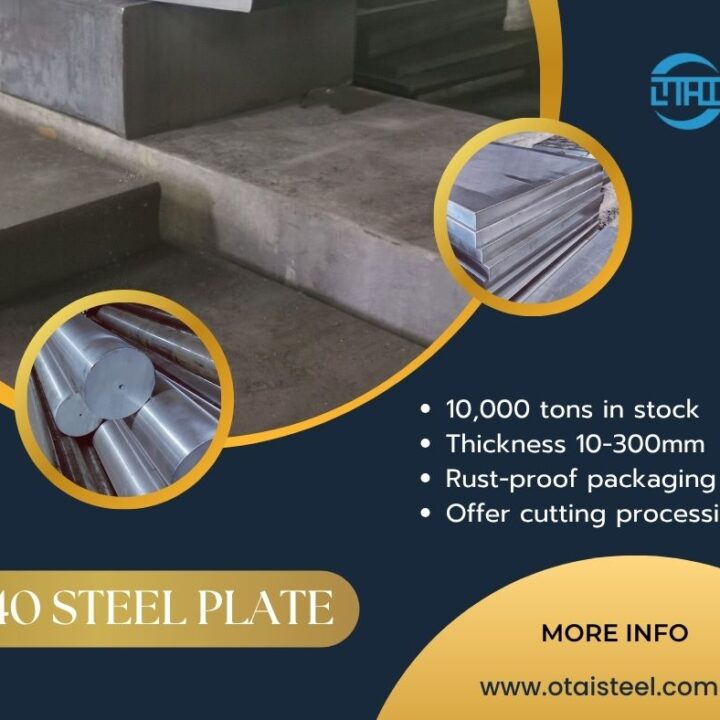
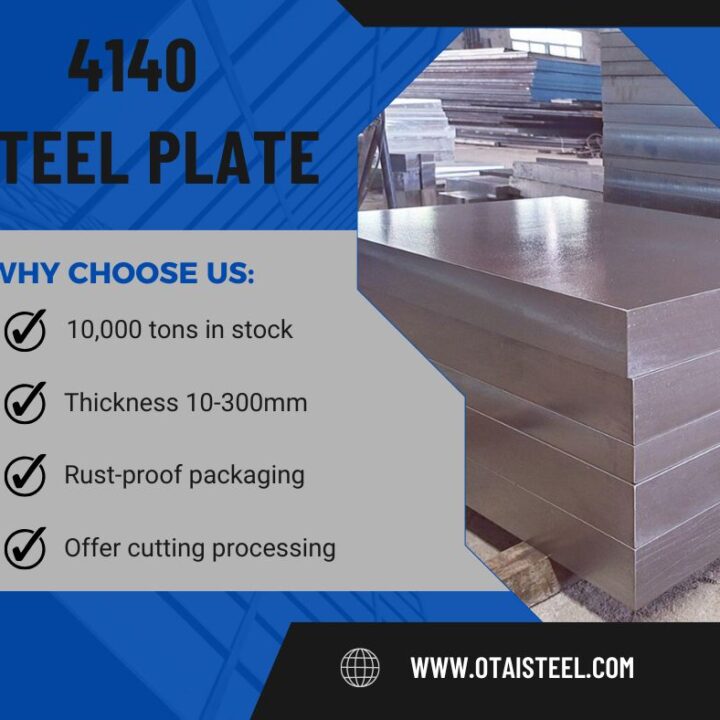
- Extensive inventory: More than 10,000 tons of steel stock supports a range of industrial purchasing requirements.
- 5140 steel plate: Available thickness range of 4–300 mm, subject to current stock confirmation.
- 4140 steel plate: Available thickness range of 4–380 mm.
- 4140 QT plate: Available thickness range of 13–200 mm.
- Cutting and machining: 20 saw-cutting machines, CNC machining, and grinding services support customized sizes and tolerances.
- Quality support: Material testing, ultrasonic testing, and third-party inspection support can be arranged according to project requirements.
- Export experience: Supplying international customers since 1999, with exports to more than 54 countries.
- Packaging and delivery: Anti-rust protection, strapping, bundling, and wooden-case packaging options help protect goods during transportation.
- One-stop service: Cutting, machining, inspection coordination, and packaging help simplify the purchasing process.
For product details, visit our official pages for AISI 5140 alloy steel and 4140 alloy steel plate.
If you are comparing 5140 and 4140 for a specific component, send us the required grade, dimensions, quantity, delivery condition, and technical requirements. Our team can help check the suitable stock options and processing requirements for your project.
❓ Frequently Asked Questions
1. Is 5140 steel stronger than 4140 steel?
Not necessarily. Both grades can achieve high strength after suitable heat treatment. However, 4140 generally has higher hardenability because it contains molybdenum. The actual strength of either grade depends on its section size, delivery condition, heat-treatment process, and test results.
2. What is the main difference between 5140 and 4140 steel?
The main difference is their alloying composition. Both contain chromium and a similar carbon range, but 4140 also contains a specified molybdenum addition. This improves its hardenability and influences its response to tempering, particularly in larger sections.
3. Can I use 5140 instead of 4140?
In some applications, yes. However, you must confirm that 5140 meets the required chemical, mechanical, and heat-treatment specifications. Check section size, core hardness, impact requirements, and customer approval before substituting it for 4140.
4. Which steel is better for shafts, 5140 or 4140?
Both grades can be suitable for shafts. 5140 may work well for components with appropriate section dimensions and moderate performance requirements. 4140 is often preferred when the shaft needs higher hardenability or more demanding through-section properties. The final choice should follow the shaft’s loading conditions and engineering specification.
5. Is 4140 more expensive than 5140?
4140 may cost more than 5140 because of its alloying composition and market conditions, but the price difference varies by supplier, dimensions, quantity, and delivery condition. Buyers should compare the total cost, including machining, heat treatment, inspection, packaging, and transportation, rather than relying only on the price per ton.