 16MnCr5 vs 16MnCr5H: A Detailed Comparison
🔍 Introduction
When comparing 16MnCr5 vs 16MnCr5H, both materials are alloy steels used extensively in mechanical and automotive industries. They share similar characteristics, but subtle differences in composition, hardness, strength, and applications make each one suitable for specific purposes. Understanding these differences helps you choose the right material for your project.
In this article, we’ll explore the chemical composition, hardness, strength properties, and applications of 16MnCr5 and 16MnCr5H to help you understand how they compare and which one suits your needs.
⚙️ Chemical Composition of 16MnCr5 vs 16MnCr5H
The chemical composition of 16MnCr5 and 16MnCr5H is similar, but 16MnCr5H contains additional elements that enhance its hardness and wear resistance, making it suitable for more demanding applications.
1. 16MnCr5 Chemical Composition:
- Carbon (C): 0.14–0.19%
- Manganese (Mn): 1.00–1.30%
- Chromium (Cr): 0.80–1.10%
- Silicon (Si): 0.20–0.35%
- Phosphorus (P): ≤ 0.035%
- Sulfur (S): ≤ 0.035%
This composition allows 16MnCr5 to undergo carburizing and case hardening processes, which give it good wear resistance and toughness.
2. 16MnCr5H Chemical Composition:
- Carbon (C): 0.18–0.22%
- Manganese (Mn): 1.00–1.30%
- Chromium (Cr): 0.80–1.10%
- Silicon (Si): 0.20–0.35%
- Phosphorus (P): ≤ 0.035%
- Sulfur (S): ≤ 0.035%
- Boron (B): 0.001–0.005%
The addition of boron in 16MnCr5H improves its hardenability, making it better suited for parts requiring greater hardness and durability.
📊 Hardness and Strength Comparison
When comparing 16MnCr5 vs 16MnCr5H hardness, it’s evident that 16MnCr5H is specifically designed to be harder, offering better wear resistance.
| Property | 16MnCr5 | 16MnCr5H |
|---|---|---|
| Carbon Content | 0.14–0.19% | 0.18–0.22% |
| Chromium Content | 0.80–1.10% | 0.80–1.10% |
| Manganese Content | 1.00–1.30% | 1.00–1.30% |
| Hardness (HRC) | 25–32 HRC (heat treated) | 35–45 HRC (heat treated) |
| Yield Strength | 550–800 MPa | 600–850 MPa |
| Tensile Strength | 850–1000 MPa | 900–1200 MPa |
Insights:
- 16MnCr5H has a higher hardness range and superior tensile strength compared to 16MnCr5. The addition of boron enhances its ability to retain hardness in demanding conditions, making it ideal for parts exposed to heavy wear.
- 16MnCr5 offers versatility and good balance between toughness and wear resistance, which makes it suitable for general industrial applications.
🔥 Heat Treatment of 16MnCr5 vs 16MnCr5H
Both 16MnCr5 and 16MnCr5H can undergo similar heat treatment processes, but 16MnCr5H is more effective at achieving higher hardness levels due to the boron content.
1. 16MnCr5 Heat Treatment:
- Carburizing: This process adds carbon to the surface, increasing hardness.
- Tempering: After carburizing, tempering relieves internal stresses and improves toughness.
2. 16MnCr5H Heat Treatment:
- Carburizing with Boron: The boron in 16MnCr5H allows it to be hardened more deeply and uniformly than 16MnCr5, improving its wear resistance.
- Higher Tempering Temperature: To reach the desired hardness and strength, 16MnCr5H requires higher tempering temperatures, which results in a more durable finish.
🏭 Applications of 16MnCr5 vs 16MnCr5H
Both materials find applications in industries such as automotive, machinery, and engineering, but the choice depends on the required durability, hardness, and strength.
16MnCr5 Applications:
- Gears and shafts: Suitable for components exposed to moderate wear.
- Axles and bearings: Ideal for parts that experience moderate to high loads.
- Automotive parts: Perfect for car parts that require case hardening and moderate strength.
16MnCr5H Applications:
- High-performance gears: Ideal for automotive gears that require enhanced durability and wear resistance.
- Heavy-duty shafts: Used in machinery and equipment requiring high tensile strength and resistance to wear.
- Industrial machinery components: Perfect for parts exposed to high loads, stress, and abrasion.
Insight:
16MnCr5H is better suited for heavy-duty applications that require superior hardness and wear resistance. On the other hand, 16MnCr5 is a more versatile and cost-effective option for general industrial applications.
🏆 Company Advantages
At Otai Special Steel, we offer 16MnCr5 and 16MnCr5H with tailored solutions to meet the needs of various industries:
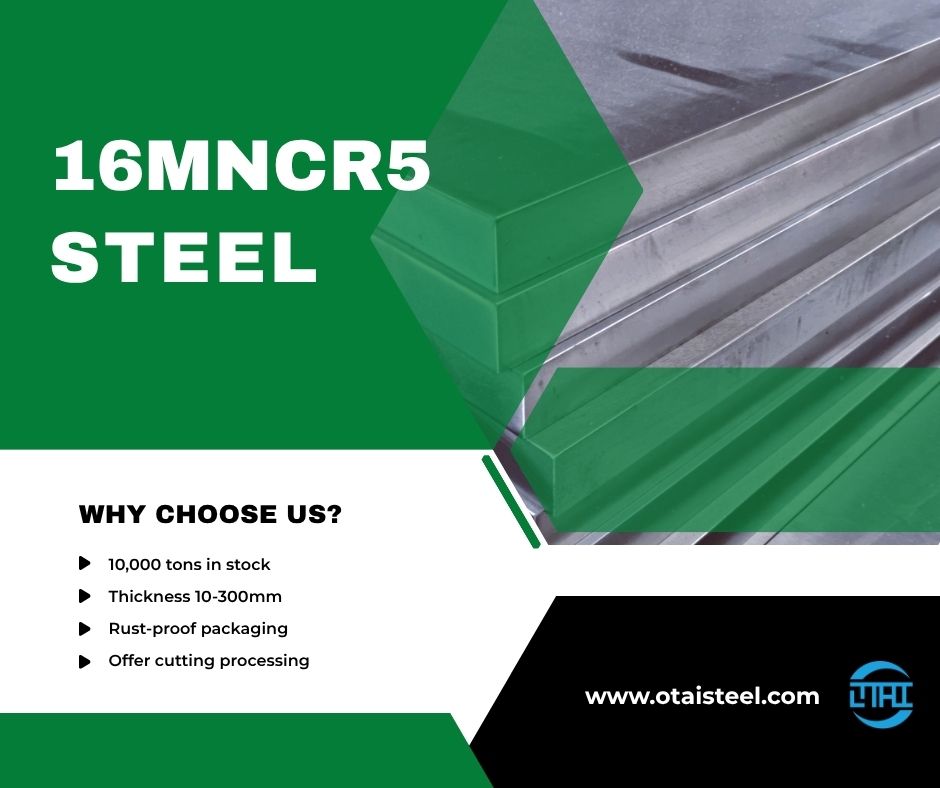
- Large Inventory: We maintain over 10,000 tons of steel in stock, including 16MnCr5 and 16MnCr5H.
- Custom Sizes and Cutting: We provide precision cutting and customized heat treatment services to meet your specific requirements.
- Strict Quality Control: Our products undergo ultrasonic testing (UT), chemical analysis, and third-party inspections, such as SGS, to ensure the highest quality.
- Global Supply: We serve industries around the world, delivering high-performance steels on time.
We are committed to providing high-quality materials that meet your performance and durability needs.
❓ FAQ
1. What is the main difference between 16MnCr5 and 16MnCr5H?
The key difference is that 16MnCr5H contains boron, which improves its hardenability and wear resistance, making it suitable for more demanding applications.
2. Can 16MnCr5H replace 16MnCr5 in all applications?
While 16MnCr5H offers superior hardness and tensile strength, 16MnCr5 is often more cost-effective and versatile for general applications.
3. What are the best uses for 16MnCr5?
16MnCr5 is ideal for components such as gears, shafts, and bearings, where moderate strength and wear resistance are needed.
4. Why is 16MnCr5H better for high-performance applications?
16MnCr5H provides higher hardness, wear resistance, and tensile strength, making it more suitable for parts exposed to heavy wear and high mechanical loads.
5. How does boron in 16MnCr5H affect its performance?
The addition of boron enhances 16MnCr5H‘s ability to achieve higher surface hardness, increasing its durability and resistance to wear.