 16MnCr5 Properties: Mechanical Performance, Heat Treatment, and Industrial Applications
🔍 Introduction
16MnCr5 properties make this alloy steel one of the most popular materials for components that require high surface hardness, strong core toughness, and excellent wear resistance. Manufacturers widely use 16MnCr5 steel in automotive, engineering, and heavy machinery industries because it responds exceptionally well to carburizing and heat treatment processes.
Engineers often select this material for gears, shafts, and transmission parts where strength and fatigue resistance play a critical role. Understanding the complete range of 16MnCr5 properties helps buyers and manufacturers choose the correct steel for demanding applications.
🛠️ What Is 16MnCr5 Steel?
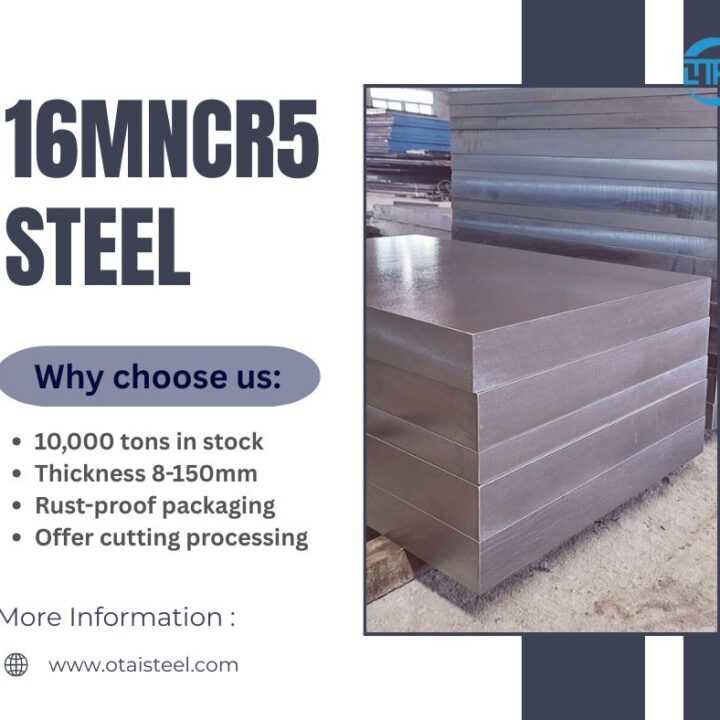
16MnCr5 steel is a low-carbon chromium-manganese alloy steel mainly used for carburizing applications. The material combines a tough core with a hardened surface after heat treatment.
Chemical Composition of 16MnCr5 Steel
| Element | Composition (%) |
|---|---|
| Carbon (C) | 0.14 – 0.19 |
| Manganese (Mn) | 1.00 – 1.30 |
| Chromium (Cr) | 0.80 – 1.10 |
| Silicon (Si) | ≤ 0.40 |
| Phosphorus (P) | ≤ 0.025 |
| Sulfur (S) | ≤ 0.035 |
This balanced composition gives the steel excellent hardenability and wear resistance while maintaining good machinability.
📊 Mechanical 16MnCr5 Properties
The mechanical 16MnCr5 properties vary depending on heat treatment condition and section size.
| Property | Typical Value |
|---|---|
| Tensile Strength | 800 – 1100 MPa |
| Yield Strength | 550 – 850 MPa |
| Elongation | 9 – 12% |
| Hardness (Core) | 28 – 34 HRC |
| Surface Hardness After Carburizing | 58 – 62 HRC |
| Impact Toughness | Good |
| Density | 7.85 g/cm³ |
| Elastic Modulus | 210 GPa |
These properties allow the material to handle heavy mechanical stress and repeated loading conditions.
🔥 Heat Treatment and Its Effect on 16MnCr5 Properties
Heat treatment plays a major role in developing the final performance of this alloy steel.
Carburizing
Carburizing increases carbon content on the steel surface.
Benefits include:
- Higher surface hardness
- Improved wear resistance
- Better fatigue strength
Quenching
Quenching rapidly cools the steel after heating.
This process:
- Increases hardness
- Enhances tensile strength
- Improves load-bearing capability
Tempering
Tempering reduces brittleness while maintaining strength.
Manufacturers use tempering to:
- Improve toughness
- Stabilize dimensions
- Reduce internal stress
After carburizing, quenching, and tempering, 16MnCr5 properties become ideal for high-wear industrial components.
⚙️ Key Advantages of 16MnCr5 Properties
Excellent Surface Hardness
The steel achieves extremely high surface hardness after carburizing, making it suitable for gears and wear-resistant components.
Strong Core Toughness
While the surface becomes hard, the core remains tough and resistant to impact loads.
Good Fatigue Resistance
Repeated stress cycles do not easily crack or deform the material.
Reliable Machinability
In annealed condition, manufacturers can machine the steel efficiently before heat treatment.
Excellent Hardenability
Chromium and manganese improve hardening depth and mechanical consistency.
🏭 Applications Based on 16MnCr5 Properties
Because of its excellent balance of strength and hardness, manufacturers use this steel in many industries.
Automotive Industry
Common applications include:
- Transmission gears
- Pinions
- Camshafts
- Drive shafts
Industrial Machinery
The steel performs well in:
- Gear systems
- Rollers
- Couplings
- Machine shafts
Agricultural Equipment
Manufacturers use the material for:
- Heavy-duty gears
- Rotating shafts
- Wear-resistant mechanical parts
Heavy Engineering
The steel supports applications requiring:
- High fatigue strength
- Surface durability
- Tough impact resistance
🌍 Equivalent Grades
Many international standards provide equivalent materials for 16MnCr5 steel.
| Standard | Equivalent Grade |
|---|---|
| DIN | 16MnCr5 |
| EN | 1.7131 |
| JIS | SCM415 |
| ASTM/AISI | 5115 |
| GB | 16CrMnH |
These equivalent grades offer similar chemical composition and mechanical performance.
🏢 Company Advantages
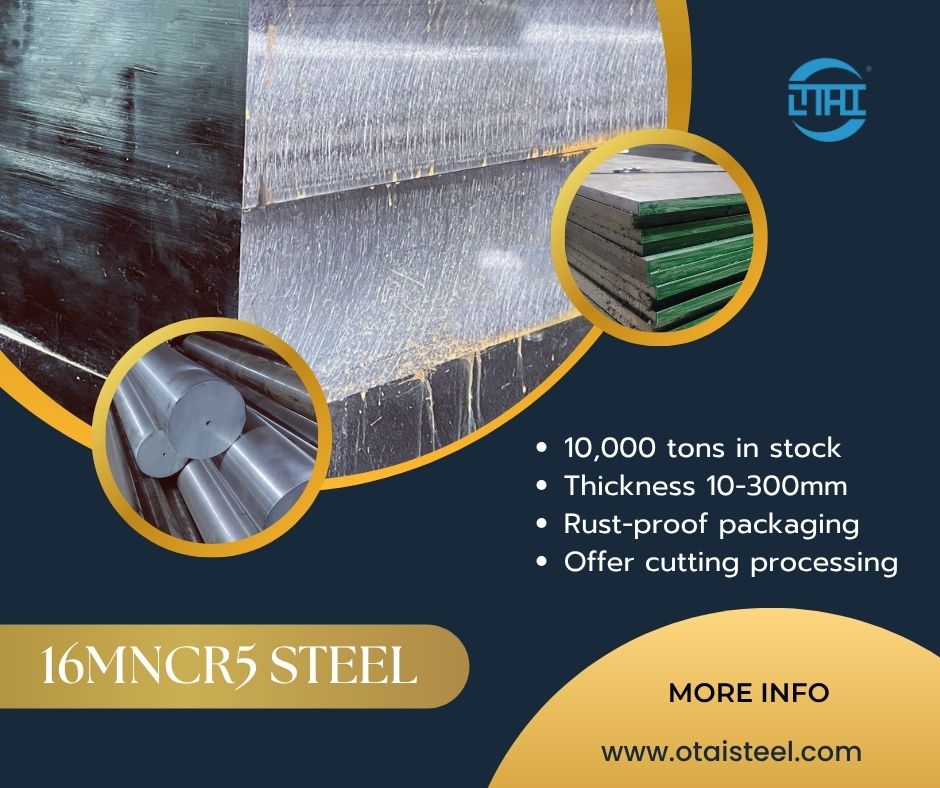
At Otai Special Steel, we provide premium-quality 16MnCr5 steel products for global industrial customers.
Our Services Include:
- Large inventory availability
- Precision cutting
- Heat treatment support
- Ultrasonic testing (UT)
- Mechanical property inspection
- Export-standard packaging
We help customers reduce machining costs and improve production efficiency with stable-quality alloy steel materials.
❓ FAQ
1. What are the main 16MnCr5 properties?
The material offers high surface hardness, strong core toughness, excellent wear resistance, and good fatigue strength.
2. What hardness can 16MnCr5 achieve after carburizing?
The surface hardness typically reaches 58–62 HRC after proper carburizing and quenching.
3. Is 16MnCr5 suitable for gears?
Yes. Manufacturers widely use it for gears because of its excellent wear resistance and fatigue performance.
4. Can 16MnCr5 steel be machined easily?
Yes. In annealed condition, the material provides good machinability before final heat treatment.
🔚 Conclusion
Understanding 16MnCr5 properties helps engineers and buyers select the right alloy steel for demanding industrial applications. With excellent surface hardness, strong toughness, and outstanding fatigue resistance, this material performs exceptionally well in gears, shafts, and high-load mechanical components.
Otai Special Steel supplies high-quality 16MnCr5 steel with custom processing services, strict quality control, and reliable global delivery for industrial manufacturers worldwide.