Skip to Content

Blog Archives

5140 Steel Bar: What Should Buyers Look for in 5140 Steel Bar?

5140 Steel Bar: What Should Buyers Look for in 5140 Steel Bar?

🔍 1. What Is 5140 Steel?

5140 steel is a medium-carbon chromium alloy steel commonly used for components that need higher strength and hardenability than plain carbon steel can provide. The grade belongs to the SAE/AISI 5100-series alloy steels, where chromium improves hardenability and supports the response to quenching and tempering.

In international material references, 5140 is associated with UNS G51400. Other cross-reference designations include 41Cr4 and 1.7035 in European material systems, although buyers should verify the applicable standard before treating two grades as interchangeable.

The term “5140 steel bar” normally describes a bar product supplied in a round, square or flat form depending on the producer and applicable specification. The product can undergo hot rolling, forging, machining or heat treatment before it reaches the final component stage.

For engineering applications, the main attraction comes from the balance between carbon and chromium. Carbon supports strength and hardness after heat treatment, while chromium improves hardenability compared with an equivalent plain-carbon steel.

Material condition matters just as much as the grade designation. Annealed 5140 favors machining, normalized material provides a different strength level, and quenched-and-tempered material can deliver substantially higher strength and hardness.

MatWeb lists 5140 under several related specifications and identifies UNS G51400, DIN 1.7035, AFNOR 42 C 4, JIS SCr4H and several SAE/ASTM specifications among its cross-reference information.

Therefore, a professional purchasing inquiry should specify the grade, standard, product dimensions, delivery condition, mechanical requirements and inspection documents instead of requesting only “5140 steel bar.”

⬆️ Back to Table of Contents

🧪 2. 5140 Steel Chemical Composition

The chemical composition of 5140 should be presented as a specified range rather than as one exact analysis. Actual chemistry can vary within the applicable specification, and the final heat analysis appears on the mill test certificate.

A commonly referenced SAE J404 composition range gives carbon at 0.38–0.43%, manganese at 0.70–0.90% and chromium at 0.70–0.90%. The same reference lists silicon at 0.15–0.35%, phosphorus at a maximum of 0.030% and sulfur at a maximum of 0.040%.

Element Commonly Referenced Range / Limit Main Function
Carbon (C) 0.38–0.43% Raises hardness and strength after heat treatment
Silicon (Si) 0.15–0.35% Supports deoxidation and strength
Manganese (Mn) 0.70–0.90% Improves strength and hardenability
Phosphorus (P) ≤0.030% Controlled impurity
Sulfur (S) ≤0.040% Controlled impurity; influences machinability
Chromium (Cr) 0.70–0.90% Improves hardenability and wear resistance

MatWeb provides a 5140 reference with the same core chemistry ranges: carbon 0.38–0.43%, chromium 0.70–0.90%, manganese 0.70–0.90%, silicon 0.15–0.30%, phosphorus up to 0.035% and sulfur up to 0.040%.

The small differences between published limits illustrate an important purchasing point: the applicable material specification controls the accepted chemistry. A supplier should therefore quote against the customer’s specified standard rather than mix composition limits from different references.

A steelmaker may also publish a typical analysis. That value represents a representative production heat and does not replace the permitted range. For procurement, the actual MTC remains the most relevant document because it identifies the chemical analysis of the supplied heat.

Chromium contributes particularly strongly to hardenability. Meanwhile, carbon determines much of the achievable hardness after quenching. Together, these elements make 5140 suitable for components that require a stronger heat-treated condition than ordinary mild steel.

⬆️ Back to Table of Contents

⚙️ 3. 5140 Steel Properties and Mechanical Performance

5140 steel provides a practical balance of strength, toughness, machinability and hardenability. Its final performance depends heavily on the delivery condition and heat-treatment process.

In annealed condition, MatWeb reports a reference hardness of 167 HB, tensile strength of 570 MPa and yield strength of 295 MPa. The same reference reports 28.6% elongation in 50 mm.

A normalized 25 mm round reference shows a different result: 229 HB hardness, 793 MPa tensile strength, 470 MPa yield strength and 22.7% elongation. These figures demonstrate why engineers should always identify the material condition when discussing 5140 mechanical properties.

Condition / Reference Hardness Tensile Strength Yield Strength Elongation
Annealed, 830°C reference 167 HB 570 MPa 295 MPa 28.6%
Normalized, 25 mm round 229 HB 793 MPa 470 MPa 22.7%
Q&T, 25 mm round reference 293 HB / 31 HRC 972 MPa 841 MPa 18.5%

The quenched-and-tempered reference above uses oil quenching from 845°C followed by tempering at 540°C. MatWeb reports 293 HB, approximately 31 HRC, 972 MPa tensile strength and 841 MPa yield strength for that specific 25 mm round specimen.

These numbers are reference test data for specific conditions and specimen sizes, not universal guaranteed properties for every 5140 steel bar. Section size, cooling rate and tempering temperature can all change the final mechanical performance.

For design work, engineers should use certified data for the actual material condition whenever the component has a critical strength or fatigue requirement.

⬆️ Back to Table of Contents

🔥 4. 5140 Steel Bar Heat Treatment

Heat treatment gives 5140 its main engineering advantage. The process can move the material from a relatively soft machining condition to a substantially stronger quenched-and-tempered condition.

A commonly referenced hardening cycle uses an austenitizing temperature around 845°C, followed by oil quenching. One MatWeb reference then tempers the 25 mm round specimen at 540°C and records approximately 31 HRC hardness.

Process Reference Temperature Typical Purpose
Annealing Around 830°C in one MatWeb reference Lower hardness and improve machinability
Normalizing Around 870°C in one reference Refine structure and establish a normalized condition
Hardening 845°C reference Create a hardenable austenitic structure before quenching
Quenching After austenitizing Increase hardness through rapid cooling
Tempering 540°C reference Balance hardness, strength and toughness

The exact heat-treatment cycle should not rely on one temperature copied from a general datasheet. Section diameter or thickness, furnace loading, heating rate, quenching medium and required final hardness all affect the appropriate process.

Holding time also requires engineering control. A large 5140 steel bar needs more time to reach a uniform core temperature than a small section. For this reason, a fixed “30-minute” or “one-hour” rule does not apply universally.

Quenching presents another important trade-off. Faster cooling can increase hardness, but excessive thermal stress can raise the risk of distortion or cracking. Oil quenching often provides a different cooling severity from water, so the selected medium should match the component geometry and required properties.

Tempering follows quenching to reduce excessive brittleness and establish the desired combination of hardness and toughness. Lower tempering temperatures generally retain more hardness, while higher temperatures normally reduce hardness and increase toughness.

⬆️ Back to Table of Contents

📏 5. 5140 Steel Hardness

There is no single hardness value for all 5140 steel bars. The delivery condition and heat-treatment route determine the actual hardness.

For example, MatWeb reports 167 HB for an annealed 5140 reference. A normalized 25 mm round specimen reaches 229 HB, while a specific oil-quenched and tempered specimen reaches 293 HB, equivalent to approximately 31 HRC.

Condition Reference Hardness What It Means for Buyers
Annealed 167 HB Suitable reference condition for machining
Normalized, 25 mm round 229 HB / approx. 19 HRC Higher strength than the annealed reference
Oil quenched + tempered, 25 mm round 293 HB / approx. 31 HRC Higher strength and hardness after Q&T

Hardness measurements also require attention to location. A large bar can develop different hardness levels from the surface toward the center because the surface cools faster during quenching.

For production purchasing, specify the hardness condition clearly. “5140 steel bar” identifies the alloy, but “5140, quenched and tempered, 28–32 HRC” communicates a much more precise requirement.

When the customer plans induction hardening, the supplier should also understand that the final surface hardness belongs to the finished component rather than the untreated incoming bar.

⬆️ Back to Table of Contents

🔧 6. Machining, Welding and Surface Hardening

Annealed 5140 generally offers better machinability than hardened material. MatWeb gives a machinability reference of approximately 65%, based on its stated comparison method using AISI 1212 steel as 100%.

Machining strategy should follow the actual hardness rather than the grade name alone. A bar supplied in an annealed condition can require very different cutting parameters from the same alloy after quenching and tempering.

Dimensional control becomes increasingly important when the component will undergo heat treatment after rough machining. Manufacturers commonly leave suitable machining allowance so that final grinding or machining can compensate for dimensional changes.

Grinding can provide tighter final dimensions, but excessive grinding heat may affect the hardened surface. Controlled feed rates, suitable wheels and adequate cooling help maintain the required surface condition.

Welding requires more care because 5140 contains approximately 0.4% carbon. The combination of carbon and alloying elements can increase hardening in the heat-affected zone, which may raise cracking risk if the welding procedure does not control thermal conditions.

For critical welded components, engineers should establish a qualified welding procedure that considers preheating, heat input, interpass temperature and any required post-weld heat treatment.

Surface hardening offers another route when a component needs a harder working surface without making the entire section equally hard. Induction hardening can rapidly heat the selected surface and then quench it.

This approach can work well for shafts, gears and other components exposed to repeated contact or wear. The final process should specify the required surface hardness and hardening depth instead of simply requesting “hardened 5140.”

⬆️ Back to Table of Contents

🏭 7. 5140 Steel Applications

5140 steel bar suits mechanical components that need a useful combination of strength, toughness and hardenability. Engineers can machine the material into individual components and then apply heat treatment according to the service requirements.

Common application areas include:

  • Automotive components
  • Machine shafts
  • Axles and axle-related components
  • Gears and transmission components
  • Drive components
  • Pinions
  • Bolts and high-strength mechanical parts
  • Induction-hardened components
  • General machinery components

The appropriate condition depends on the application. A machined shaft may require a relatively soft starting condition before final heat treatment, while a finished transmission component may need a defined quenched-and-tempered condition.

Component size also affects the selection. Small sections generally respond differently to quenching than large sections because the cooling rate through the cross-section changes.

Surface loading provides another selection factor. When the component experiences concentrated contact or repeated friction, an induction-hardening process may provide a harder surface while retaining a tougher interior.

For this reason, application-based material selection should consider load, section size, required hardness, heat-treatment route, machining allowance and service environment together.

⬆️ Back to Table of Contents

🔄 8. 5140 Steel Equivalent Grades and Comparisons

“5140 steel equivalent” is a common purchasing search because different markets use different grade designations. However, an equivalent designation should never replace technical verification.

Grade / Designation System Relationship Buyer Check
5140 / G51400 SAE / UNS Primary 5140 reference Confirm the required SAE specification
41Cr4 / 1.7035 EN / European Common international comparison Compare chemistry and standard requirements
SCr440 JIS Frequently compared Japanese grade Verify the exact JIS grade and condition
42CrMo4 EN Higher-alloy comparison grade Check molybdenum content and strength requirements

MatWeb lists 41Cr4, DIN 1.7035, AFNOR 42 C 4 and JIS SCr4H among the cross-reference information associated with AISI 5140.

These references are useful when a buyer searches for a local designation, but they do not automatically prove interchangeability for every application. Standards can differ in chemistry limits, product dimensions, mechanical requirements and delivery conditions.

42CrMo4 deserves particular attention because it contains molybdenum and belongs to a different alloy design. Therefore, buyers should not treat 42CrMo4 as simply another name for 5140.

When replacing 5140 with another grade, compare chemical composition → applicable standard → product form → heat-treatment condition → mechanical properties → inspection requirements.

⬆️ Back to Table of Contents

🛒 9. How to Buy 5140 Steel Bar

Buying 5140 for an industrial project requires more information than the grade name. A professional RFQ should tell the supplier exactly what the finished project requires.

For a 5140 steel bar inquiry, specify:

  • 5140 grade and applicable standard
  • Required product form
  • Diameter, width, thickness or other dimensions
  • Required length
  • Total quantity or weight
  • Delivery condition
  • Hardness requirement
  • Mechanical-property requirements
  • Dimensional tolerance
  • Surface condition
  • Material test certificate requirements
  • Ultrasonic testing requirements when applicable
  • Third-party inspection requirements when applicable
  • Packaging and export requirements

Material condition deserves special attention. If the customer plans CNC machining before final heat treatment, an annealed or machinable condition may make more sense than ordering fully hardened material.

On the other hand, a component that requires immediate mechanical service may need a defined quenched-and-tempered condition. The supplier should confirm the required hardness and mechanical properties before quotation.

For international procurement, the MTC should identify the heat number and report the actual chemical analysis. Buyers can then compare the supplied material against the agreed specification instead of relying on a generic online composition table.

Dimensional tolerance can also affect total project cost. When the customer needs precision-cut material, the supplier should confirm the cutting tolerance, machining allowance and final dimensions before production.

Finally, buyers should confirm the actual available product form. A supplier may list 5140 as a general alloy-steel grade while holding only certain forms or dimensions at the time of inquiry.

⬆️ Back to Table of Contents

🏢 10. Why Choose Otai for 5140 Steel?

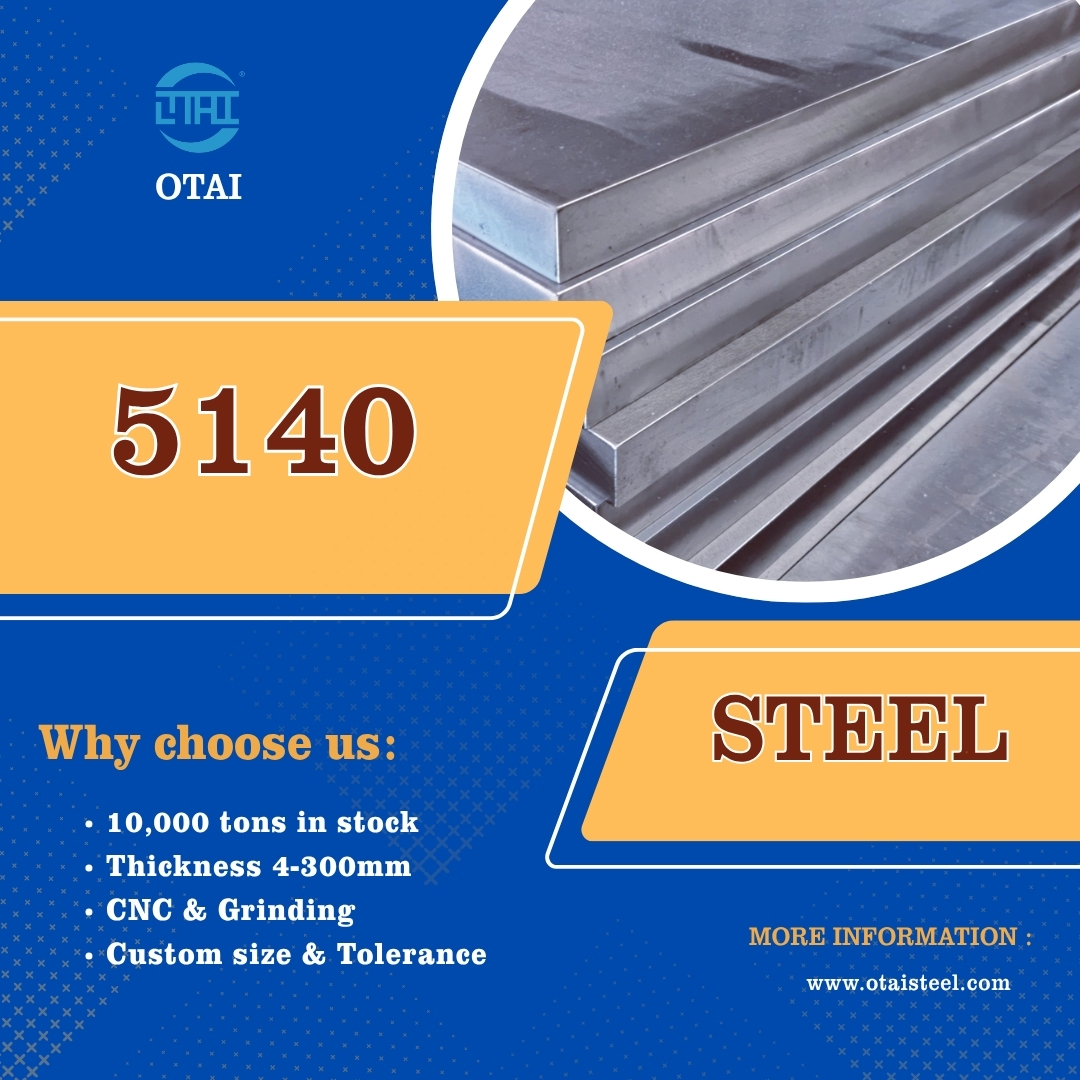
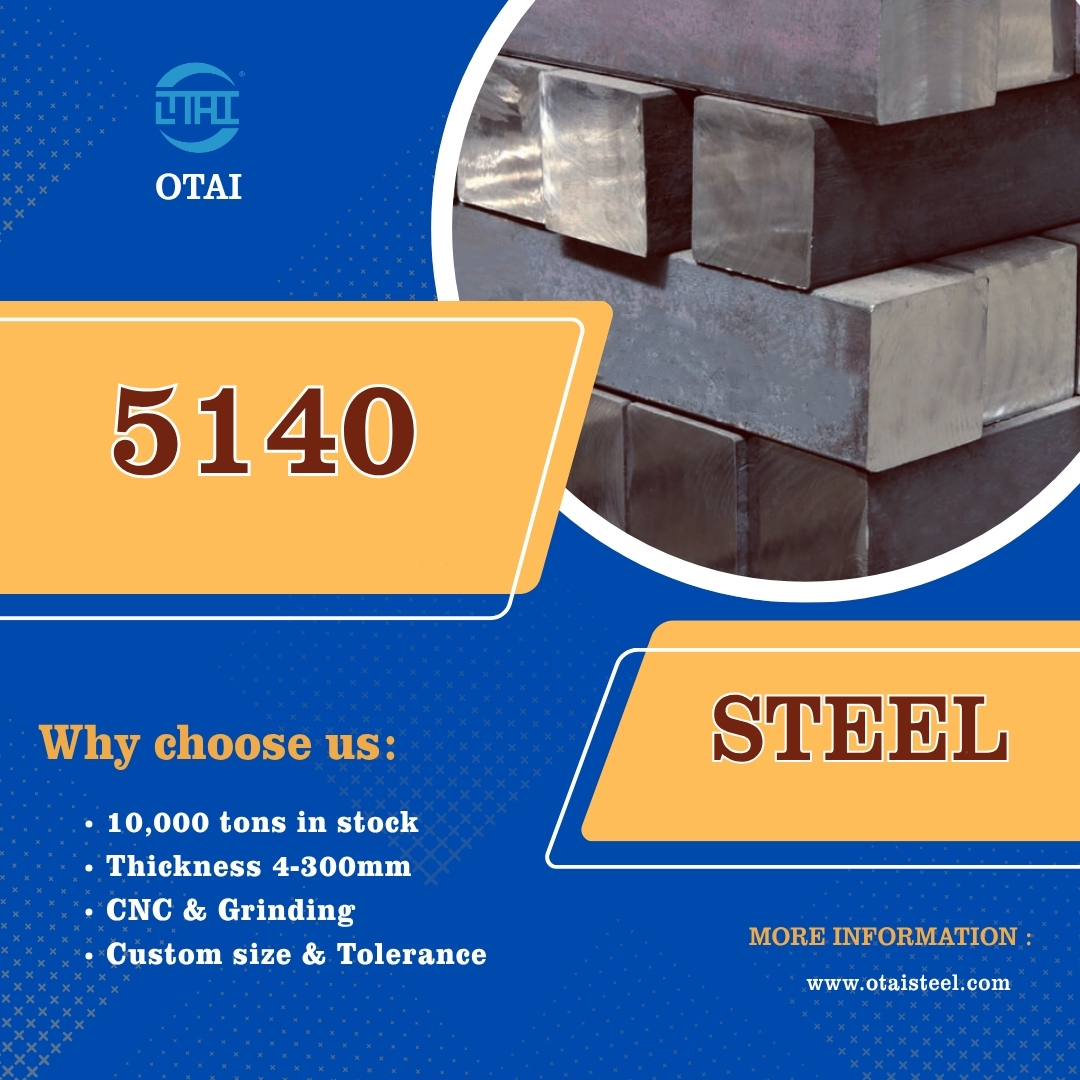
  • 5140 / 41Cr4 steel plate in stock: Otai currently has 5140 / 41Cr4 steel plate available in 4–300 mm thickness.
  • 10,000+ tons of total steel stock: Large inventory supports industrial sourcing and export orders.
  • 20 saw cutting machines: Otai can provide cutting services according to customer-specified dimensions.
  • Custom size and tolerance: Buyers can discuss required dimensions and machining allowances before shipment.
  • CNC and grinding: Additional processing can support projects that require closer dimensional control.
  • One-stop service: Cutting, machining, inspection, packaging and export coordination can be arranged through one supplier.
  • International export experience: Otai has exported steel to 54+ countries since 1999.
  • Inspection support: Material certificates, ultrasonic testing and third-party inspection can be arranged according to project requirements.
  • Export packaging: Anti-rust protection, bundled packaging and wooden box packaging can support international shipments.

For a 5140 steel inquiry, send the required dimensions, quantity, applicable standard, delivery condition and inspection requirements. Otai can then confirm the available 5140 / 41Cr4 steel plate stock and discuss cutting or additional processing requirements.

⬆️ Back to Table of Contents

❓ FAQ

1. What is 5140 steel bar?

5140 steel bar is a medium-carbon chromium alloy steel used for shafts, axles, gears, machine components and other parts that need useful strength and hardenability. The grade is commonly identified as SAE/AISI 5140 and UNS G51400.

2. What is the chemical composition of 5140 steel?

A commonly referenced SAE J404 composition gives 0.38–0.43% carbon, 0.70–0.90% manganese and 0.70–0.90% chromium, with silicon at 0.15–0.35%, phosphorus up to 0.030% and sulfur up to 0.040%. The actual heat chemistry should come from the supplier’s MTC.

3. What is the hardness of 5140 steel?

Hardness depends on the delivery condition. One annealed reference shows 167 HB, a normalized 25 mm round reference shows 229 HB, and an oil-quenched plus tempered 25 mm reference shows 293 HB or approximately 31 HRC.

4. What temperature is used for 5140 steel heat treatment?

One published reference uses 845°C for austenitizing, oil quenching and 540°C tempering. The exact cycle depends on section size, furnace conditions, quenching medium and the required final properties.

5. Is 5140 equivalent to 41Cr4?

5140 and 41Cr4 / 1.7035 frequently appear as international comparison grades. However, buyers should verify the applicable standard, chemistry, product form, heat-treatment condition and mechanical requirements before approving them as substitutes.
⬆️ Back to Table of Contents

0 0 Continue Reading →

5140 Steel: What Should You Know Before Buying 5140 Steel?

5140 Steel: What Should You Know Before Buying 5140 Steel?

When engineers and purchasing teams search for 5140 steel, they are usually looking for a practical combination of strength, toughness, hardenability and cost. The grade belongs to the AISI/SAE 5100 chromium alloy steel family and is widely considered for shafts, axles, pins, gears, machine parts and other components that need more performance than plain carbon steel can provide.

However, the grade designation alone does not define the final performance. Annealed 5140 behaves very differently from normalized or quenched-and-tempered material. Section size also affects the cooling rate and therefore the hardness and strength that the steel can achieve through the section.

For international buyers, another important point is grade comparison. 5140 is frequently compared with 41Cr4 / 1.7035, but the two designations should not automatically be treated as chemically identical. The applicable standard, chemistry, delivery condition and mechanical-property requirements should always be checked before substitution.

This article examines 5140 from both an engineering and purchasing perspective, including chemical composition, mechanical properties, heat treatment, hardness, equivalent grades, applications, machining, welding and supplier selection.

🔍 1. What Is 5140 Steel?

5140 is a medium-carbon chromium alloy steel commonly specified under the AISI/SAE system. Its UNS designation is G51400, and the material is also associated with specifications such as ASTM A322, ASTM A331, ASTM A505 and ASTM A519 depending on the product form and application.

The grade contains roughly 0.40% carbon and around 0.80% chromium. This combination gives it greater hardenability than a comparable plain carbon steel while keeping the alloy system relatively economical.

In production, 5140 can be supplied in annealed, normalized or quenched-and-tempered conditions. Buyers should therefore include the required delivery condition in the purchase specification instead of requesting only “5140 steel.”

Item 5140 Steel Information
AISI/SAE designation 5140
UNS G51400
Steel family Medium-carbon chromium alloy steel
Main alloying element Chromium
Common conditions Annealed, normalized, quenched and tempered
Typical role General-purpose strength-oriented engineering steel

In simple terms, 5140 is a medium-carbon chromium steel selected when a component needs a useful balance of strength, toughness and hardenability. It is not stainless steel, despite containing chromium, because its chromium content remains far below the level required for stainless behavior.

⬆️ Back to Table of Contents

🧪 2. 5140 Steel Chemical Composition

The chemical composition of 5140 explains why the grade performs differently from ordinary medium-carbon steel. Carbon provides the basic hardening potential, while chromium improves hardenability. Manganese also contributes to strength and hardening response.

Element Typical AISI 5140 Range / Limit (%) Main Contribution
C 0.38–0.43 Hardness and strength after heat treatment
Si 0.15–0.30 Deoxidation and strengthening
Mn 0.70–0.90 Strength and hardenability
Cr 0.70–0.90 Hardenability and wear resistance contribution
P Max. 0.035 Controlled residual element
S Max. 0.040 Residual element affecting machinability and toughness

The chemistry makes 5140 particularly useful for heat-treated components. Its carbon level is high enough to develop substantial hardness, while chromium improves the ability to harden beyond the immediate surface.

For procurement, the actual mill test certificate remains more important than a generic composition table. A professional buyer should verify the heat number, chemical analysis, applicable material standard and delivery condition before accepting the material.

It is also worth separating 5140 from nearby grades. For example, 5140 is not the same chemical grade as 4140. AISI 4140 contains molybdenum and a higher chromium range, while 5140 relies primarily on chromium and manganese for its alloying effect. That difference becomes important when engineers compare hardenability, strength and heat-treatment response.

⬆️ Back to Table of Contents

⚙️ 3. 5140 Steel Mechanical Properties

The mechanical properties of 5140 depend strongly on its metallurgical condition. This point matters because data for annealed, normalized and quenched-and-tempered material can differ substantially.

For example, MatWeb reports annealed 5140 at approximately 570 MPa ultimate tensile strength, 295 MPa yield strength and 167 HB under its stated annealing condition. A normalized 25 mm round example reaches approximately 793 MPa tensile strength and 470 MPa yield strength. These values demonstrate why the delivery condition must accompany a material quotation.

Condition / Example Ultimate Tensile Strength Yield Strength Hardness
Annealed reference About 570 MPa About 295 MPa About 167 HB
Normalized, 25 mm round About 793 MPa About 470 MPa About 229 HB
Normalized, 100 mm round About 765 MPa About 415 MPa About 217 HB
QT reference, 25 mm round About 972 MPa About 841 MPa About 293 HB

The QT values above come from a specific 25 mm round condition using oil quenching from 845°C followed by tempering at 540°C. They should therefore be treated as a reference condition rather than a universal specification for every 5140 product.

For engineering calculations, designers should use the mechanical values specified for the actual product standard and section size. Do not use a generic 5140 tensile-strength value without checking the delivery condition and dimensions.

⬆️ Back to Table of Contents

🔥 4. 5140 Steel Heat Treatment

Heat treatment allows manufacturers to adjust the strength and hardness of 5140 for different component requirements. The most common route is quenching followed by tempering, although annealing and normalizing also play important roles during manufacturing.

Treatment Reference Temperature / Condition Purpose
Annealing Example reference: 830°C, furnace cooling Reduce hardness and improve machinability
Normalizing Example: 870°C, air cooling Refine structure and establish a more uniform condition
Hardening Example QT condition: 845°C Austenitize before quenching
Quenching Oil used in the reference QT example Develop martensitic hardness
Tempering Example: 540°C Balance strength, hardness and toughness

The 845°C hardening and 540°C tempering values above come from a specific published 25 mm round test condition. Actual production parameters should account for section size, furnace loading, quenching equipment and required final properties.

For larger sections, the center cools more slowly than the surface. Consequently, the final hardness can vary through the cross-section. This is one reason why a supplier should not promise a single HRC value without knowing the product dimensions and heat-treatment condition.

The practical sequence is define the required mechanical properties → select the hardening condition → control the holding period → quench correctly → temper → verify hardness and test results.

⬆️ Back to Table of Contents

📏 5. 5140 Steel Hardness

Hardness is one of the most frequently searched properties when buyers look for 5140. However, there is no single hardness value that applies to every 5140 steel product.

Annealed 5140 can be around 167 HB in a published reference condition, while normalized 25 mm material reaches approximately 229 HB. A specific quenched-and-tempered 25 mm example reaches about 293 HB after oil quenching from 845°C and tempering at 540°C.

Condition Reference Hardness Typical Purpose
Annealed About 167 HB Machining and manufacturing preparation
Normalized, 25 mm About 229 HB General engineering condition
QT, 25 mm reference About 293 HB / 31 HRC Higher strength and toughness balance
Oil-quenched surface, reference About 53 HRC before tempering in the cited example High as-quenched surface hardness

In the cited 25 mm round QT example, the hardness after quenching was approximately 53 HRC at the surface, 48 HRC at half-radius and 45 HRC at the center. This illustrates the influence of section position on hardening response.

For purchasing, always specify the required hardness together with the delivery condition. A request such as “5140 steel, 30 HRC” is far more useful to a supplier than simply requesting 5140 without a final property requirement.

⬆️ Back to Table of Contents

🔄 6. 5140 Steel Equivalent Grades

Equivalent-grade searches are common in international steel purchasing because customers may design a component under one national standard while sourcing from another country.

5140 is commonly compared with 41Cr4, 1.7035 and several other chromium alloy steel designations. Nevertheless, the comparison should focus on chemistry and specification rather than the name alone.

Grade / Designation System / Region Relationship to 5140
AISI/SAE 5140 USA Reference grade
UNS G51400 UNS UNS designation associated with 5140
41Cr4 EN / Europe Commonly compared / close equivalent; verify chemistry
1.7035 European Werkstoff number Material number associated with 41Cr4
SCr440 / SCr440H Japan Comparable chromium alloy steel family
42C4 / 40Cr4 family European / historical designations May appear in cross-reference data

The important distinction is between a commercially comparable grade and a strict standard equivalent. 5140 and 41Cr4 are frequently grouped together, but their chromium ranges are not identical. AISI 5140 is commonly listed around 0.70–0.90% Cr, whereas EN 41Cr4 is commonly specified around 0.90–1.20% Cr.

For this reason, a replacement should follow the sequence compare chemistry → compare standard → compare mechanical properties → confirm heat treatment → approve the substitute.

⬆️ Back to Table of Contents

🏭 7. 5140 Steel Applications

5140 is widely considered for mechanical components that experience moderate to high loads and benefit from heat treatment. Its combination of medium carbon and chromium makes it suitable for components where strength and toughness matter more than corrosion resistance.

Application Reason for Considering 5140 Key Engineering Check
Shafts Good strength after heat treatment Torsion, fatigue and diameter
Axles Useful strength/toughness balance Impact and fatigue loading
Pins Can be hardened for wear resistance Contact stress and surface hardness
Gears Suitable for selected surface-hardening processes Hardness profile and tooth fatigue
Machine parts Balanced alloy-steel performance Machining condition and final hardness
Automotive components Useful for strength-oriented parts Load, fatigue and heat-treatment specification

For example, shafts and pins can benefit from the strength developed after quenching and tempering, while wear-prone surfaces may receive induction hardening. Meanwhile, less demanding parts can use normalized or annealed stock before machining.

5140 can also be considered when the customer wants a cost-conscious chromium alloy steel without moving to a more heavily alloyed grade. However, the final decision should always reflect the component’s actual load, size and required service life.

⬆️ Back to Table of Contents

🛠️ 8. Machining, Welding and Surface Hardening

Machining performance depends on the supplied condition. Annealed 5140 is generally easier to machine than hardened material, making it a practical choice when the customer needs to remove substantial material before final heat treatment.

When a component requires close dimensional control, buyers can also consider rough machining before heat treatment followed by finish machining or grinding. This approach helps manage distortion when the heat-treatment specification is demanding.

Welding requires more care because the carbon content allows the heat-affected zone to harden during cooling. Preheating, controlled heat input and appropriate post-weld treatment may be necessary depending on thickness, joint design and service requirements.

For critical welded parts, the welding procedure should be developed and qualified for the actual grade and thickness. A supplier should not simply treat 5140 like a low-carbon structural steel.

Surface hardening offers another useful route. Induction hardening can produce a hard outer layer while retaining a tougher interior. In one published 25 mm reference condition, oil-quenched 5140 showed approximately 53 HRC at the surface, 48 HRC at half-radius and 45 HRC at the center before the cited tempering condition.

For an actual production order, the specification should state surface hardness + effective hardened depth + inspection method rather than simply saying “hardened 5140.”

⬆️ Back to Table of Contents

📦 9. Buying 5140 Steel: Specifications and Supplier Checks

When buyers search for a 5140 steel supplier, the lowest quoted price is rarely the only factor that matters. Grade verification, stock availability, dimensional accuracy, processing capability and inspection documents can directly affect the total project cost.

A good purchase inquiry should define the product form and final use. For example, “5140 steel plate” does not tell the supplier the required thickness, width, length, delivery condition or inspection level.

Purchase Requirement Information to Confirm
Grade AISI/SAE 5140 and applicable standard
Product form Plate, round bar, flat bar, forged product or other form
Dimensions Thickness/diameter, width and length
Condition Annealed, normalized, QT or specified condition
Mechanical requirements Tensile strength, yield strength, elongation or hardness
Inspection MTC, UT, dimensional inspection or third-party inspection
Processing Saw cutting, CNC machining, grinding or heat treatment
Packaging Anti-rust protection, steel strapping or wooden cases

Stock availability can shorten the purchasing cycle when the required dimensions already exist in inventory. This is especially useful for prototype orders, maintenance projects and customers who need several different sizes rather than one mill-production dimension.

For an international quotation, the most effective inquiry format is 5140 + standard + product form + dimensions + quantity + delivery condition + inspection + processing requirements. With these details, a supplier can check stock and provide a more accurate quotation.

⬆️ Back to Table of Contents

🏢 10. Why Buy 5140 Steel from Otai?

Otai Special Steel supplies alloy steels and tool steels to international industrial customers. For buyers looking for a reliable 5140 steel stockist, distributor or exporter, the practical value comes from combining inventory with cutting, machining, inspection and export support.

  • 5140 steel plate stock: 4–300 mm thickness available from stock, subject to current inventory confirmation.
  • 10,000+ tons of total steel stock: Large inventory supports faster material selection and shipment planning.
  • 20 saw cutting machines: Saw cutting allows customers to purchase material closer to the required dimensions.
  • CNC machining and grinding: Additional processing can reduce downstream preparation work.
  • Custom size and tolerance: Cutting and machining can be coordinated according to customer drawings and technical requirements.
  • One-stop service: Cutting, machining, heat treatment, inspection and export packaging can be arranged through one supplier.
  • Inspection support: Material certificates, ultrasonic testing and third-party inspection support are available according to project requirements.
  • International export experience: Otai has exported steel to customers in 54+ countries since 1999.
  • Export packaging: Anti-rust packaging, steel strapping and wooden box packaging can be arranged according to shipment requirements.
  • B2B technical support: Buyers can confirm grade, dimensions, delivery condition and processing requirements before shipment.

For buyers comparing a 5140 steel manufacturer with other international suppliers, the most useful question is whether the supplier can consistently match the requested specification, size, inspection level and delivery schedule. Those factors can have a greater impact on the final purchasing result than the nominal material price alone.

⬆️ Back to Table of Contents

❓ FAQ

1. What is 5140 steel?

5140 is a medium-carbon chromium alloy steel in the AISI/SAE system. It contains approximately 0.38–0.43% carbon and 0.70–0.90% chromium and is commonly used for shafts, axles, pins, gears and other mechanical components requiring heat-treated strength.

2. Is 5140 the same as 41Cr4?

5140 and 41Cr4 are commonly compared and often treated as close equivalent grades in international steel sourcing. However, they do not have identical chemistry: 5140 is commonly specified with about 0.70–0.90% Cr, while EN 41Cr4 is commonly specified with about 0.90–1.20% Cr. Always verify the applicable standard before substitution.

3. What is the hardness of 5140 steel?

The hardness depends on the condition. A published annealed reference is about 167 HB, while a normalized 25 mm round example is about 229 HB. A specific quenched-and-tempered 25 mm example reaches about 293 HB or 31 HRC.

4. What temperature is used for 5140 heat treatment?

A published QT example uses 845°C oil quenching followed by 540°C tempering for a 25 mm round. Actual production temperatures and holding times should be selected according to section size, furnace practice and the required final properties.

5. Is 5140 suitable for induction hardening?

Yes. Its medium-carbon chromium chemistry makes 5140 suitable for surface-hardening applications. The exact result depends on induction parameters, section geometry and prior condition, so buyers should specify the required surface hardness and effective hardened depth.

⬆️ Back to Table of Contents

0 0 Continue Reading →