5140 Steel Price: What Actually Determines Your Purchase Cost?
📑 Table of Contents
- 💰 1. What Does 5140 Steel Price Actually Mean?
- 🧪 2. 5140 Steel Composition and Material Grade
- 📊 3. Why 5140 Steel Prices Vary by Specification
- 📏 4. Size, Weight and Steel Form: A Major Price Factor
- 🔥 5. How Heat Treatment Changes the Cost
- ⚙️ 6. Machining, Cutting and Inspection in the Final Price
- 🌍 7. 5140 Steel Price: Domestic, Export and Delivered Cost
- 📋 8. How to Request an Accurate 5140 Steel Quote
- 🏭 9. 5140 Steel Plate Stock and Supply Options
- 🏢 10. Otai Special Steel Supply Advantages
- ❓ FAQ About 5140 Steel Price
💰 1. What Does 5140 Steel Price Actually Mean?
When buyers search for 5140 steel price, they usually want a simple number. In industrial steel purchasing, however, one number rarely tells the complete story. A 5140 steel plate, round bar, cut-to-size component and quenched-and-tempered product can all carry different prices even though they use the same basic grade.
5140 is a medium-carbon chromium alloy steel commonly identified under SAE/AISI or SAE specifications. It is also closely associated with grades such as 41Cr4, SCr440 and GB 40Cr. The grade itself establishes the basic material chemistry, but the final quotation depends on much more than the chemical composition.
For example, two buyers may both request 5140 steel but receive very different quotations because one needs standard hot-rolled material while the other requires precision-cut plate, heat treatment, ultrasonic testing and export packaging.
Therefore, the useful question is not simply “What is the price of 5140 steel?” but “What is the delivered price of the exact 5140 specification I need?”
Current Chinese alloy-structural-steel market references show why published market figures should be treated carefully. Recent market listings identify 40Cr as a material corresponding to ASTM 5140, but the listed figures may represent specific domestic products, sizes, locations and transaction conditions rather than a universal export price. Public market data also commonly excludes freight.
For an international buyer, the final purchasing cost can therefore include several layers:
- Base steel material cost.
- Size and thickness premium.
- Supply condition and heat treatment.
- Cutting or machining cost.
- Inspection and testing.
- Packaging.
- Domestic transportation.
- Export documentation.
- Ocean or air freight.
- Destination-related charges and taxes.
Understanding these factors makes supplier quotations much easier to compare. Instead of choosing the lowest number on the quotation sheet, you can check whether each supplier is actually offering the same material specification.
🧪 2. 5140 Steel Composition and Material Grade
Before comparing 5140 steel prices, it is important to confirm what material you are actually buying. SAE 5140 belongs to the chromium alloy-steel family and contains approximately 0.38–0.43% carbon, 0.70–0.90% manganese and 0.70–0.90% chromium. Silicon commonly falls within about 0.15–0.35%, while phosphorus and sulfur have maximum limits around 0.035% and 0.040%, respectively, depending on the applicable specification.
These values describe the applicable standard chemistry range. They should not be confused with a steel mill’s Typical Analysis or the actual chemistry recorded on your Material Test Certificate.
| Element | 5140 Typical Specification Range / Limit | Effect on Material |
|---|---|---|
| C | 0.38–0.43% | Strength, hardness and hardening response |
| Si | 0.15–0.35% | Strength and deoxidation |
| Mn | 0.70–0.90% | Hardenability and strength |
| Cr | 0.70–0.90% | Hardenability and wear resistance |
| P | ≤0.035% | Controlled for toughness and cleanliness |
| S | ≤0.040% | Influences machinability and cleanliness |
SAE’s published alloy-steel standard explains that its nominal composition ranges are subject to standard check-analysis variations. This is another reason a purchasing specification should distinguish between the grade designation and the actual heat chemistry.
Why chemistry matters when comparing prices
Suppose one supplier offers 5140 at a noticeably lower price than another supplier. Before assuming that the second supplier is simply more expensive, compare the material certificates and specifications.
The two offers may differ in steelmaking route, production mill, chemistry control, supply condition, inspection level or product size. A low quotation that does not include the testing or condition you require is not directly comparable with a quotation that includes those requirements.
The same principle applies when comparing 5140 with 41Cr4. MatWeb lists 5140 alongside 41Cr4 and other closely related designations, while actual standards still define their own composition requirements.
For procurement, always compare the specification behind the grade name rather than comparing the grade name alone.
📊 3. Why 5140 Steel Prices Vary by Specification
Several buyers may request “5140 steel” and still receive very different quotations. The following factors usually explain most of the difference.
Steel form
Plate, round bar, flat bar and precision-machined material require different production routes. A standard mill product generally costs less to process than a finished component that requires several additional operations.
Thickness and dimensions
Thickness affects production availability, rolling requirements, yield and machining allowance. A commonly stocked size may receive a better quotation than an unusual thickness that requires new production.
Quantity
Large orders can distribute production, handling and logistics costs across more tonnes. Small orders may carry higher cutting, packing and handling costs per kilogram.
Supply condition
Annealed, normalized, quenched-and-tempered and other delivery conditions involve different production requirements. If your manufacturing process requires a specific hardness or mechanical property, include that condition in the inquiry.
Inspection requirements
Standard MTC documentation may satisfy one application, while another project may require ultrasonic testing, mechanical testing, dimensional inspection or third-party inspection. Additional inspection naturally affects the quotation.
Delivery terms
EXW, FOB, CFR and CIF prices are not directly interchangeable. A supplier quoting FOB may show a lower material price than a supplier quoting CIF simply because the freight and destination-related costs appear elsewhere.
| Price Factor | Possible Impact | What the Buyer Should Confirm |
|---|---|---|
| Grade | Changes base material cost | Exact standard and grade |
| Thickness | Can affect production and availability | Exact thickness and tolerance |
| Quantity | Influences production and logistics efficiency | Total tonnes or pieces |
| Heat treatment | Adds processing cost | Condition and target hardness |
| Cutting | Adds labor and material-handling cost | Finished cutting dimensions |
| Inspection | Higher inspection level increases service cost | UT, MTC and third-party requirements |
| Freight | Can significantly affect delivered cost | Incoterm and destination |
📏 4. Size, Weight and Steel Form: A Major Price Factor
When you compare 5140 steel price by kilogram or tonne, remember that the quoted unit price does not tell you the total purchasing cost unless the dimensions are identical.
For example, a buyer requesting a 20 mm plate and another buyer requesting a 200 mm plate may both ask for 5140. The production route, available stock and cutting requirements can be completely different.
Stock availability can also change the economics. If a supplier already has the required thickness in stock, the buyer may avoid the additional cost and lead time associated with a new production order.
Cut-to-size material
Suppose your finished component requires 85 × 320 × 600 mm pieces. Buying a large plate and machining every dimension yourself may create unnecessary material waste and additional labor. A supplier that can saw-cut the material before shipment may offer a higher price per kilogram but a lower total processing cost.
That is why procurement teams should compare total acquisition cost rather than only the raw steel price.
Thickness tolerance
Standard commercial tolerances may work for general fabrication. Precision machining projects can require tighter dimensions to reduce subsequent material removal. If you need a specific tolerance, state it before receiving the quotation.
Surface condition
Black hot-rolled surfaces, milled surfaces and ground surfaces involve different processing levels. A finished surface can reduce machining work at your facility, but it also increases the supplier’s processing cost.
The correct comparison therefore looks like this:
Material price + processing + inspection + logistics + internal machining cost = practical purchasing cost.
This calculation often gives a more useful picture than comparing two supplier unit prices in isolation.
🔥 5. How Heat Treatment Changes the Cost
Heat treatment can have a significant effect on 5140 steel pricing because it adds controlled processing after the steel reaches the required production condition.
5140 can respond to quenching and tempering because its carbon and chromium contents provide a useful hardening response. Published material data also shows that hardness varies with the supplied condition. For example, MatWeb lists a normalized 100 mm 5140 round product at approximately 217 HBW, while other conditions have different properties.
That difference matters when you request a quotation. “5140 steel” alone does not specify the final hardness.
Annealed condition
Annealed material provides a softer condition that can help subsequent machining. If your components will undergo extensive turning, milling or drilling before final heat treatment, this condition may suit the manufacturing route.
Normalized condition
Normalization can refine the structure and establish a suitable starting condition for further manufacturing. The final mechanical properties depend on the exact process and section size.
Quenched and tempered condition
Quenching followed by tempering allows the supplier or processor to balance hardness, strength and toughness. Because the treatment requires controlled heating, cooling and tempering, the quotation will normally differ from untreated or annealed material.
Induction hardening
If the finished component needs a hard surface and relatively tough core, induction hardening may be considered. In this case, the buyer should specify the target surface hardness and effective hardened depth instead of simply requesting “hard 5140.”
When heat treatment forms part of the purchase, ask the supplier to confirm:
- Heat-treatment condition.
- Target hardness.
- Mechanical-property requirements.
- Heat-treatment method.
- Section size used for property verification.
- Inspection method and test location.
A small difference in the quoted steel price can become insignificant if one supplier already provides the required heat-treatment condition and the other does not.
⚙️ 6. Machining, Cutting and Inspection in the Final Price
Industrial buyers rarely purchase steel simply to put it into storage. The material normally enters a manufacturing process. Therefore, cutting, machining and inspection can have a direct effect on the actual cost of using 5140.
Saw cutting
For plate orders, saw cutting can convert standard stock into production-sized pieces. The supplier may charge for cutting, but your own factory can save handling time and reduce preliminary machining.
CNC machining
If you require basic machining before shipment, CNC processing can move the material closer to the finished component. This option becomes particularly useful when your order contains repeatable dimensions.
Grinding
Grinding can improve dimensional accuracy and surface finish. It also removes additional material and therefore carries a higher processing cost than standard hot-rolled supply.
Ultrasonic testing
For demanding applications, ultrasonic testing can provide additional information about internal discontinuities. It should be included in the inquiry if the customer specification requires it.
Third-party inspection
Some international projects require an independent inspection company to verify material, dimensions, marking or documentation. This service can add cost, but it may form part of the customer’s quality-assurance procedure.
Consequently, when comparing a 5140 steel price from two suppliers, check whether both quotations include the same processing and inspection scope.
| Quotation Item | Basic Supply | Processed Supply |
|---|---|---|
| 5140 material | ✓ | ✓ |
| Standard MTC | Usually included according to order | ✓ |
| Cutting | Optional | According to required dimensions |
| CNC machining | No | Optional |
| Grinding | No | Optional |
| UT inspection | According to specification | According to specification |
🌍 7. 5140 Steel Price: Domestic, Export and Delivered Cost
A domestic mill or stockist quotation is not necessarily comparable with an export quotation. International buyers need to consider the complete delivery route.
EXW pricing
An EXW quotation generally places more transportation and export responsibility on the buyer. The material price may look attractive, but inland transportation, loading and export arrangements remain outside the quoted material cost.
FOB pricing
FOB pricing generally includes delivery of the goods to the agreed port and completion of the seller’s export responsibilities under the specified Incoterm. Ocean freight beyond that point remains outside the material quotation.
CIF pricing
CIF can make purchasing easier for buyers who want the supplier to arrange ocean freight and insurance to the named destination port. However, destination charges and import-related costs may still apply.
For that reason, international buyers should always specify the destination when asking about 5140 steel price. “Price per ton” without a delivery term can create misleading comparisons.
Freight also depends on weight and volume. A heavy steel order may use container or breakbulk logistics differently from a small shipment. Packaging, port handling and destination requirements can therefore influence the delivered cost.
When comparing export quotations, compare the same Incoterm, destination, quantity, specification and service scope.
📋 8. How to Request an Accurate 5140 Steel Quote
A detailed inquiry helps the supplier provide a useful quotation without repeatedly asking for missing information.
1. State the grade and standard
Write 5140 together with the applicable specification. If your project accepts 41Cr4, SCr440 or 40Cr as an alternative, state that clearly rather than allowing the supplier to make an assumption.
2. Give the exact dimensions
For plate, provide thickness × width × length. If you need several cutting sizes, list each size and quantity.
3. State the quantity
Give the total weight, number of pieces or estimated annual demand. A supplier can then evaluate stock versus new production.
4. Specify the supply condition
Indicate whether you need annealed, normalized, quenched and tempered or another condition. If you need a specific hardness, state the target and testing method.
5. Explain the inspection requirement
State whether you need MTC, ultrasonic testing, mechanical testing, dimensional inspection or third-party inspection.
6. Identify the delivery destination
For export orders, provide the destination port or city and your preferred Incoterm. This allows the supplier to calculate the logistics component of the quotation.
7. Ask for the complete quotation
A useful request should ask for the material price, cutting or machining charges, inspection cost, packaging, lead time and shipping terms separately where appropriate.
A practical RFQ could therefore contain:
- Grade: 5140.
- Standard: required SAE/ASTM specification.
- Product form: steel plate or other required form.
- Dimensions: exact thickness, width and length.
- Quantity: tonnes or pieces.
- Condition: annealed, normalized or QT.
- Hardness or mechanical-property target.
- Inspection: MTC / UT / third-party inspection.
- Cutting or machining requirements.
- Destination and Incoterm.
- Required delivery date.
This information allows suppliers to quote the same purchasing scope, making the resulting 5140 steel price much easier to compare.
🏭 9. 5140 Steel Plate Stock and Supply Options
For buyers who need 5140 in plate form, stock availability can be an important part of the purchasing decision. A material that already exists in the supplier’s warehouse may reduce production lead time compared with a new manufacturing order.
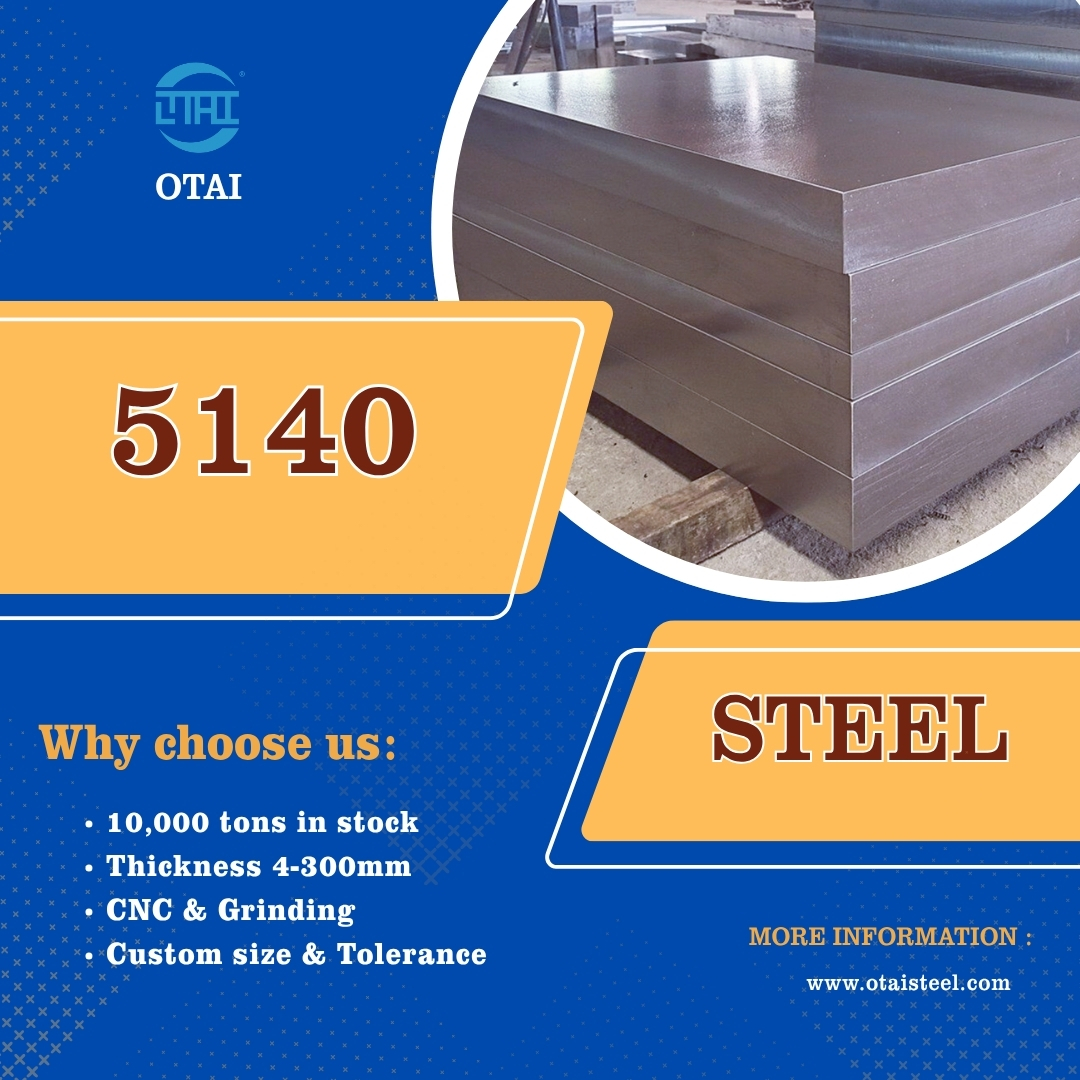
Otai Special Steel supplies 5140 / 41Cr4 steel plate with a 4–300 mm thickness range. This gives buyers options for both relatively thin sections and heavy machining stock.
The company can also support more than basic material supply. Depending on the project, buyers can request saw cutting, CNC machining, grinding, heat treatment, inspection and export packaging.
That service structure matters when calculating the real 5140 steel price. For example, if a buyer needs several cut pieces rather than full plates, the quotation should account for material utilization, cutting, handling and packaging. A supplier that can coordinate these operations may reduce the number of separate vendors involved in the purchasing process.
For an industrial RFQ, consider confirming:
- Available 5140 / 41Cr4 plate thickness.
- Actual stock quantity.
- Material standard and grade identification.
- Heat-treatment or delivery condition.
- Cutting tolerance.
- MTC availability.
- Ultrasonic testing availability.
- Third-party inspection support.
- Packaging method.
- Lead time and shipping terms.
The objective is not simply to find the lowest material price. Instead, you want a quotation that matches the technical specification and minimizes additional work after delivery.
🏢 10. Otai Special Steel Supply Advantages
- 5140 / 41Cr4 steel plate stock: 4–300 mm thickness range available for industrial purchasing requirements.
- 10,000+ tons of steel stock: Supports regular orders and project-based requirements.
- 20 saw cutting machines: Supports efficient cutting to customer-required dimensions.
- CNC machining and grinding: Suitable for buyers who need processed material rather than standard stock alone.
- Custom sizes and tolerances: Cutting and processing can follow agreed technical requirements.
- Inspection support: Ultrasonic testing and third-party inspection can be arranged according to project requirements.
- One-stop service: Cutting, machining, heat treatment, inspection and export packaging can be coordinated through one supplier.
- Export experience since 1999: Otai has supplied special and alloy steels to customers in 54+ countries.
- Export packaging: Steel can be strapped or bundled and protected with wooden boxes and anti-rust packaging according to shipping requirements.
❓ FAQ About 5140 Steel Price
What is the current price of 5140 steel?
There is no single global 5140 steel price. The quotation depends on product form, dimensions, quantity, supply condition, inspection, processing, delivery terms and destination. A current market reference for comparable 40Cr/5140 alloy round bar may provide a market indication, but it should not be treated as a universal export quotation.
Why can two suppliers offer different prices for 5140 steel?
The quotations may cover different specifications. One supplier may quote standard stock, while another includes heat treatment, cutting, inspection, tighter tolerances or delivery. Always compare the complete scope rather than the unit price alone.
Is 5140 steel expensive compared with carbon steel?
5140 generally costs more than ordinary carbon structural steel because it contains alloying elements, including chromium, and requires controlled alloy-steel production. The actual difference depends on market conditions, product dimensions, quantity and supply form.
Is 5140 the same as 41Cr4?
5140 and 41Cr4 are closely related grades and are frequently cross-referenced. However, their standard chemical ranges are not identical. For example, 5140 commonly specifies approximately 0.70–0.90% chromium, while EN 41Cr4 commonly specifies about 0.90–1.20%. The applicable standard should therefore be confirmed before substitution.
How can I get an accurate 5140 steel quotation?
Provide the supplier with the grade and standard, dimensions, quantity, delivery condition, hardness or mechanical requirements, inspection requirements, cutting or machining needs, destination and preferred Incoterm. With these details, the supplier can calculate a quotation that reflects your actual purchasing requirements rather than giving a generic price per kilogram.