Skip to Content

Blog Archives

16MnCr5 Steel Number – Understanding Global Material Equivalents

16MnCr5 Steel Number – Understanding Global Material Equivalents16MnCr5 Steel Number – Understanding DIN 1.7131 and Global Material Equivalents

When engineers, buyers, and heat treatment specialists search for 16MnCr5 steel number, they usually want to identify the exact material designation used in international standards. This carburizing alloy steel is widely used in automotive, gear manufacturing, and mechanical engineering industries because of its excellent surface hardness, core toughness, and machinability.

The official steel number for 16MnCr5 is:

Standard Steel Grade Steel Number
EN / DIN 16MnCr5 1.7131
EN 10084 16MnCr5 1.7131
DIN Standard 16MnCr5 1.7131

Many global manufacturers also compare this material with other case hardening steels such as 16MnCr5 equivalent grade, SAE 5115 steel, 20MnCr5 steel, and JIS SCM420 due to their similar carburizing performance.

🔍 What Is 16MnCr5 Steel?

16MnCr5 is a low-carbon alloy carburizing steel containing manganese and chromium. Manufacturers primarily use it for components requiring:

  • High wear resistance
  • Strong fatigue strength
  • Tough core properties
  • Excellent hardenability after carburizing

The steel performs especially well in applications involving repeated stress, friction, and contact loading.

Common products include:

  • Transmission gears
  • Pinions
  • Shafts
  • Bushings
  • Camshafts
  • Worm gears
  • Heavy-duty mechanical parts

Because of its balanced composition, many buyers searching for 16MnCr5 steel number are actually sourcing material for gear manufacturing and precision-machined components.

🧪 Chemical Composition of 16MnCr5 Steel

The alloy chemistry directly affects carburizing response and mechanical performance.

Element Content (%)
Carbon (C) 0.14 – 0.19
Silicon (Si) 0.17 – 0.37
Manganese (Mn) 1.00 – 1.30
Phosphorus (P) ≤ 0.025
Sulfur (S) ≤ 0.035
Chromium (Cr) 0.80 – 1.10

The chromium content improves hardenability and wear resistance, while manganese enhances strength and toughness. This combination makes the material suitable for case hardening steel applications requiring durable surfaces and impact-resistant cores.

📊 Mechanical Properties of 16MnCr5

Mechanical properties depend heavily on heat treatment condition, carburizing depth, and quenching process.

Property Typical Value
Tensile Strength 800 – 1200 MPa
Yield Strength 550 – 850 MPa
Elongation 8 – 12%
Hardness Before Heat Treatment 160 – 220 HB
Surface Hardness After Carburizing 58 – 62 HRC

After carburizing and quenching, the steel develops a hard outer case while maintaining a relatively ductile inner core. This structure helps reduce cracking under cyclic loading conditions.

🌍 Why Is the Steel Number 1.7131 Important?

The steel number system provides a universal identification method across international markets. Many global buyers prefer ordering by steel number rather than grade name because naming conventions vary between countries.

For example:

Country/Region Equivalent Designation
Germany 1.7131 / 16MnCr5
USA SAE 5115
Japan SCM420
China 16CrMnH
France 16MC5
Italy 16MnCr5

When sourcing alloy steel internationally, using the correct DIN steel number 1.7131 reduces confusion and ensures material traceability.

This becomes especially important for:

  • Export orders
  • Third-party inspection
  • OEM manufacturing
  • Automotive supply chains
  • Heat treatment certification

🔥 Heat Treatment Process of 16MnCr5

One reason why 16MnCr5 steel number receives global attention is the steel’s excellent response to carburizing and quenching.

🌡️ Typical Heat Treatment Parameters

Process Temperature
Forging 850 – 1050°C
Normalizing 870 – 900°C
Carburizing 880 – 980°C
Hardening 820 – 860°C
Tempering 150 – 200°C

The carburizing process increases carbon concentration on the surface layer, producing high hardness after quenching.

Typical effective case depth:

  • 0.8 mm
  • 1.0 mm
  • 1.2 mm
  • 1.5 mm

depending on component requirements.

Manufacturers often choose this steel for carburized gear steel applications where surface wear resistance and internal toughness must coexist.

🛠️ Machining and Weldability

16MnCr5 offers good machinability in normalized condition. Many workshops machine the material before carburizing to reduce tool wear and improve dimensional control.

⚙️ Machining Characteristics

  • Good turning performance
  • Stable drilling behavior
  • Suitable for CNC machining
  • Good dimensional stability after heat treatment

🔩 Weldability

The steel can be welded, but preheating is usually recommended because chromium alloy steels may develop hard zones near weld areas.

Typical recommendations:

  • Preheat: 150–250°C
  • Controlled cooling
  • Post-weld stress relief when necessary

For high-performance gears or shafts, manufacturers usually avoid welding after carburizing.

🚗 Common Industrial Applications

Due to its excellent combination of hardness and toughness, 16MnCr5 is widely used in several industries.

🚘 Automotive Industry

  • Gearboxes
  • Differential gears
  • Transmission shafts
  • Clutch components

🏗️ Heavy Machinery

  • Mining gears
  • Industrial reducers
  • Power transmission parts

🚜 Agricultural Equipment

  • Drive shafts
  • Wear-resistant couplings
  • Gear systems

🧩 Precision Engineering

  • CNC machined gears
  • Hardened pinions
  • Mechanical bushings

Many OEMs searching for 16MnCr5 material specifications prioritize stable hardness distribution and fatigue resistance in rotating parts.

⚖️ 16MnCr5 vs 20MnCr5

Both steels belong to the carburizing alloy steel family, but they have slight differences.

Property 16MnCr5 20MnCr5
Carbon Content Lower Higher
Toughness Better Slightly Lower
Surface Hardness Excellent Excellent
Core Strength Good Higher
Machinability Very Good Good

16MnCr5 often becomes the preferred option when toughness and machinability matter more than maximum core strength.

🏭 Company Advantages

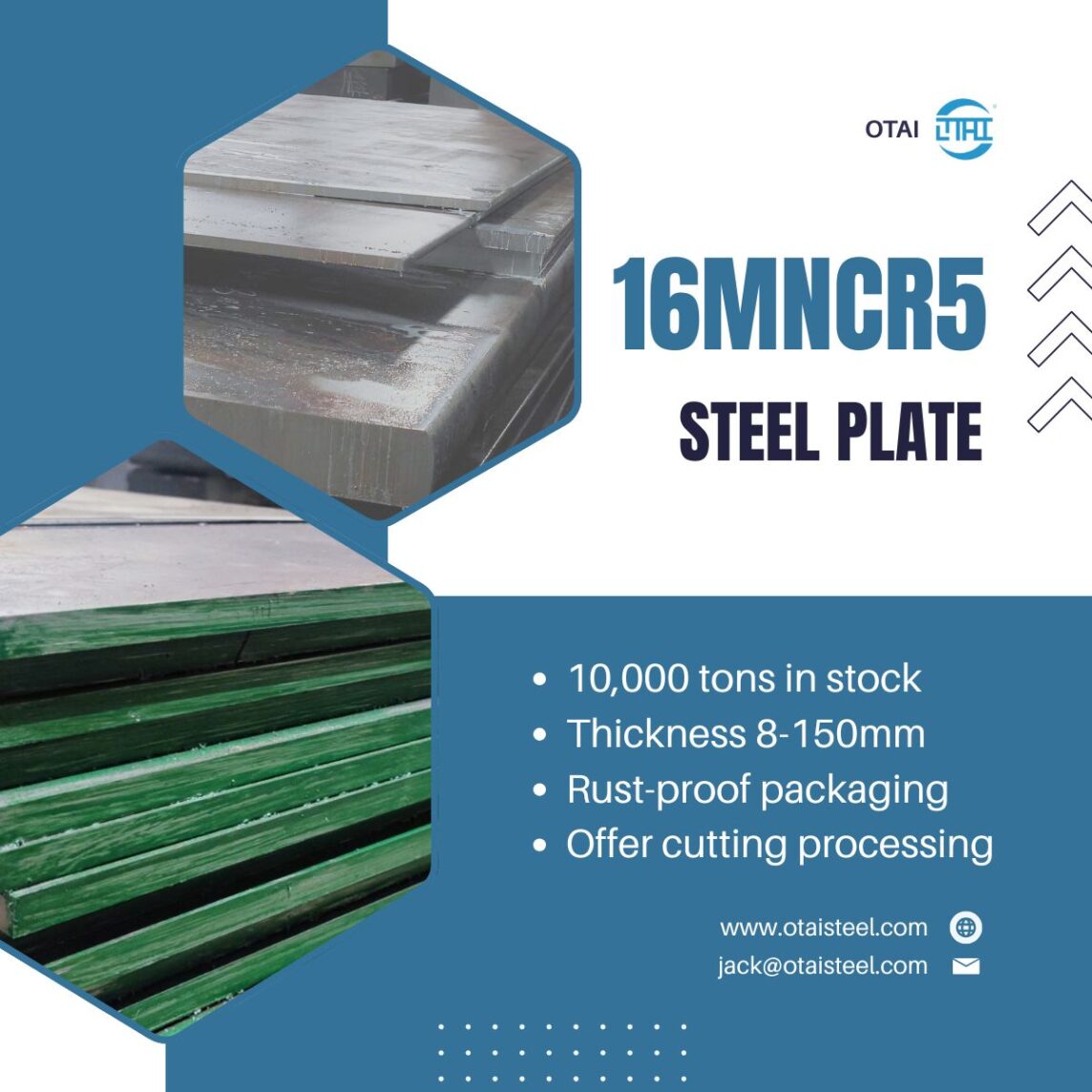
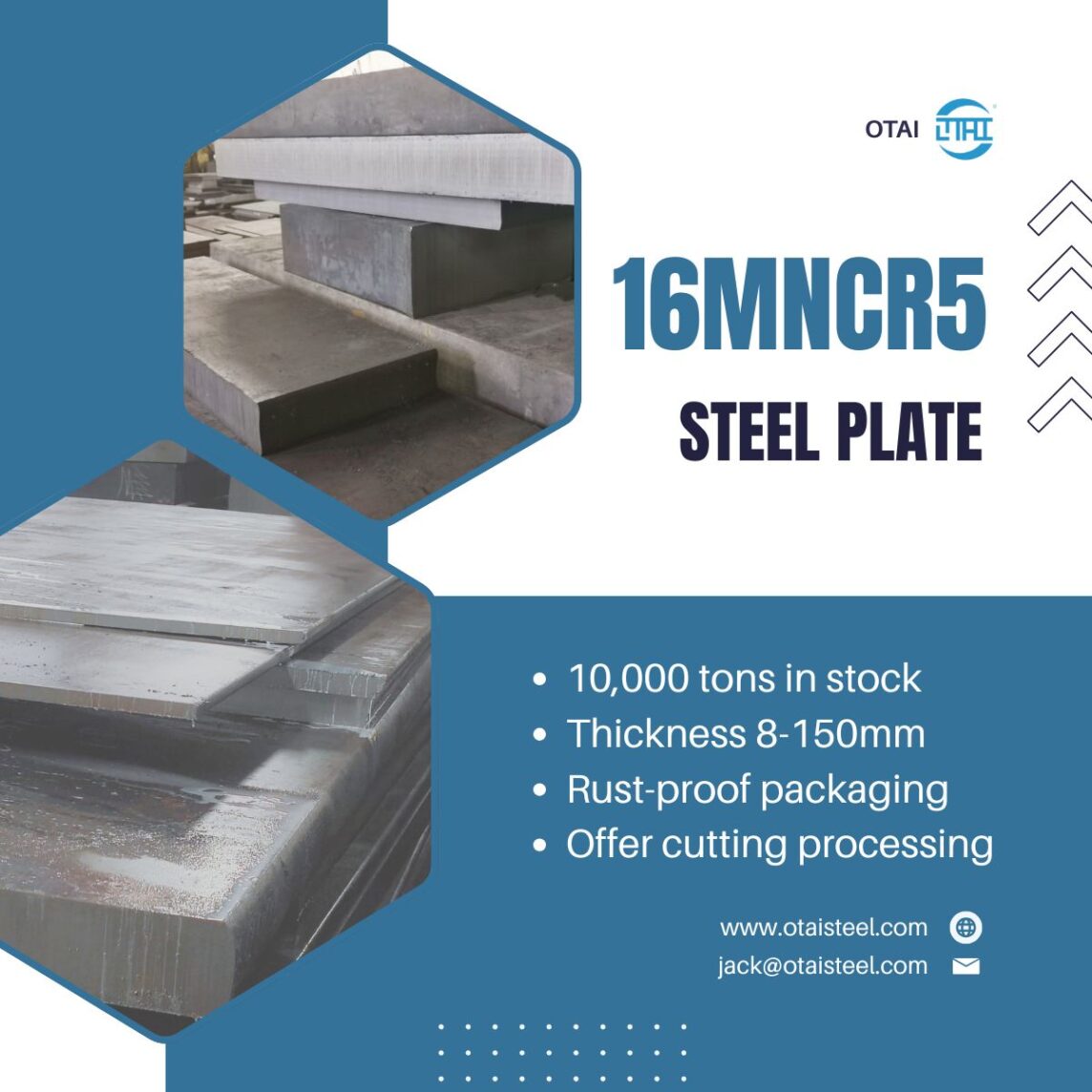
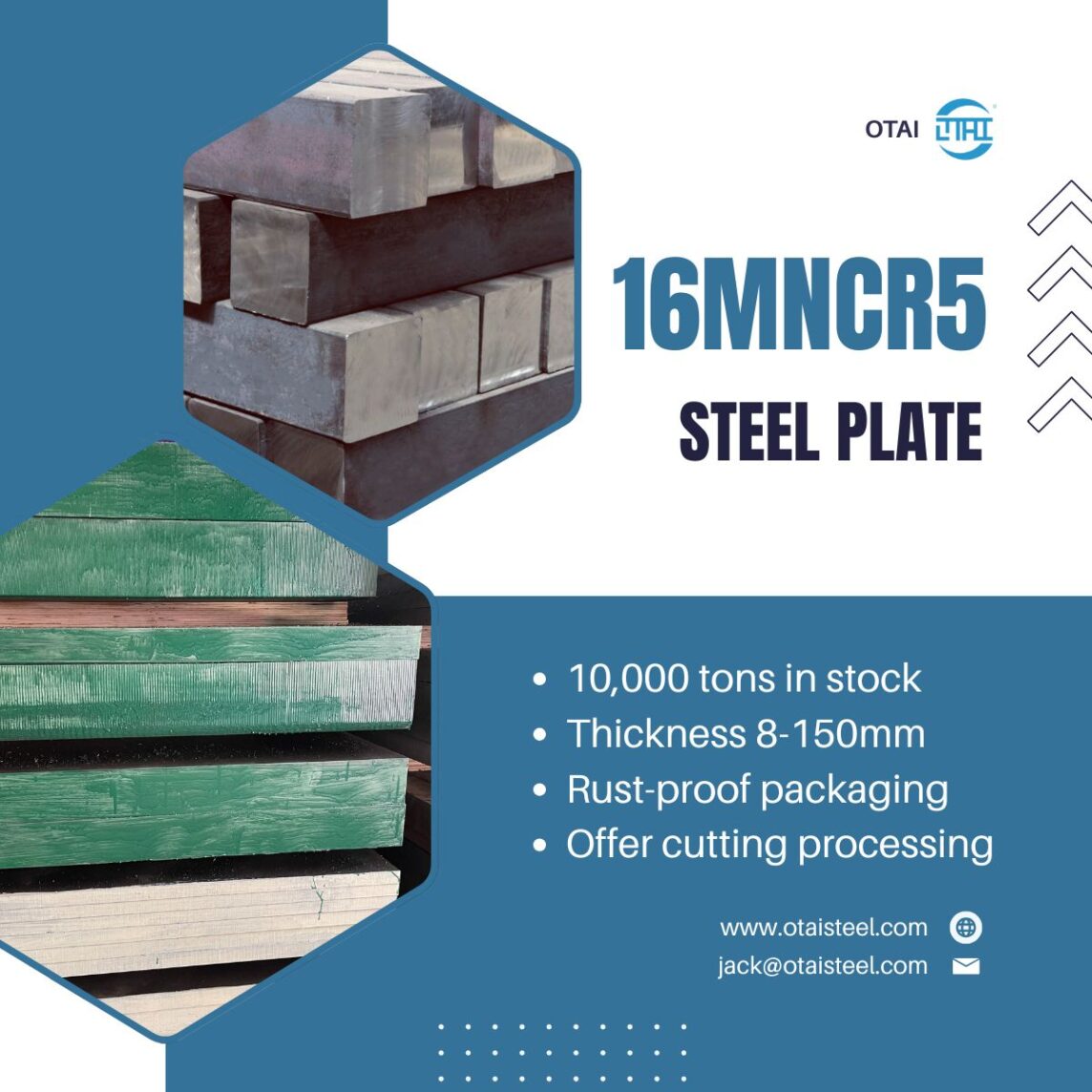
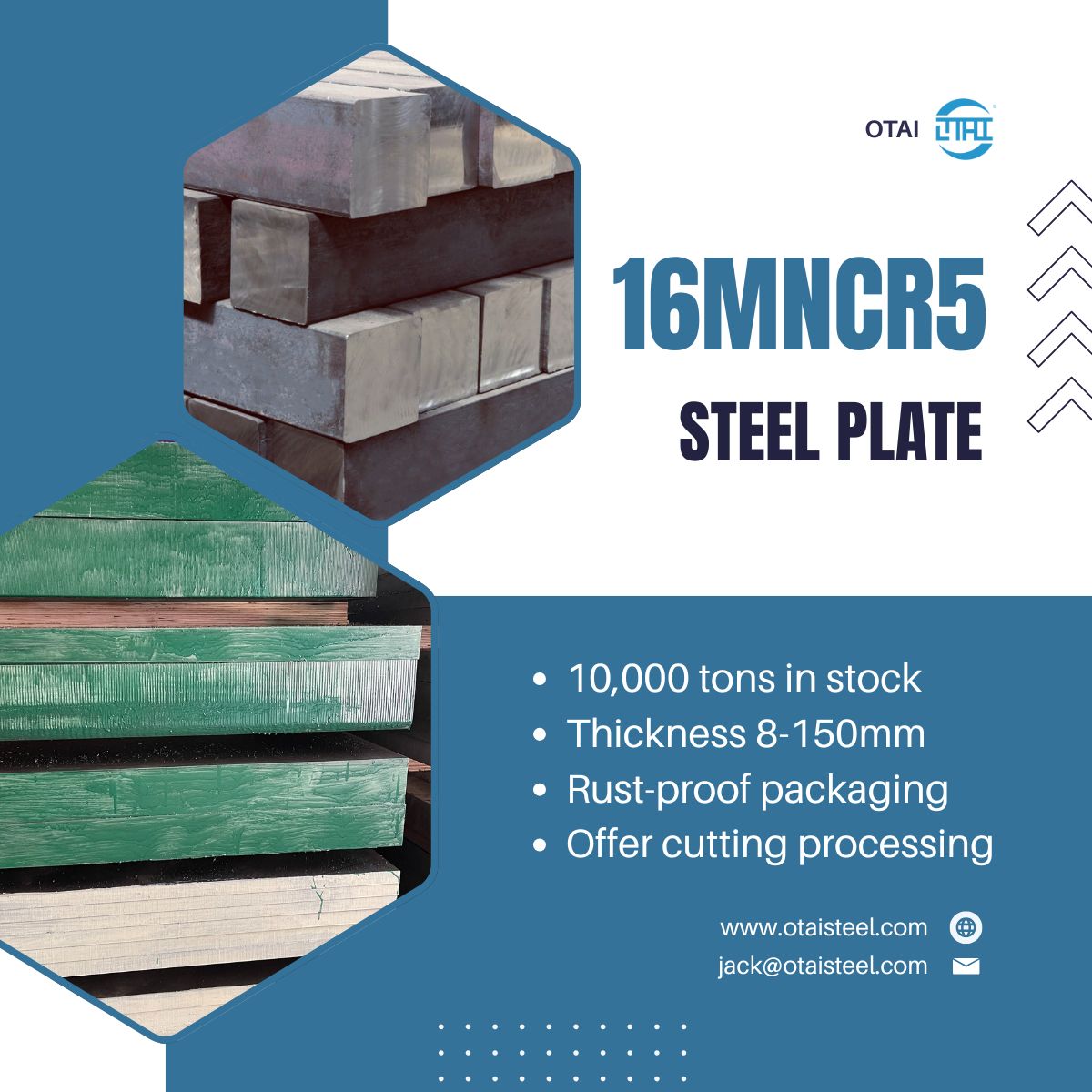
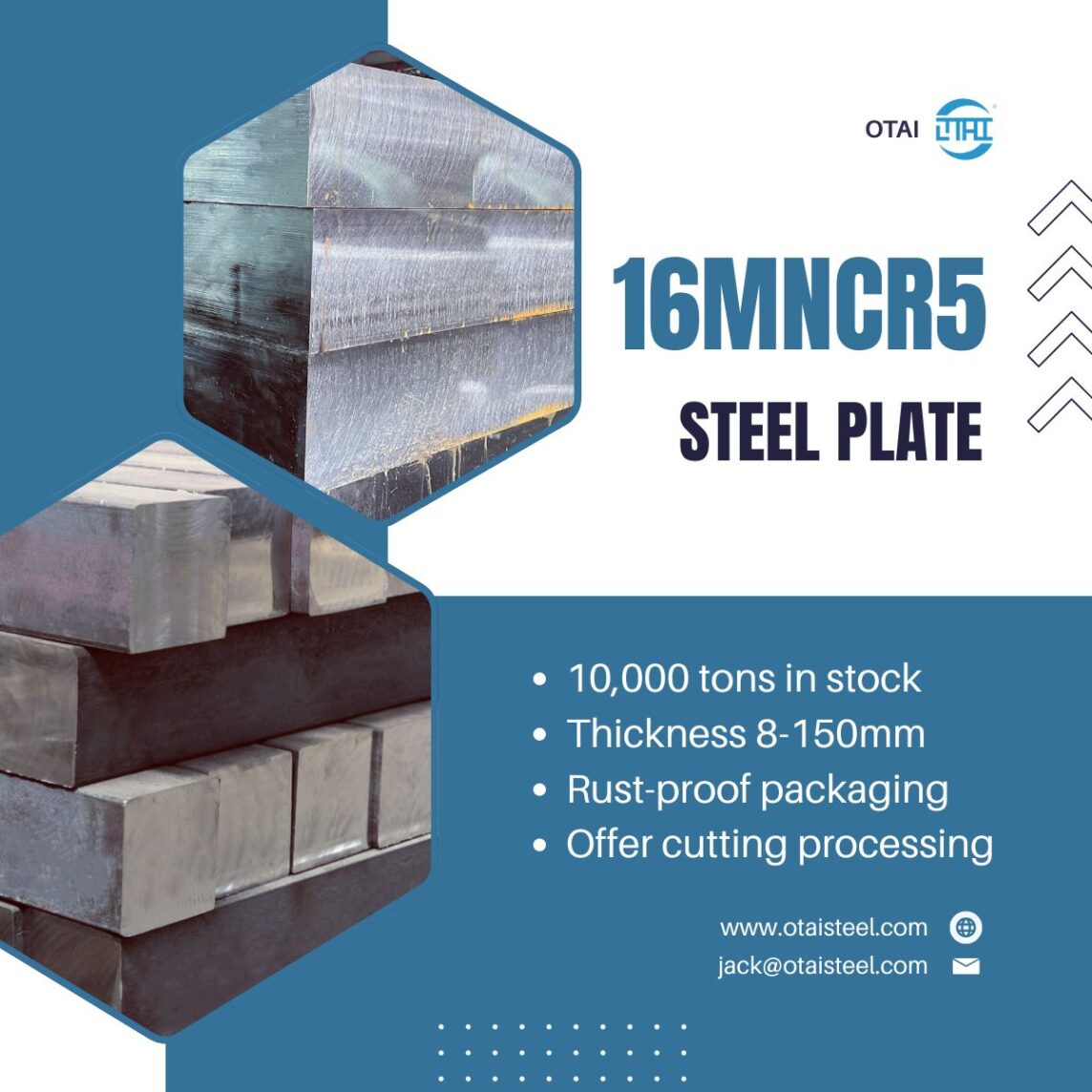
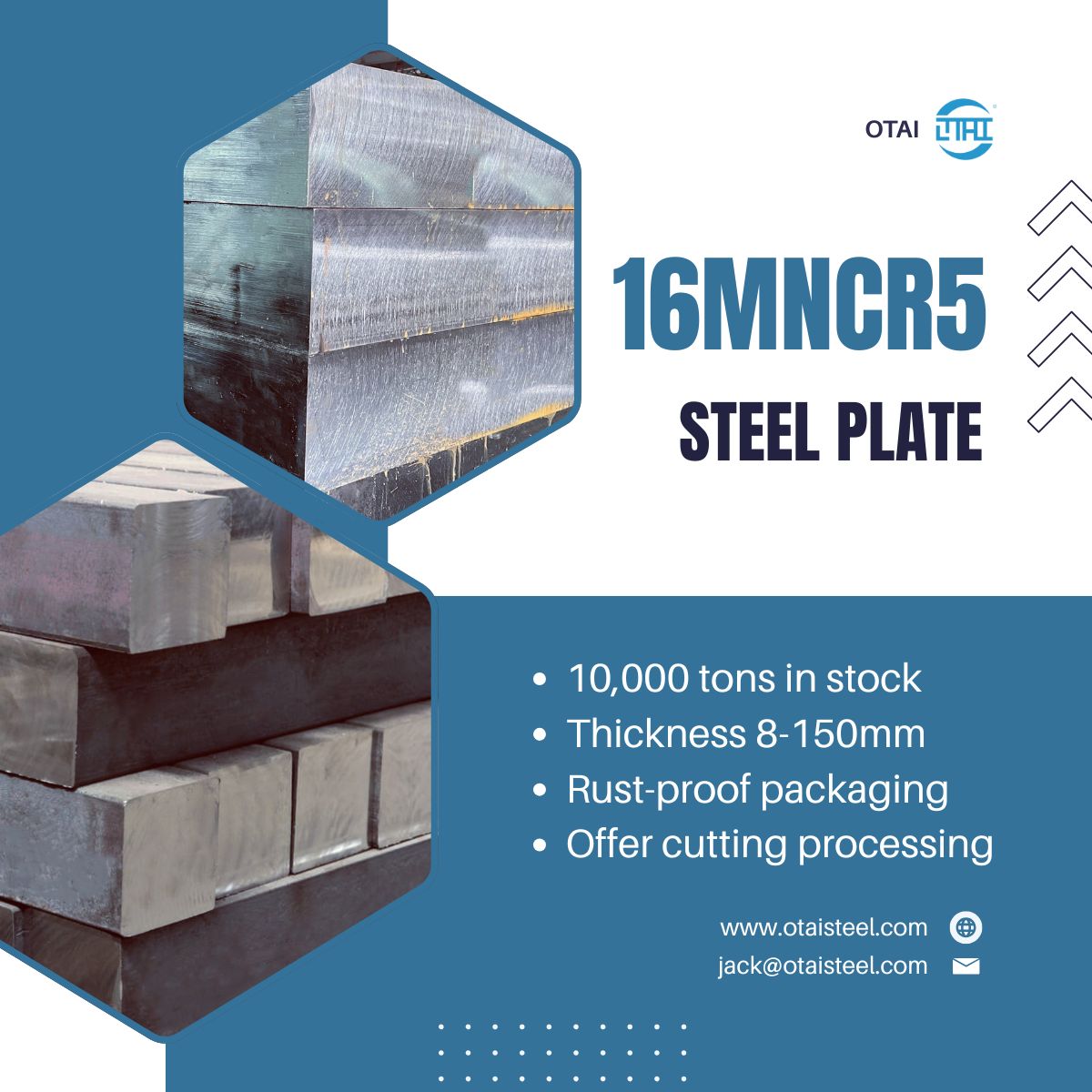
At Otai Special Steel, we supply high-quality 16MnCr5 alloy steel plates, flats, rounds, and forged blocks for global industrial applications.

Our advantages include:

  • Large stock availability year-round
  • 8–150mm thickness plates available in stock
  • Customized cutting services
  • Heat treatment support
  • Ultrasonic testing (UT)
  • Chemical composition verification
  • Third-party inspection support such as SGS
  • Stable export packaging
  • Fast delivery for international orders

We provide 16MnCr5 materials in multiple dimensions suitable for gear manufacturing, machinery production, and precision engineering projects.

❓ FAQ

What is the steel number of 16MnCr5?

The official steel number is 1.7131 under DIN and EN standards.

Is 16MnCr5 a carburizing steel?

Yes. It is a low-carbon alloy carburizing steel widely used for case hardening applications.

What is the equivalent of 16MnCr5 in the USA?

The closest American equivalent is SAE 5115 steel.

What hardness can 16MnCr5 achieve?

After carburizing and quenching, the surface hardness typically reaches 58–62 HRC.

Is 16MnCr5 suitable for gears?

Yes. The material is commonly used for gears, pinions, shafts, and transmission components due to its wear resistance and fatigue strength.

Can 16MnCr5 be welded?

Yes, but controlled preheating and post-weld treatment are recommended to minimize cracking risks.

0 0 Continue Reading →

Yield Strength of 16MnCr5: Understanding Its Mechanical Performance

Yield Strength of 16MnCr5: Understanding Its Mechanical PerformanceYield Strength of 16MnCr5: Understanding Its Mechanical Performance

🔍 Introduction

The yield strength of 16MnCr5 steel is a critical property that engineers and designers consider when selecting materials for high-stress applications. 16MnCr5 is a medium-carbon, chromium-manganese alloy steel known for its high strength, hardness, and wear resistance. By understanding its yield strength and related mechanical properties, manufacturers can ensure reliable performance in demanding industrial environments.

This article explores the yield strength of 16MnCr5, its chemical composition, heat treatment options, and key applications.


🛠️ What is 16MnCr5 Steel?

16MnCr5 steel is a versatile alloy steel widely used in automotive, aerospace, and industrial machinery sectors. The “16” in the name indicates the carbon content (around 0.16%), while Mn stands for manganese and Cr for chromium, which contribute to its strength and toughness.

Chemical Composition of 16MnCr5

Element Composition (%)
Carbon (C) 0.14 – 0.20
Manganese (Mn) 0.70 – 1.00
Chromium (Cr) 0.80 – 1.10
Silicon (Si) 0.10 – 0.35
Phosphorus (P) ≤ 0.035
Sulfur (S) ≤ 0.035

This composition provides good hardenability, high wear resistance, and strong fatigue performance, making it ideal for components such as gears, shafts, and bearings.


🔩 Yield Strength of 16MnCr5

Yield strength is the stress at which a material begins to deform plastically. For 16MnCr5 steel, the yield strength depends on its heat treatment and condition.

Typical Yield Strength Values

Condition Yield Strength (MPa) Tensile Strength (MPa) Hardness (HRC)
Annealed / Soft 300 – 400 500 – 650 180 – 220 HB
Quenched & Tempered 600 – 850 800 – 1000 28 – 32 HRC
Carburized Surface 700 – 950 (surface) 800 – 1000 58 – 62 HRC

Note: Yield strength increases significantly after quenching, tempering, or carburizing, enhancing the steel’s performance under high load.


🔥 Heat Treatment and Its Effect on Yield Strength

Heat treatment directly affects the mechanical properties of 16MnCr5, including yield strength:

1. Annealing

  • Softens the steel, improving machinability and reducing internal stress.
  • Yield strength is relatively low (300-400 MPa), suitable for shaping or forming operations.

2. Quenching and Tempering

  • Increases hardness and yield strength, typically 600-850 MPa.
  • Balances strength and toughness, ideal for components under heavy mechanical loads.

3. Carburizing

  • Enhances surface hardness and yield strength in the outer layer while maintaining ductility in the core.
  • Commonly applied to gears, shafts, and other high-wear components.

⚙️ Applications Based on Yield Strength

The high yield strength of 16MnCr5 steel makes it suitable for load-bearing and wear-resistant applications:

1. Automotive Industry

  • Components: Gears, drive shafts, crankshafts.
  • Reason: High yield strength ensures durability under repeated load cycles.

2. Industrial Machinery

  • Components: Bearings, sprockets, shafts.
  • Reason: Can withstand high mechanical stress while maintaining dimensional stability.

3. Aerospace and Defense

  • Components: Actuators, landing gear, high-strength shafts.
  • Reason: High yield strength ensures structural integrity under extreme forces.

4. Oil & Gas / Heavy Equipment

  • Components: Drill shafts, couplings, industrial gears.
  • Reason: High yield strength provides resistance to fatigue and deformation in harsh environments.

🏆 Advantages of 16MnCr5 Steel

  • High Load Capacity: With a yield strength of 600-850 MPa after heat treatment, the steel withstands heavy mechanical stress.
  • Wear Resistance: Especially after carburizing, the surface resists wear and prolongs component life.
  • Balanced Toughness: High yield strength does not compromise toughness, preventing brittle failure.
  • Versatile Heat Treatment: Can be tailored to achieve desired mechanical properties for specific applications.

🏢 Company Advantages

At Otai Special Steel, we supply 16MnCr5 steel with precise heat treatment and quality assurance:

  • Custom Cutting: Precise sizing to meet exact project requirements.
  • Heat Treatment Services: Quenching, tempering, and carburizing to optimize yield strength.
  • Quality Assurance: Chemical analysis, hardness testing, and ultrasonic inspections ensure reliable performance.

❓ Frequently Asked Questions

1. What is the yield strength of 16MnCr5 steel?

It ranges from 300-400 MPa in the annealed condition to 600-850 MPa after quenching and tempering.

2. How does heat treatment affect the yield strength?

Heat treatment significantly increases yield strength, improves wear resistance, and balances toughness.

3. What applications benefit most from high yield strength 16MnCr5 steel?

Automotive, aerospace, industrial machinery, and oil & gas industries rely on 16MnCr5 for load-bearing and wear-resistant components.


Jack Tan


📧 jack@otaisteel.com

📱 WhatsApp: +8676923190193

0 0 Continue Reading →

Steel 16MnCr5 Equivalent: Understanding Alternatives and Applications

Steel 16MnCr5 Equivalent: Understanding Alternatives and ApplicationsSteel 16MnCr5 Equivalent: Understanding Alternatives and Applications

🔍 Introduction

Steel 16MnCr5 is a widely used alloy steel known for its strength, wear resistance, and hardness, making it a popular choice for components subjected to high stress and fatigue. However, engineers often need to know the steel 16MnCr5 equivalent when sourcing materials in different standards or regions. Understanding equivalent grades helps ensure performance, durability, and compatibility in global applications.

This article explains the 16MnCr5 equivalents, their chemical and mechanical similarities, and the industries where they are applied.


🛠️ What is 16MnCr5 Steel?

16MnCr5 steel is a medium-carbon, chromium-manganese alloy steel. Its composition typically includes:

Element Composition (%)
Carbon (C) 0.14 – 0.20
Manganese (Mn) 0.70 – 1.00
Chromium (Cr) 0.80 – 1.10
Silicon (Si) 0.10 – 0.35
Phosphorus (P) ≤ 0.035
Sulfur (S) ≤ 0.035

The manganese and chromium content provides hardenability, wear resistance, and strength, making 16MnCr5 steel suitable for gears, shafts, bearings, and other high-stress components.


🔄 Steel 16MnCr5 Equivalent Standards

Different countries and standards often assign different numbers to steel with similar properties. Knowing the steel 16MnCr5 equivalent ensures consistent performance across regions.

Standard Equivalent Grade
EN (Europe) 16MnCr5
DIN (Germany) C16CrMn5
JIS (Japan) SCM420
GB/T (China) 16MnCr5
UNS (USA) AISI 5115 (approx.)
SAE (USA) SAE 5115 / 5115H

While chemical compositions may slightly differ, these equivalents share similar mechanical properties, hardness, and heat treatment responses, making them interchangeable in most engineering applications.


🔥 Mechanical Properties

The mechanical properties of steel 16MnCr5 equivalents are important for ensuring the material meets design requirements. Typical properties after carburizing, quenching, and tempering include:

Property 16MnCr5 Steel
Tensile Strength 600 – 800 MPa
Yield Strength 350 – 550 MPa
Hardness (HRC) 58 – 62 (surface after carburizing)
Elongation 12 – 15%
Impact Toughness 40 – 60 J

These properties make 16MnCr5 and its equivalents ideal for high-load, wear-resistant applications.


⚙️ Heat Treatment

16MnCr5 steel and its equivalents respond well to heat treatment, which enhances their surface hardness and overall durability:

  1. Carburizing: Introduces additional carbon to the surface for a hardened layer.
  2. Quenching: Rapid cooling to increase hardness.
  3. Tempering: Reduces brittleness while maintaining high hardness.

After proper heat treatment, the steel achieves excellent wear resistance and fatigue strength, suitable for gears, shafts, and high-load components.


🏭 Applications of 16MnCr5 Steel Equivalents

Due to its combination of hardness, strength, and toughness, steel 16MnCr5 equivalents are widely used in various industries:

1. Automotive Industry

  • Components: Gears, crankshafts, and drive shafts.
  • Reason: High wear resistance and strength under repeated stress.

2. Manufacturing & Machinery

  • Components: Bearings, sprockets, and industrial gears.
  • Reason: Good machinability with excellent fatigue resistance.

3. Aerospace & Defense

  • Components: Landing gear parts, actuators, and shafts.
  • Reason: Reliable strength and toughness for critical applications.

4. Oil & Gas / Heavy Machinery

  • Components: Drill bits, shafts, and mechanical couplings.
  • Reason: Resistant to wear, fatigue, and high-load conditions.

🏆 Advantages of Using 16MnCr5 Equivalents

  • Global Compatibility: Equivalent steels allow engineers to source materials from different standards without compromising performance.
  • High Hardness and Wear Resistance: Ideal for components under friction or repeated stress.
  • Excellent Toughness: Maintains strength under high mechanical loads.
  • Flexible Heat Treatment: Responds well to carburizing, quenching, and tempering to suit specific applications.

❓ Frequently Asked Questions

1. What is the steel 16MnCr5 equivalent in JIS or SAE standards?

The JIS equivalent is SCM420, and the SAE equivalent is approximately SAE 5115.

2. Can 16MnCr5 steel equivalents be heat-treated the same way?

Yes. All equivalents respond well to carburizing, quenching, and tempering, providing similar hardness and toughness.

3. Which industries benefit most from 16MnCr5 equivalents?

Automotive, manufacturing, aerospace, and oil & gas industries rely heavily on 16MnCr5 equivalents due to their wear resistance, high strength, and durability.


Jack Tan


📧 jack@otaisteel.com

📱 WhatsApp: +8676923190193

0 0 Continue Reading →

Steel Grade 16MnCr5: Properties, Applications, and Benefits

Steel Grade 16MnCr5: Properties, Applications, and BenefitsSteel Grade 16MnCr5: Properties, Applications, and Benefits

🔍 Introduction to 16MnCr5 Steel

16MnCr5 steel is a high-quality alloy steel that engineers commonly use in various engineering applications. It offers high strength, good hardenability, and excellent wear resistance. Manufacturers often utilize it in the manufacturing of gears, shafts, and other high-stress components. This steel grade offers a balanced combination of strength, toughness, and machinability, making it suitable for numerous industrial applications.

In this article, we will dive into the key features of 16MnCr5 steel, its chemical composition, heat treatment process, and the industries that benefit from its use.


🛠️ What is 16MnCr5 Steel?

16MnCr5 is a medium-carbon chromium-manganese steel. The steel’s composition includes manganese and chromium, which provide improved strength, hardness, and wear resistance. The “16” in the name refers to the carbon content (approximately 0.16%), while Mn stands for manganese and Cr stands for chromium.

Chemical Composition of 16MnCr5 Steel:

  • Carbon (C): 0.14% – 0.20%
  • Manganese (Mn): 0.70% – 1.00%
  • Chromium (Cr): 0.80% – 1.10%
  • Silicon (Si): 0.10% – 0.35%
  • Phosphorus (P): ≤ 0.035%
  • Sulfur (S): ≤ 0.035%

The manganese helps improve the steel’s toughness and hardenability, while chromium enhances corrosion resistance and contributes to overall hardness.


🔥 Heat Treatment of 16MnCr5 Steel

One of the key features of 16MnCr5 steel is its ability to undergo heat treatment processes such as carburizing, quenching, and tempering. These treatments help increase the material’s hardness, wear resistance, and strength, making it ideal for high-performance components.

1. Carburizing

  • Carburizing is a heat treatment process that introduces carbon to the surface of 16MnCr5 steel to increase its surface hardness. This is especially useful for components like gears, shafts, and bearings, which need high wear resistance on their surfaces.
  • The carbon content in the outer layer of the material can reach up to 0.9% after carburizing, which results in a high hardness layer.

2. Quenching and Tempering

  • Quenching involves heating the steel to a high temperature and then rapidly cooling it, which increases its hardness.
  • Tempering follows quenching to relieve stress and reduce brittleness, making the steel more durable without losing its strength. This process gives 16MnCr5 steel a balance between high hardness and toughness.
  • After quenching and tempering, 16MnCr5 achieves a hardness range of HRC 58-62, which is ideal for highly stressed components like gears and crankshafts.

⚙️ Applications of 16MnCr5 Steel

Due to its excellent hardness, wear resistance, and toughness, 16MnCr5 steel is used in a wide range of applications where durability and high performance are crucial. Here are some key industries that benefit from 16MnCr5 steel:

1. Automotive Industry

16MnCr5 steel is frequently used in the automotive industry for parts like gears, shafts, and crankshafts. These components need to endure high stresses and wear, making 16MnCr5 an ideal choice due to its combination of strength, hardness, and toughness.

  • Example: Drive shafts made from 16MnCr5 steel offer a good balance between durability and wear resistance under high loads.

2. Manufacturing and Engineering

In manufacturing and engineering, 16MnCr5 steel is used for gears, sprockets, and bearings that operate under high loads and need high wear resistance. This steel grade can withstand significant mechanical stresses and harsh operating conditions.

  • Example: Industrial gears made from 16MnCr5 can withstand heavy-duty use and provide extended service life.

3. Aerospace and Defense

In the aerospace and defense sectors, 16MnCr5 steel is utilized for components that require high strength and toughness, such as engine parts, actuators, and landing gear.

  • Example: Landing gear components made from 16MnCr5 steel provide the necessary strength and durability to support aircraft during take-off and landing.

4. Heavy Machinery and Oil & Gas

16MnCr5 steel is also commonly used in heavy machinery and oil & gas industries for parts that experience high wear, abrasion, and fatigue. Examples include gears, shafts, and crankshafts.

  • Example: Drill bits made from 16MnCr5 steel can withstand the tough conditions found in oil exploration, where high strength and durability are essential.

🏆 Advantages of 16MnCr5 Steel

The high hardness, strength, and wear resistance of 16MnCr5 steel offer several benefits for applications in demanding environments:

1. Excellent Wear Resistance

The high carbon content and the ability to undergo carburizing treatment provide 16MnCr5 steel with exceptional wear resistance. This makes it ideal for components subjected to continuous friction, such as gears, bearings, and sprockets.

2. High Strength and Toughness

16MnCr5 steel retains high strength even at elevated temperatures and under heavy mechanical loads. Its toughness ensures that components are resistant to cracking and fatigue over long periods.

3. Good Hardenability

With the right heat treatment, 16MnCr5 steel can achieve a high surface hardness, making it perfect for parts that need to maintain their integrity under extreme conditions, such as crankshafts and gears.

4. Improved Fatigue Resistance

Due to its excellent toughness and high strength, 16MnCr5 steel exhibits great fatigue resistance, making it suitable for high-stress components that undergo repeated cycles of load.


🏆 Company Advantages

At Otai Special Steel, we offer 16MnCr5 steel in a variety of heat-treated conditions to meet your specifications. Our services include:

  • Custom Cutting: We provide precise cutting services for 16MnCr5 steel in various thicknesses and dimensions.
  • Heat Treatment: We offer carburizing, quenching, and tempering to optimize the hardness and mechanical properties of 16MnCr5 steel.
  • Quality Assurance: Our products undergo rigorous chemical analysis, hardness testing, and ultrasonic testing to ensure that they meet the highest standards.

❓ Frequently Asked Questions

1. What is 16MnCr5 steel used for?

Manufacturers commonly use 16MnCr5 steel to manufacture parts like gears, shafts, crankshafts, and bearings, particularly in the automotive, aerospace, and manufacturing industries.

2. How does heat treatment affect 16MnCr5 steel?

Heat treatment processes such as carburizing, quenching, and tempering increase the hardness, strength, and wear resistance of 16MnCr5 steel, making it ideal for high-stress applications.

3. What is the chemical composition of 16MnCr5 steel?

The chemical composition of 16MnCr5 steel includes carbon (0.14% – 0.20%), manganese (0.70% – 1.00%), and chromium (0.80% – 1.10%), contributing to its excellent strength, toughness, and wear resistance.


Jack Tan


📧 jack@otaisteel.com

📱 WhatsApp: +8676923190193

0 0 Continue Reading →

16MnCr5 vs EN8: A Comprehensive Comparison

16MnCr5 vs EN8: A Comprehensive Comparison16MnCr5 vs EN8: A Comprehensive Comparison

🔍 Introduction

When selecting the right material for a specific application, it’s crucial to compare the properties of different steel grades. 16MnCr5 and EN8 are two popular medium-carbon steels used in various industries. Each material has unique characteristics that make it suitable for specific applications. This article compares 16MnCr5 and EN8, examining their chemical compositions, mechanical properties, and common uses to help you understand their differences and choose the best option for your needs.


🛠️ What is 16MnCr5?

16MnCr5 is an alloy steel with a composition that includes manganese (Mn) and chromium (Cr). The material is commonly used for parts that require good wear resistance, fatigue strength, and the ability to withstand high cyclic loads. 16MnCr5 is often used in applications that involve heavy machinery, gears, and shafts.

Typical Chemical Composition of 16MnCr5:

  • Carbon (C): 0.14% – 0.19%
  • Manganese (Mn): 1.00% – 1.30%
  • Chromium (Cr): 0.80% – 1.10%
  • Silicon (Si): 0.20% – 0.35%

The combination of manganese and chromium provides excellent hardness, toughness, and wear resistance, making 16MnCr5 suitable for high-performance applications.


⚙️ What is EN8?

EN8, also known as 080M40, is a medium-carbon steel widely used for general engineering applications. It is well-regarded for its good tensile strength, impact resistance, and versatility in applications requiring moderate strength and durability. Unlike 16MnCr5, EN8 does not contain chromium, making it less resistant to wear and fatigue but easier to machine.

Typical Chemical Composition of EN8:

  • Carbon (C): 0.35% – 0.45%
  • Manganese (Mn): 0.60% – 0.90%
  • Silicon (Si): 0.10% – 0.35%
  • Sulfur (S): 0.035% (max)
  • Phosphorus (P): 0.035% (max)

The higher carbon content in EN8 provides a good balance of strength and machinability, but it sacrifices some of the toughness and wear resistance found in alloy steels like 16MnCr5.


📊 Mechanical Properties Comparison

The mechanical properties of 16MnCr5 and EN8 differ significantly, making each material suited for different applications. Let’s compare some key properties of both materials:

Property 16MnCr5 EN8
Tensile Strength 550 – 700 MPa 600 – 750 MPa
Yield Strength 350 – 450 MPa 320 – 500 MPa
Hardness (HB) 180 – 255 HB 150 – 250 HB
Impact Toughness High Moderate
Fatigue Strength Excellent Good
Machinability Moderate to Good Good
  • Tensile Strength: Both 16MnCr5 and EN8 offer high tensile strength, but EN8 tends to be slightly stronger in certain cases.
  • Yield Strength: 16MnCr5 offers a higher yield strength than EN8, which gives it an advantage in high-stress applications.
  • Hardness: Both materials have a similar hardness range, but 16MnCr5 tends to have a higher hardness when carburized.
  • Impact Toughness: 16MnCr5 performs better in terms of impact toughness, making it more suitable for applications that involve high-impact stress.
  • Fatigue Strength: 16MnCr5 excels in fatigue resistance, making it a better choice for components subjected to repetitive loads.

⚙️ Key Differences Between 16MnCr5 and EN8

  1. Alloy Content and Composition
    • 16MnCr5 contains chromium, which provides better wear resistance and fatigue strength than EN8, making it ideal for heavy-duty applications.
    • EN8 is a more basic carbon steel and doesn’t contain chromium, making it more suitable for applications that don’t require exceptional wear resistance.
  2. Fatigue Resistance
    • 16MnCr5 has significantly better fatigue resistance than EN8, which makes it ideal for parts that experience cyclic loading, such as gears and shafts.
    • EN8 is better suited for general applications where high fatigue resistance is not the primary concern.
  3. Machinability
    • EN8 is easier to machine compared to 16MnCr5, which can be harder and require more precise cutting tools, especially when carburized.
    • This makes EN8 a better option for applications requiring easy machining and moderate strength.
  4. Wear Resistance
    • 16MnCr5 has superior wear resistance due to its chromium content, making it suitable for high-load applications.
    • EN8, while having good strength, doesn’t perform as well in applications involving high wear.

🏗️ Applications of 16MnCr5 vs EN8

1. 16MnCr5 Applications

16MnCr5 is primarily used in applications where high fatigue resistance and wear resistance are critical. Some common uses include:

  • Automotive components (e.g., gears, shafts, axles)
  • Heavy machinery (e.g., bearings, rotating parts)
  • Industrial tools (e.g., tool holders, cutting tools)
  • Energy equipment (e.g., drill bits, pumps)

2. EN8 Applications

EN8 is often used for parts that need a good balance of strength and machinability but do not require extreme wear or fatigue resistance. Common applications include:

  • General engineering parts (e.g., shafts, pins, bolts)
  • Machine parts (e.g., axles, brackets, clamps)
  • Forging and machining (e.g., housings, spindles)

🏆 Company Advantages

At Otai Special Steel, we offer high-quality 16MnCr5 and EN8 steel products tailored to meet your specific needs. We provide various services to ensure that our materials meet the highest industry standards:

  • Custom Cutting: We offer precise cutting services for 16MnCr5 and EN8 plates to your exact specifications.
  • Heat Treatment: We provide treatments like carburizing, tempering, and quenching to enhance the material’s properties.
  • Quality Assurance: We conduct chemical analysis, ultrasonic testing, and visual inspection to ensure that our products meet the highest quality standards.

Frequently Asked Questions

1. What is the difference between 16MnCr5 and EN8?

16MnCr5 contains chromium, which gives it better wear resistance and fatigue strength than EN8. EN8 is a simpler carbon steel that is easier to machine but offers lower wear resistance.

2. Which material is better for gears and shafts?

For gears and shafts, 16MnCr5 is the better choice due to its superior wear resistance and fatigue strength.

3. Is EN8 easier to machine than 16MnCr5?

Yes, EN8 is easier to machine compared to 16MnCr5 due to its simpler composition and lower hardness.


Jack Tan


📧 jack@otaisteel.com

📱 WhatsApp: +8676923190193

0 0 Continue Reading →

16MnCr5 Yield Strength: Properties, Importance, and Applications

16MnCr5 Yield Strength: Properties, Importance, and Applications16MnCr5 Yield Strength: Properties, Importance, and Applications

🔍 Introduction

16MnCr5 is a medium-carbon, alloy steel known for its high yield strength and excellent wear resistance. Due to its unique composition, it is commonly used in applications where parts are subjected to heavy load-bearing and repeated stress. This article will explore the yield strength of 16MnCr5, its role in material selection, and its typical applications in various industries.


🛠️ What is 16MnCr5 Steel?

16MnCr5 is an alloy steel that primarily contains manganese (Mn) and chromium (Cr). These elements give it exceptional toughness, wear resistance, and high tensile strength. It is commonly used for components that require high fatigue strength and wear resistance, such as gears, shafts, and bearings.

Typical Chemical Composition of 16MnCr5:

  • Carbon (C): 0.14% – 0.19%
  • Manganese (Mn): 1.00% – 1.30%
  • Chromium (Cr): 0.80% – 1.10%
  • Silicon (Si): 0.20% – 0.35%

Due to its versatility, 16MnCr5 is particularly useful in heavy-duty applications that require both toughness and hardness.


📊 Understanding the Yield Strength of 16MnCr5

The yield strength of a material refers to the stress at which it begins to deform plastically. For 16MnCr5, the yield strength is a critical factor when determining its suitability for various applications, especially in scenarios involving high-stress and cyclic loading.

Yield Strength of 16MnCr5

  • Yield Strength: Typically between 350 – 450 MPa depending on the heat treatment and processing methods.

This makes 16MnCr5 a reliable choice for parts subjected to significant stresses, ensuring that the material can handle both dynamic and static loads without permanent deformation.


⚙️ Importance of Yield Strength in 16MnCr5

The yield strength of 16MnCr5 directly impacts its performance and durability in demanding applications. Understanding this property is essential when selecting materials for components that experience repeated loading and high pressure. Here are some reasons why yield strength is important in 16MnCr5:

1. Resistance to Plastic Deformation

A higher yield strength means the material can resist permanent deformation under stress, which is critical for parts like gears and shafts. These components often operate under cyclic loading, where repeated stress can lead to failure if the material cannot withstand the forces.

2. Fatigue Resistance

The yield strength plays a role in a material’s fatigue strength, meaning its ability to resist failure from repeated cycles of stress. A higher yield strength allows 16MnCr5 to perform well in applications where parts undergo frequent stress reversals, such as automotive and heavy machinery components.

3. Impact Resistance

The material’s yield strength also affects its impact resistance. 16MnCr5, with its high yield strength, can withstand impacts and sudden stresses without deforming, making it ideal for high-stress applications.


⚙️ Applications of 16MnCr5 with High Yield Strength

Due to its high yield strength, 16MnCr5 is used in a wide variety of applications, especially in industries where parts are subjected to repetitive stress and heavy loads. Some of its primary applications include:

1. Automotive Components

16MnCr5 is used to manufacture critical components such as gears, shafts, and axles. These parts often undergo high cyclic loading and need to resist wear and deformation. The material’s high yield strength ensures that components maintain their structural integrity under stress.

2. Industrial Machinery

In industrial machinery, 16MnCr5 is used for parts like bearings and gears that require both high fatigue resistance and toughness. The material’s ability to handle heavy loads and resist deformation makes it suitable for machinery that operates under continuous stress.

3. Mining and Energy Equipment

Heavy machinery in the mining and energy industries, such as drill bits, crushers, and pumps, benefits from the yield strength of 16MnCr5. These parts are exposed to extreme loads and wear, so the material’s high yield strength helps to ensure longevity and reliability.

4. Manufacturing Tools

The high yield strength of 16MnCr5 also makes it a popular choice for manufacturing tools, such as cutting tools and tool holders, where resistance to deformation under pressure is essential for precision and performance.


🏗️ Heat Treatment of 16MnCr5 to Enhance Yield Strength

To further enhance the yield strength of 16MnCr5, manufacturers often perform heat treatment processes. The heat treatment can harden the material’s surface while maintaining its toughness, which is crucial for parts that require both strength and ductility.

Common Heat Treatments for 16MnCr5:

  1. Carburizing: This process increases the carbon content on the surface of 16MnCr5, improving its surface hardness while maintaining a tough core. It is ideal for components like gears and shafts that need high surface hardness and strength.
  2. Tempering and Quenching: These heat treatments improve the yield strength by hardening the material and relieving internal stresses. Quenching followed by tempering helps to enhance the material’s resilience and fatigue resistance.

🏆 Company Advantages

At Otai Special Steel, we provide 16MnCr5 plates with a wide range of heat treatment options to enhance the yield strength and performance of our products. We ensure that all our materials meet the highest quality standards to help you achieve the best results in your projects.

Our services include:

  • Custom Cutting: We offer precision cutting for 16MnCr5 plates to match your exact specifications.
  • Heat Treatment: We provide a variety of heat treatments, including carburizing, tempering, and quenching, to enhance the material properties of 16MnCr5.
  • Quality Assurance: We conduct thorough chemical analysis and ultrasonic testing to ensure the integrity and consistency of the steel.

❓ Frequently Asked Questions

1. What is yield strength in 16MnCr5?

The yield strength of 16MnCr5 refers to the amount of stress the material can withstand before it begins to deform plastically. It typically ranges from 350 – 450 MPa.

2. Why is yield strength important for 16MnCr5?

The yield strength is crucial because it determines the material’s ability to resist permanent deformation under load. This is essential for components that experience high stress and cyclic loading.

3. What applications require high yield strength in materials like 16MnCr5?

Industries like automotive, machinery manufacturing, and mining use 16MnCr5 for parts that are exposed to high stress and fatigue, such as gears, shafts, and bearings.


Jack Tan


📧 jack@otaisteel.com

📱 WhatsApp: +8676923190193

0 0 Continue Reading →

16MnCr5 Plate: Properties, Uses, and Applications

16MnCr5 Plate: Properties, Uses, and Applications16MnCr5 Plate: Properties, Uses, and Applications

🔍 Introduction

16MnCr5 is an alloy steel containing manganese and chromium, known for its high wear resistance and good toughness. Manufacturers widely use this material to create plates and components that require excellent resistance to fatigue and wear. This article explores the properties of 16MnCr5 plate, its common applications, and why it is a great choice for various industries.


🛠️ What is 16MnCr5 Steel?

16MnCr5 is an alloy steel that primarily contains manganese (Mn) and chromium (Cr). Engineers use this material to make high-strength components with superior wear resistance and surface hardness. It’s especially suitable for applications that require good machinability and carburizing properties, making it an ideal choice for heat treatment processes.

Typical Chemical Composition of 16MnCr5:

  • Carbon (C): 0.14% – 0.19%
  • Manganese (Mn): 1.00% – 1.30%
  • Chromium (Cr): 0.80% – 1.10%
  • Silicon (Si): 0.20% – 0.35%

Manufacturers commonly use this material to create components like gears, shafts, and bearings that withstand high loads and repeated stresses.


📊 Properties of 16MnCr5 Plate

16MnCr5 plates stand out for their superior mechanical properties, making them perfect for applications requiring high tensile strength and surface hardness. Below are some of the key properties of the material.

Mechanical Properties of 16MnCr5

Property Approximate Value
Tensile Strength 550 – 700 MPa
Yield Strength 350 – 450 MPa
Hardness (HRC) 58 – 62 HRC (after carburizing)
Fracture Toughness Good

The hardness of 16MnCr5 plate ensures that parts made from this material can withstand harsh working conditions such as constant friction and high stress.


⚙️ Applications of 16MnCr5 Plate

The 16MnCr5 plate is widely used in the automotive, industrial, and heavy machinery industries due to its ability to resist wear and fatigue. Here are some of its key applications:

1. Automotive Components

Manufacturers use 16MnCr5 for parts like shafts, gears, and bushings in vehicles. The material’s resistance to wear and fatigue makes it ideal for parts subjected to high cyclic loads and repeated stresses.

2. Industrial Machinery

In industrial machinery and manufacturing equipment, 16MnCr5 plate is often used to create bearings, shafts, and gears. This material offers good toughness and wear resistance under tough working conditions.

3. Energy and Mining Equipment

16MnCr5 plate also performs well in the energy and mining industries, where it is used to create heavy machinery parts. The material’s properties allow it to resist extreme working conditions.


🏗️ Heat Treatment of 16MnCr5 Plate

Heat treatment plays a vital role in improving the properties of 16MnCr5 plate. Tempering and quenching are the most common treatments used to enhance its hardness and improve fatigue resistance. In many cases, carburizing the steel increases its surface hardness, making it perfect for components such as gears and bearings that are constantly in contact with other parts.

Carburizing Process

  • Carburizing: During this process, the steel’s carbon content increases on the surface, enhancing surface hardness while maintaining the toughness of the core. This treatment is ideal for parts requiring high wear resistance and fatigue resistance.

🌍 Advantages of 16MnCr5 Plate in Industry

16MnCr5 plate offers numerous advantages, making it a great choice for a variety of industrial applications:

1. High Fatigue and Wear Resistance

Thanks to its alloy composition, 16MnCr5 plate provides excellent fatigue and wear resistance, making it ideal for parts that experience repeated stresses and tough working conditions.

2. Good Machinability

16MnCr5 plate is easy to machine, allowing for efficient and precise machining processes when creating complex parts. This is possible because of its well-balanced combination of toughness and hardness.

3. Carburizing Capability

One of the key benefits of this material is its ability to undergo carburizing, which significantly improves its surface hardness, making it suitable for parts exposed to high wear.


🏆 Company Advantages

At Otai Special Steel, we offer high-quality 16MnCr5 plates with custom heat treatment options to meet the specific needs of our clients. We also provide additional services to ensure quality and precision in each part:

  • Large Inventory: We maintain a large inventory of 16MnCr5 plates in various sizes.
  • Precision Cutting: We offer custom cutting to meet your exact specifications.
  • Custom Heat Treatment: We provide tempering, quenching, and carburizing treatments to optimize the properties of your parts.
  • Quality Assurance: We conduct ultrasonic testing and chemical composition analysis to ensure the material’s integrity and quality.

❓ Frequently Asked Questions

1. What is 16MnCr5 plate?

16MnCr5 plate is an alloy steel plate containing manganese and chromium, known for its high wear resistance and good toughness.

2. What are the common uses of 16MnCr5 plate?

People use 16MnCr5 plate for automotive components, industrial machinery, and mining equipment because of its wear resistance and fatigue resistance.

3. What kind of heat treatment can be done on 16MnCr5 plate?

You can subject 16MnCr5 plate to tempering, quenching, and carburizing to improve its surface hardness and fatigue resistance.

4. What applications benefit from the properties of 16MnCr5 plate?

Applications benefiting from its properties include gears, shafts, bearings, and machinery parts that require high wear resistance and fatigue resistance.


Jack Tan


📧 jack@otaisteel.com

📱 WhatsApp: +8676923190193

0 0 Continue Reading →

16MnCr5 Material Number: What You Need to Know

16MnCr5 Material Number: What You Need to Know16MnCr5 Material Number: What You Need to Know

🔍 Introduction

16MnCr5 is a versatile alloy steel used in many industries, including automotive, machinery, and engineering. It’s well-known for its strength, wear resistance, and toughness, making it a top choice for parts that face high stress. Common applications include gears, shafts, and crankshafts. When sourcing 16MnCr5, understanding its material number is crucial for identifying the steel’s composition and properties.

In this article, we’ll explain the 16MnCr5 material number, how it reflects the steel’s chemical makeup, and why it’s essential in selecting the right material for your needs.


🏷️ Understanding the 16MnCr5 Material Number

The material number for 16MnCr5 serves as an identifier in the steel industry, giving key details about the steel’s composition and properties. The number 16MnCr5 reveals the following:

  • 16: This part indicates the carbon content, showing approximately 0.16% carbon in the steel.
  • Mn: Stands for manganese, an alloying element that improves the steel’s strength and hardness.
  • Cr: Represents chromium, which boosts corrosion resistance and enhances hardenability.
  • 5: Indicates that the steel is designed for case-hardening applications.

As a result, 16MnCr5 is a medium-carbon steel alloyed with manganese and chromium. It offers excellent properties for case-hardening, where a tough core combines with a durable outer layer.


🌍 International Standards and Material Numbers

16MnCr5 has equivalents in other international standards. Knowing these equivalents helps when sourcing or replacing components made from this steel, ensuring compatibility across regions. Let’s explore some of the common equivalents:

1. DIN 17210 (Germany)

In Germany, DIN 17210 refers directly to 16MnCr5. This material is used for components like gears and shafts that require strength and wear resistance.

2. AISI 5115 (USA)

In the U.S., 16MnCr5 is equivalent to AISI 5115. The two grades share similar carbon content and alloying elements, making them interchangeable for case-hardened parts.

3. UNS G51150 (USA)

Under the Unified Numbering System (UNS), 16MnCr5 corresponds to UNS G51150. This system provides consistency across international steel standards, making it easier to identify and source materials.

4. BS EN 10083-3 (UK)

In the UK, 16MnCr5 aligns with BS EN 10083-3. This standard is widely used for case-hardened steels that need strength and durability, making it suitable for automotive and industrial machinery applications.

5. ISO 683-17 (International)

ISO 683-17 covers case-hardened steels and is the international standard for materials like 16MnCr5. It ensures that the material meets global specifications for hardness, toughness, and strength in demanding applications.


🔧 Chemical Composition of 16MnCr5

To understand 16MnCr5 more thoroughly, let’s look at its chemical composition. This composition directly relates to its material number and influences its properties:

Element Content Range
Carbon (C) 0.14–0.19%
Manganese (Mn) 0.50–0.80%
Chromium (Cr) 0.90–1.20%
Silicon (Si) 0.10–0.35%
Phosphorus (P) ≤0.025%
Sulfur (S) ≤0.025%

The alloying elements—manganese and chromium—give 16MnCr5 its strength, wear resistance, and corrosion resistance. The carbon content increases the steel’s hardness, while the chromium enhances its ability to resist oxidation and wear at high temperatures.


🛠️ Applications of 16MnCr5 Steel

The high strength and toughness of 16MnCr5 make it ideal for a variety of applications. It’s widely used in sectors where durability and resistance to wear are essential. Here are some of the most common applications:

1. Automotive Industry

In the automotive sector, 16MnCr5 is used to manufacture gears, crankshafts, axles, and shafts. These parts benefit from the material’s wear resistance and strength, especially after undergoing case-hardening.

2. Mechanical Engineering

16MnCr5 is used in mechanical engineering for components such as gears, bearings, axles, and clutch components. The material’s ability to withstand heavy mechanical loads makes it ideal for such applications.

3. Aerospace Industry

In aerospace, 16MnCr5 plays a crucial role in producing components like turbine blades, compressor rotors, and landing gear parts. These components need to endure high stresses and fatigue, and 16MnCr5 meets these demands.

4. Tooling Applications

Because of its case-hardening capability, 16MnCr5 is used in tooling applications. It is ideal for molds, dies, and cutting tools that need to maintain sharpness and durability even under challenging conditions.


🏆 Company Advantages

At Otai Special Steel, we provide top-quality 16MnCr5 steel and offer tailored services to meet your specific requirements. Here’s why you should choose us:

  • Large Inventory: We stock over 10,000 tons of 16MnCr5 steel, ensuring quick delivery for your projects.
  • Custom Services: We offer precision cutting, heat treatment, and machining to meet your exact specifications.
  • Global Shipping: We deliver 16MnCr5 steel worldwide, ensuring timely and reliable service.
  • Quality Assurance: All our products undergo rigorous testing, including ultrasonic testing (UT) and chemical composition analysis, to meet the highest quality standards.

❓ FAQ

1. What is the material number of 16MnCr5?

The material number 16MnCr5 provides a standardized identification system that details the steel’s chemical composition and properties. The “16” indicates carbon content, while Mn and Cr refer to manganese and chromium.

2. What are the equivalents of 16MnCr5 in other standards?

16MnCr5 is equivalent to AISI 5115, UNS G51150, and BS EN 10083-3 in various international standards.

3. How do the mechanical properties of 16MnCr5 compare to its equivalents?

The mechanical properties of 16MnCr5 and its equivalents are very similar, offering high tensile strength, wear resistance, and toughness.

4. What are the common applications of 16MnCr5?

Manufacturers use 16MnCr5 in automotive parts (e.g., gears, shafts), mechanical engineering components (e.g., bearings, clutch components), and aerospace parts (e.g., landing gear).

5. Where can I buy 16MnCr5 steel?

You can purchase 16MnCr5 from Otai Special Steel, where we offer a wide selection of materials and provide custom services to meet your specifications.


Jack Tan


📧 jack@otaisteel.com

📱 WhatsApp: +8676923190193

0 0 Continue Reading →

What is 16MnCr5 Material Equivalent To?

What is 16MnCr5 Material Equivalent To?What is 16MnCr5 Material Equivalent To?

🔍 Introduction

16MnCr5 is a widely used alloy steel that offers high strength, wear resistance, and toughness. Manufacturers highly seek it for parts that need durability and the ability to withstand high mechanical stresses. 16MnCr5 is common in industries like automotive, aerospace, and machine engineering. However, understanding its material equivalents is essential when you need to source or replace components made from this steel, particularly across different global standards.

In this article, we will explore the material equivalents of 16MnCr5, helping you select the correct material for your projects or find suitable replacements.


🌐 International Equivalents of 16MnCr5

Manufacturers widely use 16MnCr5 in Europe, and other regions recognize several equivalents under different international steel standards. Here’s a look at the most common equivalents:

1. DIN Standard (Germany)

In the DIN standard, 16MnCr5 is directly referenced. The “16” represents the carbon content, while “MnCr” indicates the alloying elements: manganese and chromium. This steel is equivalent to the following grades in other standards:

  • DIN 17210: 16MnCr5 appears under this specification in Germany and other European markets, often used in components like gears, shafts, and other automotive parts.

2. AISI / SAE (American)

In the AISI/SAE system, 16MnCr5 corresponds to AISI 5115.

  • AISI 5115: This material mirrors 16MnCr5 in composition and mechanical properties, making it suitable for high-strength, wear-resistant components.

3. UNS (United States)

Under the Unified Numbering System (UNS), 16MnCr5 has the designation UNS G51150.

  • UNS G51150: This UNS-grade material is directly interchangeable with 16MnCr5 for applications requiring toughness and high strength.

4. BS (British Standard)

In the British Standard (BS), 16MnCr5 is aligned with EN 10083-3, a standard for case-hardened steels in Britain and Europe. Both materials share similar chemical and mechanical properties.

  • BS EN 10083-3: A matching specification for 16MnCr5, used for parts like gears, bearings, and shafts that require durability and strength.

5. ISO Standard (International)

Under ISO, 16MnCr5 is equivalent to ISO 683-17, a specification for case-hardened steels. ISO 683-17 applies to components made from 16MnCr5 and similar materials for high-performance applications.

  • ISO 683-17: This standard matches 16MnCr5 and is used internationally for parts that undergo case-hardening, such as gears and shafts.

🔧 Key Properties of 16MnCr5 and Its Equivalents

Let’s compare the key properties of 16MnCr5 and its equivalents to ensure they provide similar performance. Here’s a breakdown of these properties:

Property 16MnCr5 AISI 5115 UNS G51150 BS EN 10083-3
Tensile Strength 800–1000 MPa 850–1000 MPa 850–1000 MPa 800–1000 MPa
Yield Strength 600–850 MPa 600–850 MPa 600–850 MPa 600–850 MPa
Hardness 58–62 HRC 58–62 HRC 58–62 HRC 58–62 HRC
Carbon Content 0.14–0.19% 0.15–0.20% 0.15–0.20% 0.14–0.19%
Chromium Content 0.90–1.20% 0.90–1.20% 0.90–1.20% 0.90–1.20%
Manganese Content 0.50–0.80% 0.50–0.80% 0.50–0.80% 0.50–0.80%

These properties confirm that 16MnCr5 and its equivalents perform similarly. They provide high tensile strength, excellent wear resistance, and sufficient toughness, making them ideal for components that need to withstand mechanical stress and wear.


🏗️ Common Applications of 16MnCr5 and Its Equivalents

Whether you’re working with 16MnCr5 or one of its equivalents, their uses remain similar across industries. Some of the most common applications include:

1. Automotive Components

In the automotive industry, manufacturers use 16MnCr5 for producing gears, crankshafts, axles, and shafts. The material’s excellent wear resistance makes it ideal for components subjected to heavy loads and high-stress environments.

2. Industrial Machinery

16MnCr5 is commonly used in industrial machinery for gears, bearings, clutch components, and axles. The case-hardened properties make it perfect for machinery exposed to continuous mechanical forces.

3. Aerospace Parts

The aerospace industry relies on 16MnCr5 for landing gear, turbine blades, and compressor rotors. These parts require both strength and resistance to fatigue, qualities 16MnCr5 offers in abundance.

4. Tooling Applications

16MnCr5 and its equivalents are widely used in the tooling industry for molds, dies, and cutting tools. The material’s ability to undergo case-hardening ensures that the tools remain sharp and durable even under the toughest conditions.


🏆 Company Advantages

At Otai Special Steel, we offer a wide range of 16MnCr5 and its equivalents, and we pride ourselves on providing top-tier customer service. Here’s why you should choose us:

  • Large Inventory: With over 10,000 tons of 16MnCr5 and equivalent materials in stock, we can meet your needs quickly and efficiently.
  • Customized Services: We offer precision cutting, heat treatment, and machining to ensure our products meet your exact specifications.
  • Global Shipping: We provide worldwide shipping, ensuring that you get what you need when you need it.
  • Quality Assurance: All our materials undergo stringent testing procedures, including chemical composition analysis and ultrasonic testing, to guarantee the highest standards of quality.

❓ FAQ

1. What are the equivalents of 16MnCr5?

16MnCr5 is equivalent to AISI 5115, UNS G51150, and BS EN 10083-3 in different international standards.

2. What is 16MnCr5 used for?

It is used in gears, shafts, crankshafts, and various automotive and industrial machinery components that require strength and wear resistance.

3. How do the mechanical properties of 16MnCr5 compare with its equivalents?

The mechanical properties of 16MnCr5 and its equivalents are very similar. They all offer high tensile strength, wear resistance, and toughness.

4. Where can I buy 16MnCr5 and its equivalents?

You can purchase 16MnCr5 and its equivalents from Otai Special Steel, where we offer high-quality steel products and customized services.


Jack Tan


📧 jack@otaisteel.com

📱 WhatsApp: +8676923190193

0 0 Continue Reading →

16MnCr5 Rod: Properties, Applications, and Best Practices

16MnCr5 Rod: Properties, Applications, and Best Practices16MnCr5 Rod: Properties, Applications, and Best Practices

🔍 Introduction

The 16MnCr5 alloy steel is a popular choice for applications that require high strength, excellent wear resistance, and toughness. Many industries, including automotive, mechanical engineering, and construction, rely on 16MnCr5 rods for their durability and performance. These rods are particularly suitable for components that experience high stress and require long-term reliability.

In this article, we will explore the key properties of 16MnCr5 rods, their typical uses, and the best practices for machining them to meet specific needs.


⚙️ Properties of 16MnCr5 Rods

16MnCr5 is a medium-carbon, chromium-manganese alloy steel that performs well in case-hardening applications. This steel balances strength, toughness, and ductility, making it an ideal choice for various industrial applications.

Key Properties of 16MnCr5:

Property Value Range
Tensile Strength 800–1000 MPa
Yield Strength 600–850 MPa
Hardness 58–62 HRC (case-hardened)
Carbon Content 0.14–0.19%
Manganese Content 0.50–0.80%
Chromium Content 0.90–1.20%

The high levels of manganese and chromium give 16MnCr5 excellent strength and wear resistance, making it a reliable material for components that endure high stress and fatigue.


🛠️ Applications of 16MnCr5 Rods

Industries use 16MnCr5 rods for a wide range of applications. Here are some common uses:

1. Automotive Industry

Manufacturers use 16MnCr5 rods to produce gears, shafts, crankshafts, and axles. The rods undergo case-hardening, providing wear resistance while maintaining toughness in the core. These properties make them ideal for automotive components exposed to mechanical stress.

2. Mechanical Engineering

In mechanical engineering, 16MnCr5 rods are essential for creating connecting rods, camshafts, and rollers. These parts need to withstand significant mechanical forces, and 16MnCr5 provides the required durability.

3. Aerospace Industry

Aerospace manufacturers use 16MnCr5 rods for components like landing gear, turbine blades, and compressor rotors. These parts must resist fatigue and wear, and 16MnCr5 delivers the toughness needed for high-performance aerospace applications.

4. Tooling Industry

In the tooling industry, 16MnCr5 rods are used to manufacture dies, molds, and cutting tools. The steel’s ability to undergo case-hardening ensures that these tools remain durable and perform well under high-stress conditions.


🛠️ Machining 16MnCr5 Rods

When machining 16MnCr5 rods, manufacturers must consider the material’s hardness and toughness. Although the rods are easier to machine in their annealed state, heat treatment can make the material more challenging to work with.

Here are some best practices for machining 16MnCr5 rods:

1. Use of Proper Cutting Tools

High-speed steel (HSS) tools or carbide inserts are ideal for machining 16MnCr5 rods. Carbide tools are particularly effective in cutting hardened sections, as they can withstand the high heat generated during the process and maintain sharpness for longer.

2. Control Cutting Speed and Feed Rate

Controlling cutting speed and feed rate helps maintain a smooth finish and minimizes tool wear. Lower cutting speeds are generally recommended for 16MnCr5, particularly when working with hardened sections, as they reduce heat buildup.

3. Use Coolants

Using cutting fluids or coolants helps control the temperature during machining. Coolants reduce heat generation, extend tool life, and improve the surface finish of the rods.

4. Ensure Proper Workpiece Clamping

Proper clamping of the workpiece prevents vibrations and distortions during machining, ensuring precision and better surface quality. Secure clamping helps achieve higher accuracy when working with 16MnCr5 rods.


🔥 Heat Treatment of 16MnCr5 Rods

To improve the hardness and wear resistance, manufacturers often apply heat treatment to 16MnCr5 rods. The heat treatment process, which includes carburizing, quenching, and tempering, enhances the material’s surface hardness while maintaining toughness in the core.

Common Heat Treatment Steps:

Treatment Type Process Description
Carburizing The rod is heated to high temperatures (around 900–950°C) in a carbon-rich environment to increase surface carbon content.
Quenching After carburizing, the rod is rapidly cooled in water or oil to harden the surface.
Tempering The rod is heated again to a lower temperature (around 200–650°C) to reduce brittleness while maintaining desired hardness.

The case-hardened surface provides exceptional wear resistance, while the tough core ensures the rod’s strength under high stress.


🏆 Company Advantages

At Otai Special Steel, we provide high-quality 16MnCr5 rod and tailored services to meet your needs. Here’s why you should choose us:

  • Large Inventory: We keep over 10,000 tons of 16MnCr5 rods in stock, available year-round for your projects.
  • Customized Services: We offer precision cutting, heat treatment, and machining services to meet specific requirements.
  • Global Shipping: We deliver 16MnCr5 rods worldwide, ensuring fast and reliable service.
  • Quality Assurance: We rigorously test our products, including ultrasonic testing (UT) and chemical composition analysis, to meet the highest quality standards.

❓ FAQ

1. What is 16MnCr5 used for?

16MnCr5 is used in components that require high strength, wear resistance, and toughness, such as gears, shafts, and tool parts.

2. How do I machine 16MnCr5 rods?

Use carbide inserts or HSS tools, control cutting speeds, and ensure proper clamping and coolant usage to prevent tool wear and achieve a smooth finish.

3. What is the hardness range of 16MnCr5 rods?

After case-hardening, 16MnCr5 rods typically reach a surface hardness of 58–62 HRC, providing excellent wear resistance.

4. Where can I buy 16MnCr5 rod?

You can buy 16MnCr5 rods from suppliers like Otai Special Steel, who offer customized services and worldwide shipping.


Jack Tan


📧 jack@otaisteel.com

📱 WhatsApp: +8676923190193

0 0 Continue Reading →