5140 Price: How Do Size and Delivery Condition Affect Cost?
📑 Table of Contents
- 💰 Why Does 5140 Steel Price Vary Between Suppliers?
- 📏 How Does 5140 Steel Thickness Affect the Price?
- ⚙️ How Does Delivery Condition Change 5140 Steel Cost?
- 🔥 Why Can Heat-Treated 5140 Steel Cost More?
- ✂️ How Do Cutting and Machining Requirements Affect the Final Price?
- 📊 How Can Buyers Compare 5140 Steel Quotes Fairly?
- 📦 What Additional Costs Should Importers Consider?
- 💡 How Can Buyers Reduce 5140 Steel Purchasing Costs?
- 🏭 OTAI Company Advantages
- ❓ Frequently Asked Questions
When buyers request a 5140 steel price, they may receive noticeably different quotations from different suppliers. One supplier may quote a lower price per kilogram, while another may offer a higher price for material that already meets the required dimensions and delivery condition. These quotations do not necessarily describe the same product.
For procurement teams, the important question is not simply how much 5140 steel costs per kilogram. Buyers also need to understand what they will receive, how much additional processing they must arrange, and whether the material can meet their production requirements without unnecessary waste.
Size and delivery condition are two major factors behind the final purchase cost. A standard plate size may be easier to source than a non-standard thickness. Similarly, annealed material and quenched-and-tempered material require different production routes and may involve different costs.
This article explains how these factors influence 5140 steel quotations. It also provides practical comparison points for buyers sourcing 5140 steel plate for machinery, shafts, gears, and other engineering components.
💰 Why Does 5140 Steel Price Vary Between Suppliers?
5140 is a chromium alloy structural steel commonly used for components that require a combination of strength, hardenability, and toughness. Buyers may also encounter related designations such as 41Cr4 and 1.7035. However, they should confirm the applicable standard and technical requirements instead of assuming that every designation represents an identical product.
The price of 5140 steel depends on more than its chemical composition. A supplier must consider the raw material, manufacturing route, product dimensions, delivery condition, processing requirements, inspection scope, and delivery arrangements before preparing a quotation.
Different quotations may cover different specifications
For example, two suppliers may quote 5140 steel plate with the same nominal thickness. However, one quotation may cover hot-rolled material in an annealed condition, while the other includes quenched-and-tempered material with specified mechanical properties. The second product may require additional processing and testing.
Likewise, a quotation for standard commercial dimensions may not be directly comparable with one that includes precision cutting, tighter tolerances, or additional inspection. Buyers should therefore check the full quotation rather than compare only the unit price.
Main factors that influence the quotation
| Cost factor | How it affects the price | What buyers should check |
|---|---|---|
| Steel dimensions | Affects material weight, availability, and cutting yield. | Thickness, width, length, and tolerances. |
| Delivery condition | Different production and heat-treatment routes involve different costs. | Annealed, normalized, or quenched and tempered. |
| Processing | Cutting, machining, and grinding add service costs. | Finished dimensions and required tolerances. |
| Inspection | Additional testing and documentation may increase the quotation. | MTC, ultrasonic testing, and third-party inspection. |
| Logistics | Packaging, loading, freight, and insurance affect delivered cost. | Incoterms, destination, and shipment method. |
Buyers should compare quotations with matching specifications. Otherwise, a lower price may simply reflect a different delivery condition, a less demanding tolerance, or fewer included services.
📏 How Does 5140 Steel Thickness Affect the Price?
Thickness is one of the first dimensions buyers should confirm when requesting a 5140 steel plate quotation. It influences the weight of each plate, the available stock range, cutting requirements, and the amount of machining needed before the material reaches its final application.
Thickness changes the weight per plate
For a rectangular steel plate, buyers can estimate the theoretical weight using the following formula:
Weight (kg) = Thickness (mm) × Width (mm) × Length (mm) × 7.85 ÷ 1,000,000
The density factor of 7.85 is a commonly used estimating value for steel. Actual supplied weight can vary slightly because of dimensional tolerances and the material’s measured dimensions.
Consider two plates with the same width and length but different thicknesses. The thicker plate contains more steel, so its total price will generally be higher when the price per kilogram remains unchanged. However, the unit price per kilogram does not always increase in direct proportion to thickness. Availability, production route, and processing requirements can also affect the quotation.
Non-standard dimensions may require additional processing
Standard stock dimensions can be easier for suppliers to source and prepare. By contrast, a customer may request an unusual thickness or a specific combination of width and length. The supplier may need to select a larger parent plate and cut it down to the required size.
This process can create additional material loss. It may also require more cutting time, special handling, or a production arrangement that differs from normal stock supply. As a result, the quotation may include a higher processing charge even if the requested finished plate is not particularly large.
Check the actual dimensions available in stock
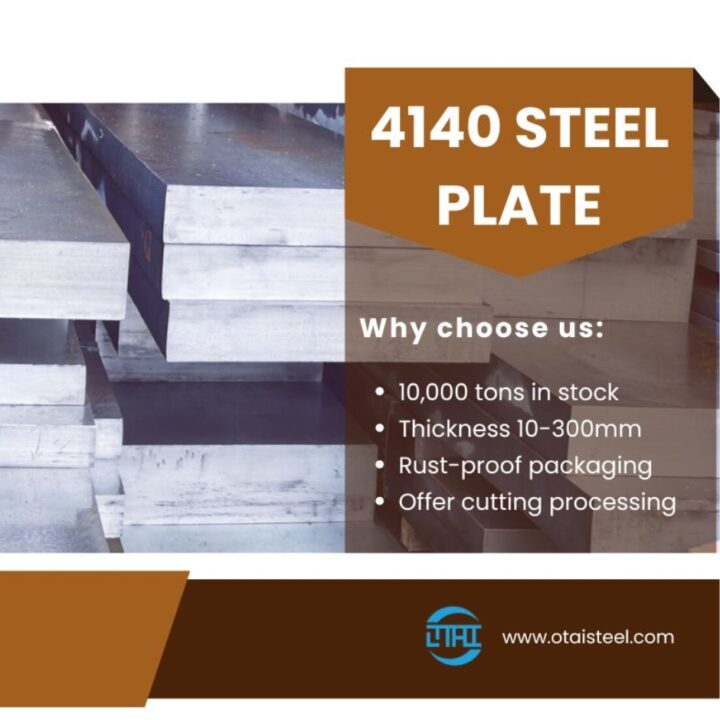
OTAI supplies 5140 steel plate with a stated stock thickness range of 4–300 mm. Buyers should still confirm the available width, length, quantity, and current stock status for their required specification. A published thickness range does not mean every thickness and plate size is immediately available in every quantity.
When requesting a quotation, provide all three main dimensions rather than asking only for a thickness-based price. For example, a request for a 20 mm plate is incomplete if the supplier does not know the required width and length.
Consider machining allowance before choosing the size
Some buyers order oversized plates because their components require milling, grinding, or other machining operations. This can be reasonable when the manufacturing process needs extra material. However, excessive machining allowance increases the purchased weight and may create avoidable material waste.
Discuss the finished component dimensions and machining plan with the supplier before confirming the order. A suitable cutting size can help reduce waste while preserving enough allowance for subsequent processing.
⚙️ How Does Delivery Condition Change 5140 Steel Cost?
Delivery condition describes the condition in which the steel is supplied. It is an important part of a 5140 steel quotation because different conditions involve different manufacturing processes and provide different starting properties for the buyer’s production route.
Buyers should not treat delivery condition as a minor note. If the material arrives in a condition that does not suit the planned machining or heat-treatment process, the buyer may need to arrange additional work or change the production schedule.
Annealed 5140 steel
Annealing softens the steel and can improve machinability. Buyers who plan to machine components before carrying out their own hardening and tempering operations may prefer an annealed supply condition.
However, annealed material is not automatically the cheapest option in every quotation. The supplier’s available stock, production history, dimensions, and inspection requirements still influence the final price. Buyers should also confirm the specified hardness range rather than relying on the word “annealed” alone.
Normalized 5140 steel
Normalizing involves heating the steel to a suitable temperature and allowing it to cool under controlled conditions. This process can refine the microstructure and provide a different balance of strength and machinability compared with an annealed condition.
Whether normalized material costs more or less than annealed material depends on the supplier’s production route and available stock. Buyers should compare the required mechanical properties and processing needs instead of assuming a fixed price difference between the two conditions.
Quenched-and-tempered 5140 steel
Quenching and tempering produce a stronger starting condition than a typical annealed supply. The process involves heating, quenching, and subsequent tempering to achieve the specified balance of hardness, strength, and toughness.
This condition may suit buyers who need material with defined mechanical properties before further component manufacturing. However, the quotation can include additional heat-treatment costs, inspection, and controls to verify the required condition.
Buyers should specify the required hardness or mechanical properties, the applicable standard, and any test requirements. Simply asking for “Q&T 5140” may not provide enough information for a supplier to prepare a technically comparable quotation.
Compare the conditions before placing an order
| Delivery condition | Typical buyer consideration | Potential cost consideration |
|---|---|---|
| Annealed | Machining before final heat treatment. | Annealing route, stock availability, and hardness requirements. |
| Normalized | A specified starting microstructure and mechanical condition. | Normalizing process and required test results. |
| Quenched and tempered | Material supplied with specified strength and hardness. | Quenching, tempering, process control, and inspection. |
The right delivery condition depends on the component’s manufacturing route. Buyers should discuss whether they intend to machine the steel first, heat-treat it after machining, or use material that already meets specified mechanical properties.
🔥 Why Can Heat-Treated 5140 Steel Cost More?
Heat treatment can add significant value to 5140 steel, but it also introduces additional production steps. The cost depends on the required treatment, the dimensions of the material, the target properties, and the level of quality control specified in the order.
Heat-treatment requirements affect processing costs
Quenching and tempering require suitable heating equipment, temperature control, cooling arrangements, and subsequent tempering. The supplier must select a process that meets the agreed technical requirements while considering the size and shape of the steel.
Large or thick sections can require particular attention because cooling conditions and hardenability influence the properties achieved through the cross-section. A hardness result taken from one location does not automatically prove that every part of a large section has identical properties.
Hardness requirements must be clearly defined
Buyers sometimes request a hardness value without specifying the test method, testing location, or applicable delivery standard. This can lead to different interpretations during quotation and inspection.
For example, a requirement for a specific HRC range should identify whether the supplier must test the finished material in its supplied condition and where the test should take place. If the material is too soft for a reliable HRC measurement, the parties should agree on an appropriate test method.
Distortion and dimensional control also matter
Heat treatment can cause dimensional changes and distortion. The degree depends on the material dimensions, geometry, initial condition, heating and cooling process, and stress distribution.
When buyers require tight dimensional tolerances after heat treatment, they should discuss whether the supplier needs to leave machining allowance or perform additional straightening, grinding, or finishing. These services can increase the final price, but they may reduce the buyer’s downstream processing burden.
Inspection should match the application
Not every order needs the same inspection scope. A general engineering application may require a material test certificate and agreed mechanical-property checks. More demanding applications may call for additional inspection, such as ultrasonic testing or third-party verification.
Buyers should identify these requirements before requesting a quotation. Adding inspection after production has started may create extra cost or delay shipment, particularly if the supplier needs to arrange an independent inspection body.
✂️ How Do Cutting and Machining Requirements Affect the Final Price?
The price of 5140 steel can change when buyers request material in cut-to-size or machined form rather than as a standard stock plate. These services can save time at the buyer’s factory, but they require additional equipment, labor, production planning, and quality checks.
Cutting to length and width
Suppliers may use sawing or other suitable cutting methods to prepare material in specified dimensions. The cutting charge depends on factors such as plate thickness, cutting length, equipment capacity, number of pieces, and the complexity of the cutting plan.
Ordering several pieces from one parent plate may improve material utilization. However, the supplier must also consider cutting kerf, edge allowance, and whether the requested pieces can be arranged efficiently. A detailed cutting list helps the supplier estimate the material requirement more accurately.
Precision machining and grinding
Some applications require a more controlled surface finish or dimensional tolerance than standard plate supply provides. In these cases, buyers may request milling, CNC machining, or grinding.
These operations add value by reducing the work required after delivery. Nevertheless, they can increase the purchase price because the supplier must remove material, maintain dimensional accuracy, and inspect the finished surfaces.
Buyers should distinguish between standard dimensional tolerances and special requirements. If the application does not need a highly precise surface, requesting unnecessary grinding or tight tolerances may increase the cost without improving component performance.
Specify the finished dimensions clearly
A practical cutting or machining inquiry should include:
- Required finished thickness, width, and length.
- Quantity of each dimension and the total number of pieces.
- Dimensional tolerances and any parallelism or flatness requirements.
- Whether the dimensions apply before or after heat treatment.
- Required surface condition, such as as-cut, machined, or ground.
- Any machining allowance needed for the next production stage.
Clear specifications help the supplier calculate the processing route and avoid misunderstandings about what the quoted price includes. They also make it easier for the buyer to compare a standard plate quotation with a cut-to-size or machined-material quotation.
Balance service costs against internal production costs
Buyers should not automatically reject a supplier’s cutting or machining charge. Instead, compare it with the labor, equipment time, material handling, and waste involved in carrying out the same operation internally.
For smaller orders, outsourced cutting may be more economical than preparing a full plate at the buyer’s facility. For larger production runs, the buyer may prefer standard stock dimensions and process the material in-house. The best option depends on order volume, production capacity, and delivery schedule.
📊 How Can Buyers Compare 5140 Steel Quotes Fairly?
Comparing supplier quotations requires a consistent technical basis. A low unit price may look attractive, but it does not necessarily represent the lowest purchase cost if the material arrives in the wrong condition or requires additional processing.
Use one specification for every supplier
Send the same material specification to each supplier. Include the grade designation, applicable standard, product form, dimensions, delivery condition, quantity, and inspection requirements. If your project uses a drawing or technical specification, attach the relevant document and identify the controlling revision.
Also clarify whether the quotation uses theoretical weight or actual weight. Differences in weight calculation can make two apparently similar unit prices difficult to compare.
Quotation comparison checklist
| Quotation item | Questions to ask the supplier |
|---|---|
| Grade and standard | Does the quotation specify the required 5140 standard and edition? |
| Dimensions | Are thickness, width, length, and tolerances identical? |
| Delivery condition | Is the steel annealed, normalized, or quenched and tempered? |
| Mechanical properties | Are hardness and strength requirements clearly stated? |
| Processing | Does the price include cutting, machining, or grinding? |
| Inspection documents | Is an MTC included? Are additional tests required? |
| Delivery terms | Are packaging, freight, insurance, and Incoterms specified? |
| Lead time | Is the material in stock, or does the supplier need to produce it? |
Look beyond the price per kilogram
Consider a buyer who receives two quotations for the same nominal quantity of 5140 steel. Supplier A offers a lower price per kilogram but supplies material that requires additional cutting and heat treatment. Supplier B offers a higher price but includes the required delivery condition and cut dimensions.
Supplier A may still be the better option if the buyer has suitable equipment and can process the material economically. However, Supplier B may provide a lower overall cost when the buyer needs ready-to-use dimensions and wants to reduce internal processing.
Therefore, buyers should compare the complete cost of obtaining material that meets their production requirements, not simply the first number on the quotation.
📦 What Additional Costs Should Importers Consider?
For international buyers, the supplier’s material quotation is only one part of the total purchasing cost. Export packaging, inspection, inland transport, international freight, insurance, customs clearance, and local delivery can all affect the final amount paid.
Packaging and corrosion protection
Steel products need suitable protection during storage and transportation. Depending on the shipment route and customer requirements, suppliers may use anti-rust protection, strapping, bundled packing, or wooden cases.
Packaging requirements should reflect the product dimensions, shipment method, handling conditions, and destination requirements. Buyers should confirm whether export packing is included in the quotation or listed as a separate charge.
Inspection and certification
A material test certificate (MTC) helps buyers verify the reported chemical composition and other agreed test results for the supplied heat or batch. The required certificate type should be confirmed before production or shipment.
Additional inspection may include ultrasonic testing, dimensional checks, hardness testing, or third-party inspection. These services can increase the order cost, but they may be important for applications with strict quality requirements.
Freight and trade terms
International freight depends on shipment weight, volume, destination, transport method, and market conditions. Steel plate can be heavy, so the packing dimensions and loading arrangement may influence the freight calculation as well as the material weight.
Buyers should also compare quotations under the same Incoterms rule and named place. An EXW price, an FOB price, and a CIF price cover different responsibilities and cost elements. A lower EXW quotation cannot be compared directly with a CIF quotation without adding the costs that the buyer must arrange.
Calculate the landed cost
For procurement planning, buyers can use a simple cost structure:
Landed Cost = Material Cost + Processing + Inspection + Packaging + Freight + Insurance + Import Charges + Local Delivery
This formula is a planning framework rather than a universal quotation formula. The actual charges depend on the agreed contract terms, destination regulations, and services included in the supplier’s offer.
Ask suppliers to separate material and service costs where practical. This makes it easier to identify which items drive the total and where adjustments may reduce the purchase budget.
💡 How Can Buyers Reduce 5140 Steel Purchasing Costs?
Reducing the cost of 5140 steel does not always mean choosing the supplier with the lowest unit price. Buyers can often achieve better value by improving the specification, selecting suitable stock dimensions, planning processing requirements, and communicating the order details clearly.
Choose dimensions that match available stock
Before requesting a non-standard plate size, ask whether a suitable stock dimension can meet the production requirement. A small adjustment to the cutting plan may allow the supplier to use an available plate more efficiently.
For example, if a component can accept a slightly different blank size without affecting its final design, the buyer may be able to reduce cutting waste or avoid special production arrangements. Any dimensional change must still be approved by the engineering team.
Select the correct delivery condition
Do not specify quenched-and-tempered material automatically if the manufacturing route requires annealed material for machining and will carry out final heat treatment later. Equally, do not choose annealed material solely because its initial quotation appears lower if the component requires specified mechanical properties at delivery.
Discuss the sequence of machining and heat treatment with the supplier. This helps both parties identify the most economical supply condition that still meets the technical requirements.
Plan cutting and machining together
Prepare a complete cutting list instead of requesting separate pieces one at a time. Grouping dimensions and quantities may help the supplier improve material utilization and organize production more efficiently.
Also identify which operations your factory can perform economically. If you have suitable machining capacity, standard stock material may be more cost-effective. If you need smaller blanks or precise finished dimensions, supplier processing may reduce handling and production time at your facility.
Set inspection requirements before quotation
Inspection should reflect the component’s risk and specification. Requesting unnecessary tests can increase the purchase price, while failing to specify essential checks can create disputes after delivery.
Define the required MTC, testing scope, acceptance criteria, and any third-party inspection arrangements in advance. This allows suppliers to include the correct cost in their initial quotations.
Consider the total order rather than one line item
When buyers purchase several dimensions or repeat orders, they should discuss the complete requirement with the supplier. A consolidated order may help with stock allocation, cutting arrangements, packaging, and shipment planning.
However, buyers should avoid purchasing excessive material simply to obtain a lower unit price. Storage costs, capital tied up in inventory, corrosion protection, and unused offcuts can outweigh the apparent discount.
The most effective cost-saving strategy is to buy the right 5140 steel specification in the right dimensions and delivery condition. A clear technical inquiry helps suppliers quote accurately and gives procurement teams a more reliable basis for comparing offers.
🏭 OTAI Company Advantages
- 5140 steel plate stock: Plate thickness range of 4–300 mm. Please confirm current availability, width, length, and quantity for your required dimensions.
- Large overall inventory: More than 10,000 tons of steel stock across the company’s product range, supporting a wide range of industrial purchasing requirements.
- Cutting capacity: 20 saw cutting machines support material preparation and cut-to-size orders.
- Processing services: CNC machining and grinding are available for customers who require additional dimensional control or processing.
- Customized dimensions: Support for customer-specific sizes and tolerances, subject to technical review and order confirmation.
- Quality assurance: Material testing, ultrasonic testing arrangements, and third-party inspection support can be discussed according to project requirements.
- Export packaging: Anti-rust protection, strapping, bundling, and wooden case packaging options help prepare steel for international transportation.
- One-stop service: Support for material selection, cutting, processing coordination, inspection, and export arrangements.
- International supply experience: Export experience covering more than 54 countries since 1999, serving customers in different industrial markets.
For buyers comparing 5140 steel prices, OTAI can discuss the required plate dimensions, delivery condition, processing scope, and inspection requirements before preparing a quotation. You can review the OTAI AISI 5140 alloy steel product page for further product information.
To help us quote accurately, please provide the required thickness, width, length, quantity, delivery condition, and destination. If your project has a specific hardness, mechanical-property, or inspection requirement, include it in your inquiry so that the quotation can reflect the actual specification.
❓ Frequently Asked Questions
1. What factors have the biggest influence on 5140 steel price?
The main factors include material dimensions, delivery condition, quantity, processing requirements, inspection scope, and delivery terms. Thickness affects the total material weight, while annealing, normalizing, or quenching and tempering can change the production cost. Buyers should compare quotations using the same technical specification and service scope.
2. Is thicker 5140 steel plate always more expensive?
A thicker plate generally contains more steel than a thinner plate with the same width and length, so its total price is usually higher. However, the price per kilogram does not necessarily increase at the same rate. Stock availability, production route, cutting yield, and special dimensional requirements can also influence the unit price.
3. Is annealed 5140 steel cheaper than quenched-and-tempered 5140 steel?
Annealed material may have a lower processing cost than quenched-and-tempered material when the supplier needs to carry out additional heat treatment for the latter. However, actual quotations depend on stock availability, dimensions, hardness requirements, and inspection scope. Buyers should compare the delivered specifications rather than assume a fixed price difference.
4. Does cut-to-size 5140 steel cost more than standard plate?
Cut-to-size material may include additional cutting and handling charges. The final cost depends on plate thickness, cutting length, number of pieces, material utilization, and dimensional tolerances. Although the supplier’s quotation may be higher, cut-to-size material can reduce internal labor, equipment use, and material handling at the buyer’s factory.
5. What information should I provide to get an accurate 5140 steel quotation?
Provide the grade and applicable standard, product form, thickness, width, length, quantity, delivery condition, and required tolerances. Also state any hardness or mechanical-property requirements, MTC or additional inspection needs, cutting or machining services, destination, and preferred Incoterms. Complete information helps the supplier prepare a more accurate and comparable quotation.