16MnCr5 Steel: Properties, Chemical Composition, Heat Treatment and Applications
🔍 1. What Is 16MnCr5 Steel?
16MnCr5 steel is a low-carbon alloy case-hardening steel designed to develop a hard, wear-resistant surface while retaining a tougher and relatively softer core. It is widely associated with the European designation 16MnCr5 and material number 1.7131.
The grade belongs to the family of case-hardening steels. Its relatively low carbon content allows manufacturers to machine components before carburizing, while the manganese and chromium additions improve hardenability and support the development of useful surface properties after heat treatment.
In practical manufacturing, this combination is particularly valuable for components that experience surface contact, friction, repeated loading or tooth engagement. Gears, shafts, pinions and other transmission components are typical examples.
Unlike through-hardening alloy steels, the main purpose of 16MnCr5 is not to make the entire section uniformly hard. Instead, the manufacturer normally machines the component first, carburizes the surface, then quenches and tempers it. The resulting structure combines a hard outer case with a tougher core.
The designation also appears in standards and technical references alongside 1.7131. EN 10084 covers case-hardening steels, while 16MnCr5 is also referenced in other European product standards depending on the product form. :contentReference[oaicite:1]{index=1}
| Item | 16MnCr5 Reference |
|---|---|
| Steel grade | 16MnCr5 |
| Material number | 1.7131 |
| Steel family | Alloy case-hardening steel |
| Main treatment | Carburizing and case hardening |
| Typical purpose | Hard wear-resistant surface with tougher core |
🧪 2. 16MnCr5 Steel Chemical Composition
The chemical composition of 16MnCr5 should be presented as a standard range rather than a single fixed analysis. This distinction matters when buyers compare suppliers or review a material certificate.
For the EN 10084 reference commonly associated with 16MnCr5, the main alloying elements fall within defined limits. Carbon remains relatively low, while manganese and chromium provide the alloying basis required for case-hardening performance.
| Element | Common EN 10084 Reference | Function in the Steel |
|---|---|---|
| C | 0.14–0.19% | Controls core carbon level and supports surface hardening |
| Si | ≤0.40% | Deoxidation and strength contribution |
| Mn | 1.00–1.30% | Improves hardenability and strength |
| P | ≤0.025% | Controlled as an impurity |
| S | ≤0.035% | Controlled for cleanliness and machinability |
| Cr | 0.80–1.10% | Improves hardenability and case-hardening performance |
The ranges above are a standard-oriented reference. A steelmaker may publish a typical analysis that sits near the middle of these limits. For example, Ovako lists a typical analysis for one 16MnCr5 product of approximately C 0.16%, Si 0.20%, Mn 1.20% and Cr 1.00%. That value should not be treated as the chemistry of every 16MnCr5 heat. :contentReference[oaicite:2]{index=2}
For purchasing, the most important document is the actual mill test certificate (MTC). The MTC identifies the actual heat analysis supplied with the material and allows the buyer to compare it with the required specification.
⚙️ 3. 16MnCr5 Steel Properties
The main advantage of 16MnCr5 comes from its response to carburizing and subsequent hardening. Before heat treatment, the relatively low-carbon structure supports machining. After carburizing, the surface gains additional carbon and can transform into a hard martensitic case during quenching.
As a result, engineers can obtain two different property zones in the same component. The surface resists wear and contact fatigue, while the core retains greater toughness than a fully hardened high-carbon tool steel.
Typical physical-property data from Ovako include a density of approximately 7,800 kg/m³, an elastic modulus of about 210 GPa and a Poisson’s ratio of approximately 0.30. These are typical reference values rather than acceptance criteria for every product form. :contentReference[oaicite:3]{index=3}
| Property | Reference Value / Condition | Practical Significance |
|---|---|---|
| Density | Approx. 7,800 kg/m³ | Useful for weight calculations |
| Elastic modulus | Approx. 210 GPa | Indicates elastic stiffness |
| Poisson’s ratio | Approx. 0.30 | Used in engineering calculations |
| Soft-annealed hardness | Around 207 HB typical | Suitable for machining before case hardening |
Another important characteristic is dimensional behavior during hardening. Compared with some higher-alloy tool steels, 16MnCr5 is designed specifically for case hardening, so process control remains essential when manufacturers need tight dimensional tolerances.
🔥 4. 16MnCr5 Steel Heat Treatment
Heat treatment is the key to obtaining the characteristic surface/core combination of this grade. The exact cycle depends on component geometry, required case depth, furnace atmosphere, quenching system and final hardness requirements.
For reference, Ovako lists the following heat-treatment temperatures for its 16MnCr5 material data: hot forging at approximately 850–1200°C, soft annealing at 670–710°C, normalizing at 860–890°C, carburizing at 880–980°C, quenching at 860–900°C, and tempering at 150–200°C. :contentReference[oaicite:4]{index=4}
| Treatment | Reference Temperature | Cooling / Process |
|---|---|---|
| Hot forging | 850–1200°C | Slow cooling or air cooling |
| Soft annealing | 670–710°C | Slow cooling |
| Normalizing | 860–890°C | Air cooling |
| Carburizing | 880–980°C | Controlled carburizing atmosphere |
| Quenching | 860–900°C | Oil or water, depending on process |
| Tempering | 150–200°C | Air cooling |
These temperatures should be treated as reference process ranges, not universal production recipes. Holding time requires calculation from section thickness and furnace conditions. Carburizing time also depends directly on the required case depth and carbon potential.
In practice, a manufacturer may machine the component in the annealed condition, carburize the finished surface, quench the component, then temper it. This sequence minimizes unnecessary machining of hardened material and allows the engineer to control the final surface/core property balance.
📏 5. 16MnCr5 Steel Hardness and Mechanical Properties
When buyers ask about 16MnCr5 steel hardness, the answer depends strongly on the delivery condition and whether the material has already undergone carburizing and hardening.
In soft-annealed condition, a representative hardness is around 207 HB. Other delivery conditions can produce lower or different hardness ranges. SteelNumber lists approximately 140–187 HB for a ferritic-pearlitic condition and 138–187 HB for normalized material, while its reference data also gives 1000 MPa tensile strength after hardening and tempering at 200°C for a specified section condition. :contentReference[oaicite:5]{index=5}
After carburizing and quenching, the surface hardness can increase substantially because the carburized layer contains more carbon than the original low-carbon core. Therefore, quoting one universal HRC value for 16MnCr5 without stating the treatment condition can be misleading.
| Condition | Reference Hardness / Strength | Typical Purpose |
|---|---|---|
| Soft annealed (+A) | Approx. 207 HB typical | Machining before case hardening |
| Ferritic-pearlitic (+FP) | Approx. 140–187 HB | Controlled delivery condition |
| Normalized (+N) | Approx. 138–187 HB | Refined pre-treatment structure |
| Carburized and hardened | Higher surface hardness; target depends on process | Wear and contact-fatigue resistance |
For engineering specifications, always state the hardness location and condition: core hardness, surface hardness, as-delivered hardness, or post-carburizing hardness. This prevents suppliers and buyers from comparing different test conditions as though they were equivalent.
🔧 6. Machining, Welding and Surface Hardening
16MnCr5 is generally easier to machine before carburizing than after final case hardening. For this reason, manufacturers normally complete most dimensional machining while the steel remains in an annealed or relatively soft delivery condition.
Machining strategy should still account for the actual hardness, cutting allowance and final heat-treatment distortion. For precision components, leaving suitable finishing allowance before carburizing can make it easier to correct dimensional changes after hardening.
Welding requires more process control than ordinary low-carbon steel because 16MnCr5 contains manganese and chromium. Preheating, controlled heat input and post-weld treatment may become necessary depending on section thickness and welding procedure.
Surface hardening is the defining feature of this material. During carburizing, carbon diffuses into the component surface at elevated temperature. After quenching, the enriched surface can form a hard martensitic case, while the low-carbon core remains comparatively tougher.
Ovako describes case-hardening steels as materials with relatively low carbon contents that are carburized at high temperature to create a hard surface and softer core. The carburized layer is commonly around 0.5–1.0 mm, although deeper cases can also be produced depending on the process. :contentReference[oaicite:6]{index=6}
For this reason, the correct purchasing specification should include the required case depth, surface hardness and core properties rather than simply stating “16MnCr5 steel.”
🏭 7. 16MnCr5 Steel Applications
The combination of a machinable pre-treatment condition, hardenable surface and tougher core makes 16MnCr5 useful for mechanical components subjected to repeated surface contact.
Common applications include:
- Transmission gears
- Pinions
- Drive shafts
- Gear shafts
- Cam components
- Machine components requiring wear-resistant surfaces
- Mechanical transmission parts
- Components exposed to repeated contact loading
Gears are one of the clearest examples. A gear tooth requires a surface that can resist wear and contact fatigue, while the underlying material needs enough toughness to tolerate repeated mechanical loading. Case-hardening steel provides this property combination more effectively than a material selected only for high uniform hardness.
Component size also matters. 16MnCr5 has relatively limited hardenability compared with more highly alloyed case-hardening grades. Therefore, engineers should evaluate section thickness and required core properties before choosing it for a large cross-section component.
🔄 8. 16MnCr5 Equivalent Grades and Comparisons
16MnCr5 is commonly identified as EN 1.7131. International equivalent tables also list grades such as SAE 5115 as a comparison, but buyers should not automatically treat every “equivalent” designation as a fully interchangeable specification.
The reason is simple: chemical composition, product standard, dimensional range, heat-treatment condition and mechanical requirements can differ between standards.
| Grade / Designation | Relationship | Buyer Consideration |
|---|---|---|
| 16MnCr5 | European grade designation | Specify the applicable EN standard |
| 1.7131 | Material number associated with 16MnCr5 | Useful for material identification |
| SAE 5115 | Frequently listed as a close comparison | Verify chemistry and product specification before substitution |
| 16MnCrS5 / 1.7139 | Sulfur-modified related grade | Improved machinability; not automatically identical |
International equivalent references themselves warn that comparison tables are indicative and that the original standards should be checked for the specific application. :contentReference[oaicite:7]{index=7}
Therefore, when a customer asks for a “16MnCr5 equivalent,” the safest procurement approach is to compare the complete specification rather than only the grade name.
🛒 9. Buying 16MnCr5 Steel for Industrial Use
For industrial purchasing, the grade name is only the starting point. A professional inquiry should define the material standard, product form, dimensions, delivery condition, quantity, inspection requirements and documentation.
For 16MnCr5 steel plate, buyers should confirm the required thickness, width, length, dimensional tolerance and surface condition before requesting a quotation.
Heat-treatment requirements also deserve attention. If the final component will undergo carburizing, the purchasing specification should identify the intended process and final requirements rather than asking only for “hardness.”
- Material grade: 16MnCr5 / 1.7131
- Applicable standard: specify the required EN or customer standard
- Product form: steel plate
- Thickness: define the required size range
- Delivery condition: annealed, normalized or other specified condition
- Inspection: MTC and additional inspection if required
- Dimensions: thickness, width, length and tolerance
- Packaging: export packaging suitable for sea or land transportation
For buyers comparing suppliers, the MTC is particularly important. It should allow the purchasing team to verify the actual chemical analysis and relevant delivery-condition data against the agreed specification.
Stock availability can also reduce lead time. For projects with urgent machining or production schedules, asking a supplier to confirm the actual thickness available from stock can be more useful than relying on a general statement that the grade is “available.”
🏢 10. Why Choose Otai for 16MnCr5 Steel?
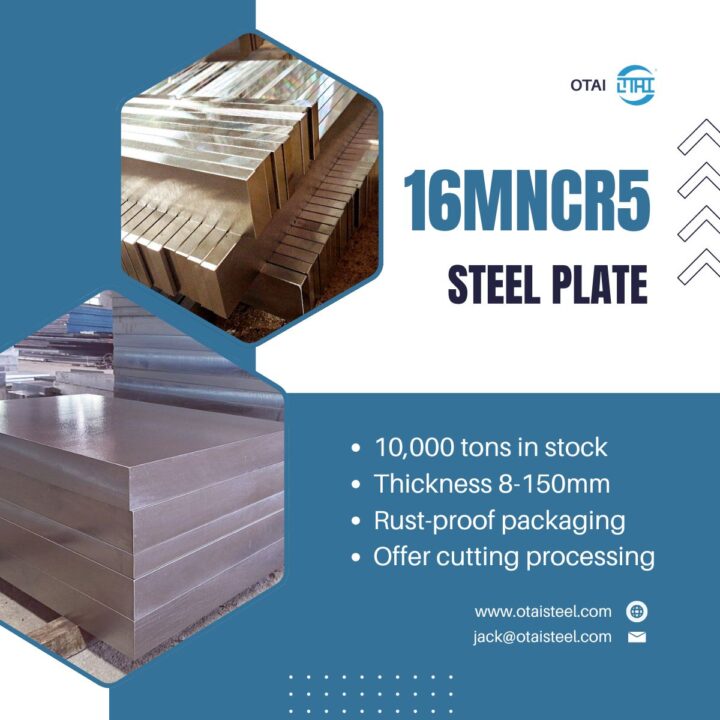
- 16MnCr5 steel plate in stock: Otai keeps 16MnCr5 steel plate in 8–150 mm thickness for industrial purchasing requirements.
- 10,000+ tons of steel stock: Large inventory supports regular export orders and project-based purchasing.
- 20 saw cutting machines: Otai can provide cutting services according to customer dimensions.
- Custom size and tolerance: Buyers can discuss required dimensions and machining allowances before shipment.
- CNC and grinding services: Additional processing can help reduce the number of operations required after material receipt.
- One-stop service: Cutting, machining, inspection, packaging and export coordination can be arranged according to project requirements.
- International export experience: Otai has supplied steel to customers in 54+ countries since 1999.
- Inspection support: MTC documentation, ultrasonic testing and third-party inspection can be arranged when required by the customer.
- Export packaging: Anti-rust protection, bundled packaging and wooden cases can be selected according to transportation requirements.
For a 16MnCr5 steel inquiry, provide the required thickness, width, length, quantity, delivery condition, standard and inspection requirements. This allows the supplier to check stock and prepare a more accurate quotation.
❓ FAQ
1. What is 16MnCr5 steel?
16MnCr5 is a low-carbon manganese-chromium alloy case-hardening steel, commonly associated with material number 1.7131. It is designed for carburizing and subsequent hardening, producing a wear-resistant surface with a tougher core.
2. What is the chemical composition of 16MnCr5?
The commonly referenced EN composition includes 0.14–0.19% carbon, 1.00–1.30% manganese and 0.80–1.10% chromium, with silicon, phosphorus and sulfur controlled within specified limits. The actual chemistry should always be confirmed from the supplier’s MTC.
3. What is the hardness of 16MnCr5 steel?
Hardness depends on the delivery and heat-treatment condition. Soft-annealed material is commonly around 207 HB, while carburizing and quenching can produce a substantially harder surface. Therefore, a hardness requirement should specify whether it refers to the core, surface or as-delivered material.
4. What is the heat-treatment temperature for 16MnCr5?
Reference data lists carburizing around 880–980°C, quenching around 860–900°C and tempering around 150–200°C. Actual holding time and process parameters depend on section size, furnace conditions, required case depth and the selected heat-treatment procedure.
5. Is 16MnCr5 the same as 1.7131?
Yes. 1.7131 is the material number commonly associated with 16MnCr5. However, buyers should still specify the applicable product standard and delivery condition because the same grade designation can appear in different product standards with different technical requirements.