Specific Heat of 4140 Steel: Heat Capacity, Temperature Effects and Thermal Processing
📑 Table of Contents
🔍 1. Specific Heat of 4140 Steel: What Does It Mean?
🧪 2. 4140 Steel Thermal Properties
📊 3. Specific Heat Capacity of 4140 Steel at Different Temperatures
🔥 4. How Temperature Changes the Specific Heat of 4140
⚙️ 5. Specific Heat and 4140 Steel Heat Treatment
🛠️ 6. Specific Heat, Machining and Welding of 4140 Steel
🏭 7. Why Specific Heat Matters in Industrial Applications
💡 8. How to Calculate Heat Energy for 4140 Steel
🔍 1. Specific Heat of 4140 Steel: What Does It Mean?
The specific heat of 4140 steel describes how much thermal energy the material needs to increase its temperature by a specific amount. Engineers commonly express specific heat capacity in J/kg·K or J/kg·°C.
For 4140 steel at approximately room temperature, a practical engineering value is around 460 J/kg·K. However, this value is not constant across the entire temperature range. Specific heat changes as the steel becomes hotter and can change significantly around phase transformation temperatures.
This property becomes important whenever manufacturers heat, cool, weld, forge, machine or heat-treat 4140 steel. The specific heat affects how much energy the material absorbs during heating and how quickly its temperature changes under a given heat input.
4140 is a chromium-molybdenum alloy steel widely used for shafts, axles, gears, bolts, machinery components and other high-strength parts. Its thermal behavior therefore matters in both production and service environments.
| Property | Typical Engineering Information |
|---|---|
| Steel grade | 4140 alloy steel |
| Steel type | Chromium-molybdenum alloy steel |
| Specific heat at room temperature | Approximately 460 J/kg·K |
| Common unit | J/kg·K or J/kg·°C |
| Thermal behavior | Temperature dependent |
| Important applications | Heat treatment, welding, forging, machining and thermal analysis |
The value of 460 J/kg·K should be treated as an engineering reference rather than a universal material constant. The actual value can depend on temperature, microstructure and the source of the technical data.
For detailed furnace calculations, simulation work or process qualification, engineers should use temperature-dependent material data from the relevant material database or technical specification.
🧪 2. 4140 Steel Thermal Properties
Specific heat is only one part of the thermal behavior of 4140 steel. Thermal conductivity, thermal expansion, density and transformation temperatures also affect how the material responds to heating and cooling.
When engineers design a heating process, they need to consider these properties together. For example, specific heat determines how much energy the steel can absorb, while thermal conductivity influences how that energy moves through the section.
| Thermal Property | Typical Engineering Value / Behavior | Why It Matters |
|---|---|---|
| Specific heat | About 460 J/kg·K at room temperature | Determines energy required for temperature increase |
| Thermal conductivity | Approximately 40–45 W/m·K near room temperature | Controls heat transfer through the steel |
| Thermal expansion | Changes with temperature | Influences dimensional change during heating |
| Density | Approximately 7,850 kg/m³ | Used in mass and heat-energy calculations |
| Transformation behavior | Depends on heating and cooling conditions | Important during hardening and annealing |
Specific heat vs thermal conductivity
These two properties are easy to confuse. Specific heat describes the energy required to change the temperature of a material. Thermal conductivity describes how effectively heat travels through the material.
A steel part can therefore have a relatively high specific heat while still developing temperature differences between its surface and core during rapid heating.
This distinction matters when working with thick 4140 steel plates or large round bars. The furnace may raise the surface temperature quickly, while the center requires more time to reach the same temperature.
Why density also matters
Specific heat is normally expressed per unit mass. Therefore, engineers need the material density when converting the value into a volumetric heat capacity.
For 4140 steel, multiplying density by specific heat provides an approximate volumetric heat capacity. This value helps engineers estimate how much energy a given volume of steel requires during thermal processing.
Consequently, the 4140 steel thermal properties should be considered as a group rather than as isolated numbers.
📊 3. Specific Heat Capacity of 4140 Steel at Different Temperatures
The specific heat capacity of 4140 steel changes with temperature. At relatively low temperatures, engineers can often use a room-temperature value for preliminary calculations. Higher-temperature processes require more careful data selection.
During heat treatment, 4140 may reach temperatures well above 800°C. At these temperatures, the thermal properties differ from their room-temperature values. The steel also undergoes microstructural changes that can influence the measured thermal response.
| Temperature Range | Specific Heat Behavior | Engineering Consideration |
|---|---|---|
| Room temperature | Approximately 460 J/kg·K | Useful for basic calculations |
| Moderate heating | Generally increases with temperature | Temperature-dependent data is preferable |
| High-temperature processing | Can differ substantially from room-temperature data | Use process-specific thermal data |
| Near transformation temperatures | Thermal response can change sharply | Important for heat-treatment simulation |
| Cooling after hardening | Changes as temperature falls | Cooling rate affects the final microstructure |
Why one specific heat value is not enough
A single number is convenient, but it cannot describe every thermal process. If a furnace heats 4140 from 20°C to 850°C, the steel does not absorb energy according to the room-temperature specific heat during the entire cycle.
A more accurate calculation uses temperature-dependent specific heat. Engineers can integrate the heat capacity across the temperature range to estimate the total sensible heat required.
This approach becomes particularly useful for large production furnaces, automated heat-treatment lines and thermal simulation software.
Specific heat and section size
Section size does not normally change the intrinsic specific heat value of the steel. However, thickness strongly affects the time required for heat to reach the center of a component.
A thin 4140 plate can approach furnace temperature relatively quickly. A large-diameter bar requires substantially more time for the core to heat uniformly.
For this reason, engineers should distinguish between the material property itself and the thermal response of a real component.
The 4140 specific heat capacity is therefore essential for energy calculations, but it should be combined with thermal conductivity, density, geometry and heating conditions for practical process design.
🔥 4. How Temperature Changes the Specific Heat of 4140
Temperature has a major influence on the heat capacity of metals. As 4140 becomes hotter, its specific heat generally changes rather than remaining fixed at the room-temperature value.
The change becomes particularly important during heat treatment. A process that heats the material from ambient temperature to the austenitizing range involves a wide temperature interval, so a constant-value assumption can introduce calculation errors.
Heating from room temperature
During the initial heating stage, engineers can use an approximate room-temperature value for basic estimates. For many preliminary calculations, around 460 J/kg·K provides a useful starting point.
As the temperature rises, however, the specific heat changes. Furnace calculations should therefore use temperature-dependent data when accuracy matters.
Approaching phase transformations
Alloy steels experience changes in their microstructure during heating and cooling. Around transformation regions, the relationship between temperature and thermal energy can become more complex.
The apparent heat requirement can increase because part of the supplied energy contributes to microstructural transformation rather than simply increasing temperature.
| Factor | Effect on Thermal Calculations |
|---|---|
| Temperature | Specific heat changes with temperature |
| Microstructure | Can influence thermal properties |
| Phase transformation | Can alter the energy-temperature relationship |
| Heating rate | Influences thermal gradients and transformation behavior |
| Section thickness | Controls the temperature difference between surface and core |
| Furnace atmosphere | Can affect surface condition during heating |
These factors explain why professional heat-treatment engineers do not normally design a complete process from a single specific heat of 4140 steel value.
Instead, they combine experimental data, published thermal properties, furnace characteristics and the actual component geometry to establish suitable heating and cooling schedules.
⚙️ 5. Specific Heat and 4140 Steel Heat Treatment
Heat treatment is one of the most important situations where the thermal properties of 4140 become practical. Manufacturers commonly anneal, normalize, harden and temper 4140 to obtain the required combination of strength and toughness.
Each process requires controlled heating and cooling. The amount of energy required to raise the steel temperature depends partly on its specific heat and mass.
Annealing 4140
Annealing generally involves heating the steel to an appropriate temperature followed by controlled cooling. The goal is to produce a suitable microstructure for machining or subsequent processing.
For large 4140 components, uniform heating is especially important. The furnace must supply enough energy to bring both the surface and core to the required temperature.
Normalizing 4140
Normalizing uses controlled heating followed by cooling in air or another specified condition. This process can refine the microstructure and prepare the material for further heat treatment.
The heating stage again depends on mass, temperature range, furnace efficiency and the thermal properties of the steel.
Quenching and tempering
Quenching requires heating 4140 into the appropriate austenitizing range before rapidly cooling it. Tempering then reheats the steel to a lower temperature to obtain the desired balance of hardness and toughness.
| Heat Treatment | Typical Purpose | Thermal Property Consideration |
|---|---|---|
| Annealing | Improve machinability and adjust microstructure | Controlled heating and slow cooling |
| Normalizing | Refine and homogenize the structure | Uniform heating is important |
| Quenching | Develop high hardness and strength | Heating rate and section temperature matter |
| Tempering | Reduce brittleness and adjust toughness | Controlled reheating is required |
| Induction hardening | Harden selected surface areas | Rapid localized heating creates thermal gradients |
The 4140 steel heat treatment process should not rely on a nominal specific heat value alone. Furnace power, load size, thermal conductivity, emissivity, geometry and heating rate all affect the actual process.
For this reason, production engineers often validate furnace schedules through thermocouple measurements or process trials. This approach helps ensure that the component reaches the required temperature throughout the section.
🛠️ 6. Specific Heat, Machining and Welding of 4140 Steel
Thermal properties also influence manufacturing operations such as welding and machining. The material condition plays an important role in both cases.
4140 welding
4140 has higher hardenability than many plain carbon steels. During welding, the heat-affected zone can cool quickly enough to form hard microstructures.
This behavior can increase the risk of cracking, especially when the material has a high hardness or when welding involves thick sections. Preheating and controlled cooling are therefore commonly considered for demanding 4140 welding procedures.
Specific heat helps describe how much energy the steel can absorb, but it does not determine weldability by itself. Carbon content, alloying elements, thickness, heat input, restraint and cooling rate also matter.
4140 machining
During cutting operations, mechanical energy becomes partly converted into heat. The resulting temperature depends on cutting speed, feed rate, tool geometry, lubrication and material condition.
Specific heat affects the amount of energy required to raise the workpiece temperature. Thermal conductivity then influences how quickly that heat spreads through the steel.
| Manufacturing Operation | Why Thermal Properties Matter |
|---|---|
| Welding | Influence thermal gradients, cooling and heat-affected-zone behavior |
| Machining | Influence heat accumulation and temperature rise |
| Forging | Help determine heating energy and temperature control |
| Heat treatment | Support furnace energy and heating-cycle calculations |
| Induction hardening | Important for rapid localized heating |
| Stress relieving | Relevant to controlled thermal cycles |
Why thick 4140 sections require attention
A thick plate or large round bar does not heat uniformly at the same instant. The surface can reach the target temperature before the center.
If the process moves to the next stage too early, the core may not have reached the required temperature. This issue can affect transformation, hardness and final mechanical performance.
Consequently, engineers should consider section size when developing thermal processes for 4140. The specific heat capacity of 4140 steel provides part of the calculation, but thermal conductivity and heat-transfer conditions also influence the real heating time.
🏭 7. Why Specific Heat Matters in Industrial Applications
Manufacturers encounter specific heat in many situations, even when they do not calculate it directly. Furnace operators, forging engineers, welding specialists and thermal simulation engineers all need to understand how steel absorbs and transfers heat.
For example, a company heating a large batch of 4140 bars needs substantially more total energy than a small batch. The required energy depends on the total mass and the temperature increase.
Forging operations also depend on controlled heating. The steel must reach a suitable forging temperature without excessive overheating or undesirable surface damage.
| Industry / Process | Importance of 4140 Thermal Properties |
|---|---|
| Heat treatment | Furnace energy, heating time and thermal uniformity |
| Forging | Heating efficiency and temperature control |
| Welding | Heat input and cooling behavior |
| Machining | Temperature rise and heat dissipation |
| Induction hardening | Rapid localized thermal response |
| Thermal simulation | Temperature-dependent material modeling |
Energy efficiency in steel heating
Knowing the approximate heat capacity helps manufacturers estimate furnace energy requirements. Better estimates can support production planning and energy-efficiency improvements.
However, real furnace consumption is higher than the theoretical energy absorbed by the steel. Heat losses occur through furnace walls, exhaust gases, fixtures, radiation and other mechanisms.
Therefore, the specific heat provides a theoretical material requirement rather than the complete electrical or fuel consumption of the furnace.
Thermal simulation
Computer simulations often require temperature-dependent thermal properties. Engineers may enter specific heat, thermal conductivity and density into a thermal model.
The model can then estimate temperature distribution during heating, cooling or welding. More accurate input data can improve the reliability of these calculations.
For complex 4140 components, engineers should use data appropriate to the actual temperature range and material condition rather than applying a single room-temperature value to the entire simulation.
💡 8. How to Calculate Heat Energy for 4140 Steel
A basic thermal calculation uses the relationship between mass, specific heat and temperature change. The standard equation is:
Q = m × c × ΔT
Here, Q represents the required sensible heat energy, m represents mass, c represents specific heat capacity, and ΔT represents the temperature increase.
| Symbol | Meaning | Common Unit |
|---|---|---|
| Q | Heat energy | J |
| m | Mass of 4140 steel | kg |
| c | Specific heat capacity | J/kg·K |
| ΔT | Temperature change | K or °C |
Example calculation
Assume a 100 kg batch of 4140 steel starts at 20°C and must reach 800°C. For a simplified estimate, use 460 J/kg·K as the constant specific heat.
Q = 100 × 460 × (800 − 20)
Q ≈ 35,880,000 J = 35.88 MJ
This result represents an idealized sensible-heat requirement. It does not represent the actual furnace energy consumption.
In a real process, engineers should account for the changing specific heat of 4140 with temperature. They should also include furnace losses, heat-transfer efficiency, fixtures and the energy associated with phase transformations when applicable.
Why the calculation is useful for buyers
Understanding the relationship between mass, specific heat and temperature helps buyers communicate more effectively with heat-treatment suppliers. It can also help estimate production requirements for large steel components.
For example, a buyer ordering thick 4140 plates may need to know whether the supplier can provide the required heat-treatment condition, hardness range and dimensional stability after processing.
The specific heat of 4140 steel is therefore more than a laboratory property. It contributes to the practical understanding of how 4140 behaves during heating, cooling, welding, forging and heat treatment.
For preliminary engineering work, approximately 460 J/kg·K at room temperature is a useful reference. For accurate thermal process design, temperature-dependent data should be used.
📦 9. Otai Special Steel Advantages
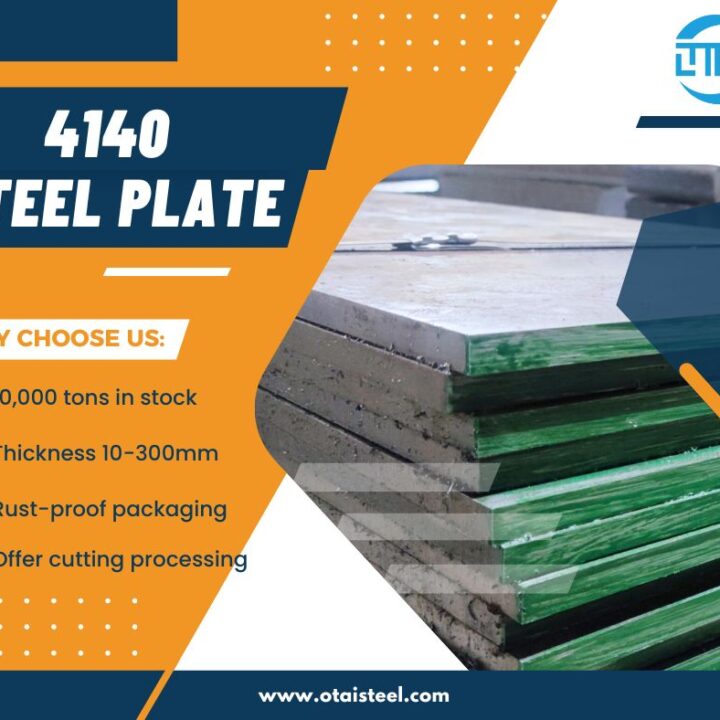
- 4140 steel round bar stock: Otai Special Steel provides 4140 steel round bars with diameters of 14–500mm available in stock for machining, forging, and industrial component manufacturing.
- 4140 steel plate stock: We supply 4140 steel plates with thicknesses of 13–200mm available in stock to meet different fabrication and heavy-duty application requirements.
- Different dimensions: We can supply different thicknesses, widths, lengths and diameters according to customer requirements.
- Cutting service: We can arrange cutting according to customer drawings and specified dimensions.
- Heat treatment: Annealing, normalizing, quenching, tempering and other heat-treatment services can be arranged according to requirements.
- Quality inspection: Ultrasonic testing and third-party inspection can be arranged for orders with specific quality requirements.
- Export packaging: Steel strapping, wooden cases and anti-rust packaging help protect steel products during international transportation.
- International supply experience: Otai Special Steel has supplied steel products to customers with demanding technical requirements, including Fortune Global 500 companies.
If you are sourcing 4140 steel for machining, forging, welding or heat treatment, provide the required dimensions, delivery condition, mechanical properties and application. Otai Special Steel can help confirm suitable 4140 material and processing options.
❓ 10. Frequently Asked Questions
1. What is the specific heat of 4140 steel?
The specific heat capacity of 4140 steel is approximately 460 J/kg·K at room temperature as a practical engineering reference. The actual value changes with temperature and material condition.
2. Does the specific heat of 4140 steel change with temperature?
Yes. Specific heat is temperature dependent. The value used for room-temperature calculations should not automatically be applied across the complete temperature range of a heat-treatment or forging process.
3. What is the difference between specific heat and thermal conductivity?
Specific heat describes how much energy is required to raise the temperature of a given mass. Thermal conductivity describes how efficiently heat travels through the material. Both properties matter when heating 4140 steel.
4. Why is specific heat important for 4140 heat treatment?
It helps engineers estimate the energy required to heat 4140 to a target temperature. However, accurate process design also requires thermal conductivity, density, heating rate, section size, furnace efficiency and temperature-dependent material data.
5. What 4140 steel products does Otai Special Steel have in stock?
Otai Special Steel provides 4140 steel round bars with diameters of 14–500mm available in stock and 4140 steel plates with thicknesses of 13–200mm available in stock. Cutting, heat treatment, inspection and export packaging can also be arranged according to project requirements.