C45 vs 16MnCr5: Chemical Composition, Hardness, Heat Treatment and Applications
📑 Table of Contents
🔍 1. C45 vs 16MnCr5: What Is the Main Difference?
🧪 2. Chemical Composition Comparison
📊 3. Hardness and Mechanical Properties
🔥 4. Heat Treatment and Hardening
⚙️ 5. Machinability and Weldability
🏭 6. Applications of C45 and 16MnCr5
🦾 7. C45 vs 16MnCr5 for Gears, Shafts and Wear Parts
💡 8. Which Steel Should You Choose?
🔍 1. C45 vs 16MnCr5: What Is the Main Difference?
The comparison between C45 vs 16MnCr5 starts with their different steel designs. C45 is a medium-carbon non-alloy steel, while 16MnCr5 is a low-carbon alloy steel developed mainly for case-hardening applications. 16MnCr5 corresponds to 1.7131, while C45 corresponds to 1.0503. C45 falls under EN 10083 for quenching and tempering, whereas 16MnCr5 belongs to EN 10084 for case-hardening steels.
C45 contains significantly more carbon. This allows the grade to achieve useful strength and hardness through quenching and tempering. It works well for general mechanical components that need a relatively uniform combination of strength and hardness.
16MnCr5 takes a different approach. Its carbon content remains relatively low, while manganese and chromium improve its hardenability. Manufacturers commonly carburize the finished component before quenching. This creates a hard, wear-resistant surface while keeping the core tougher.
This difference becomes particularly important when selecting steel for gears. C45 can work for many gears and mechanical parts, especially when surface hardening meets the design requirements. However, 16MnCr5 offers a more specialized solution when the component needs a carburized case and a tough core.
| Feature | C45 | 16MnCr5 |
|---|---|---|
| Steel type | Medium-carbon non-alloy steel | Low-carbon alloy case-hardening steel |
| Material number | 1.0503 | 1.7131 |
| Carbon content | 0.43–0.50% | 0.14–0.19% |
| Main alloying elements | Primarily carbon and manganese | Manganese and chromium |
| Typical heat treatment | Quenching and tempering | Carburizing, quenching and tempering |
| Surface hardness potential | High after suitable surface hardening | Very high after carburizing and quenching |
| Typical applications | Shafts, axles, pins, machine parts | Gears, pinions, transmission components |
In simple terms, C45 is a practical general-purpose carbon steel for mechanical engineering, while 16MnCr5 is a specialized case-hardening steel. The better grade depends on the required hardness distribution, wear resistance, toughness, component geometry, and production process.
🧪 2. Chemical Composition Comparison
Chemical composition explains why these two grades behave differently during heat treatment. C45 uses a relatively simple medium-carbon chemistry. 16MnCr5 combines low carbon with higher manganese and chromium content.
| Element | C45 Typical Composition | 16MnCr5 Typical Composition | Primary Effect |
|---|---|---|---|
| Carbon (C) | 0.43–0.50% | 0.14–0.19% | Hardness and strength |
| Silicon (Si) | Max. 0.40% | Max. 0.40% | Deoxidation and strength |
| Manganese (Mn) | 0.50–0.80% | 1.00–1.30% | Strength and hardenability |
| Chromium (Cr) | Max. 0.40% | 0.80–1.10% | Hardenability |
| Phosphorus (P) | Max. 0.045% | Max. 0.025% | Controlled for steel quality |
| Sulfur (S) | Max. 0.045% | Max. 0.035% | Controlled for steel quality and machinability |
The exact limits can vary with the product standard and delivery condition. Buyers should therefore confirm the actual chemical analysis on the mill certificate when the application has strict requirements.
Why C45 has higher carbon
The higher carbon content gives C45 a stronger response to conventional quenching. After suitable heat treatment, manufacturers can obtain useful hardness and tensile strength across the section.
However, C45 has lower hardenability than many alloy steels. Larger sections may not develop the same hardness throughout the cross-section as smaller sections.
Why 16MnCr5 uses chromium
16MnCr5 uses chromium and manganese to support hardenability during case hardening. During carburizing, carbon enters the surface and changes the composition of the outer layer.
After quenching, the carbon-enriched layer develops high hardness. The original low-carbon core remains comparatively softer and tougher.
Therefore, the C45 vs 16MnCr5 chemical composition comparison reveals two different engineering strategies. C45 uses medium carbon to support through-hardening and surface hardening, while 16MnCr5 uses low carbon plus alloying elements to support carburized case hardening.
📊 3. Hardness and Mechanical Properties
Hardness is one of the most common reasons engineers compare these grades. However, neither C45 nor 16MnCr5 has one fixed hardness value for every condition.
Material condition, section size, heat-treatment parameters, cooling medium, tempering temperature, and testing location can all change the final result.
| Property / Condition | C45 | 16MnCr5 |
|---|---|---|
| Annealed hardness | Typically up to about 207 HBW | Typically up to about 207 HBW |
| Normalized condition | Moderate hardness and strength | Relatively soft ferrite-pearlite condition |
| Quenched and tempered | High strength and hardness potential | Used mainly for selected core-property requirements |
| Carburized surface | Not the typical treatment route | Very high surface hardness |
| Core toughness | Depends on heat treatment | Good when properly case hardened |
| Wear resistance | Good after suitable hardening | Excellent at the carburized case |
C45 hardness
C45 can reach high hardness through quenching and subsequent tempering. It can also receive induction or flame hardening when the design requires a harder working surface.
The final hardness should always match the application. Excessive hardness can reduce toughness, while insufficient hardness may lead to accelerated wear.
16MnCr5 hardness
The hardness profile of 16MnCr5 differs from C45 because case hardening creates a hardness gradient from the surface toward the core.
A properly carburized and quenched surface can commonly reach around the high-50s to low-60s HRC range, depending on the process and specification. The core remains considerably softer.
Which is harder: C45 or 16MnCr5?
There is no meaningful answer without specifying the heat-treatment condition. Hardened C45 can achieve high hardness, while carburized 16MnCr5 can achieve a very hard surface.
The more useful question is whether the component needs uniform hardness or a hard surface with a tougher core. That distinction often determines the better grade.
🔥 4. Heat Treatment and Hardening
Heat treatment creates one of the clearest differences between C45 and 16MnCr5. C45 commonly receives quenching and tempering, while 16MnCr5 often receives carburizing before quenching and tempering.
C45 heat treatment
A typical C45 heat-treatment route starts with austenitizing followed by quenching. Tempering then adjusts the balance between hardness, strength, and toughness.
Manufacturers can also use normalizing or annealing before machining. For selected components, induction hardening can create a hard surface without hardening the complete section.
16MnCr5 heat treatment
16MnCr5 normally follows a case-hardening route. The component first undergoes carburizing, which increases carbon concentration near the surface.
Quenching then transforms the enriched surface into a hard martensitic case. Tempering can follow to reduce internal stresses and stabilize the final structure. Case-hardening steels typically use carburizing temperatures in the 850–950°C range, although the exact production cycle depends on the grade and required case depth.
| Heat-Treatment Route | C45 | 16MnCr5 |
|---|---|---|
| Annealing | Common | Common before machining |
| Normalizing | Common | Possible |
| Quenching and tempering | Primary hardening route | Used in selected conditions and after case hardening |
| Carburizing | Not the standard route | Primary case-hardening route |
| Induction hardening | Suitable | Possible depending on application |
Case hardening versus through hardening
Through hardening aims to increase hardness through a substantial portion of the component. Case hardening instead concentrates high hardness near the surface.
This makes 16MnCr5 particularly effective for gears. The tooth surface can resist contact wear, while the core provides structural support and toughness.
C45 remains attractive when the component needs a simpler heat-treatment route and does not require the specialized carbon-enriched case of 16MnCr5.
⚙️ 5. Machinability and Weldability
Machinability and weldability also influence material selection. The best choice depends on the material condition and the manufacturing sequence.
Machining C45
C45 generally machines well in annealed or normalized conditions. Manufacturers can turn, mill, drill, and cut the material before final heat treatment.
After quenching, machining becomes more difficult because hardness increases. Manufacturers may then use carbide tools, controlled cutting parameters, or grinding for final dimensions.
Machining 16MnCr5
16MnCr5 can also provide good machinability in suitable soft conditions. Manufacturers often complete rough machining before carburizing.
After case hardening, the hardened surface becomes difficult to machine. Precision grinding can therefore become necessary for gears and other components with tight dimensional tolerances.
Weldability comparison
C45 contains substantially more carbon than 16MnCr5. This makes welding more sensitive to cracking and usually requires greater process control.
16MnCr5 is also not a steel that manufacturers should weld casually. The material’s alloy content and heat-treatment requirements still require appropriate welding procedures.
| Manufacturing Factor | C45 | 16MnCr5 |
|---|---|---|
| Machining in soft condition | Good | Good |
| Machining after hardening | More difficult | More difficult at hardened case |
| Grinding | Used for hardened parts | Common for precision case-hardened components |
| Welding | Requires precautions | Requires suitable procedure and heat control |
| Pre-machining before heat treatment | Common | Common |
The manufacturing sequence matters. A supplier should understand whether the customer plans to machine the steel before heat treatment, after heat treatment, or both. This information helps determine the appropriate delivery condition.
🏭 6. Applications of C45 and 16MnCr5
The application often provides the clearest answer in a C45 vs 16MnCr5 comparison. C45 suits many general mechanical components, while 16MnCr5 targets components that benefit from case hardening.
| Application | C45 | 16MnCr5 |
|---|---|---|
| Shafts | Excellent for many applications | Suitable when case hardening is required |
| Axles | Suitable | Suitable for selected designs |
| Gears | Suitable with appropriate hardening | Excellent for carburized gears |
| Pinions | Suitable for moderate requirements | Excellent after case hardening |
| Machine parts | Very common | Suitable for selected components |
| Wear-resistant components | Suitable after surface hardening | Excellent after carburizing |
| Transmission components | Possible | Very suitable |
C45 applications
Typical C45 steel applications include shafts, axles, pins, rollers, bolts, studs, machine components, and parts that need moderate-to-high strength.
C45 is attractive because of its relatively simple chemistry and broad availability. Manufacturers can use several heat-treatment routes depending on the required performance.
For example, a shaft may use normalized C45 for moderate service or quenched-and-tempered C45 when higher strength is required. An induction-hardened surface can provide additional wear resistance in selected designs.
16MnCr5 applications
Typical 16MnCr5 steel applications include gears, pinions, transmission parts, shafts, bushes, and other components that benefit from a hardened outer layer and tough core.
This grade is particularly attractive when contact fatigue and surface wear control the component’s service life. Carburizing allows manufacturers to tailor the surface properties without making the entire component extremely hard.
Therefore, C45 is often a practical choice for general engineering, while 16MnCr5 becomes more attractive when case-hardening performance is a primary design requirement.
🦾 7. C45 vs 16MnCr5 for Gears, Shafts and Wear Parts
Choosing between these grades becomes easier when the component’s failure mode is clear. Gears often fail through surface fatigue, wear, tooth breakage, or a combination of these mechanisms. Shafts may instead require a broader balance of strength, toughness, fatigue resistance, and machinability.
For gears
16MnCr5 has a strong advantage for gears that require carburizing. The hardened case provides high surface hardness, while the lower-carbon core remains tougher.
C45 can also serve in gear manufacturing. However, the designer must confirm that its final surface hardness, hardening depth, fatigue performance, and dimensional stability meet the application requirements.
For shafts
C45 is often a practical choice for shafts because it can provide useful strength through conventional quenching and tempering. It also offers a straightforward machining and heat-treatment route.
16MnCr5 can work for shafts when the design specifically benefits from case hardening. However, using a case-hardening grade may add processing requirements that a general-purpose shaft does not need.
For wear parts
Both grades can provide good wear resistance after suitable treatment. The difference lies in how they achieve it.
| Requirement | C45 | 16MnCr5 |
|---|---|---|
| General machine parts | Excellent choice | Suitable |
| High-strength shafts | Excellent choice | Suitable depending on design |
| Carburized gears | Not the typical choice | Excellent choice |
| Surface wear resistance | Good after surface hardening | Excellent after case hardening |
| Tough core with hard surface | Possible but not its primary design | Primary advantage |
| Simple heat-treatment route | Advantage | More specialized |
The C45 vs 16MnCr5 for gears decision should therefore consider load, tooth size, contact stress, required case depth, surface hardness, core hardness, and heat-treatment capability.
Do not select a material simply because its nominal hardness appears higher. The complete hardness profile and the way the component carries load are much more important.
💡 8. Which Steel Should You Choose?
Neither grade is universally better. The correct selection depends on the component, required properties, heat-treatment process, and production cost.
Choose C45 when:
- You need a medium-carbon steel for general mechanical components.
- You need good strength after quenching and tempering.
- You are manufacturing shafts, axles, pins, rollers, or machine parts.
- You want a relatively simple heat-treatment route.
- You need surface hardening for selected wear applications.
- You do not require a specialized carburized case.
Choose 16MnCr5 when:
- You need a carburized and hardened surface.
- The component experiences repeated contact stress.
- You require high surface wear resistance.
- You need a tougher core beneath the hardened case.
- You are manufacturing gears, pinions, or transmission components.
- The application justifies a dedicated case-hardening alloy steel.
| Engineering Requirement | Recommended Grade |
|---|---|
| General machine components | C45 |
| Conventional quenched-and-tempered shafts | C45 |
| Pins and rollers | C45 |
| Carburized gears | 16MnCr5 |
| Carburized pinions | 16MnCr5 |
| Hard surface with tough core | 16MnCr5 |
| Simple quench-and-temper processing | C45 |
When selecting between these grades, start with the component requirements rather than the steel name. Define the required surface hardness, core hardness, tensile strength, fatigue performance, case depth, section size, dimensional tolerance, and manufacturing sequence.
For buyers comparing C45 vs 16MnCr5, the main question is whether the component needs the uniform mechanical performance of a medium-carbon steel or the specialized surface-and-core combination of a case-hardening alloy steel.
In many general engineering applications, C45 provides an economical and practical solution. For demanding gears and transmission components, 16MnCr5 can provide a more suitable route because its chemistry supports carburizing and case hardening.
📦 9. Otai Special Steel Advantages
- 4140 steel round bar stock: Otai Special Steel provides 4140 steel round bars with diameters of 14–500mm available in stock for machining, forging, and industrial component manufacturing.
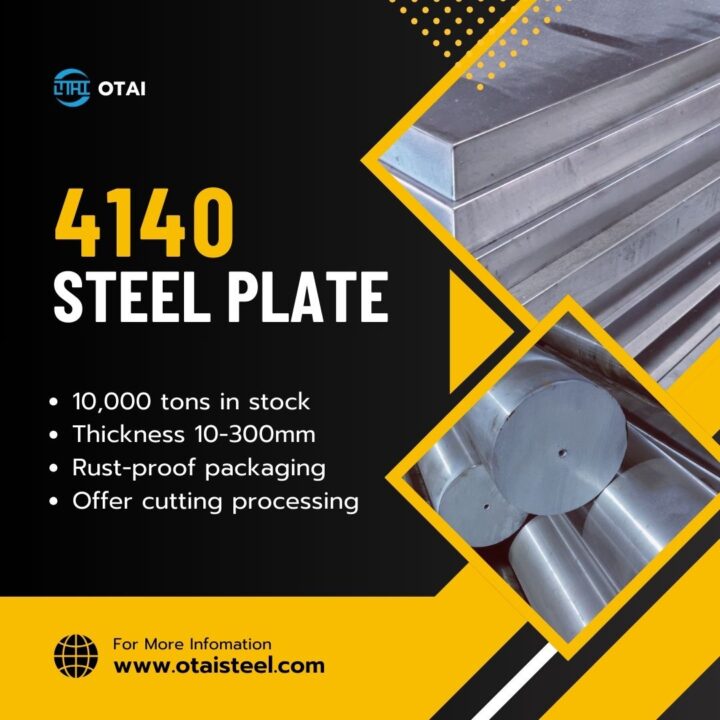
- 4140 steel plate stock: We supply 4140 steel plates with thicknesses of 13–200mm available in stock to meet different fabrication and heavy-duty application requirements.
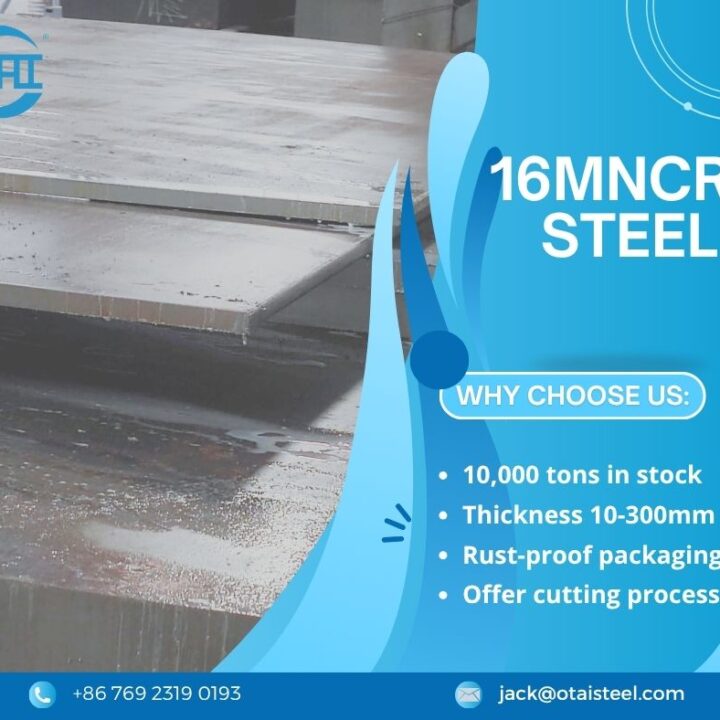
- 16MnCr5 steel plate stock: We also keep 16MnCr5 plates in 8–150mm thickness available in stock for machining and case-hardening applications.
- Cutting service: We can arrange cutting according to customer drawings and specified dimensions.
- Heat treatment: Annealing, normalizing, quenching, tempering, and other heat-treatment services can be arranged according to technical requirements.
- Quality inspection: Ultrasonic testing and third-party inspection can be arranged for orders with specific quality requirements.
- Export packaging: Steel strapping, wooden cases, and anti-rust packaging help protect steel products during international transportation.
- International supply experience: Otai Special Steel has supplied steel products to customers with demanding technical requirements, including Fortune Global 500 companies.
If you are comparing C45 vs 16MnCr5 for a specific project, provide the required dimensions, heat-treatment condition, hardness, application, and quantity. Otai Special Steel can help confirm suitable steel products and processing options.
❓ 10. Frequently Asked Questions
1. What is the main difference between C45 and 16MnCr5?
C45 is a medium-carbon non-alloy steel mainly used for general mechanical applications and quenching and tempering. 16MnCr5 is a low-carbon alloy case-hardening steel mainly used for carburized components such as gears and pinions.
2. Is C45 harder than 16MnCr5?
It depends on the material condition and heat treatment. C45 can achieve high hardness after quenching and tempering or surface hardening. Carburized 16MnCr5 can develop a very hard surface while maintaining a softer, tougher core.
3. Is 16MnCr5 better than C45 for gears?
For gears that require a hard carburized case and tough core, 16MnCr5 is generally more suitable. C45 can still work for gears when the required hardness, load, and service conditions fall within its capability.
4. Can C45 be carburized like 16MnCr5?
C45 is primarily a medium-carbon steel for quenching and tempering and is not normally selected for the same carburizing role as 16MnCr5. For a dedicated carburized component, 16MnCr5 is usually the more appropriate choice.
5. What is 16MnCr5 used for?
16MnCr5 is commonly used for gears, pinions, shafts, bushes, and transmission components that need a hard wear-resistant surface combined with a tougher core after case hardening.