Tensile Strength of Heat Treated 4140 Steel: Values, Hardness, Heat Treatment and Applications
📑 Table of Contents
🔍 1. Tensile Strength of Heat Treated 4140 Steel: What Does It Mean?
🧪 2. 4140 Chemical Composition and Strength Potential
📊 3. Tensile Strength and Hardness After Heat Treatment
🔥 4. How Heat Treatment Changes 4140 Tensile Strength
⚙️ 5. Quenching, Tempering and Cooling Conditions
🏭 6. Applications of Heat Treated 4140 Steel
🦾 7. Factors That Affect 4140 Tensile Strength
💡 8. How to Choose the Right 4140 Heat Treatment
🔍 1. Tensile Strength of Heat Treated 4140 Steel: What Does It Mean?
The tensile strength of heat treated 4140 steel describes the maximum tensile stress that the material can withstand before it fractures during a tensile test. It is one of the most important mechanical properties for engineers selecting 4140 for shafts, axles, bolts, gears, and other high-load components.
However, 4140 does not have one universal tensile strength after heat treatment. The final value depends on the heat-treatment process, tempering temperature, section size, cooling conditions, and material condition. Therefore, engineers should always connect tensile strength with hardness, yield strength, toughness, and elongation.
4140 is a chromium-molybdenum alloy steel with a strong response to quenching and tempering. Proper heat treatment can produce a useful combination of high strength and toughness.
For many engineering applications, quenched and tempered 4140 provides tensile strength in a broad range. A commonly encountered range is approximately 850–1100 MPa, while carefully controlled treatments can produce significantly higher values. The exact result depends on the specified condition and section size.
| Property | What It Indicates | Importance for 4140 |
|---|---|---|
| Tensile strength | Maximum tensile stress before fracture | Load-carrying capability |
| Yield strength | Stress at which permanent deformation begins | Important for highly loaded components |
| Hardness | Resistance to indentation and wear | Useful for controlling heat-treatment condition |
| Elongation | Plastic deformation before fracture | Indicates ductility |
| Impact toughness | Ability to absorb sudden loading | Important for shafts, axles and heavy machinery |
A higher tensile strength does not automatically mean a better material. Excessive hardness and strength can reduce ductility and toughness. For this reason, the best 4140 heat treated tensile strength should match the actual service conditions rather than simply maximize the tensile value.
🧪 2. 4140 Chemical Composition and Strength Potential
The chemical composition of 4140 explains why the steel can develop high strength after heat treatment. Carbon provides the basis for hardness, while chromium and molybdenum improve hardenability and support the desired mechanical properties.
| Element | Typical Content | Function in 4140 |
|---|---|---|
| Carbon (C) | 0.38–0.43% | Strength and hardness |
| Manganese (Mn) | 0.75–1.00% | Strength and hardenability |
| Silicon (Si) | 0.15–0.35% | Strength and deoxidation |
| Chromium (Cr) | 0.80–1.10% | Hardenability and wear resistance |
| Molybdenum (Mo) | 0.15–0.25% | Hardenability and temper resistance |
| Phosphorus (P) | Low controlled level | Steel quality |
| Sulfur (S) | Low controlled level | Steel quality and machinability |
Why carbon matters
Carbon has a major influence on the strength and hardness that 4140 can achieve after quenching. During austenitizing, carbon enters the austenitic structure. Rapid cooling can then create martensite, which provides high hardness and strength.
Tempering follows quenching in most engineering applications. It reduces brittleness and adjusts the final balance between tensile strength and toughness.
Why chromium and molybdenum matter
Chromium and molybdenum increase hardenability. This means 4140 can develop useful hardness deeper into a component than many plain-carbon steels.
This characteristic becomes especially valuable for larger shafts, axles, gears, and other components where the center of the section must maintain adequate mechanical properties.
Therefore, the 4140 steel tensile strength after heat treatment results from more than carbon alone. Alloying elements, austenitizing conditions, quenching, tempering, and section size all contribute to the final performance.
📊 3. Tensile Strength and Hardness After Heat Treatment
The relationship between hardness and tensile strength is particularly useful when evaluating heat treated 4140. As hardness increases, tensile strength generally increases as well. However, the relationship is not unlimited, because ductility and toughness can decrease as strength rises.
| 4140 Condition | Typical Hardness Range | General Tensile Strength Potential | Typical Characteristic |
|---|---|---|---|
| Annealed | Approximately 180–220 HB | Lower strength | Good machinability |
| Normalized | Approximately 200–250 HB | Moderate strength | Good balance of strength and ductility |
| Quenched and tempered, lower hardness | Approximately 25–30 HRC | Approximately 850–1000 MPa | Good strength and toughness |
| Quenched and tempered, medium hardness | Approximately 30–35 HRC | Approximately 950–1100 MPa | Higher strength |
| Quenched and tempered, high hardness | Approximately 35–40 HRC | Approximately 1050–1200 MPa or higher | High strength with reduced ductility |
These figures provide general engineering ranges rather than guaranteed material values. Actual mechanical properties can vary significantly with section size, heat-treatment parameters, test standards, and supplier specifications.
What tensile strength can 4140 reach?
With suitable heat treatment, 4140 can reach tensile strengths above 1000 MPa. Some specific quenched-and-tempered conditions can reach approximately 1100–1200 MPa or higher.
Very high-strength conditions require careful control because increasing hardness can reduce elongation and impact toughness. Engineers should therefore specify a complete mechanical-property range instead of requesting maximum tensile strength alone.
4140 hardness versus tensile strength
Hardness offers a convenient production-control parameter. A manufacturer can measure hardness at selected locations and compare the result with the required heat-treatment condition.
However, hardness should not replace tensile testing when the purchase specification requires certified tensile properties. Tensile strength, yield strength, elongation, and reduction of area provide different information about the material.
For critical applications, buyers should request a material test certificate and verify the actual heat-treatment condition before production.
🔥 4. How Heat Treatment Changes 4140 Tensile Strength
Heat treatment controls the microstructure of 4140 and therefore has a direct effect on tensile strength. The basic sequence normally involves heating to a suitable austenitizing temperature, quenching, and tempering.
Annealing
Annealing softens the material and improves machinability. It does not aim to produce the high tensile strength associated with quenched-and-tempered 4140.
This condition can be useful when manufacturers need to cut, drill, mill, or turn the steel before the final heat-treatment process.
Normalizing
Normalizing refines the microstructure and produces a useful combination of strength and ductility. It can also prepare the material for later machining or heat treatment.
Quenching
Quenching rapidly cools the steel after austenitizing. The process promotes martensite formation and significantly increases hardness and strength.
The cooling medium can affect the final result. Oil is commonly associated with 4140 heat treatment because it provides a less severe quench than water and can reduce cracking and distortion risks.
Tempering
Tempering is essential when manufacturers need a practical combination of strength and toughness. It reduces the brittleness associated with as-quenched martensite.
| Heat-Treatment Step | Main Purpose | Effect on Tensile Strength |
|---|---|---|
| Annealing | Soften steel and improve machinability | Lower |
| Normalizing | Refine structure and balance properties | Moderate |
| Austenitizing | Prepare structure for quenching | Sets the foundation for hardening |
| Quenching | Form hard martensitic structure | Strong increase |
| Tempering | Reduce brittleness and adjust properties | Usually reduces strength from the as-quenched level while improving toughness |
The final tensile strength of heat treated 4140 steel therefore depends on the complete heat-treatment cycle rather than one heating or cooling step.
A lower tempering temperature generally retains more hardness and strength. A higher tempering temperature generally reduces hardness and tensile strength while improving toughness and ductility.
⚙️ 5. Quenching, Tempering and Cooling Conditions
A successful 4140 heat-treatment process requires more than selecting a furnace temperature. Manufacturers must control heating, holding time, quenching, tempering, cooling, and inspection.
Austenitizing temperature
4140 is commonly austenitized at approximately 830–870°C, depending on section size, equipment, specification, and the required microstructure. The steel should reach a sufficiently uniform temperature before quenching.
Overheating can produce undesirable grain growth. Insufficient heating can prevent the material from reaching the required austenitic condition.
Quenching medium
Oil quenching is widely used for 4140. It provides a suitable cooling rate while helping reduce the risk of severe thermal stresses associated with more aggressive quenching.
Large sections may require special process control because the surface cools faster than the center. As a result, hardness and tensile properties can vary across the cross-section.
Tempering temperature
Tempering temperature provides one of the main controls over the final strength level. Lower tempering temperatures generally preserve higher hardness, while higher temperatures produce a softer but tougher condition.
| Factor | Possible Effect on 4140 | Why It Matters |
|---|---|---|
| Austenitizing temperature | Changes austenite condition and grain structure | Affects hardening response |
| Holding time | Influences temperature uniformity | Important for section consistency |
| Quenching rate | Controls martensite formation | Affects hardness and strength |
| Tempering temperature | Controls strength-hardness-toughness balance | Critical for final properties |
| Section size | Changes cooling rate from surface to core | Affects through-hardening |
| Final cooling | Can influence residual stresses | Important for dimensional stability |
Why section size matters
A thin 4140 component can cool more rapidly throughout its section than a large plate or thick shaft. Larger sections may therefore show a hardness gradient from the surface toward the center.
This point is critical when customers specify a tensile strength target for heavy sections. The required mechanical properties should relate to the actual product dimensions and test location.
For this reason, a reliable 4140 steel heat treatment tensile strength specification should identify the material size, delivery condition, heat-treatment route, and testing requirements.
🏭 6. Applications of Heat Treated 4140 Steel
Heat treated 4140 is widely used because it combines strength, toughness, fatigue resistance, and good hardenability. The material can serve many components where ordinary carbon steel may not provide enough performance.
| Application | Why Heat Treated 4140 Is Suitable | Typical Treatment Approach |
|---|---|---|
| Shafts | High strength and toughness | Quenching and tempering |
| Axles | Good load-bearing capability | Quenching and tempering |
| Bolts and studs | High tensile and yield strength | Quenching and tempering |
| Gears | Good strength and fatigue performance | Q&T or surface hardening |
| Hydraulic components | Strength and wear resistance | Q&T or induction hardening |
| Heavy machinery parts | Good combination of strength and toughness | Quenching and tempering |
| Spindles | High strength with suitable hardness | Q&T or surface hardening |
4140 for shafts and axles
Shafts and axles often experience bending, torsion, and cyclic loading. Heat treated 4140 can provide the strength required for these conditions while maintaining useful toughness.
The designer can select a suitable hardness range based on the actual load. A component that experiences impact or shock should not simply use the highest available hardness.
4140 for bolts and studs
High-strength bolts and studs require sufficient tensile and yield strength. Properly quenched and tempered 4140 can provide a strong combination of these properties.
Thread geometry, surface condition, hydrogen exposure, and installation loads also affect service performance. Material selection should therefore work together with proper fastener design.
4140 for gears and wear components
4140 can support gear and wear-part applications when the selected heat treatment provides sufficient surface hardness and core strength. Induction hardening can create a hardened surface in selected components.
For applications requiring a very hard carburized case and a low-carbon tough core, engineers may instead consider dedicated case-hardening grades such as 16MnCr5 or 8620.
This flexibility is one reason manufacturers continue to use 4140 across a wide range of industrial applications.
🦾 7. Factors That Affect 4140 Tensile Strength
The final strength of 4140 depends on several variables. Engineers should consider these factors before comparing published tensile-strength values.
1. Heat-treatment condition
The same 4140 chemistry can produce different tensile strengths depending on whether the material is annealed, normalized, quenched and tempered, or surface hardened.
2. Tempering temperature
Tempering temperature has a strong influence on the final hardness and tensile strength. Higher tempering temperatures generally reduce strength but increase toughness and ductility.
3. Section size
Section size affects the cooling rate during quenching. Thick sections may not harden as deeply as thin sections, so the center can have lower hardness and tensile strength than the surface.
4. Quenching medium
Oil, water, polymer solutions, and other cooling media provide different cooling rates. The selected medium must balance hardening requirements with cracking and distortion risks.
5. Material quality
Clean steel, controlled chemistry, suitable forging or rolling practices, and proper ultrasonic inspection can all contribute to reliable component performance.
6. Testing method
Tensile results can vary depending on specimen location, specimen orientation, test standard, and product dimensions. Engineers should compare values under equivalent testing conditions.
| Factor | Effect on Strength | Engineering Consideration |
|---|---|---|
| Higher hardness | Generally increases tensile strength | Check toughness and ductility |
| Higher tempering temperature | Generally lowers strength | Improves toughness |
| Larger section size | May reduce core hardness | Check through-hardening requirements |
| Faster quenching | Can increase hardening response | Control cracking and distortion |
| Proper tempering | Balances strength and toughness | Essential for practical components |
The tensile strength of heat treated 4140 steel should therefore never be evaluated in isolation. A reliable engineering specification should also define hardness, yield strength, elongation, impact toughness where required, dimensions, and heat-treatment condition.
💡 8. How to Choose the Right 4140 Heat Treatment
There is no single best heat-treatment condition for every 4140 component. The correct target depends on the service environment and the type of load.
Choose a higher-strength condition when:
- The component carries high static tensile loads.
- High yield strength is a primary design requirement.
- The component needs high resistance to permanent deformation.
- The operating environment does not involve severe impact loading.
- The design can tolerate lower ductility.
Choose a tougher condition when:
- The component experiences shock or impact loads.
- Fatigue resistance is important.
- The component has stress concentrations or complex geometry.
- Fracture resistance is more important than maximum hardness.
- The application requires a balanced combination of strength and toughness.
| Application Requirement | Recommended 4140 Approach |
|---|---|
| General machining | Annealed or normalized condition |
| General high-strength components | Quenched and tempered |
| High tensile strength | Controlled Q&T with appropriate tempering |
| High wear resistance | Q&T plus suitable surface hardening |
| Shock-loaded components | Q&T with emphasis on toughness |
| Surface wear with tough core | Consider induction hardening |
When specifying tensile strength of heat treated 4140 steel, buyers should provide the product size, required tensile strength, yield strength, hardness range, heat-treatment condition, and testing standard.
For example, requesting only “4140 heat treated” leaves too much room for variation. A more useful specification identifies the required hardness and mechanical properties together.
This approach helps the steel supplier select the correct stock condition and heat-treatment process. It also reduces the risk of receiving material that meets one property but fails another.
For industrial components, the best result comes from balancing strength, hardness, toughness, machinability, dimensional stability, and production cost.
📦 9. Otai Special Steel Advantages
- 4140 steel round bar stock: Otai Special Steel provides 4140 steel round bars with diameters of 14–500mm available in stock for machining, forging, and industrial component manufacturing.
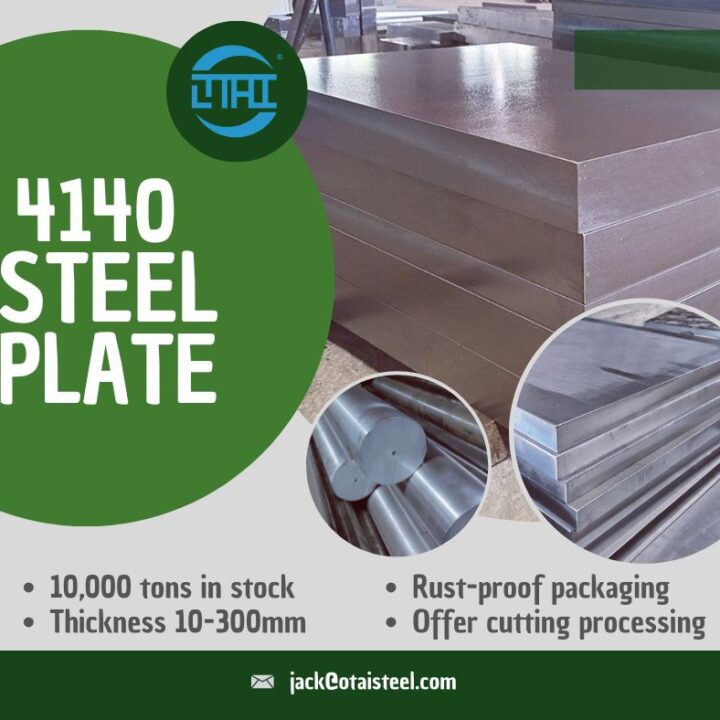
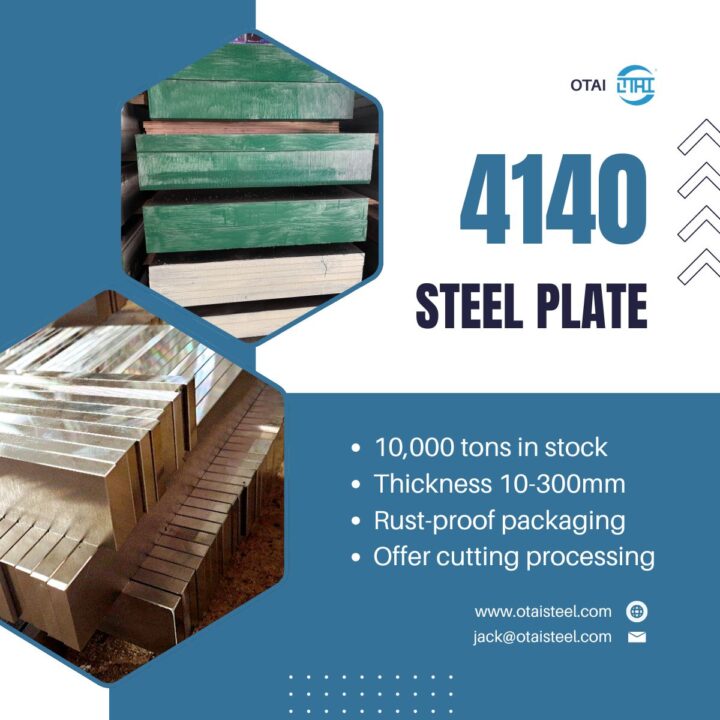
- 4140 steel plate stock: We supply 4140 steel plates with thicknesses of 13–200mm available in stock to meet different fabrication and heavy-duty application requirements.
- Different dimensions: We can supply different thicknesses, widths, lengths, and diameters according to project requirements.
- Cutting service: We can arrange cutting according to customer drawings and specified dimensions.
- Heat treatment: Annealing, normalizing, quenching, tempering, and other heat-treatment services can be arranged according to technical requirements.
- Quality inspection: Ultrasonic testing and third-party inspection can be arranged for orders with specific quality requirements.
- Export packaging: Steel strapping, wooden cases, and anti-rust packaging help protect steel products during international transportation.
- International supply experience: Otai Special Steel has supplied steel products to customers with demanding technical requirements, including Fortune Global 500 companies.
If you need 4140 steel with a specific tensile strength, provide the required dimensions, heat-treatment condition, hardness range, mechanical properties, and quantity. Otai Special Steel can help confirm suitable 4140 material and processing options.
❓ 10. Frequently Asked Questions
1. What is the tensile strength of heat treated 4140 steel?
The tensile strength depends on the heat-treatment condition, section size, and testing requirements. Quenched-and-tempered 4140 commonly falls around 850–1100 MPa, while some higher-strength conditions can reach approximately 1100–1200 MPa or higher.
2. Does heat treatment make 4140 steel stronger?
Yes. Quenching can significantly increase the hardness and strength of 4140 by promoting martensite formation. Tempering then adjusts the final balance between tensile strength, toughness, and ductility.
3. What hardness does heat treated 4140 steel have?
There is no single hardness value. Quenched-and-tempered 4140 can cover a broad range, commonly from around 25 HRC to 40 HRC or higher depending on the treatment and application.
4. Is 4140 stronger than C45 after heat treatment?
4140 generally offers better hardenability than C45 because of its chromium and molybdenum alloying. This can help larger 4140 sections develop useful strength deeper into the material. The actual comparison still depends on heat treatment and section size.
5. Can Otai supply heat treated 4140 steel?
Otai Special Steel provides 4140 steel round bars in 14–500mm diameters and 4140 steel plates in 13–200mm thickness available in stock. Heat-treatment, cutting, inspection, and export packaging services can also be arranged according to project requirements.