 4140 Alloy vs Stainless Steel: Which Material Fits Your Application Better?
📑 Table of Contents
🔍 1. 4140 Alloy vs Stainless Steel: The Basic Difference
🧪 2. Chemical Composition and Alloying Elements
⚙️ 3. Strength, Hardness and Mechanical Performance
🛡️ 4. Corrosion Resistance: 4140 vs Stainless Steel
🔥 5. Heat Treatment and Hardening Response
🛠️ 6. Machinability, Welding and Fabrication
🏭 7. Common Applications of Both Materials
📌 8. How to Choose Between 4140 and Stainless Steel
🔍 1. 4140 Alloy vs Stainless Steel: The Basic Difference
When comparing 4140 alloy vs stainless steel, the first thing to understand is that these materials serve different engineering priorities.
4140 is a chromium-molybdenum alloy steel. It offers high strength, good toughness, and a strong response to heat treatment. Engineers often choose it for shafts, gears, bolts, axles, and other heavily loaded components.
Stainless steel represents a much broader family of steels. Its defining feature is a chromium content of at least about 10.5%, which allows the steel to form a protective passive oxide layer on the surface.
Because stainless steel includes many grades, its properties can vary significantly. For example, 304 stainless steel focuses on general corrosion resistance, while 316 stainless steel offers better resistance in chloride-containing environments.
| Factor | 4140 Alloy Steel | Stainless Steel |
|---|---|---|
| Material family | Chromium-molybdenum alloy steel | Family of corrosion-resistant alloy steels |
| Main advantage | Strength, toughness and heat treatment response | Corrosion resistance and surface durability |
| Typical chromium content | About 0.8–1.1% | Usually at least 10.5% |
| Heat treatment | Strong response to quenching and tempering | Depends strongly on grade |
| Corrosion resistance | Limited without additional protection | Generally much better |
| Typical applications | Shafts, gears, axles, bolts, machinery parts | Food equipment, chemical equipment, medical parts, outdoor components |
This means there is no universal winner in the 4140 alloy steel vs stainless steel comparison. The better choice depends on the environment, mechanical load, manufacturing process, and required service life.
If the component faces high mechanical stress but only moderate exposure to moisture, 4140 can provide an excellent combination of strength and toughness.
If corrosion represents the primary failure risk, stainless steel may provide greater long-term value even when its initial material cost is higher.
🧪 2. Chemical Composition and Alloying Elements
Chemical composition creates one of the biggest differences between 4140 and stainless steel.
4140 contains moderate amounts of chromium and molybdenum. These alloying elements improve hardenability and help the steel develop strong mechanical properties after heat treatment.
Carbon also plays an important role. The carbon level of 4140 is much higher than that of many common austenitic stainless steels, which allows 4140 to respond effectively to quenching and tempering.
| Element / Feature | 4140 Alloy Steel | 304 Stainless Steel | 316 Stainless Steel |
|---|---|---|---|
| Carbon | Approx. 0.38–0.43% | Typically ≤0.08% | Typically ≤0.08% |
| Chromium | Approx. 0.80–1.10% | Approx. 18–20% | Approx. 16–18% |
| Nickel | Usually not a major alloying element | Approx. 8–10.5% | Approx. 10–14% |
| Molybdenum | Approx. 0.15–0.25% | Not normally specified as a major addition | Approx. 2–3% |
| Primary design objective | Mechanical strength and hardenability | General corrosion resistance | Enhanced corrosion resistance, especially against chlorides |
Why 4140 Does Not Behave Like Stainless Steel
The chromium content of 4140 is far below that of stainless steel. Therefore, 4140 does not develop the same chromium-rich passive surface layer that protects stainless steel from corrosion.
However, the lower alloy content keeps 4140 focused on mechanical performance. Its composition allows manufacturers to achieve high strength without relying on the large nickel and chromium additions found in many stainless grades.
Stainless steel takes a different approach. High chromium levels provide corrosion resistance, while nickel, molybdenum, nitrogen, and other elements modify the structure and improve specific properties.
For buyers researching 4140 vs stainless steel composition, this distinction explains many of the performance differences seen in real applications.
304 and 316 Are Not the Same
It is also important to avoid treating all stainless steel as one material. 304 and 316 are among the most common grades, but their performance differs.
316 contains molybdenum, which improves resistance to chloride-related corrosion. As a result, engineers often consider 316 for marine, chemical, and coastal applications where 304 may face greater corrosion risk.
Therefore, a meaningful material comparison should identify the specific stainless grade rather than simply saying “stainless steel.”
⚙️ 3. Strength, Hardness and Mechanical Performance
Mechanical performance is where 4140 often has a clear advantage over common austenitic stainless steels.
4140 responds well to quenching and tempering. By controlling the heat treatment process, manufacturers can achieve a wide range of hardness and strength levels.
This flexibility makes 4140 useful for heavily loaded mechanical components. Shafts, gears, axles, studs, and high-strength fasteners often benefit from its combination of strength and toughness.
| Mechanical Factor | 4140 | 304 Stainless Steel | 316 Stainless Steel |
|---|---|---|---|
| Typical strength potential | High after heat treatment | Moderate | Moderate |
| Heat treatment response | Excellent | Cannot be hardened significantly by conventional quenching | Cannot be hardened significantly by conventional quenching |
| Hardness potential | High after suitable treatment | Limited by cold working and material condition | Limited by cold working and material condition |
| Toughness | Good with suitable treatment | Good | Good |
| Wear resistance | Good to high after hardening | Moderate | Moderate |
| Fatigue performance | Strong when properly heat treated and designed | Good depending on condition | Good depending on condition |
Why Heat-Treated 4140 Is Popular
Heat treatment gives 4140 a major engineering advantage. A quenched and tempered 4140 component can reach substantially higher hardness and tensile strength than its annealed condition.
Manufacturers can select the treatment according to the required balance between strength, hardness, ductility, and toughness.
This makes 4140 steel for high strength applications a common choice when mechanical loading is more important than corrosion resistance.
Where Stainless Steel Has an Advantage
Common austenitic stainless steels such as 304 and 316 cannot gain high hardness through conventional quenching because their microstructure remains austenitic.
However, stainless grades can still provide strong mechanical performance. Cold working can increase strength, and other stainless families such as martensitic grades can achieve much higher hardness through heat treatment.
Therefore, buyers should compare the correct stainless grade with 4140. Comparing 4140 with 304 is a different engineering question from comparing 4140 with a martensitic stainless grade such as 410 or 420.
In short, 4140 is usually the stronger choice when the project requires a heat-treated alloy steel with high strength and hardness. Stainless steel becomes more attractive when corrosion resistance carries greater importance.
🛡️ 4. Corrosion Resistance: 4140 vs Stainless Steel
Corrosion resistance is one of the clearest differences when comparing 4140 alloy vs stainless steel. 4140 focuses on strength and hardenability, while stainless steel uses high chromium content to resist corrosion.
4140 can rust when exposed to moisture, oxygen, salts, and other corrosive environments. Manufacturers can reduce this risk with painting, plating, oiling, coating, or other surface protection methods.
Stainless steel takes a different approach. Its high chromium content allows the surface to form a thin passive oxide layer. This layer can protect the underlying metal from many common forms of corrosion.
| Environment | 4140 Alloy Steel | 304 Stainless Steel | 316 Stainless Steel |
|---|---|---|---|
| Dry indoor environment | Good with basic protection | Excellent | Excellent |
| Humid environment | Needs corrosion protection | Good | Very good |
| Outdoor exposure | Requires suitable coating | Good depending on conditions | Very good depending on conditions |
| Salt exposure | Limited without protection | Moderate to good | Better resistance than 304 |
| Chloride-rich environment | Not normally the first choice | Can experience pitting | Better chloride resistance |
Does 4140 Have Any Corrosion Resistance?
4140 is not a stainless steel, so buyers should not expect stainless-level corrosion resistance. Its chromium content improves hardenability rather than creating the highly chromium-rich passive surface associated with stainless grades.
However, this does not make 4140 unsuitable for outdoor machinery or industrial equipment. Engineers can use protective coatings when the mechanical advantages of 4140 outweigh its lower natural corrosion resistance.
For example, a high-strength shaft can use heat-treated 4140 with an appropriate surface protection system. The design then addresses both mechanical loading and environmental exposure.
By contrast, 4140 vs stainless steel corrosion resistance becomes an easier decision when the component operates continuously in seawater, chemical processing, or another aggressive environment. In such cases, a suitable stainless grade may provide a more practical solution.
🔥 5. Heat Treatment and Hardening Response
Heat treatment creates another major difference between 4140 and many common stainless steels. 4140 is specifically valued for its strong response to quenching and tempering.
Manufacturers can heat the steel to the appropriate austenitizing temperature, quench it, and then temper it to obtain the desired balance of hardness, strength, and toughness.
| Process | 4140 | 304 Stainless Steel | 316 Stainless Steel |
|---|---|---|---|
| Annealing | Commonly used | Used for specific processing requirements | Used for specific processing requirements |
| Quenching and tempering | Highly effective | Does not significantly harden the austenitic structure | Does not significantly harden the austenitic structure |
| Cold working | Can increase strength | Strong strengthening response | Strong strengthening response |
| Maximum hardness potential | High with suitable treatment | Generally limited in annealed condition | Generally limited in annealed condition |
| Typical hardening method | Quenching and tempering | Cold working | Cold working |
4140 Quenching and Tempering
4140 contains enough carbon and alloying elements to respond strongly to conventional hardening. The final hardness depends on section size, austenitizing conditions, quenching medium, and tempering temperature.
A properly controlled treatment can produce a strong and tough component for demanding mechanical applications.
This is why heat treated 4140 alloy steel appears frequently in shafts, gears, axles, studs, and heavy-duty machinery.
Stainless Steel Heat Treatment Depends on Grade
The phrase “stainless steel” covers several metallurgical families. Austenitic grades such as 304 and 316 do not harden through conventional quenching in the same way as 4140.
Martensitic stainless grades follow a different heat-treatment route. Grades such as 410 and 420 can achieve high hardness through hardening and tempering.
Therefore, engineers should identify the exact stainless grade before making a heat-treatment comparison.
🛠️ 6. Machinability, Welding and Fabrication
Machinability and fabrication requirements can also influence the choice between 4140 and stainless steel. Neither material provides the same manufacturing experience in every condition.
Annealed 4140 generally offers good machinability. After hardening, however, the material becomes much harder to machine and may require suitable carbide tooling, controlled cutting parameters, or grinding.
Common austenitic stainless steels can also require careful machining. Their tendency to work harden means that inadequate cutting conditions can make machining more difficult.
| Manufacturing Factor | 4140 | 304 / 316 Stainless Steel |
|---|---|---|
| Annealed machinability | Good | Good to moderate |
| After hardening | More difficult to machine | 304/316 are not normally hardened by quenching |
| Work hardening | Lower concern than austenitic stainless | Important consideration |
| Welding | Requires controlled procedures | Generally good for common austenitic grades |
| Heat affected zone concerns | Important due to hardenability | Depends on stainless grade and welding process |
Machining 4140
Machining 4140 in an annealed or normalized condition can be relatively straightforward. The situation changes after quenching and tempering because increased hardness raises cutting forces and tool wear.
For this reason, manufacturers often complete major machining operations before final hardening when the component design allows it.
Machining Stainless Steel
304 and 316 stainless steels can work harden rapidly. Cutting tools should maintain proper feed and cutting speed to avoid excessive rubbing.
The material can also generate more heat during machining than some carbon and alloy steels. Good tool selection and coolant management can therefore improve production efficiency.
When evaluating 4140 vs stainless steel machinability, the exact material condition and machining operation matter as much as the nominal grade.
🏭 7. Common Applications of Both Materials
The different properties of 4140 and stainless steel naturally lead engineers toward different applications. The correct choice depends on which failure mode presents the greatest risk.
| Application | Preferred Material | Main Reason |
|---|---|---|
| High-strength shafts | 4140 | High strength and excellent heat treatment response |
| Heavy-duty axles | 4140 | Good toughness and fatigue performance |
| Industrial gears | 4140 | Hardness, strength, and wear resistance after treatment |
| Food processing equipment | Stainless steel | Corrosion resistance and cleanable surface |
| Marine components | 316 stainless steel | Better resistance to chloride environments |
| Chemical equipment | Suitable stainless grade | Corrosion resistance |
| High-strength fasteners | 4140 | High strength after suitable heat treatment |
| Outdoor decorative components | Stainless steel | Appearance and corrosion resistance |
When 4140 Makes More Sense
Choose 4140 when mechanical strength, toughness, hardness, and fatigue resistance dominate the design requirements.
It works especially well for components that experience high loads, shock, bending, torsion, or repeated stress.
Examples include drive shafts, axles, gears, spindles, bolts, studs, and heavy machinery components.
When Stainless Steel Makes More Sense
Stainless steel becomes the stronger option when corrosion represents a major design concern.
Food processing, chemical processing, medical equipment, marine environments, and architectural applications often benefit from stainless steel’s corrosion resistance.
However, the designer should still select the specific stainless grade according to the environment. 304 may work well in many general applications, while 316 offers improved resistance in chloride-containing environments.
This is why the best answer to 4140 alloy vs stainless steel for industrial applications depends on the complete service environment rather than one mechanical property.
📌 8. How to Choose Between 4140 and Stainless Steel
The simplest way to choose between these materials is to start with the actual service conditions. Instead of asking which steel is universally better, identify the properties that the component needs most.
| Design Requirement | Recommended Direction | Reason |
|---|---|---|
| Very high mechanical strength | 4140 | Excellent response to quenching and tempering |
| High hardness | 4140 or suitable hardened stainless | Depends on the required corrosion resistance |
| Good toughness under heavy loads | 4140 | Strong combination of strength and toughness |
| General corrosion resistance | 304 stainless steel | High chromium content provides passive protection |
| Chloride exposure | 316 stainless steel | Molybdenum improves resistance to chloride-related corrosion |
| High-strength rotating parts | 4140 | Suitable for shafts, axles, gears, and similar components |
| Easy cleaning and corrosion resistance | Stainless steel | Suitable for hygienic and corrosion-sensitive applications |
| Cost-sensitive heavy machinery | 4140 | Strong mechanical performance without stainless-level alloy content |
Ask These Five Questions Before Selecting the Material
1. Will the component experience high mechanical loads?
If the answer is yes, 4140 deserves serious consideration because heat treatment can produce high strength and hardness.
2. Will the component remain in a wet or corrosive environment?
If corrosion represents the main risk, stainless steel may provide better long-term performance.
3. Does the component require high surface hardness?
4140 can achieve high hardness through suitable heat treatment. Some stainless grades can also reach high hardness, but the exact grade matters.
4. Will the component require extensive machining?
Consider the material condition. Annealed 4140 offers good machinability, while hardened 4140 requires more demanding machining. Austenitic stainless steels can also work harden during cutting.
5. What is the complete lifecycle cost?
Do not compare only the initial material price. Consider corrosion protection, machining, heat treatment, maintenance, replacement frequency, and expected service life.
In practical engineering, 4140 alloy vs stainless steel is not simply a competition between two steel grades. It is a decision between different combinations of strength, hardness, corrosion resistance, manufacturability, and lifecycle performance.
4140 is usually the better fit for demanding mechanical loads. Stainless steel is often the better fit for corrosive environments. When both requirements are important, engineers should evaluate specialized stainless grades or use 4140 with an appropriate corrosion-protection system.
📦 9. Otai Special Steel Advantages
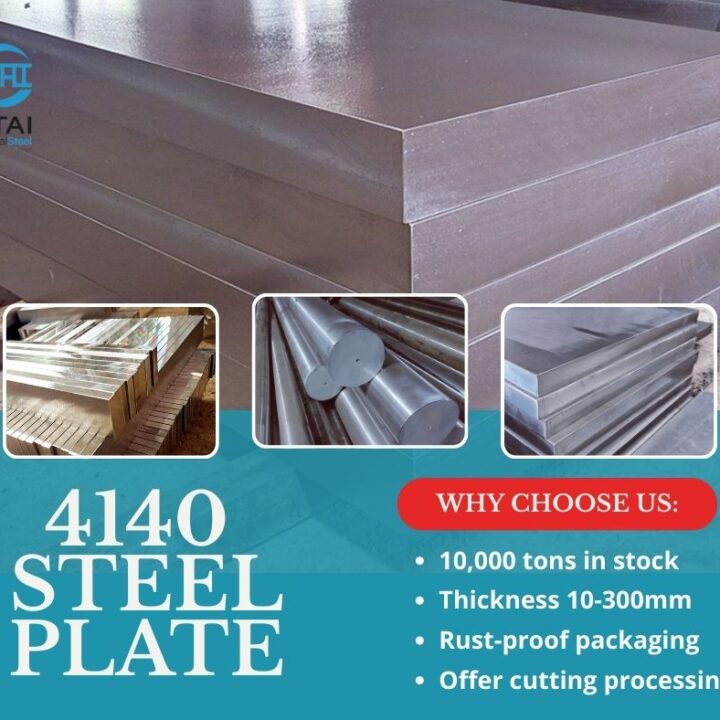
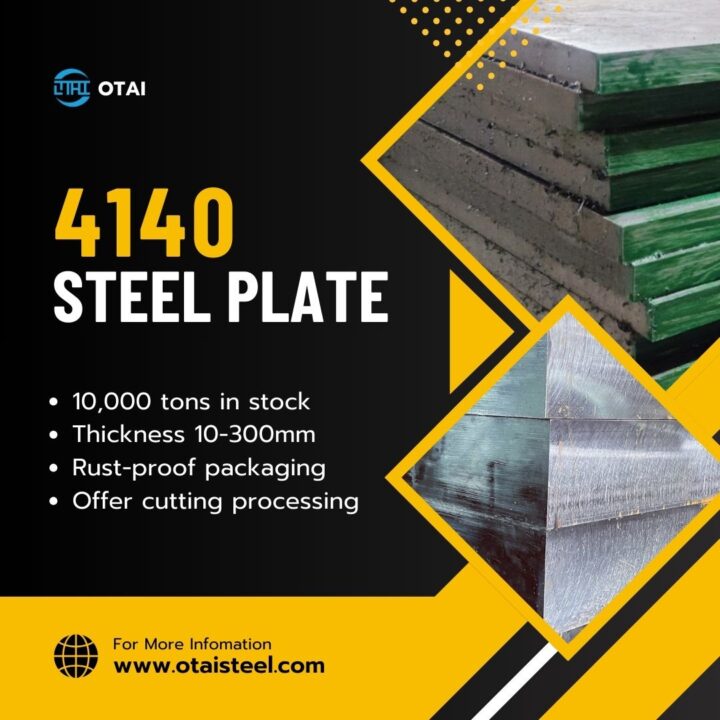
Otai Special Steel supplies 4140 alloy steel for customers in machinery, automotive, energy, tooling, and industrial manufacturing. We focus on reliable material quality, flexible processing, and stable stock availability.
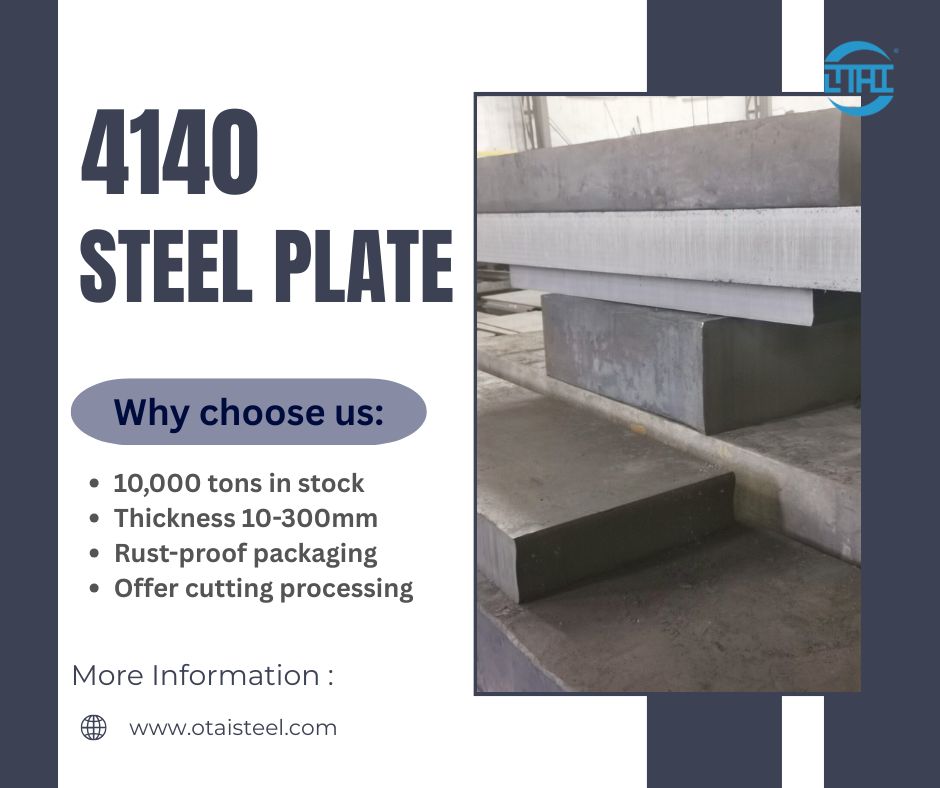
- Large 4140 inventory: We maintain around 10,000 tons of steel inventory, with different sizes available for customers with regular and urgent requirements.
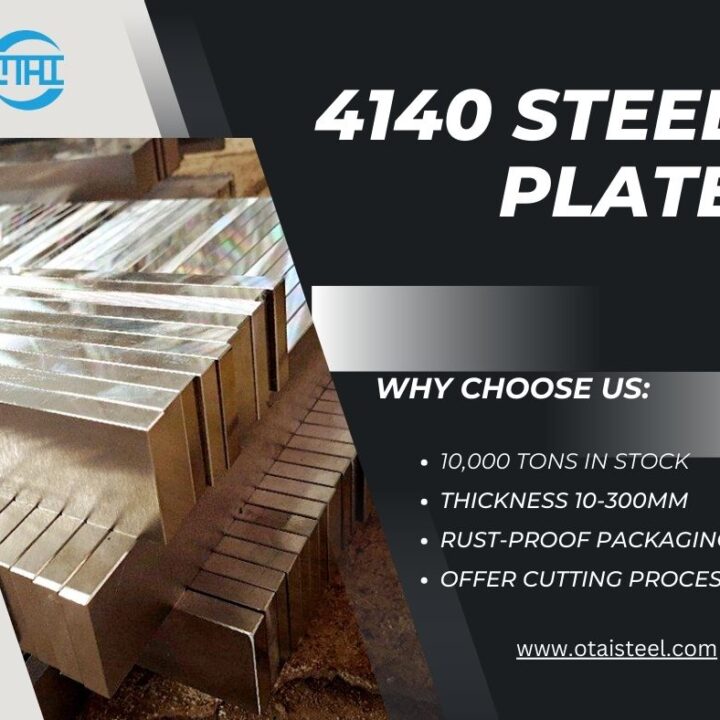
- 4140 steel plate stock: Different thicknesses and dimensions can be supplied according to customer requirements and available stock.
- Custom cutting: We provide cutting services to prepare 4140 plates and other products according to customer dimensions.
- Quality inspection: Ultrasonic testing and third-party inspection can be arranged for projects that require additional quality verification.
- Processing support: We provide heat treatment support, cutting, anti-rust treatment, steel strapping, and wooden box packaging.
- International supply experience: We have supplied steel materials to customers with demanding technical requirements, including Fortune Global 500 companies.
For buyers comparing 4140 alloy vs stainless steel, material selection should start with the actual application. Customers can provide the required grade, dimensions, quantity, material condition, inspection requirements, and application so our team can help identify a suitable supply solution.
❓ 10. FAQ About 4140 Alloy vs Stainless Steel
1. Is 4140 stronger than stainless steel?
4140 can achieve very high strength and hardness after suitable quenching and tempering. However, stainless steel includes many different grades, so the answer depends on which stainless grade you compare with 4140. Heat-treated 4140 generally offers an advantage over common annealed 304 and 316 stainless steel in high-strength mechanical applications.
2. Is 4140 corrosion resistant?
4140 has limited natural corrosion resistance and can rust when exposed to moisture and corrosive environments. Protective coatings, plating, painting, oiling, or other surface treatments can reduce corrosion risk. Stainless steel generally provides much better corrosion resistance because of its high chromium content.
3. What is the main difference between 4140 and 304 stainless steel?
4140 is a chromium-molybdenum alloy steel designed mainly for strength, toughness, hardenability, and mechanical performance. 304 stainless steel contains much more chromium and nickel and focuses primarily on corrosion resistance and general stainless performance.
4. Is 4140 easier to machine than stainless steel?
The answer depends on the material condition and stainless grade. Annealed 4140 generally offers good machinability. However, heat-treated 4140 becomes harder to machine. Austenitic stainless steels such as 304 and 316 can also create machining challenges because they tend to work harden.
5. Where can I buy 4140 alloy steel?
Otai Special Steel supplies 4140 alloy steel plates and other forms for international industrial customers. We maintain approximately 10,000 tons of inventory with different sizes available. We also provide cutting, inspection, heat treatment support, anti-rust protection, and export packaging according to project requirements.