 Difference Between 16MnCr5 and 16MnCrS5: Composition, Properties and Applications
📑 Table of Contents
🔥 1. Understanding the Difference Between 16MnCr5 and 16MnCrS5
📊 4. 16MnCr5 vs 16MnCrS5 Chemical Composition Comparison
⚖️ 5. Mechanical Properties Comparison
🔥 6. Machinability and Heat Treatment Differences
🏭 7. Applications and Material Selection Guide
🏭 Otai Special Steel Advantages
❓ FAQ About 16MnCr5 and 16MnCrS5
🔥 1. Understanding the Difference Between 16MnCr5 and 16MnCrS5
When engineers search for the difference between 16MnCr5 and 16MnCrS5, they usually want to understand why these two carburizing steels have similar names but different performance characteristics.
Both materials belong to the low alloy chromium-manganese steel family and are widely used for gears, shafts, and mechanical components requiring a hard surface and tough core.
The main difference is the sulfur content.
16MnCrS5 contains a higher sulfur level than standard 16MnCr5, which improves machinability but slightly reduces certain mechanical properties.
A proper 16MnCr5 vs 16MnCrS5 steel comparison should consider chemical composition, machining requirements, heat treatment performance, and final application conditions.
Why Are 16MnCr5 and 16MnCrS5 Often Compared?
| Reason | Explanation |
|---|---|
| Similar Names | Both grades belong to the same carburizing steel family. |
| Similar Applications | Both are used for gears, shafts, and transmission components. |
| Different Machining Performance | 16MnCrS5 offers improved machinability due to higher sulfur content. |
| Material Selection | Engineers choose based on production method and performance requirements. |
Although these grades look very similar, the small chemical difference creates noticeable differences during machining and manufacturing.
⚙️ 2. What Is 16MnCr5 Steel?
16MnCr5 is a low alloy carburizing steel defined under European standards.
It is one of the most popular gear steels because it provides excellent surface hardness after carburizing while maintaining a strong and tough core.
The material number of 16MnCr5 is 1.7131, and it is commonly supplied according to EN 10084 requirements.
The balanced combination of carbon, manganese, and chromium allows this steel to achieve excellent wear resistance after heat treatment.
Basic Information of 16MnCr5 Steel
| Item | Description |
|---|---|
| Steel Type | Low alloy carburizing steel |
| Standard | EN 10084 |
| Material Number | 1.7131 |
| Main Alloy Elements | Manganese and chromium |
| Heat Treatment | Carburizing, quenching, and tempering |
| Main Features | Hard surface, tough core, good fatigue resistance |
Advantages of 16MnCr5 Steel
- Excellent carburizing performance.
- High surface hardness after heat treatment.
- Good wear resistance.
- Strong fatigue resistance for gears.
- Reliable performance under impact loads.
Because of these advantages, 16MnCr5 is widely used in automotive transmission systems, industrial gears, and mechanical power components.
For engineers looking for a reliable 16MnCr5 chemical composition, this grade provides a good balance between machinability and final mechanical performance.
🔬 3. What Is 16MnCrS5 Steel?
16MnCrS5 is a modified version of 16MnCr5 with increased sulfur content.
The additional sulfur improves chip breaking and machining efficiency, making this material suitable for automatic machining operations.
The letter “S” in 16MnCrS5 represents sulfur modification.
Compared with standard 16MnCr5, 16MnCrS5 is designed for applications where productivity and machining speed are important.
Basic Information of 16MnCrS5 Steel
| Item | Description |
|---|---|
| Steel Type | Free machining carburizing steel |
| Modified Grade | Based on 16MnCr5 chemistry |
| Main Difference | Higher sulfur content |
| Main Advantage | Improved machinability |
| Heat Treatment | Carburizing, quenching, and tempering |
| Typical Use | High-volume machined components |
Advantages of 16MnCrS5 Steel
- Better chip breaking during machining.
- Higher machining efficiency.
- Reduced cutting tool wear.
- Suitable for automated production lines.
- Maintains good carburizing performance.
The main purpose of adding sulfur is not to increase strength, but to improve manufacturing efficiency.
Therefore, the selection between 16MnCr5 and 16MnCrS5 depends mainly on whether the priority is machining performance or maximum mechanical reliability.
🔬 4. 16MnCr5 vs 16MnCrS5 Chemical Composition Comparison
The most important factor in the difference between 16MnCr5 and 16MnCrS5 is the sulfur content.
Both steels have a very similar alloy design, including carbon, manganese, and chromium. However, 16MnCrS5 contains additional sulfur, which changes its machining characteristics.
Sulfur forms manganese sulfide (MnS) inclusions inside the steel structure. These inclusions improve chip breaking during cutting operations and reduce machining resistance.
16MnCr5 and 16MnCrS5 Chemical Composition Comparison
| Element | 16MnCr5 (%) | 16MnCrS5 (%) | Main Effect |
|---|---|---|---|
| Carbon (C) | 0.14–0.19 | 0.14–0.19 | Provides carburizing ability and core strength |
| Silicon (Si) | ≤0.40 | ≤0.40 | Improves deoxidation and strength |
| Manganese (Mn) | 1.00–1.30 | 1.00–1.30 | Improves hardenability |
| Chromium (Cr) | 0.80–1.10 | 0.80–1.10 | Improves wear resistance and hardening response |
| Phosphorus (P) | ≤0.035 | ≤0.035 | Controlled for toughness |
| Sulfur (S) | ≤0.035 | 0.020–0.040 | Improves machinability |
Main Chemical Difference Between 16MnCr5 and 16MnCrS5
| Feature | 16MnCr5 | 16MnCrS5 |
|---|---|---|
| Sulfur Content | Standard sulfur level | Higher sulfur modification |
| Steel Structure | Cleaner steel structure | Contains more MnS inclusions |
| Main Purpose | Balanced mechanical performance | Improved machining efficiency |
| Typical Production | General machining and heat treatment | Automatic machining production |
The increased sulfur content is the key reason why 16MnCrS5 free machining steel provides better cutting performance compared with standard 16MnCr5.
📊 5. Mechanical Properties Comparison
Although 16MnCr5 and 16MnCrS5 have similar chemical compositions, their mechanical properties may show slight differences due to sulfur modification.
After carburizing and heat treatment, both materials can achieve a hard surface layer with a tough internal structure.
16MnCr5 vs 16MnCrS5 Mechanical Properties
| Property | 16MnCr5 | 16MnCrS5 |
|---|---|---|
| Tensile Strength | Approx. 800–1200 MPa after treatment | Approx. 750–1150 MPa after treatment |
| Yield Strength | Approx. 550–900 MPa | Approx. 500–850 MPa |
| Surface Hardness After Carburizing | 58–62 HRC | 58–62 HRC |
| Core Toughness | Excellent | Very good |
| Fatigue Resistance | Excellent | Good to excellent |
| Machinability | Good | Better |
Performance Difference After Heat Treatment
| Performance Area | Better Choice | Reason |
|---|---|---|
| Surface Hardness | Both Similar | Both are carburizing steels |
| Core Toughness | 16MnCr5 | Cleaner steel structure |
| Machining Speed | 16MnCrS5 | Higher sulfur improves cutting performance |
| Tool Life | 16MnCrS5 | Reduced cutting resistance |
| High Stress Applications | 16MnCr5 | Better overall mechanical balance |
For components requiring maximum strength and reliability, 16MnCr5 is usually preferred.
For large-volume machining where production efficiency is important, 16MnCrS5 can provide better economic benefits.
🔥 6. Machinability and Heat Treatment Differences
Machinability is the most noticeable difference in the 16MnCr5 vs 16MnCrS5 steel comparison.
16MnCr5 provides a balanced combination of machinability and mechanical properties, while 16MnCrS5 focuses more on production efficiency.
Machinability Comparison
| Factor | 16MnCr5 | 16MnCrS5 |
|---|---|---|
| Cutting Performance | Good | Excellent |
| Chip Breaking | Normal | Improved due to MnS inclusions |
| Tool Wear | Standard | Lower |
| Automatic Machining | Suitable | More suitable |
| Surface Finish | Good | Very good |
Heat Treatment Comparison
| Process | 16MnCr5 | 16MnCrS5 |
|---|---|---|
| Carburizing | Excellent response | Excellent response |
| Quenching | Good hardening ability | Good hardening ability |
| Tempering | Maintains toughness | Maintains good toughness |
| Surface Hardness | High | High |
The sulfur modification does not significantly change the carburizing ability of the steel.
The main purpose of 16MnCrS5 is to improve machining performance before heat treatment, not to create a stronger steel grade.
🏭 7. Applications and Material Selection Guide
Understanding the difference between 16MnCr5 and 16MnCrS5 helps engineers select the correct material for different manufacturing requirements.
Although both steels are carburizing grades, their different sulfur contents make them suitable for different production environments.
Applications of 16MnCr5 Steel
| Industry | Typical Components | Reason for Selection |
|---|---|---|
| Automotive Industry | Transmission gears, shafts, sprockets | Excellent fatigue resistance and core toughness |
| Mechanical Engineering | Gear wheels, pins, rollers | Good wear resistance after carburizing |
| Industrial Equipment | Drive components and power transmission parts | Reliable performance under heavy loads |
| Precision Machinery | Small gears and mechanical parts | Balanced strength and machinability |
Applications of 16MnCrS5 Steel
| Industry | Typical Components | Reason for Selection |
|---|---|---|
| Automated Manufacturing | High-volume gear components | Better machining efficiency |
| Automotive Production | Mass-produced shafts and transmission parts | Lower machining cost |
| CNC Machining Industry | Precision turned components | Improved chip control |
| Industrial Parts Production | Complex machined components | Higher productivity |
How to Choose Between 16MnCr5 and 16MnCrS5?
| Requirement | Recommended Grade | Reason |
|---|---|---|
| Maximum mechanical reliability | 16MnCr5 | Cleaner structure and excellent toughness |
| Large-volume machining | 16MnCrS5 | Higher machining efficiency |
| Automatic CNC production | 16MnCrS5 | Better chip breaking performance |
| Heavy impact applications | 16MnCr5 | Better toughness balance |
| Carburized gears | Both | Both provide high surface hardness |
16MnCr5 and 16MnCrS5 Equivalent Grades
Both materials belong to the EN carburizing steel family and have similar international equivalents.
| Grade | Equivalent / Related Grade | Standard |
|---|---|---|
| 16MnCr5 | 1.7131 | EN 10084 |
| 16MnCr5 | 5115 / 5117 (similar range) | AISI / SAE |
| 16MnCrS5 | Modified 16MnCr5 with sulfur addition | EN Standard |
| 16MnCrS5 | Free machining carburizing steel | Special sulfur grade |
When replacing one grade with another, engineers should consider not only chemical composition but also machining conditions, heat treatment requirements, and final working environment.
🏭 Otai Special Steel Advantages
Otai Special Steel supplies high-quality carburizing steels including 16MnCr5 and related alloy steel products for international customers.
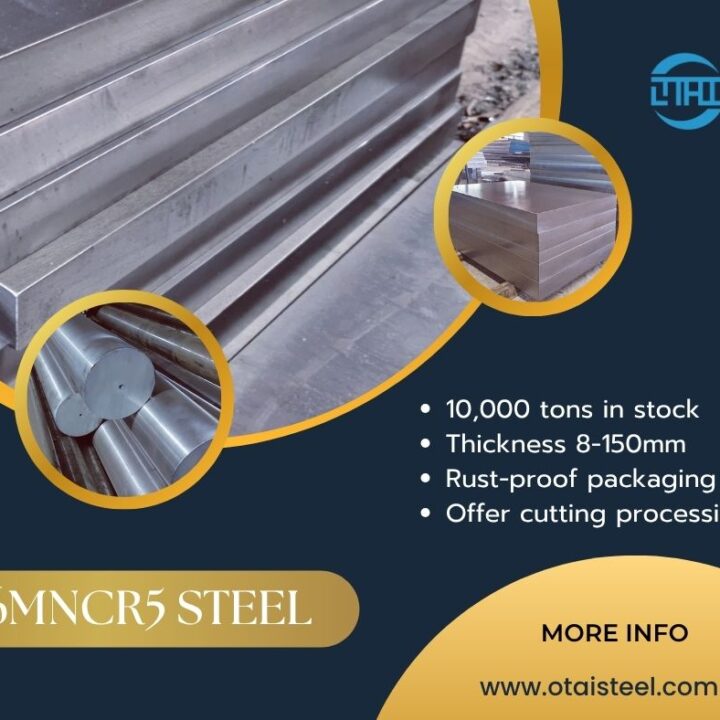
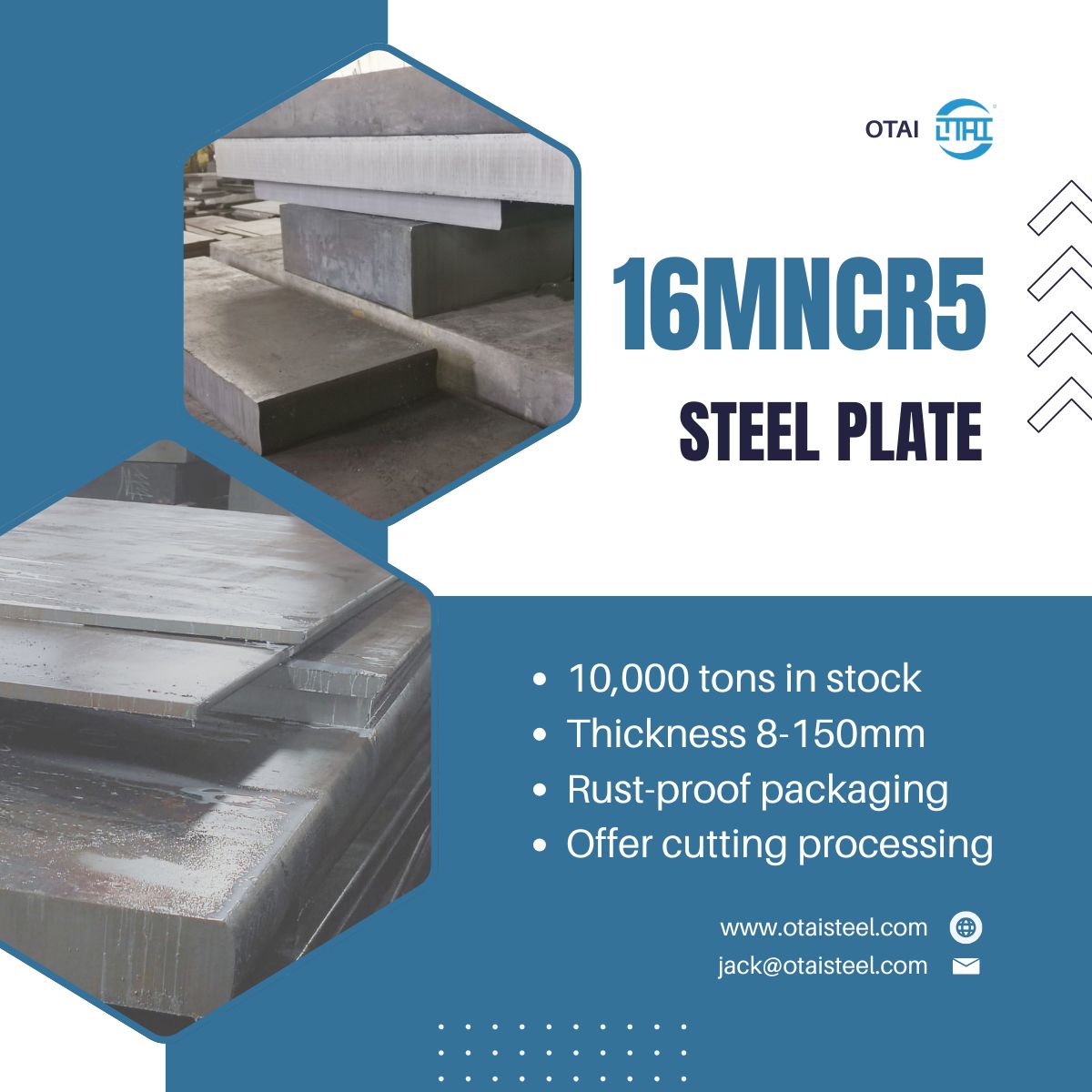
- Stable inventory: Otai keeps 8–150mm thickness plates available in stock for 16MnCr5 steel requirements.
- Complete processing service: Cutting, machining, heat treatment support, and customized processing solutions are available.
- Quality inspection: Ultrasonic testing and third-party inspection can be provided according to customer requirements.
- Professional packaging: Anti-rust packaging, steel strapping, and wooden box packaging ensure safe delivery.
- Technical experience: Otai supplies alloy steels to global customers with strict quality requirements.
With professional service and reliable steel supply capability, Otai helps customers select suitable materials for gears, shafts, and industrial components.
❓ FAQ About Difference Between 16MnCr5 and 16MnCrS5
Q1: What is the main difference between 16MnCr5 and 16MnCrS5?
The main difference is sulfur content. 16MnCrS5 contains more sulfur, which improves machinability and chip breaking performance.
Q2: Is 16MnCrS5 stronger than 16MnCr5?
No. 16MnCrS5 is mainly designed for better machining performance. 16MnCr5 usually provides a better balance of toughness and mechanical reliability.
Q3: Can 16MnCrS5 replace 16MnCr5?
In many machining applications, 16MnCrS5 can replace 16MnCr5. However, engineers should confirm mechanical requirements and service conditions before substitution.
Q4: Which steel is better for gears, 16MnCr5 or 16MnCrS5?
Both steels can be used for gears after carburizing. 16MnCr5 is preferred for higher toughness requirements, while 16MnCrS5 is suitable for high-volume gear production.
Q5: What is the equivalent grade of 16MnCr5?
16MnCr5 is commonly identified as 1.7131 according to EN standards and is comparable with other carburizing steels depending on the specification.
Q6: Does Otai supply 16MnCr5 steel plates?
Yes. Otai supplies 16MnCr5 steel products with stock availability, processing service, heat treatment support, and quality inspection options.