 Properties of 16MnCr5 – Complete Analysis of Chemical Composition
📑 Table of Contents
🔍 1. What Are the Properties of 16MnCr5 Steel?
🧪 2. Chemical Composition and Alloy Element Functions of 16MnCr5
⚙️ 3. Mechanical Properties of 16MnCr5 Steel
🔥 4. Heat Treatment Effects on 16MnCr5 Properties
📊 5. Hardness, Strength and Wear Resistance Analysis
🏭 6. Industrial Applications Based on 16MnCr5 Properties
🌍 7. 16MnCr5 Equivalent Grades and Performance Comparison
📌 8. How to Select 16MnCr5 Steel for Engineering Applications
🏭 Otai Special Steel Advantages
🔍 1. What Are the Properties of 16MnCr5 Steel?
The properties of 16MnCr5 steel come from its carefully balanced alloy design. Unlike general structural steels, 16MnCr5 is developed specifically for surface hardening applications.
Before heat treatment, the steel has relatively low carbon content. This allows good machinability and forming performance.
After carburizing and quenching, the surface becomes extremely hard while the core remains tough and resistant to impact.
| Property | Description |
|---|---|
| Steel Type | Low-carbon chromium-manganese carburizing steel |
| Main Alloy Elements | Manganese (Mn) and Chromium (Cr) |
| Carbon Content | Approximately 0.16% |
| Main Feature | Hard surface + tough core after carburizing |
| Standard | EN 10084 / DIN specification |
The main engineering advantages of 16MnCr5 include:
- Excellent carburizing performance: Allows the surface to achieve high hardness after treatment.
- Good core toughness: Prevents cracking under impact loads.
- High fatigue resistance: Suitable for repeated mechanical stress.
- Good machinability: Easier processing before final heat treatment.
- Reliable dimensional stability: Suitable for precision mechanical components.
These characteristics explain why 16MnCr5 is widely selected for gears, shafts, transmission components, and industrial machinery parts.
The key difference between 16MnCr5 and ordinary carbon steel is its ability to create different properties between the surface and core.
A gear made from 16MnCr5 can have a wear-resistant tooth surface while maintaining a strong and flexible internal structure.
This balance improves service life and reduces the risk of premature failure in demanding applications.
🧪 2. Chemical Composition and Alloy Element Functions of 16MnCr5
The 16MnCr5 chemical composition is the foundation of its mechanical performance. Each alloy element contributes specific functions that influence hardenability, toughness, and carburizing behavior.
| Element | Typical Content | Function |
|---|---|---|
| Carbon (C) | 0.14–0.19% | Provides carburizing ability and controls core strength |
| Manganese (Mn) | 1.00–1.30% | Improves hardenability and tensile strength |
| Chromium (Cr) | 0.80–1.10% | Improves wear resistance and hardening depth |
| Silicon (Si) | ≤0.40% | Supports deoxidation and strength |
| Phosphorus (P) | ≤0.035% | Controlled to reduce brittleness |
| Sulfur (S) | ≤0.035% | Controlled for machinability |
Carbon plays a special role in this steel grade. The initial carbon level is intentionally low because the core must remain tough after carburizing.
During carburizing, additional carbon enters the surface layer. After quenching, this carbon-rich area transforms into hard martensite.
Manganese improves hardenability and helps achieve more uniform mechanical properties throughout the material.
Chromium is one of the most important alloy elements because it improves wear resistance and supports deeper hardening.
The combination of manganese and chromium gives 16MnCr5 excellent performance in applications where surface durability and internal toughness are both required.
| Chemical Feature | Engineering Effect |
|---|---|
| Low Carbon Content | Good machinability and tough core |
| Chromium Addition | Improved wear resistance |
| Manganese Addition | Better strength and hardenability |
| Controlled Impurities | Improved reliability and quality |
Understanding the relationship between chemical composition and performance helps engineers select 16MnCr5 correctly for specific applications.
⚙️ 3. Mechanical Properties of 16MnCr5 Steel
The 16MnCr5 mechanical properties depend on the supply condition and heat treatment process. Because it is a carburizing steel, engineers usually evaluate both surface properties and core performance.
Before carburizing, 16MnCr5 offers good machinability. After treatment, it develops a hard surface layer capable of resisting wear and contact fatigue.
| Mechanical Property | Typical Value | Engineering Meaning |
|---|---|---|
| Tensile Strength | 600–900 MPa | Resistance against applied forces |
| Yield Strength | 400–650 MPa | Resistance against permanent deformation |
| Elongation | 10–15% | Material ductility |
| Surface Hardness After Carburizing | 58–62 HRC | High wear resistance |
| Core Hardness | 30–45 HRC | Impact resistance |
The most valuable feature of 16MnCr5 is the balance between hardness and toughness.
A component made from extremely hard steel may resist wear but become vulnerable to impact failure. A softer steel may survive impact but wear faster.
16MnCr5 solves this problem by creating a hardened outer layer and a tougher internal structure.
Typical mechanical advantages include:
- High contact fatigue resistance
- Good impact absorption
- Improved wear performance
- Long service life under repeated loading
For this reason, 16MnCr5 remains one of the most popular carburizing steels in European mechanical engineering industries.
🔥 4. Heat Treatment Effects on 16MnCr5 Properties
The final properties of 16MnCr5 are strongly influenced by heat treatment. As a carburizing steel, 16MnCr5 does not rely only on its original chemical composition. Its main advantage comes from the ability to develop a high-hardness surface while maintaining a tough core.
The typical heat treatment process includes carburizing, quenching, and tempering. Each stage changes the microstructure and improves specific performance characteristics.
| Heat Treatment Process | Typical Temperature | Main Purpose |
|---|---|---|
| Carburizing | 850–950°C | Increase surface carbon concentration |
| Quenching | Oil cooling or controlled cooling | Create hard martensitic surface structure |
| Tempering | 150–220°C | Reduce internal stress and improve toughness |
During carburizing, carbon atoms diffuse into the surface layer of the steel. This increases the carbon concentration near the surface while the core remains relatively low in carbon.
After quenching, the surface transforms into hard martensite, while the core maintains a tougher structure.
This creates the typical structure of carburized 16MnCr5:
- Hard outer layer: Provides excellent wear resistance.
- Transition zone: Provides gradual hardness change and stress distribution.
- Tough core: Provides impact resistance and load support.
The depth of the carburized layer depends on component size, operating conditions, and customer requirements.
| Heat Treatment Condition | Expected Performance |
|---|---|
| Annealed 16MnCr5 | Good machinability and forming ability |
| Carburized 16MnCr5 | High surface hardness and wear resistance |
| Quenched and Tempered | Improved strength and toughness |
The excellent response to carburizing is one of the most important reasons why engineers select 16MnCr5 instead of ordinary carbon steel.
For example, gear teeth experience high contact pressure and friction. A soft surface would wear quickly, while an overly brittle structure could crack under load.
16MnCr5 provides the ideal balance by combining surface durability with internal toughness.
📊 5. Hardness, Strength and Wear Resistance Analysis
Among all 16MnCr5 steel properties, hardness is one of the most important factors because many applications require strong resistance against wear and repeated contact stress.
However, hardness alone does not determine performance. Engineers must also consider strength, toughness, fatigue resistance, and manufacturing requirements.
| Property | Typical Value | Importance |
|---|---|---|
| Surface Hardness | 58–62 HRC after carburizing | Provides wear resistance |
| Core Hardness | 30–45 HRC | Provides toughness |
| Tensile Strength | 600–900 MPa | Supports mechanical loads |
| Fatigue Resistance | High | Suitable for repeated stress |
The surface hardness of carburized 16MnCr5 allows components to operate under severe friction conditions.
Common failure modes such as:
- Surface wear
- Pitting damage
- Contact fatigue cracks
- Tooth surface failure
can be significantly reduced when the material receives proper heat treatment.
The tough core provides another important advantage. Mechanical components such as gears and shafts must absorb shock loads during operation.
A completely hardened material may become too brittle. However, 16MnCr5 maintains sufficient core toughness to resist sudden impact.
| Performance Requirement | How 16MnCr5 Meets It |
|---|---|
| Wear Resistance | Hard carburized martensitic surface |
| Impact Resistance | Tough low-carbon core |
| Fatigue Strength | Surface compression and hardened layer |
| Machinability | Lower hardness before treatment |
This combination makes 16MnCr5 an excellent choice for precision mechanical components that require long service life.
Compared with ordinary structural steel, 16MnCr5 provides significantly better wear performance after carburizing.
Compared with high-carbon hardened steel, it offers better toughness and lower risk of brittle failure.
Therefore, the mechanical balance of 16MnCr5 explains its continued popularity in automotive and industrial transmission systems.
🏭 6. Industrial Applications Based on 16MnCr5 Properties
The practical value of the properties of 16MnCr5 can be seen in industries where components require high wear resistance, fatigue strength, and reliable mechanical performance.
Because 16MnCr5 combines a hard surface with a tough core, it is widely used for components exposed to repeated loading and friction.
| Industry | Typical Components | Main Required Properties |
|---|---|---|
| Automotive Industry | Gears, transmission shafts, pinions | Wear resistance and fatigue strength |
| Mechanical Engineering | Gearboxes, drive components | High hardness and toughness |
| Agricultural Machinery | Rotating parts and gears | Impact resistance |
| Industrial Equipment | Power transmission components | Long service life |
Typical applications include:
- Automotive gears
- Transmission components
- Drive shafts
- Pinions
- Chain wheels
- Industrial gearbox parts
Gears are one of the most common applications because they require a unique combination of surface hardness and core strength.
During operation, gear teeth experience continuous contact pressure. The hardened surface prevents rapid wear, while the tough core supports the transmitted torque.
Another advantage of 16MnCr5 is its good dimensional stability after proper heat treatment.
This makes it suitable for precision components where accuracy and long-term reliability are important.
The connection between **16MnCr5 steel properties** and industrial applications is direct: the alloy composition and heat treatment capability create the performance required by modern mechanical systems.
🌍 7. 16MnCr5 Equivalent Grades and Performance Comparison
Understanding the equivalent grades of 16MnCr5 helps engineers select suitable alternatives when sourcing materials from different countries.
Although different standards may use different names, equivalent steels usually share similar chemical characteristics and engineering performance.
| Standard | Equivalent Grade | Main Characteristics |
|---|---|---|
| EN / DIN | 16MnCr5 | European carburizing steel with chromium and manganese |
| China | 16CrMn | Similar low-carbon alloy carburizing steel |
| USA | AISI 5115 / Similar carburizing grades | Low-carbon chromium alloy steel |
| Japan | SCM415 (similar application range) | Chromium-molybdenum carburizing steel |
When comparing equivalent materials, engineers should not only check the grade name. They should also evaluate:
- Chemical composition differences
- Heat treatment response
- Hardness requirements
- Final application conditions
- Material certification requirements
For example, 16MnCr5 and 20MnCr5 are both carburizing steels, but their carbon content is different.
| Grade | Main Difference | Typical Application |
|---|---|---|
| 16MnCr5 | Lower carbon content, excellent toughness | Gears, shafts, transmission parts |
| 20MnCr5 | Slightly higher carbon content | Heavy-duty carburized components |
| 4140 | Higher carbon and chromium-molybdenum alloy design | High-strength structural parts |
| 8620 | Nickel-chromium-molybdenum carburizing steel | Automotive gears and shafts |
Compared with 4140 steel, 16MnCr5 focuses more on surface hardening performance rather than full-section strength.
Compared with 8620 steel, 16MnCr5 provides a cost-effective European solution for carburized mechanical components.
Therefore, selecting the correct grade depends on whether the component requires surface hardness, core strength, impact resistance, or overall mechanical strength.
📌 8. How to Select 16MnCr5 Steel for Engineering Applications
Selecting the correct 16MnCr5 steel requires a complete understanding of operating conditions, manufacturing methods, and final performance requirements.
Many customers focus only on chemical composition, but the actual performance depends on material condition, thickness, heat treatment, and processing quality.
| Selection Factor | Important Consideration |
|---|---|
| Application Type | Gear, shaft, transmission component, machine part |
| Required Hardness | Surface hardness after carburizing |
| Material Size | Thickness, width and machining allowance |
| Heat Treatment | Carburizing, quenching and tempering requirements |
| Quality Requirements | Testing certificates and inspection standards |
Before purchasing 16MnCr5 steel plate, customers should confirm the following information:
- Required dimensions and thickness
- Delivery condition
- Heat treatment requirements
- Mechanical property requirements
- Inspection requirements
For example, a manufacturer producing precision gears may require strict control of chemical composition and carburized hardness depth.
A general mechanical component manufacturer may focus more on machining performance and delivery availability.
A professional steel supplier should provide technical support during material selection instead of simply supplying raw material.
The correct selection of 16MnCr5 improves:
- Production efficiency
- Component service life
- Manufacturing stability
- Final product reliability
Therefore, understanding the complete **properties of 16MnCr5** allows engineers to make better material decisions.
🏭 Otai Special Steel Advantages
Otai Special Steel specializes in supplying alloy steels and engineering materials for global industrial customers. With strong inventory capability and professional processing services, Otai supports customers who require stable quality and reliable delivery of 16MnCr5 steel.
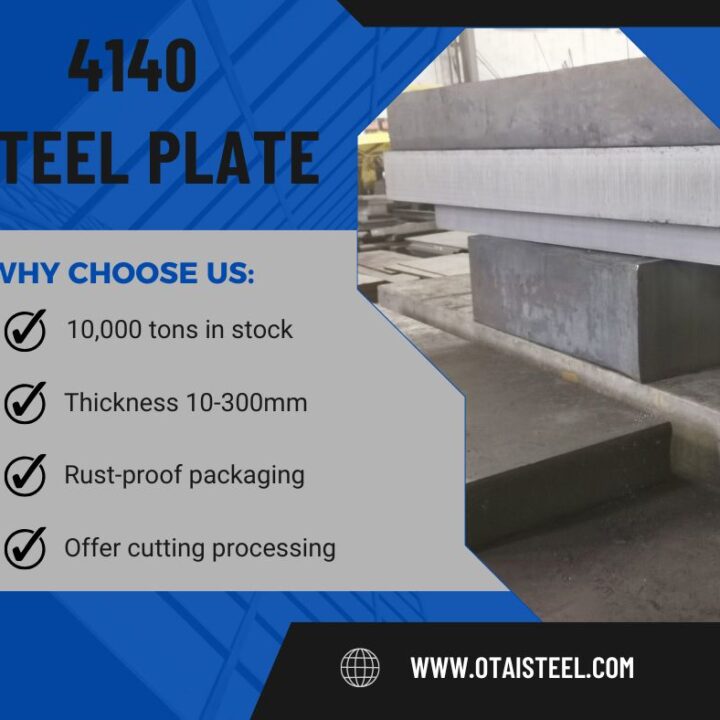
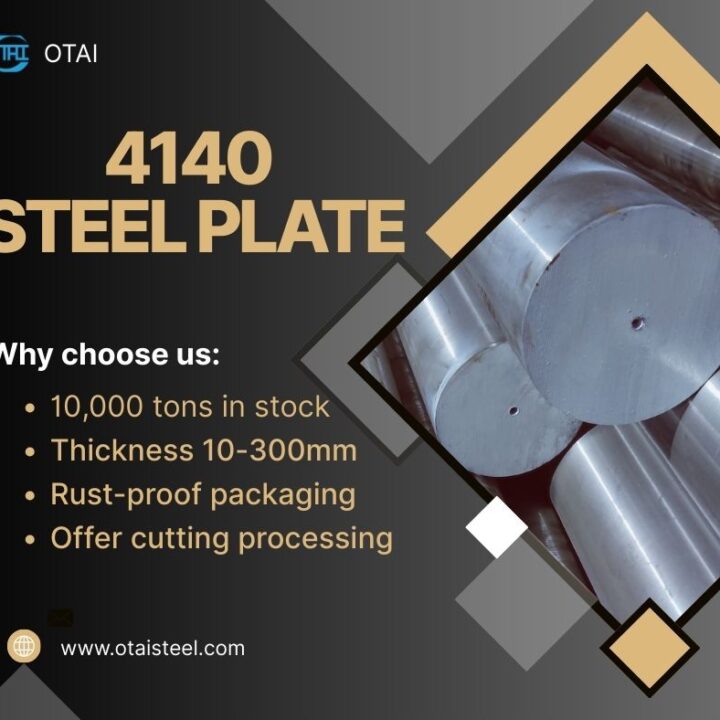
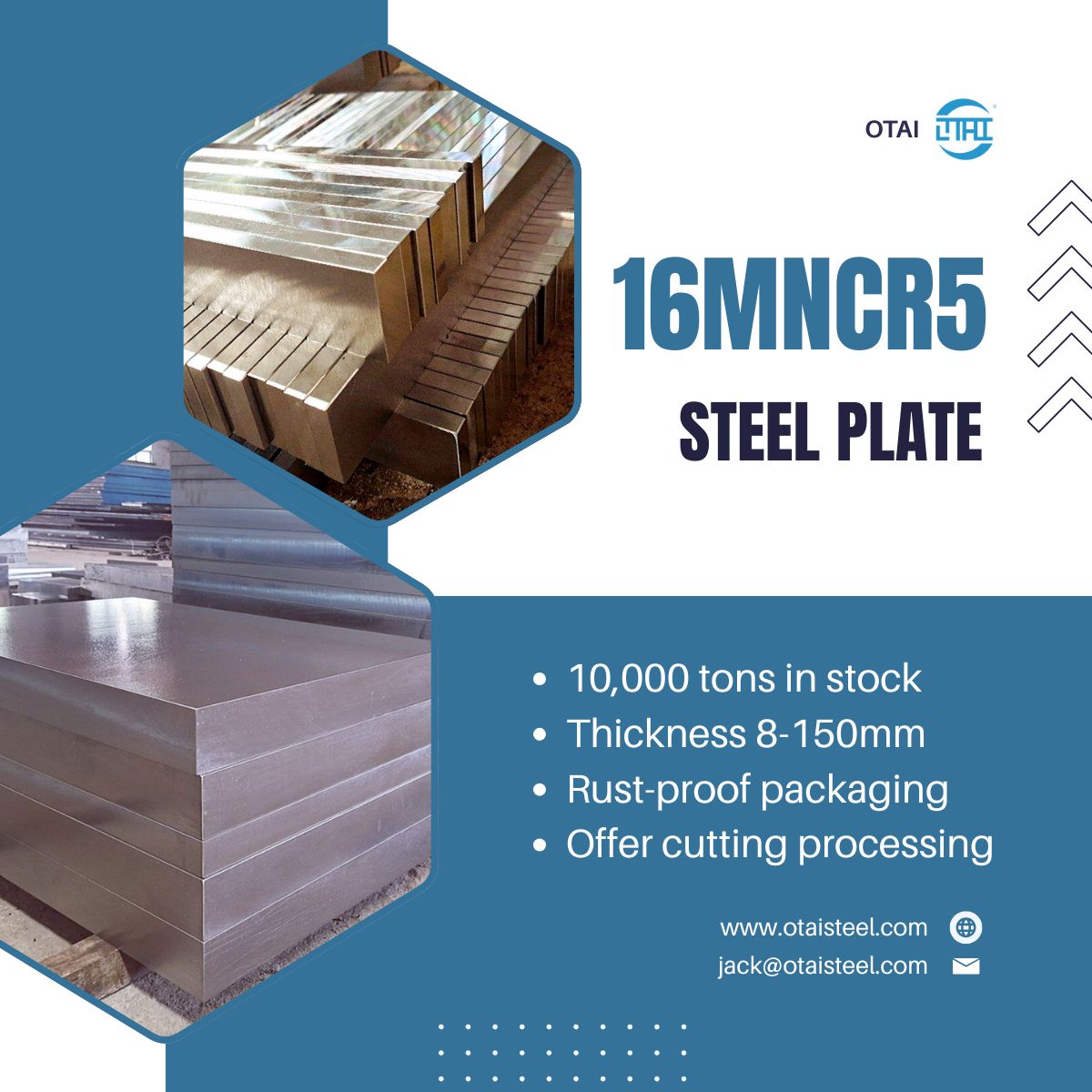
- Specialized 16MnCr5 inventory: Otai keeps 8–150mm thickness 16MnCr5 steel plates available in stock to support different machining requirements.
- Large stock capability: Long-term inventory management helps customers reduce waiting time and improve production efficiency.
- Cutting and processing service: Provides customized cutting and preparation according to customer drawings and manufacturing requirements.
- Heat treatment support: Helps customers achieve suitable hardness and mechanical performance through professional heat treatment solutions.
- Quality inspection: Provides ultrasonic testing and third-party inspection services to ensure material reliability.
- International supply experience: Has supplied steel products to Fortune Global 500 companies with strict technical requirements.
- Professional packaging: Provides anti-rust packaging, steel strapping packaging, and wooden box packaging for international transportation.
For customers searching for a reliable supplier of 16MnCr5 steel plate, Otai provides complete support from material selection, stock supply, processing, inspection, and shipment.
❓ FAQ – Properties of 16MnCr5
Q1: What are the main properties of 16MnCr5 steel?
The main properties of 16MnCr5 include excellent carburizing performance, high surface hardness after heat treatment, good core toughness, wear resistance, and fatigue strength.
Q2: What is the chemical composition of 16MnCr5?
16MnCr5 mainly contains carbon, manganese, and chromium. The combination of these elements provides good hardenability and carburizing performance.
Q3: What hardness can 16MnCr5 achieve after carburizing?
After carburizing and quenching, 16MnCr5 can typically achieve approximately 58–62 HRC surface hardness depending on processing conditions.
Q4: What are the common applications of 16MnCr5?
16MnCr5 is commonly used for gears, shafts, transmission parts, pinions, and industrial components requiring high wear resistance.
Q5: What is the difference between 16MnCr5 and 4140 steel?
16MnCr5 is mainly designed for carburizing applications with a hard surface and tough core, while 4140 provides higher overall section strength after heat treatment.