 16MnCr5 Material Density – Understanding Weight and Engineering Applications
The 16MnCr5 material density is one of the most important physical properties engineers, purchasing managers, and manufacturers consider when selecting materials for gears, shafts, bearings, and other case-hardened components. While many discussions focus on hardness, tensile strength, or heat treatment, density directly affects component weight, machining calculations, transportation costs, and final product performance.
As a widely used carburizing steel according to EN 10084, 16MnCr5 offers an excellent combination of wear resistance, toughness, and machinability. Understanding the density of 16MnCr5 material helps engineers accurately calculate material requirements, estimate component weights, and optimize production costs.
📘 What Is 16MnCr5 Steel?
16MnCr5 is a low-carbon alloy steel containing manganese and chromium. It is primarily designed for carburizing applications where a hard wear-resistant surface and a tough core are required.
After carburizing and heat treatment, the steel develops excellent surface hardness while maintaining sufficient core toughness to withstand shock loads and dynamic stresses.
Typical applications include:
- Transmission gears
- Pinions
- Camshafts
- Sprockets
- Drive shafts
- Bearings
- Agricultural machinery components
- Automotive drivetrain parts
🧪 16MnCr5 Material Density Value
The standard 16MnCr5 steel density is approximately:
| Property | Value |
|---|---|
| Density | 7.85 g/cm³ |
| Density | 7850 kg/m³ |
| Density | 0.284 lb/in³ |
This density is very similar to many other low-alloy engineering steels because iron remains the primary element in the alloy.
The additions of manganese and chromium improve hardenability and mechanical performance, but they do not significantly alter the overall density.
⚙️ Why Density Matters in Engineering Design
Many engineers focus primarily on strength and hardness, but density plays an important role in product development and manufacturing.
Knowing the 16MnCr5 density in kg/m³ helps with:
- Raw material purchasing calculations
- Weight estimation of machined parts
- Transportation cost planning
- Mechanical system balancing
- Production scheduling
- Inventory management
For example, when manufacturing large transmission gears, even a small error in weight calculations can significantly affect production planning and shipping costs.
📊 Weight Calculation for 16MnCr5 Steel
One of the most common uses of density data is calculating component weight.
The basic formula is:
Weight = Volume × Density
Using the standard density of 7850 kg/m³, engineers can estimate the weight of bars, plates, and forged blocks before machining.
| Product | Dimensions | Approximate Weight |
|---|---|---|
| Plate | 1000 × 1000 × 20 mm | 157 kg |
| Round Bar | 100 mm × 1000 mm | 61.7 kg |
| Forged Block | 500 × 500 × 200 mm | 392 kg |
Accurate weight calculations help manufacturers reduce material waste and improve purchasing efficiency.
🔩 Relationship Between Density and Mechanical Properties
Although density does not directly determine strength, it influences mass-related performance characteristics.
16MnCr5 combines its standard steel density with excellent mechanical properties, making it suitable for highly stressed components.
| Property | Typical Value |
|---|---|
| Density | 7850 kg/m³ |
| Surface Hardness After Carburizing | 58–62 HRC |
| Core Toughness | Excellent |
| Wear Resistance | Very High |
This combination explains why 16MnCr5 remains one of the most popular engineering steels in the automotive and machinery industries.
🏭 Applications Where Density Is Important
In many applications, weight plays a critical role in design performance.
Examples include:
- Automotive transmissions
- Industrial gearboxes
- Agricultural machinery
- Construction equipment
- Mining machinery
- Power transmission systems
For rotating parts such as gears and shafts, engineers must consider density when calculating inertia, rotational balance, and energy consumption.
A reliable understanding of 16MnCr5 material properties allows manufacturers to optimize both performance and production costs.
📈 Comparison with Other Engineering Steels
| Steel Grade | Density (kg/m³) | Typical Use |
|---|---|---|
| 16MnCr5 | 7850 | Carburized gears and shafts |
| 20MnCr5 | 7850 | Automotive transmission parts |
| 4140 | 7850 | Heavy-duty shafts |
| 8620 | 7850 | Case-hardening components |
As shown above, density differences among these steels are minimal, so material selection is generally based on hardenability, strength, and wear resistance rather than weight alone.
🏆 Company Advantages – Otai Special Steel
- Professional supplier of 16MnCr5 engineering steel
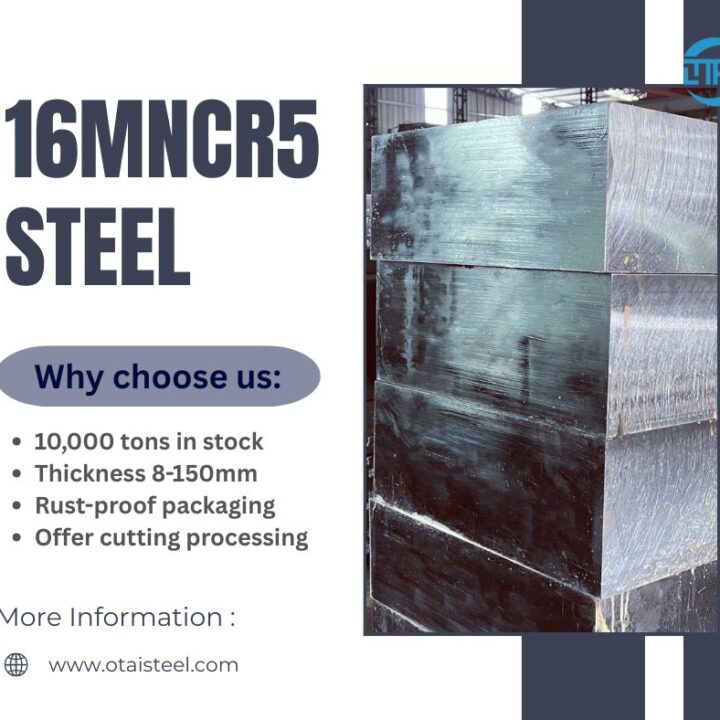
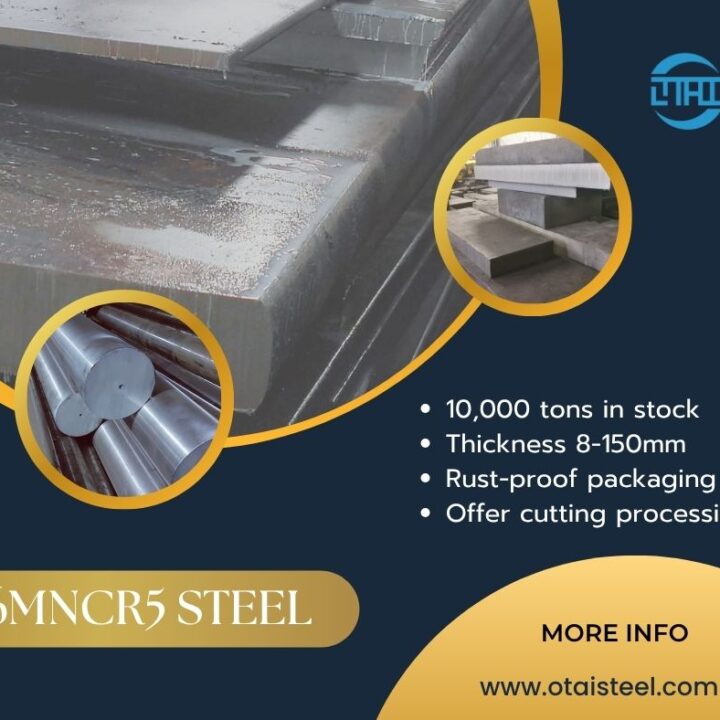
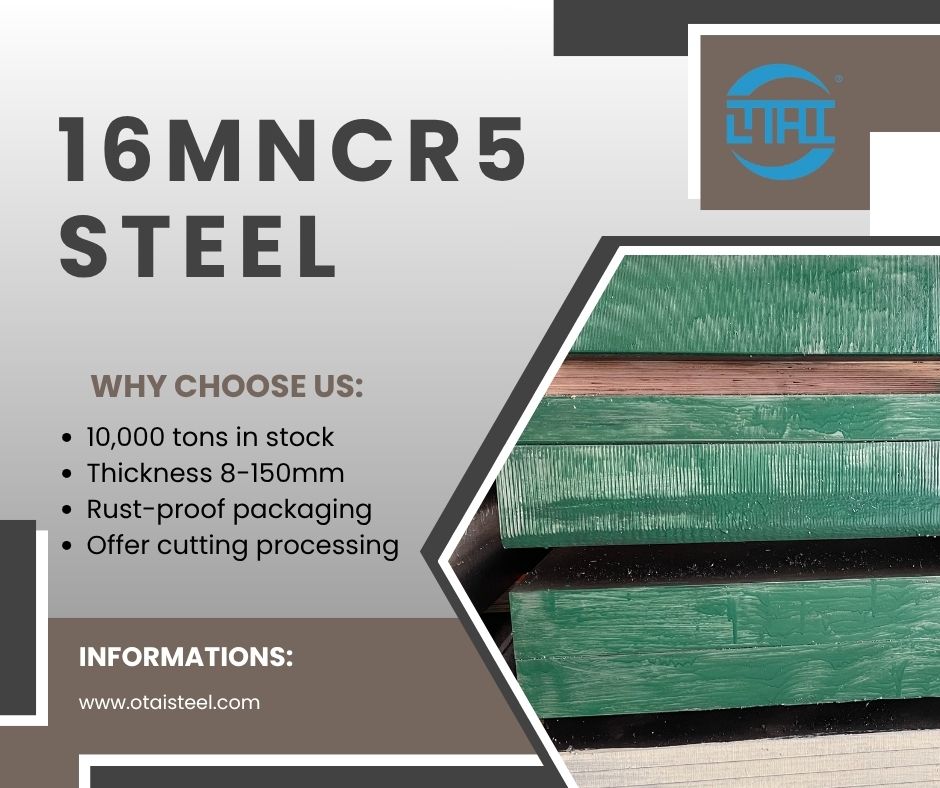
- Sufficient inventory with 8–150 mm thickness plates available in stock
- Large stock of plates, round bars, and forged blocks
- Cut-to-size processing services
- Heat treatment support available
- Ultrasonic testing and quality inspection services
- Third-party inspection support including SGS
- Stable global export supply chain
- Fast delivery and responsive customer service
- Competitive pricing for long-term industrial partnerships
📌 FAQ
Q1: What is the density of 16MnCr5 material?
A: The standard density is approximately 7.85 g/cm³ or 7850 kg/m³.
Q2: Does heat treatment change the density of 16MnCr5?
A: Heat treatment has a negligible effect on density and does not significantly change weight calculations.
Q3: Why is density important when purchasing steel?
A: Density is required for calculating material weight, transportation costs, and raw material requirements.
Q4: Is 16MnCr5 heavier than 4140 steel?
A: No. Both steels have very similar densities of approximately 7850 kg/m³.
Q5: How do I calculate the weight of a 16MnCr5 steel plate?
A: Multiply the volume of the plate by the density value of 7850 kg/m³.