 16MnCr5 Mechanical Properties: Strength and Heat Treatment Performance
The 16MnCr5 mechanical properties make this alloy steel one of the most widely used carburizing steels for gears, shafts, transmission systems, and wear-resistant mechanical components. Engineers and manufacturers prefer 16MnCr5 because it combines excellent surface hardness with strong core toughness after heat treatment.
16MnCr5 is a low-carbon chromium alloy case-hardening steel commonly produced according to EN 10084 standards. The material is specifically designed for carburizing applications where components require a hard wear-resistant outer layer and a ductile inner core.
This balance of hardness, fatigue resistance, and toughness allows 16MnCr5 steel to perform exceptionally well under heavy cyclic loading and high-contact stress conditions.
Typical applications include:
- Automotive gears
- Transmission shafts
- Pinions
- Industrial couplings
- Heavy-duty machinery parts
- Mechanical power transmission systems
🧪 Chemical Composition and Its Effect on Mechanical Properties
The chemical composition of 16MnCr5 directly influences its hardenability, wear resistance, fatigue strength, and toughness.
The combination of chromium and manganese improves carburizing response and mechanical stability after heat treatment.
| Element | Typical Content (%) | Effect on Properties |
|---|---|---|
| Carbon (C) | 0.14 – 0.19 | Improves hardness after carburizing |
| Manganese (Mn) | 1.00 – 1.30 | Increases hardenability and strength |
| Chromium (Cr) | 0.80 – 1.10 | Enhances wear resistance |
| Silicon (Si) | 0.17 – 0.37 | Improves structural stability |
| Sulfur (S) | ≤ 0.035 | Improves machinability |
This balanced alloy design allows the material to achieve excellent mechanical performance after carburizing and quenching.
📈 Typical Mechanical Properties of 16MnCr5 Steel
The mechanical properties of 16MnCr5 vary depending on the heat treatment condition, carburizing depth, and section size.
After proper carburizing and tempering, the material develops an extremely hard surface while maintaining a tough core structure.
| Mechanical Property | Typical Value |
|---|---|
| Tensile Strength | 800 – 1200 MPa |
| Yield Strength | 550 – 900 MPa |
| Surface Hardness | 58 – 62 HRC |
| Core Hardness | 30 – 45 HRC |
| Impact Toughness | Excellent |
| Fatigue Resistance | Very High |
The excellent fatigue performance makes 16MnCr5 highly suitable for heavily loaded gear systems and rotating machinery.
🔥 Heat Treatment and Mechanical Performance
Heat treatment plays a critical role in achieving the desired 16MnCr5 mechanical properties.
The standard heat treatment process usually includes carburizing, quenching, and low-temperature tempering.
| Heat Treatment Process | Typical Temperature | Main Purpose |
|---|---|---|
| Carburizing | 880 – 930°C | Increase surface carbon content |
| Quenching | 780 – 820°C | Develop martensitic hardness |
| Tempering | 150 – 200°C | Reduce internal stress |
Proper heat treatment significantly improves wear resistance, dimensional stability, and fatigue life.
⚙️ Mechanical Properties in Annealed Condition
Before carburizing and hardening, 16MnCr5 steel is often supplied in the annealed condition to improve machinability.
In this condition, the material offers moderate hardness and good cutting performance.
| Property in Annealed Condition | Typical Value |
|---|---|
| Hardness | 160 – 190 HB |
| Machinability | Good |
| Ductility | High |
| Formability | Good |
The annealed structure allows manufacturers to perform turning, drilling, milling, and gear cutting operations more efficiently before final heat treatment.
🔬 Microstructure and Mechanical Strength
The microstructure of 16MnCr5 steel strongly influences its mechanical properties and long-term service performance.
After carburizing and quenching, the material develops a hard martensitic surface layer combined with a tougher low-carbon core structure.
| Microstructural Zone | Main Structure | Performance Advantage |
|---|---|---|
| Surface Layer | Martensite | Very high wear resistance |
| Transition Zone | Mixed martensite structures | Improved fatigue resistance |
| Core Region | Ferrite and pearlite | Excellent toughness |
This hardened surface and tough core combination allows 16MnCr5 components to withstand repeated impact loading and long-term cyclic stress conditions.
⚙️ Machinability and Processing Characteristics
16MnCr5 steel provides good machinability before final carburizing and hardening operations.
The material is commonly machined in the annealed condition to improve production efficiency and reduce cutting tool wear.
| Processing Property | Performance |
|---|---|
| Machinability | Good |
| Gear Cutting Performance | Excellent |
| Grinding Capability | Very Good |
| Dimensional Stability | Good after heat treatment |
The material’s excellent machining characteristics make it highly suitable for precision gear manufacturing and CNC machining operations.
🚗 Industrial Applications Requiring High Mechanical Properties
The excellent 16MnCr5 mechanical properties make the material highly suitable for demanding industrial applications involving heavy contact stress and wear conditions.
| Industry | Typical Components |
|---|---|
| Automotive | Transmission gears and shafts |
| Industrial Machinery | Gear wheels and couplings |
| Mining Equipment | Wear-resistant rotating parts |
| Agricultural Machinery | Drive system components |
| Heavy Engineering | Power transmission systems |
The combination of surface hardness, fatigue resistance, and core toughness allows components to operate reliably under high-load service environments.
⚠️ Factors Affecting Mechanical Properties
Several manufacturing and heat treatment factors can significantly influence the final mechanical properties of 16MnCr5 steel.
| Factor | Effect on Performance |
|---|---|
| Carburizing Depth | Influences wear resistance and fatigue life |
| Quenching Process | Determines martensitic hardness |
| Tempering Temperature | Controls toughness and stress relief |
| Section Thickness | Affects cooling rate and hardness distribution |
| Surface Finish | Influences fatigue crack initiation |
Proper manufacturing control helps maximize component durability, dimensional stability, and operational reliability.
🏭 Company Advantages
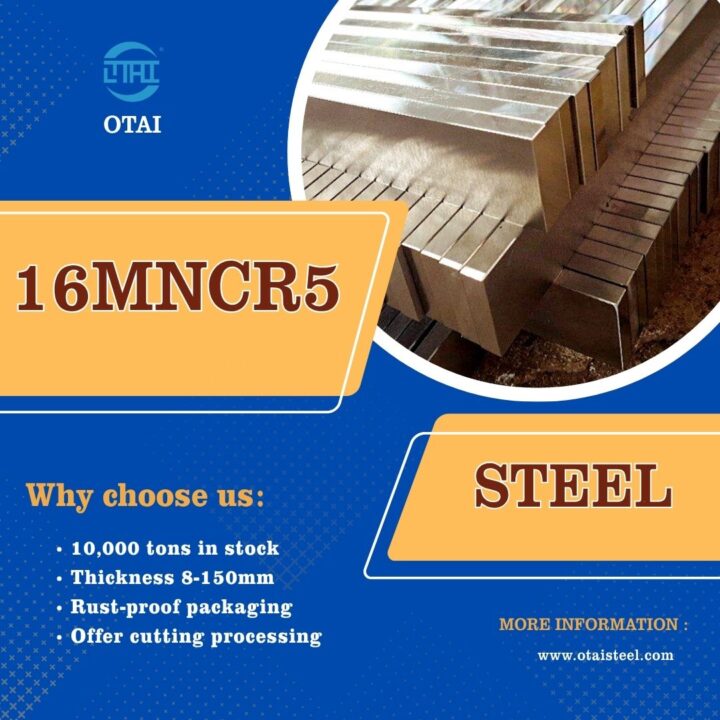
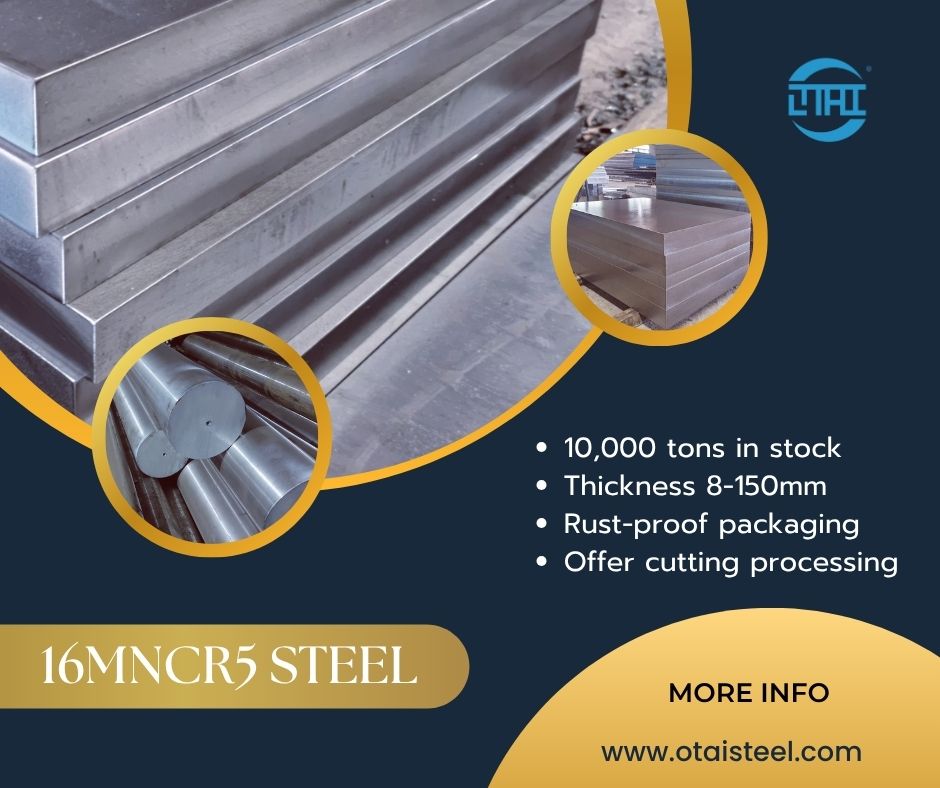
Otai Special Steel supplies premium-quality 16MnCr5 alloy steel for automotive, industrial machinery, mining, and heavy engineering applications.
- Large inventory and stable year-round supply
- 8–150mm thickness plates available in stock
- Custom cutting and machining services
- Heat treatment support including carburizing and quenching
- Ultrasonic testing (UT) support
- Chemical composition verification
- Third-party inspection support including SGS
- Professional export packaging and global logistics support
We provide reliable quality, competitive pricing, and fast delivery for customers worldwide.
❓ FAQ
Q1: What are the main mechanical properties of 16MnCr5 steel?
A1: The material offers high surface hardness, excellent fatigue resistance, strong wear resistance, and good core toughness after carburizing.
Q2: What hardness can 16MnCr5 achieve?
A2: After carburizing and quenching, surface hardness typically reaches 58–62 HRC.
Q3: Is 16MnCr5 suitable for gears?
A3: Yes. The material is widely used for gears because of its excellent wear resistance and fatigue strength.
Q4: Does heat treatment affect mechanical properties?
A4: Yes. Carburizing, quenching, and tempering strongly influence hardness, toughness, and fatigue resistance.
Q5: Is 16MnCr5 easy to machine?
A5: Yes. The material has good machinability in the annealed condition before hardening.