 16MnCr5 Hardness: Understanding Surface Strength and Heat Treatment Performance
The 16MnCr5 hardness level makes this steel one of the most popular carburizing grades for gears, shafts, pinions, and transmission systems. Engineers value 16MnCr5 because it can achieve a very hard wear-resistant surface while maintaining a tough and ductile core.
As a low-carbon chromium alloy steel, 16MnCr5 responds exceptionally well to carburizing, quenching, and tempering. The final hardness depends heavily on heat treatment parameters, carburizing depth, cooling rate, and tempering conditions.
Manufacturers widely use this steel in industries that require:
- High surface wear resistance
- Strong fatigue performance
- Excellent impact toughness
- Reliable dimensional stability
- Long service life under cyclic loading
Understanding hardness characteristics helps engineers optimize mechanical performance and select the proper heat treatment process for demanding applications.
🧪 Chemical Composition and Hardness Behavior
The alloy chemistry directly affects hardenability and final hardness after heat treatment.
| Element | Content (%) | Influence on Hardness |
|---|---|---|
| Carbon (C) | 0.14 – 0.19 | Supports martensite formation |
| Chromium (Cr) | 0.80 – 1.10 | Improves hardenability and wear resistance |
| Manganese (Mn) | 1.00 – 1.30 | Enhances strength and hardening response |
| Silicon (Si) | 0.17 – 0.37 | Improves structural stability |
The relatively low carbon content keeps the core tough, while carburizing increases the surface carbon concentration to produce high hardness after quenching.
📊 Typical Hardness Values of 16MnCr5 Steel
The hardness of 16MnCr5 changes significantly depending on its condition and heat treatment process.
| Condition | Typical Hardness | Hardness Scale |
|---|---|---|
| Annealed | 140 – 190 | HB |
| Normalized | 170 – 220 | HB |
| Carburized and Quenched Surface | 58 – 62 | HRC |
| Core Hardness | 30 – 45 | HRC |
The carburized surface layer achieves very high hardness, while the core retains enough toughness to resist cracking and shock loading.
🔥 How Heat Treatment Affects 16MnCr5 Hardness
Heat treatment strongly influences the final hardness distribution of 16MnCr5 steel. Manufacturers typically apply carburizing, quenching, and tempering to optimize mechanical properties.
The carburizing process increases surface carbon content, allowing the outer layer to transform into hard martensite during quenching.
The typical heat treatment sequence includes:
- Carburizing
- Diffusion treatment
- Quenching
- Low-temperature tempering
| Heat Treatment Stage | Effect on Hardness |
|---|---|
| Carburizing | Increases surface carbon level |
| Quenching | Forms hard martensite |
| Tempering | Reduces brittleness |
Careful process control helps maintain consistent hardness and dimensional accuracy in precision components.
⚙️ Surface Hardness vs Core Hardness
One of the main advantages of 16MnCr5 steel is the ability to create a hardness gradient between the surface and the core.
The hard surface resists wear and rolling contact fatigue, while the softer core absorbs impact energy and prevents brittle fracture.
| Area | Main Characteristic | Performance Benefit |
|---|---|---|
| Surface Layer | Very high hardness | Excellent wear resistance |
| Core | Moderate hardness and toughness | Impact resistance |
This combination explains why 16MnCr5 performs exceptionally well in heavily loaded gears and rotating mechanical systems.
🚗 Why High Hardness Matters in Gear Applications
Gear systems operate under continuous friction, rolling contact stress, and repeated cyclic loading. Insufficient hardness can lead to rapid wear, tooth deformation, pitting, and premature failure.
The high surface hardness of 16MnCr5 steel provides several important advantages for transmission components.
- Improved wear resistance
- Better rolling contact fatigue strength
- Reduced surface deformation
- Longer operational service life
- Enhanced load-carrying capacity
Automotive manufacturers widely use 16MnCr5 for transmission gears, differential gears, synchronizer hubs, and pinion shafts because of these performance benefits.
| Gear Requirement | Hardness Benefit |
|---|---|
| Wear Resistance | Reduces abrasive damage |
| Fatigue Strength | Improves cyclic durability |
| Dimensional Stability | Maintains gear accuracy |
| Shock Resistance | Prevents sudden cracking |
🔬 Hardness Testing Methods for 16MnCr5 Steel
Manufacturers perform hardness testing to verify heat treatment quality and ensure consistent mechanical performance.
The most common hardness testing methods include:
- Rockwell hardness testing
- Brinell hardness testing
- Vickers hardness testing
- Microhardness analysis
Rockwell hardness testing remains the most widely used method for carburized surfaces because it provides fast and reliable measurements.
| Testing Method | Typical Application |
|---|---|
| Rockwell HRC | Carburized surface hardness |
| Brinell HB | Annealed condition |
| Vickers HV | Case depth analysis |
| Microhardness | Detailed hardness gradient study |
Microhardness testing helps engineers evaluate carburized layer depth and hardness distribution from the surface to the core.
🌍 International Equivalent Grades and Hardness Comparison
Several international carburizing steels provide hardness characteristics similar to 16MnCr5.
| Standard | Equivalent Grade | Typical Surface Hardness |
|---|---|---|
| AISI / SAE | SAE 5115 | 58 – 62 HRC |
| JIS | SCM420 | 58 – 62 HRC |
| GB | 20CrMnTi | 58 – 63 HRC |
Although these materials share similar hardness ranges, differences in alloy composition and heat treatment response can influence fatigue strength and dimensional stability.
⚠️ Common Hardness Problems and Solutions
Improper heat treatment can create hardness-related problems that reduce component reliability and service life.
Common issues include:
- Insufficient surface hardness
- Excessive brittleness
- Uneven hardness distribution
- Shallow carburized layer
- Surface cracking after quenching
| Problem | Possible Cause | Solution |
|---|---|---|
| Low Hardness | Insufficient carburizing | Increase carburizing time |
| Surface Cracking | Excessive quenching stress | Optimize cooling process |
| Uneven Hardness | Poor temperature control | Improve furnace consistency |
Careful heat treatment control helps manufacturers maintain consistent hardness and improve long-term operational reliability.
🏭 Company Advantages
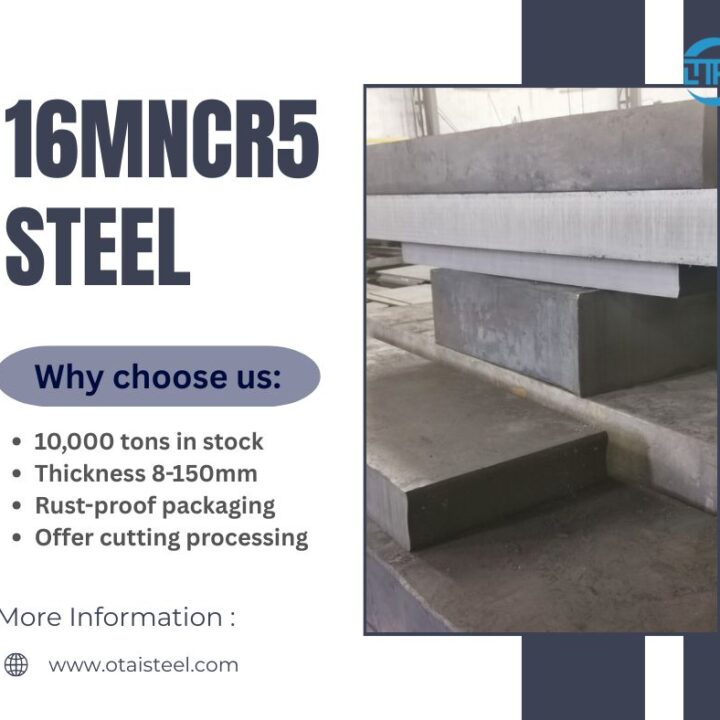
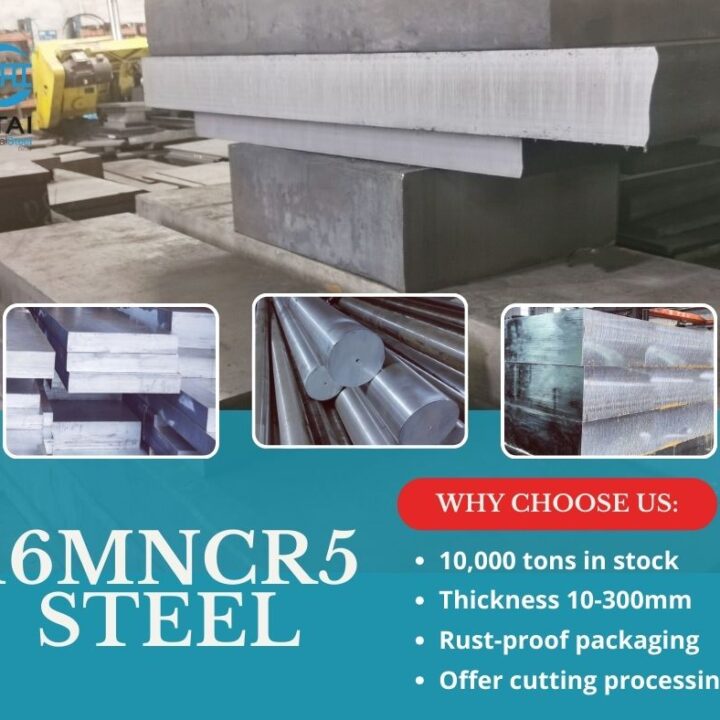
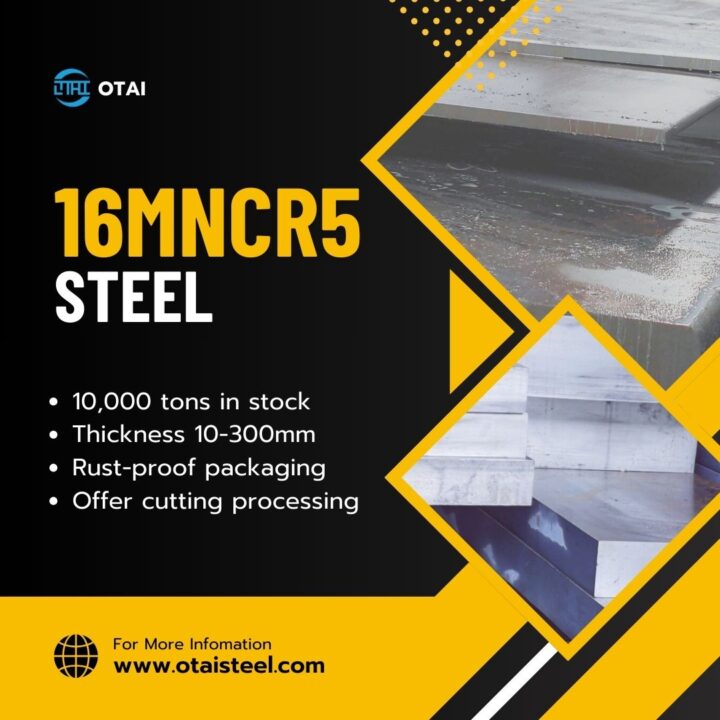
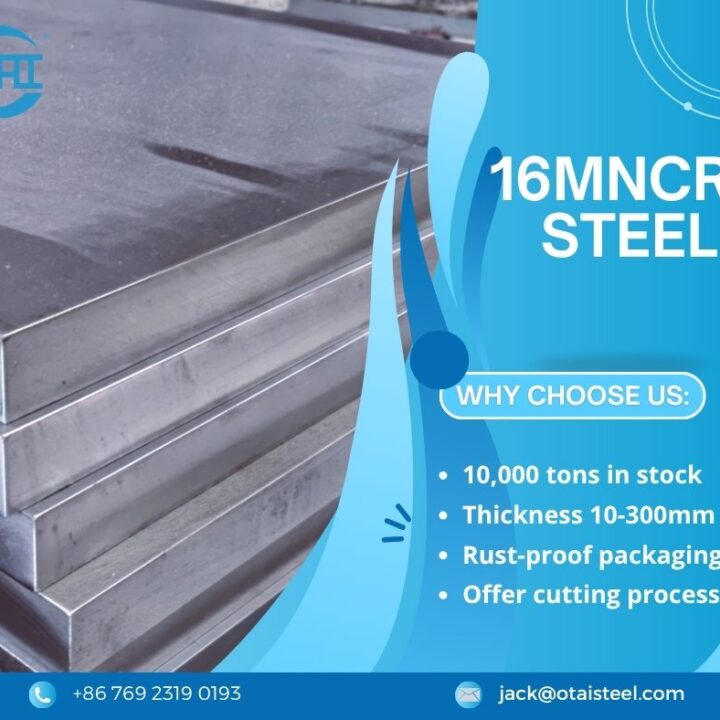
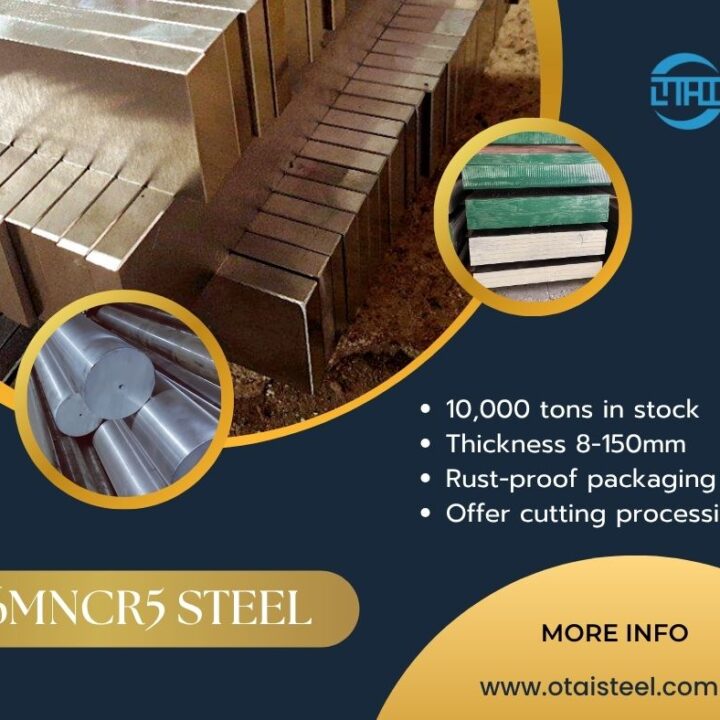
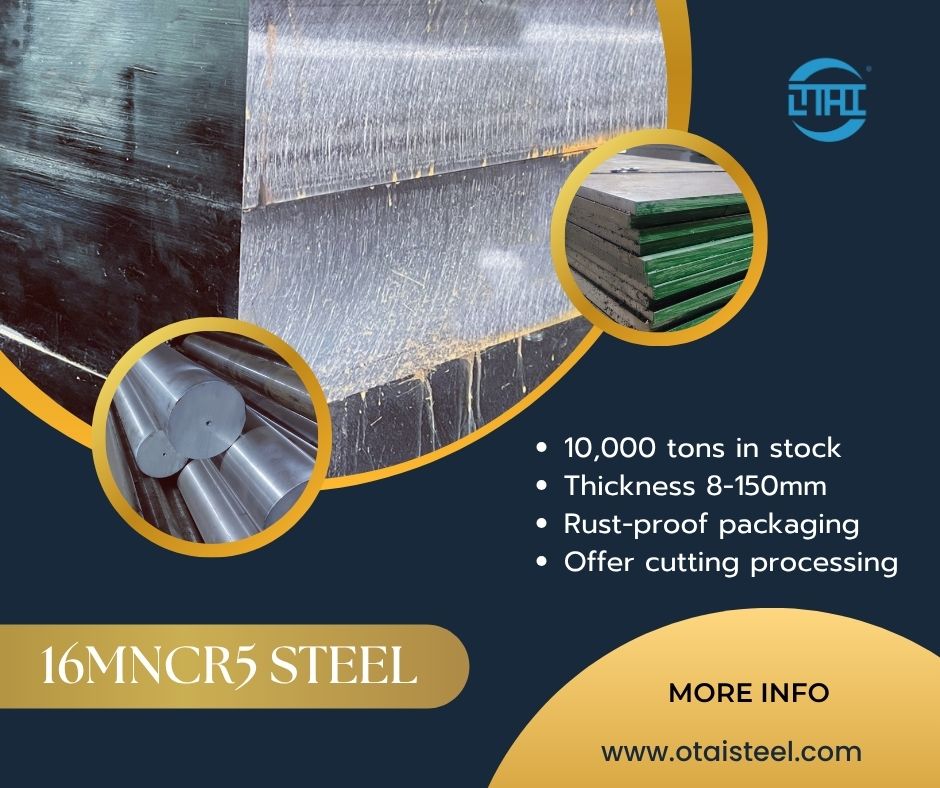
Otai Special Steel supplies premium-quality 16MnCr5 steel materials for gears, shafts, transmission systems, and heavy industrial applications.
- Large inventory and stable year-round supply
- 8–150mm thickness plates available in stock
- Custom cutting and heat treatment services
- Ultrasonic testing (UT) support
- Chemical composition verification
- Third-party inspection support including SGS
- Professional export packaging and global logistics support
- Fast response for urgent industrial projects
We support customers worldwide with reliable material quality, stable delivery performance, and professional technical assistance.
❓ FAQ
Q1: What is the typical surface hardness of carburized 16MnCr5 steel?
A1: Proper carburizing and quenching can achieve approximately 58–62 HRC surface hardness.
Q2: Why does 16MnCr5 have different surface and core hardness?
A2: Carburizing increases the carbon content near the surface, creating a hard martensitic layer while maintaining a tough low-carbon core.
Q3: Which hardness test is most common for 16MnCr5 steel?
A3: Rockwell HRC testing is widely used for carburized surfaces, while Brinell testing is common for annealed conditions.
Q4: Does higher hardness always improve performance?
A4: Not always. Excessive hardness can increase brittleness, so engineers must balance hardness and toughness carefully.
Q5: Which industries commonly use hardened 16MnCr5 steel?
A5: Automotive, industrial machinery, agricultural equipment, and heavy engineering industries widely use this material.