 Composition 16MnCr5 – Chemical Analysis and Engineering Applications
The composition of 16MnCr5 plays a critical role in determining its performance in case hardening, carburizing, and high-fatigue engineering applications. 16MnCr5 is a widely used low-carbon chromium-manganese alloy steel designed for components that require a hard wear-resistant surface combined with a tough and ductile core. Because of this balanced performance, engineers frequently select this material for automotive gears, transmission shafts, industrial pinions, and heavy-duty machinery parts.
Understanding the chemical composition of 16MnCr5 helps manufacturers optimize heat treatment, machining, and final mechanical performance. Even small variations in alloying elements can influence surface hardness, hardenability, fatigue resistance, and dimensional stability during service.
🔍 What is 16MnCr5 Steel?
16MnCr5 is a European case-hardening steel grade standardized under the EN system. The name itself provides useful information about the steel chemistry:
- 16 indicates approximately 0.16% carbon
- Mn represents manganese alloying
- Cr represents chromium alloying
- 5 relates to the approximate alloy content level
This alloy combination makes 16MnCr5 ideal for applications where components experience:
- Continuous friction and wear
- Cyclic loading and fatigue
- Torque and bending stress
- Impact loading under dynamic conditions
Unlike higher-carbon steels, 16MnCr5 maintains excellent core toughness after carburizing because the carbon content remains relatively low in the center of the material.
🧪 Chemical Composition of 16MnCr5
The standard chemical composition of 16MnCr5 typically falls within the following ranges:
| Element | Content (%) | Function in Steel |
|---|---|---|
| Carbon (C) | 0.14 – 0.19 | Improves hardness and strength after carburizing |
| Silicon (Si) | 0.17 – 0.37 | Enhances strength and oxidation resistance |
| Manganese (Mn) | 1.00 – 1.30 | Increases hardenability and tensile strength |
| Chromium (Cr) | 0.80 – 1.10 | Improves wear resistance and surface hardness |
| Phosphorus (P) | ≤ 0.025 | Controlled impurity level |
| Sulfur (S) | ≤ 0.035 | Improves machinability in small amounts |
Engineering Insight: The combination of manganese and chromium gives 16MnCr5 excellent hardenability during carburizing, allowing the steel to achieve a high-hardness surface layer while maintaining a tough core.
📊 How the Composition Affects Mechanical Properties
The chemical composition directly influences the final mechanical performance of the steel after heat treatment.
| Property | Annealed Condition | Carburized & Tempered Condition |
|---|---|---|
| Tensile Strength | 550 – 800 MPa | 800 – 1200 MPa |
| Yield Strength | 300 – 500 MPa | 550 – 850 MPa |
| Surface Hardness | 180 HB | 58 – 62 HRC |
| Elongation | 20 – 25% | 12 – 16% |
| Core Toughness | Excellent | Excellent |
🔹 Carbon Content Influence
Carbon is one of the most important elements in 16MnCr5.
- Low carbon content keeps the core ductile
- Surface carbon increases during carburizing
- Higher carbon on the surface improves wear resistance
This structure allows gears and shafts to resist surface abrasion without becoming brittle internally.
🔹 Chromium Contribution
Chromium improves:
- Hardenability
- Wear resistance
- Surface strength
- Fatigue performance
In carburized applications, chromium helps create a uniform hardened layer, which improves service life under repeated stress cycles.
🔹 Manganese Effects
Manganese increases:
- Tensile strength
- Quench response
- Toughness
- Dimensional stability during heat treatment
This element also reduces the risk of cracking during quenching, especially in larger sections.
🔥 Heat Treatment and Composition Relationship
The chemical composition of 16MnCr5 makes it highly responsive to carburizing and quench hardening.
| Heat Treatment Process | Temperature Range | Main Purpose |
|---|---|---|
| Annealing | 650 – 700°C | Improve machinability |
| Normalizing | 870 – 900°C | Refine grain structure |
| Carburizing | 880 – 980°C | Increase surface carbon content |
| Quenching | 820 – 860°C | Form martensitic surface layer |
| Tempering | 150 – 200°C | Reduce brittleness |
Practical Tip: For transmission gears, a carburized case depth of 0.8–1.2 mm often provides an ideal balance between wear resistance and impact toughness.
Because of its chemistry, 16MnCr5 develops a hard martensitic outer layer after quenching while retaining a tough ferrite-pearlite core. This combination is essential for components exposed to torsional loads and repeated impacts.
⚙️ Industrial Applications of 16MnCr5
The composition of 16MnCr5 makes it suitable for industries requiring reliable fatigue performance and wear resistance.
| Industry | Typical Components | Why 16MnCr5 is Used |
|---|---|---|
| Automotive | Gears, shafts, pinions | Excellent fatigue and wear resistance |
| Heavy Machinery | Drive systems, couplings | Tough core and hard surface |
| Agricultural Equipment | Gearboxes, axles | Resists shock loading |
| Industrial Manufacturing | Rollers, spindles | Dimensional stability and hardness |
🔹 Automotive Engineering Example
In automotive transmission systems, gears manufactured from 16MnCr5 benefit from:
- Hard carburized surfaces for wear protection
- Tough cores resisting sudden torque loads
- Long fatigue life under high rotational speed
This combination significantly reduces the risk of tooth cracking and surface pitting during long-term operation.
🌐 International Equivalent Grades
Several international grades offer similar chemical composition and performance characteristics:
| Standard | Equivalent Grade |
|---|---|
| AISI / SAE | SAE 5115 |
| JIS | SCM420 |
| GB | 20CrMnTi |
| DIN / EN | 16MnCr5 |
Although these equivalents are similar, slight composition differences may affect:
- Hardenability
- Machining performance
- Carburizing response
- Fatigue life
Engineers should always verify exact specifications before material substitution.
🏭 Company Advantages
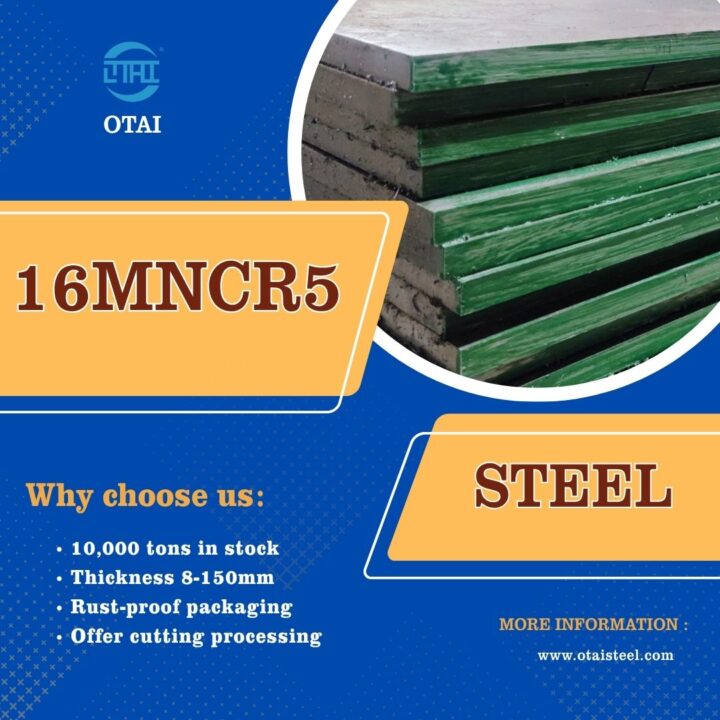
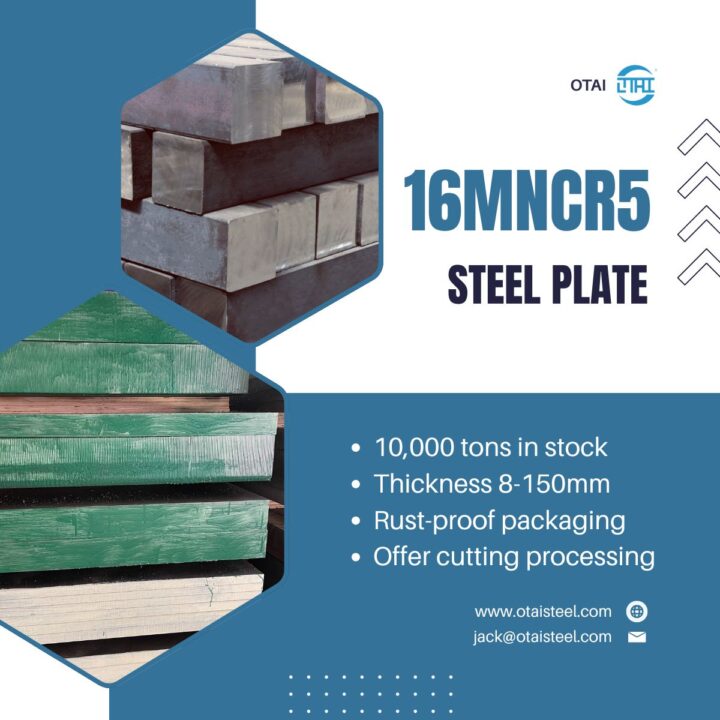
Otai Special Steel supplies high-quality 16MnCr5 steel materials for demanding engineering applications.
- Large inventory and stable supply
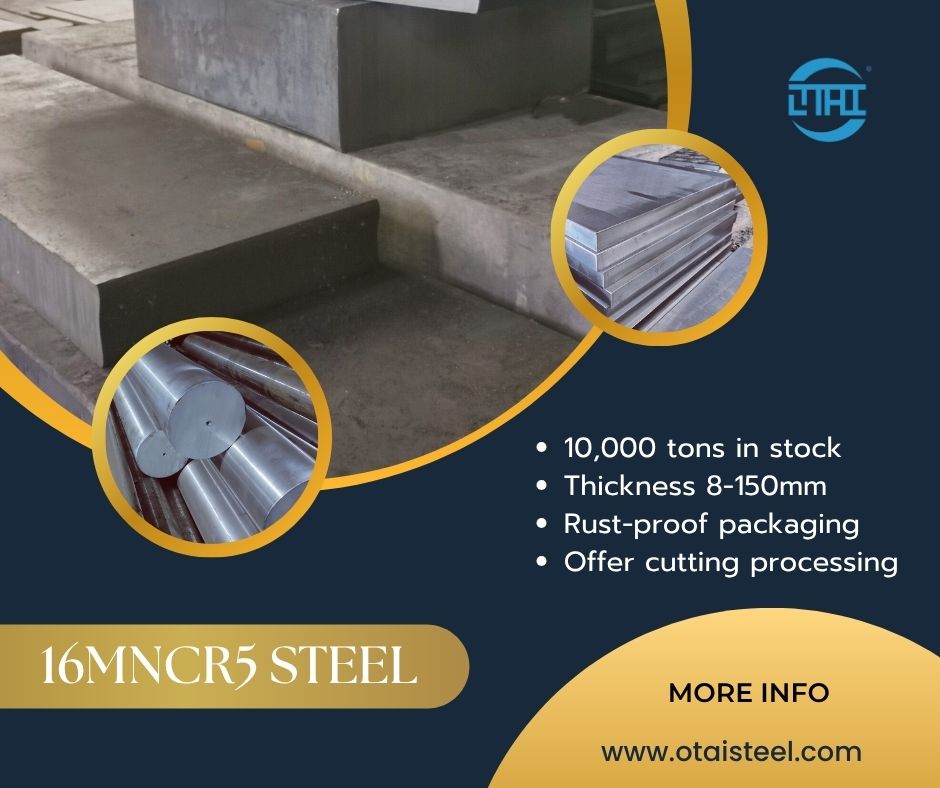
- 8–150mm thickness plates available in stock
- Custom cutting and heat treatment services
- Ultrasonic testing (UT) and chemical composition verification
- Third-party inspection support (SGS)
- Professional export packaging and logistics support
We support customers in the automotive, industrial machinery, heavy equipment, and precision engineering sectors with reliable quality and technical assistance.
❓ FAQ
Q1: What is the carbon content of 16MnCr5?
A1: The carbon content typically ranges from 0.14% to 0.19%.
Q2: Why does 16MnCr5 contain chromium?
A2: Chromium improves hardenability, wear resistance, and surface hardness after carburizing.
Q3: What is the main advantage of the 16MnCr5 composition?
A3: It provides an excellent combination of a hard wear-resistant surface and a ductile, impact-resistant core.
Q4: Can the composition affect heat treatment results?
A4: Yes. Variations in carbon, manganese, and chromium directly influence hardenability, hardness depth, and fatigue performance.
Q5: Which industries commonly use 16MnCr5 steel?
A5: Automotive, industrial machinery, agricultural equipment, and heavy engineering industries widely use this steel for gears, shafts, and transmission components.