 Equivalent Material for 16MnCr5 – International Steel Grades and Global Alternatives
When manufacturers search for equivalent material for 16MnCr5, they usually need compatible carburizing steels that match similar mechanical properties, chemical composition, and heat treatment performance. This information becomes especially important for international sourcing, engineering drawings, OEM replacement projects, and export manufacturing.
16MnCr5 is one of the most widely used alloy case hardening steels in Europe. It offers an excellent balance of wear resistance, core toughness, fatigue strength, and machinability after carburizing treatment.
The most common equivalent materials for 16MnCr5 include:
| Country/Standard | Equivalent Grade |
|---|---|
| Germany (DIN/EN) | 16MnCr5 / 1.7131 |
| USA (AISI/SAE) | SAE 5115 |
| Japan (JIS) | SCM420 |
| China (GB) | 16CrMnH |
| France (AFNOR) | 16MC5 |
| Italy (UNI) | 16MnCr5 |
| ISO | 16MnCr5 |
Many buyers also compare this material with 20MnCr5 steel, SAE 8620, SCM415, and other case hardening alloy steels depending on application requirements.
🔍 What Is 16MnCr5 Steel?
16MnCr5 is a low-carbon chromium-manganese alloy steel primarily designed for carburizing applications. The steel develops:
- A hard wear-resistant surface
- A strong and impact-resistant core
- Excellent fatigue resistance
- Stable dimensional properties after heat treatment
These characteristics make the material highly suitable for power transmission and rotating components.
Typical applications include:
- Automotive gears
- Transmission shafts
- Pinions
- Camshafts
- Worm gears
- Bushings
- Mechanical couplings
Because of its excellent carburizing response, many engineers searching for equivalent material for 16MnCr5 are often selecting substitutes for gear manufacturing or heavy-duty machinery parts.
🧪 Chemical Composition of 16MnCr5
The chemical composition directly influences hardenability, wear resistance, and core toughness.
| Element | Content (%) |
|---|---|
| Carbon (C) | 0.14 – 0.19 |
| Silicon (Si) | 0.17 – 0.37 |
| Manganese (Mn) | 1.00 – 1.30 |
| Chromium (Cr) | 0.80 – 1.10 |
| Phosphorus (P) | ≤ 0.025 |
| Sulfur (S) | ≤ 0.035 |
The relatively low carbon content improves machinability before carburizing, while chromium enhances surface hardness and wear resistance after quenching.
🌍 International Equivalent Materials for 16MnCr5
Different countries use different naming systems for carburizing steels. Understanding these equivalents helps avoid procurement mistakes during global sourcing.
🇺🇸 SAE 5115 Steel
SAE 5115 is considered one of the closest American equivalents.
Key similarities:
- Comparable carbon level
- Similar carburizing behavior
- Good core toughness
- Suitable for gears and shafts
However, slight differences in manganese and chromium levels may influence hardenability in large cross-sections.
🇯🇵 SCM420 Steel
SCM420 is a Japanese chromium-molybdenum alloy steel widely used in automotive and precision machinery industries.
Advantages include:
- Excellent hardenability
- Good fatigue resistance
- Stable mechanical performance
SCM420 sometimes offers slightly better high-temperature strength due to molybdenum addition.
🇨🇳 16CrMnH Steel
16CrMnH is the common Chinese equivalent of 16MnCr5.
Applications are highly similar:
- Automotive transmission gears
- Heavy machinery parts
- Wear-resistant components
Many Chinese factories use this grade for export-oriented mechanical production.
⚙️ Mechanical Properties Comparison
Although equivalent grades are similar, exact mechanical properties depend on heat treatment condition and section size.
| Grade | Surface Hardness | Core Toughness | Hardenability |
|---|---|---|---|
| 16MnCr5 | Excellent | Excellent | Good |
| SAE 5115 | Excellent | Good | Good |
| SCM420 | Excellent | Very Good | Very Good |
| 16CrMnH | Excellent | Excellent | Good |
After carburizing and quenching, these steels generally achieve:
- 58–62 HRC surface hardness
- Strong fatigue resistance
- Excellent wear performance
This is why they are widely used in carburized gear steel applications.
🔥 Heat Treatment Characteristics
One major reason manufacturers look for equivalent material for 16MnCr5 is to ensure similar heat treatment response.
🌡️ Typical Heat Treatment Parameters
| Process | Temperature |
|---|---|
| Forging | 850 – 1050°C |
| Normalizing | 870 – 900°C |
| Carburizing | 880 – 980°C |
| Hardening | 820 – 860°C |
| Tempering | 150 – 200°C |
The carburizing process enriches the surface carbon content, allowing the steel to develop high hardness while preserving a tougher inner core.
Typical case depth:
- 0.8 mm
- 1.0 mm
- 1.2 mm
- 1.5 mm
depending on engineering requirements.
🛠️ Machining Performance and Weldability
16MnCr5 and its equivalents offer good machinability in normalized condition. Manufacturers often complete machining before carburizing to improve productivity and reduce cutting tool wear.
⚙️ Machining Advantages
- Stable CNC machining
- Good drilling performance
- Consistent dimensional accuracy
- Moderate cutting forces
🔩 Weldability
Equivalent materials such as SAE 5115 and 16CrMnH can be welded, but proper precautions are necessary.
Recommended procedures:
- Preheating
- Controlled cooling
- Stress relief after welding
Improper welding may create hard brittle zones around the weld area.
🚗 Common Applications of 16MnCr5 Equivalent Materials
These carburizing steels are widely used in industries requiring high wear resistance and fatigue strength.
🚘 Automotive Industry
- Differential gears
- Transmission components
- Synchronizer hubs
- Drive shafts
🏗️ Industrial Machinery
- Gear reducers
- Conveyor systems
- Couplings
- Heavy-duty gear assemblies
🚜 Agricultural Equipment
- Rotary drive systems
- Hardened shafts
- Gear mechanisms
⚡ Precision Engineering
- CNC gears
- Hardened bushings
- Precision pinions
Many OEMs choose equivalent grades based on local availability, cost efficiency, and heat treatment capability.
⚖️ 16MnCr5 vs SAE 8620
Although SAE 8620 is sometimes used as an alternative, important differences exist.
| Property | 16MnCr5 | SAE 8620 |
|---|---|---|
| Chromium Content | Higher | Lower |
| Nickel Content | Lower | Higher |
| Core Toughness | Good | Excellent |
| Wear Resistance | Excellent | Very Good |
| Machinability | Very Good | Good |
SAE 8620 may provide better toughness, while 16MnCr5 often delivers stronger wear resistance after carburizing.
🏭 Company Advantages
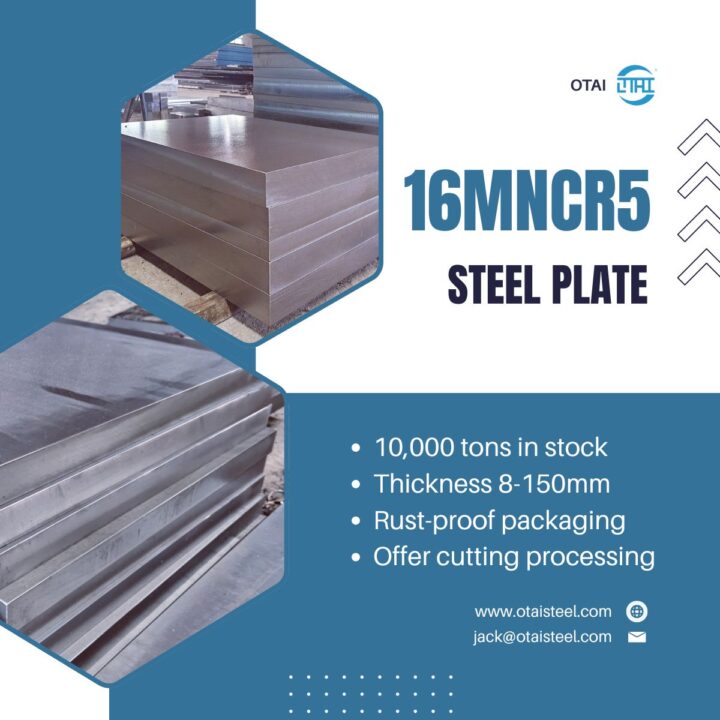
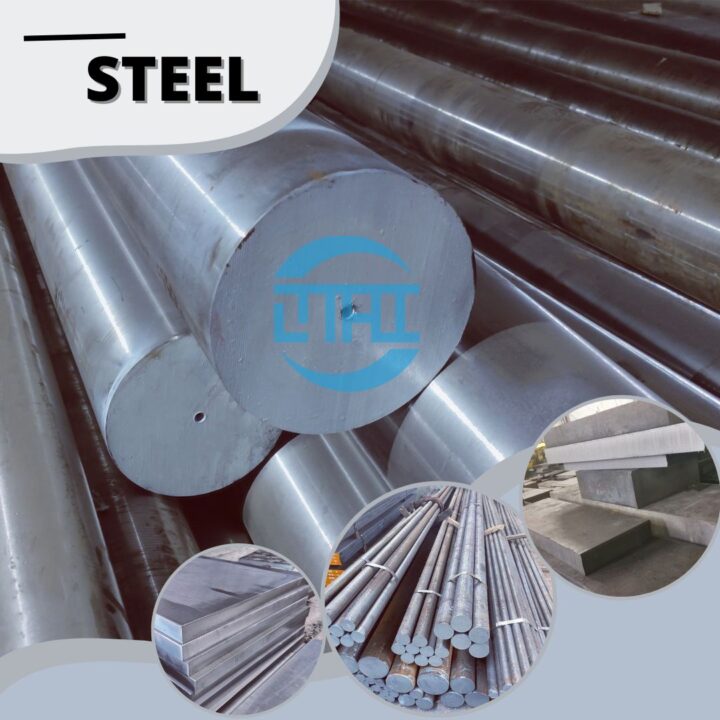
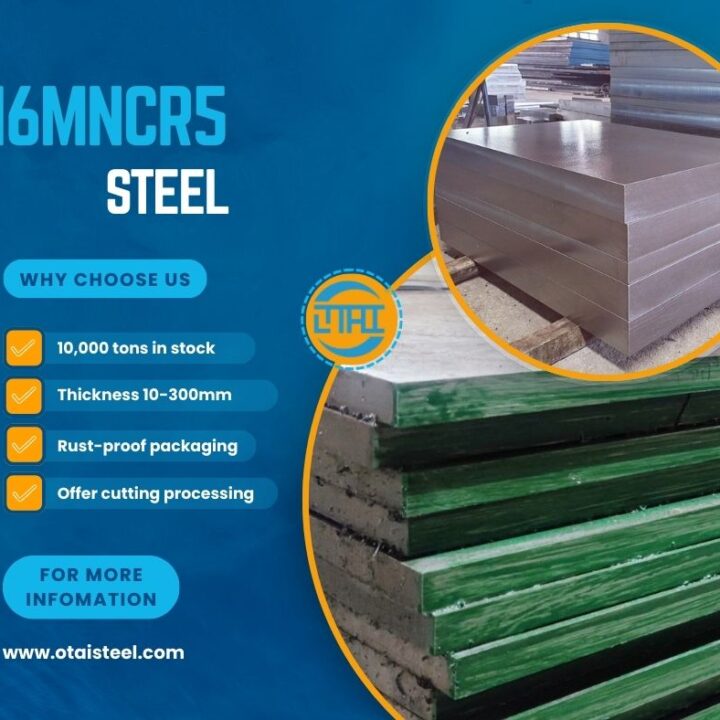
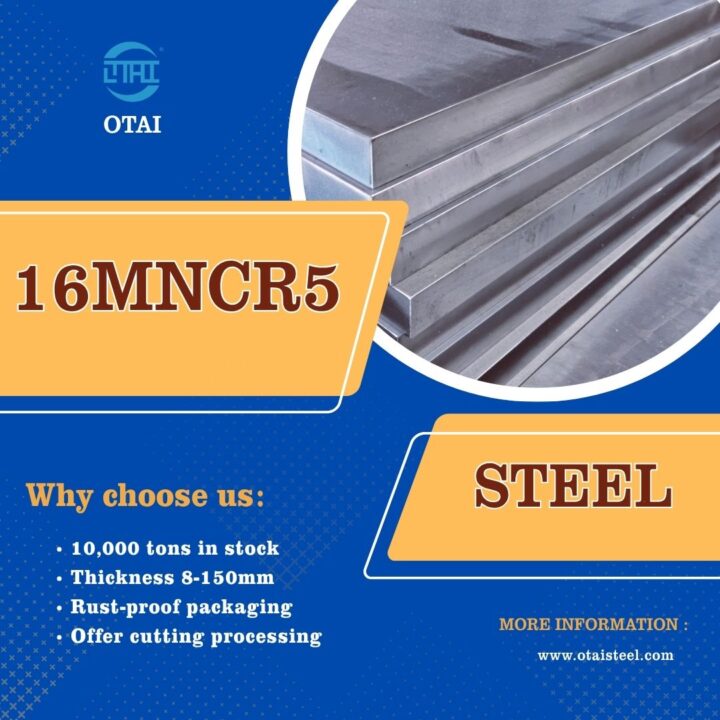
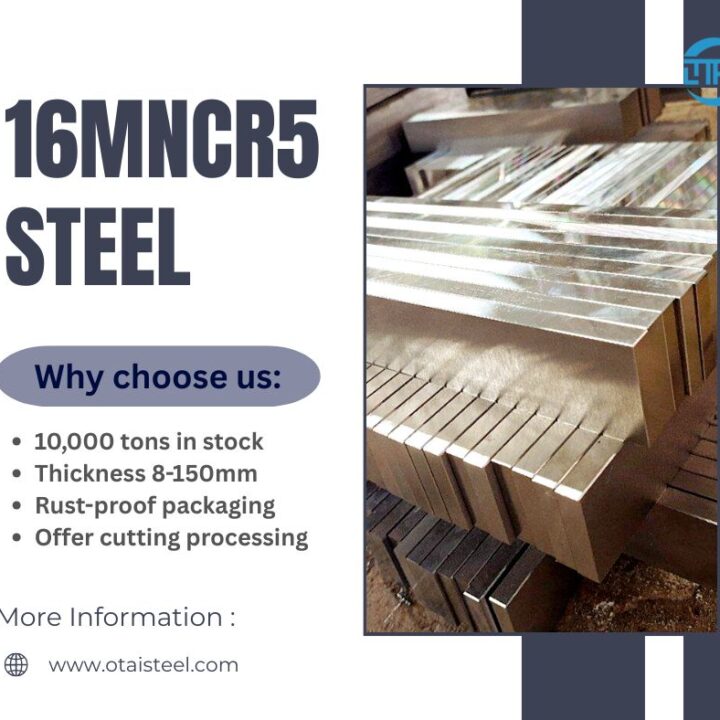
At Otai Special Steel, we supply high-quality 16MnCr5 alloy steel plates, forged blocks, flats, and rounds for international industrial applications.
Our advantages include:
- Large stock inventory available year-round
- 8–150mm thickness plates available in stock
- Customized cutting services
- Heat treatment support
- Ultrasonic testing (UT)
- Chemical composition verification
- Third-party inspection support such as SGS
- Reliable export packaging
- Fast global delivery capability
We support customers from automotive manufacturing, heavy machinery, engineering fabrication, and industrial equipment industries worldwide.
❓ FAQ
What is the equivalent material for 16MnCr5 in the USA?
The closest American equivalent is SAE 5115 steel.
What is the Japanese equivalent of 16MnCr5?
SCM420 is commonly regarded as the Japanese equivalent.
Is 16MnCr5 the same as 20MnCr5?
No. 20MnCr5 contains higher carbon content and generally provides higher core strength.
What is the steel number of 16MnCr5?
The official DIN steel number is 1.7131.
Is 16MnCr5 suitable for carburizing?
Yes. It is specifically designed for carburizing and case hardening applications.
What hardness can equivalent materials achieve?
After carburizing and quenching, most equivalent materials achieve approximately 58–62 HRC surface hardness.