 AISI 4140 Steel Mechanical Properties: Strength and Industrial Performance
Engineers and manufacturers often evaluate alloy steels based on their strength, durability, and performance under mechanical stress. One of the most widely used chromium-molybdenum alloy steels in the world is AISI 4140. Because of its excellent balance of strength, toughness, and wear resistance, this material plays a critical role in many industrial applications. Understanding aisi 4140 steel mechanical properties helps engineers select the right material for demanding components such as shafts, gears, and heavy machinery parts.
AISI 4140 steel belongs to the family of medium-carbon alloy steels that contain chromium and molybdenum. These alloying elements significantly improve hardenability, tensile strength, and fatigue resistance compared with plain carbon steels. In this article, we explore the mechanical properties of AISI 4140 steel, examine its chemical composition, analyze how heat treatment affects performance, and review its common engineering applications.
🔍 Overview of AISI 4140 Steel
AISI 4140 is a low-alloy steel developed to provide high strength and excellent toughness while maintaining good machinability. Because it responds well to heat treatment, engineers can adjust its mechanical performance depending on the application.
This material is widely used in industries such as automotive manufacturing, oil and gas, aerospace, and heavy equipment production. Many manufacturers rely on it for components that must withstand high stress and fatigue.
When discussing typical mechanical properties of AISI 4140 steel, it is important to recognize that the values vary depending on heat treatment condition, material size, and manufacturing process.
⚙️ Chemical Composition of AISI 4140 Steel
The mechanical strength of alloy steel depends largely on its chemical composition. The alloying elements in AISI 4140 improve hardenability and resistance to mechanical stress.
| Element | Percentage |
|---|---|
| Carbon (C) | 0.38 – 0.43% |
| Chromium (Cr) | 0.80 – 1.10% |
| Molybdenum (Mo) | 0.15 – 0.25% |
| Manganese (Mn) | 0.75 – 1.00% |
| Silicon (Si) | 0.15 – 0.35% |
| Phosphorus (P) | ≤0.035% |
| Sulfur (S) | ≤0.040% |
Chromium improves wear resistance and corrosion resistance, while molybdenum enhances toughness and high-temperature strength. These elements play a key role in determining the AISI 4140 steel property comparison with other alloy steels.
📊 Mechanical Properties of AISI 4140 Steel
The mechanical properties of AISI 4140 steel depend significantly on its heat treatment condition. In the quenched and tempered state, this alloy steel provides excellent strength and toughness.
Typical mechanical properties are shown below.
| Property | Typical Value |
|---|---|
| Ultimate Tensile Strength | 850 – 1000 MPa |
| Yield Strength | 655 – 850 MPa |
| Elongation | 12 – 25% |
| Reduction of Area | 45 – 60% |
| Hardness | 28 – 32 HRC |
These values represent the AISI 4140 steel tensile strength and elongation typically achieved after quenching and tempering treatment.
Because of this balanced mechanical performance, the material performs well in high-load applications.
🔧 Yield Strength and Hardness Characteristics
Engineers often focus on AISI 4140 steel yield strength and hardness when designing components that must resist deformation.
Yield strength represents the stress level at which permanent deformation begins. AISI 4140 offers high yield strength, which helps components maintain dimensional stability under heavy loads.
Typical hardness values depend on the heat treatment condition.
| Condition | Hardness Range |
|---|---|
| Annealed | 197 HB |
| Normalized | 200 – 220 HB |
| Quenched and Tempered | 28 – 32 HRC |
| Hardened | Up to 50 HRC |
These hardness levels demonstrate the material’s ability to adapt to different engineering requirements.
🔥 Heat Treatment and Property Changes
Heat treatment strongly influences heat treated AISI 4140 mechanical properties. The steel responds well to quenching and tempering processes that improve strength and toughness.
Common heat treatment processes include:
| Process | Temperature Range | Purpose |
|---|---|---|
| Annealing | 840 – 870°C | Improve machinability |
| Normalizing | 870 – 900°C | Refine grain structure |
| Quenching | 820 – 870°C | Increase hardness |
| Tempering | 400 – 650°C | Balance toughness and strength |
During quenching, the steel rapidly cools to form a martensitic structure. Tempering then reduces brittleness while maintaining high strength.
The AISI 4140 steel hardness after quenching and tempering typically ranges between 28 and 35 HRC depending on the tempering temperature.
📈 Comparison with Other Engineering Steels
Engineers often perform an AISI 4140 steel property comparison with other materials to evaluate performance differences.
| Steel Grade | Tensile Strength | Main Feature |
|---|---|---|
| 1045 | 570 – 700 MPa | Medium carbon steel |
| 4140 | 850 – 1000 MPa | High strength alloy steel |
| 4340 | 900 – 1200 MPa | Nickel alloy steel with high toughness |
| 42CrMo4 | 900 – 1100 MPa | European equivalent of 4140 |
Compared with medium carbon steels, 4140 offers superior strength and fatigue resistance due to its chromium and molybdenum content.
🏭 Industrial Applications
Because of its excellent mechanical performance, AISI 4140 steel appears in many demanding engineering applications.
Common uses include:
- Heavy-duty shafts
- Automotive crankshafts
- Industrial gears
- Oil and gas drilling components
- Hydraulic cylinders
- Machine tool components
Manufacturers often supply 4140 steel in pre-hardened condition to reduce machining time while maintaining adequate strength.
🌟 Company Advantages
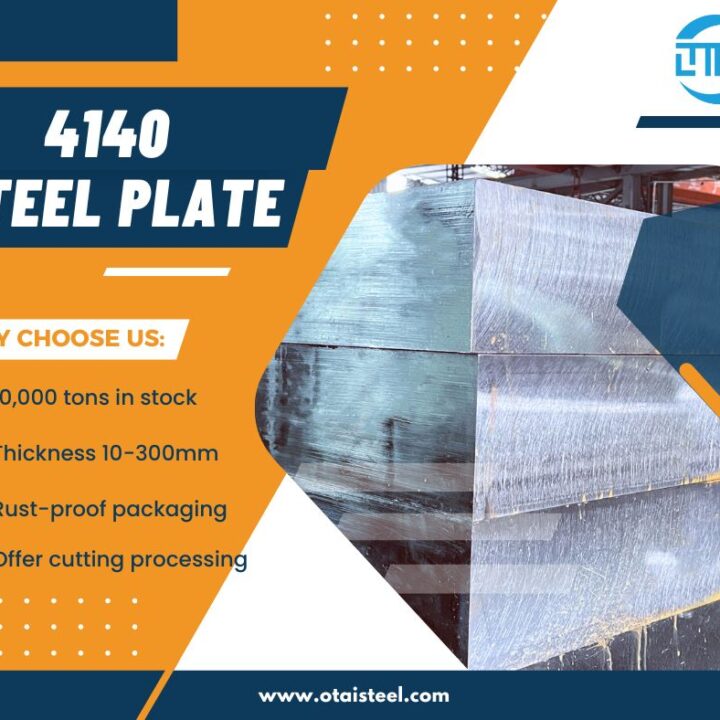
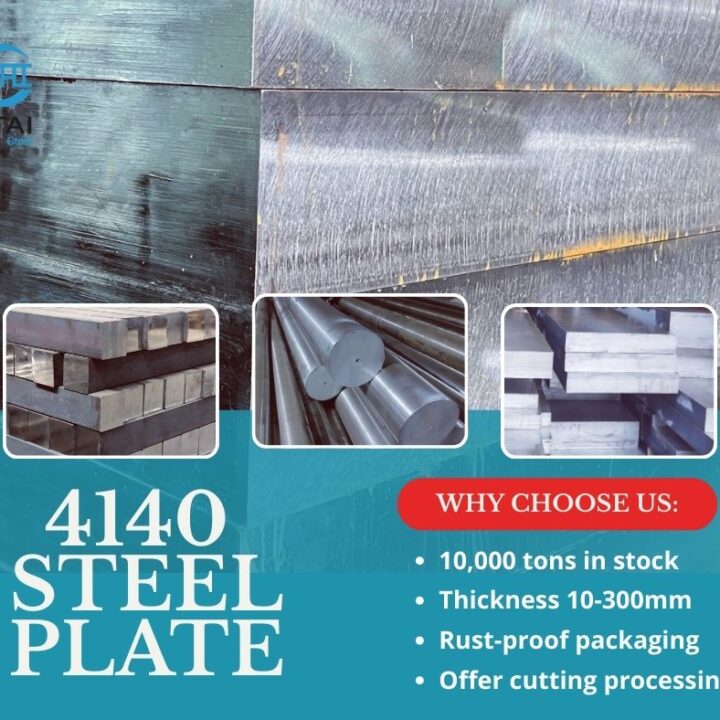
At Otai Special Steel, we specialize in supplying high-quality alloy steels including AISI 4140 for global industrial customers.
Our advantages include:
- More than 10,000 tons of alloy steel inventory available year-round
- Thickness range from 6 mm to 300 mm
- Precision custom cutting and processing services
- Strict ultrasonic testing (UT) quality inspection
- Complete chemical composition verification
- Long-term cooperation with international companies such as Thyssenkrupp and Schlumberger
These capabilities allow us to deliver reliable materials for demanding mechanical applications.
❓ FAQ
1. What are the mechanical properties of AISI 4140 steel?
Typical mechanical properties include tensile strength of 850–1000 MPa, yield strength of 655–850 MPa, and hardness of 28–32 HRC in the quenched and tempered condition.
2. How does heat treatment affect AISI 4140 steel?
Heat treatment significantly improves strength and hardness. Quenching forms a hard martensitic structure, while tempering increases toughness and reduces brittleness.
3. What is the hardness of AISI 4140 steel after heat treatment?
After quenching and tempering, the hardness usually ranges between 28 and 35 HRC, depending on the tempering temperature and final application requirements.
4. Why is AISI 4140 widely used in engineering?
AISI 4140 offers an excellent combination of strength, toughness, fatigue resistance, and machinability. This balance makes it suitable for many heavy-duty mechanical components.