 How to Weld 4140 Steel – Techniques, Tips, and Challenges
Welding 4140 steel is a challenge that many fabricators, engineers, and manufacturers face. Known as a chromium-molybdenum alloy steel, 4140 is highly valued for its strength, toughness, and wear resistance, making it a go-to choice for demanding applications in automotive, aerospace, and oil & gas. However, its medium-high carbon content and alloy composition make welding far more complex compared to mild steels.
In this article, we will explore in detail how to weld 4140 steel, why it requires special care, the recommended welding procedures, parameters, and heat treatment techniques. By the end, you’ll have a full picture of what it takes to successfully weld this material without compromising its performance.
⚡ What Makes 4140 Steel Hard to Weld?
The chemistry of 4140 steel is the root of its welding difficulties. It typically contains:
-
Carbon: 0.38–0.43%
-
Chromium: 0.8–1.1%
-
Molybdenum: 0.15–0.25%
-
Manganese: 0.75–1.0%
This combination makes the steel strong and hardenable but also sensitive to heat. The higher carbon level compared to mild steels promotes the formation of martensite in the heat-affected zone (HAZ), which is extremely hard and brittle. This is why improper welding often leads to cold cracking, hardness issues, and reduced ductility.
In simple terms, welding 4140 is like trying to balance two opposites: you need to retain its strength but prevent it from becoming too brittle.
🔧 General Welding Procedure for 4140 Steel
If you’re wondering how to weld 4140 steel in real industrial practice, here’s the standard approach that experienced welders follow:
1. Preheating
-
Temperature: 400–600°F (200–315°C).
-
Purpose: Slows down cooling, reduces the risk of martensite formation, and minimizes hydrogen-induced cracking.
-
Larger and thicker sections may need to be heated toward the higher end of the range.
2. Filler Metal Selection
-
For strength matching: ER80S-D2 (TIG/MIG), 8018-B2 (SMAW).
-
For improved ductility: ER70S-2 (TIG/MIG), 7018 (SMAW).
-
If joining 4140 to mild steel, a lower-strength filler is usually preferred to absorb stresses.
3. Welding Technique
-
Stick (SMAW), MIG (GMAW), and TIG (GTAW) are commonly used.
-
TIG welding is favored for precision and better heat control.
-
Small stringer beads should be applied instead of wide weave beads to reduce stress.
4. Interpass Temperature
-
Maintain 500–600°F (260–315°C) between passes.
-
Avoid letting the material cool below 400°F before the next pass.
5. Post-Weld Heat Treatment (PWHT)
-
Perform stress-relieving at 1100–1250°F (593–677°C) for 1–2 hours.
-
For critical components, a full tempering process may be required to restore mechanical balance.
📊 Welding Parameters and Guidelines
To make welding more reliable, the following table summarizes the commonly used parameters when fabricating with 4140 steel:
| Process | Preheat (°F) | Interpass (°F) | Filler Options | PWHT Temp (°F) | Notes |
|---|---|---|---|---|---|
| SMAW | 400–600 | 500–600 | 7018, 8018-B2 | 1100–1250 | Good for structural welding |
| GMAW | 400–600 | 500–600 | ER70S-2, ER80S-D2 | 1100–1250 | Efficient for medium to large parts |
| GTAW | 400–600 | 500–600 | ER70S-2, ER80S-D2 | 1100–1250 | Best control for critical welds |
🔍 Key Issues to Watch Out For
-
Hydrogen Cracking
-
Occurs in the heat-affected zone due to trapped hydrogen and high hardness.
-
Solution: Use low-hydrogen electrodes, preheat, and PWHT.
-
-
Excessive Hardness in HAZ
-
Can exceed 55 HRC if cooled too quickly.
-
Controlled preheat and slow cooling help avoid this.
-
-
Distortion and Residual Stress
-
4140 is strong and tends to hold stress after welding.
-
PWHT is critical to relieve these stresses.
-
🏭 Real-World Applications of Welding 4140 Steel
Knowing how to weld 4140 steel is important across industries:
-
Automotive: Crankshafts, axles, suspension parts.
-
Aerospace: Landing gear, structural supports.
-
Oil & Gas: Drill collars, downhole tools.
-
Machinery: Gears, spindles, shafts, dies.
For example, in oil drilling, 4140 components are subjected to extreme cyclic loads. Welding must ensure both fatigue resistance and fracture toughness—which means careful preheating, correct filler choice, and a strict PWHT cycle.
🧰 Practical Welding Tips from Industry Experience
-
Always keep parts insulated during cooling to avoid sharp temperature drops.
-
For sections thicker than 50 mm, consider submerged arc welding (SAW) with preheat and PWHT.
-
If welding to cast steel or mild steel, mismatched fillers are better to prevent cracking.
-
Avoid welding 4140 that has been quenched and tempered to high hardness unless it is re-heat-treated after welding.
-
In critical aerospace or defense applications, non-destructive testing (NDT) like ultrasonic testing is usually mandatory.
🔬 Case Example: Welding a 4140 Crankshaft
One real-life case comes from the automotive sector. A 4140 steel crankshaft required repair welding. The procedure was:
-
Preheated to 550°F.
-
Used ER70S-2 filler to provide ductility.
-
Applied TIG welding with multiple small passes.
-
Maintained interpass at ~575°F.
-
Stress relieved at 1200°F for 2 hours.
The result was a defect-free repair with hardness restored to ~30–32 HRC after tempering. This demonstrated that strict process control makes welding 4140 steel reliable even in high-load applications.
🏆 Why Choose Otai Special Steel for 4140 Welding Projects?
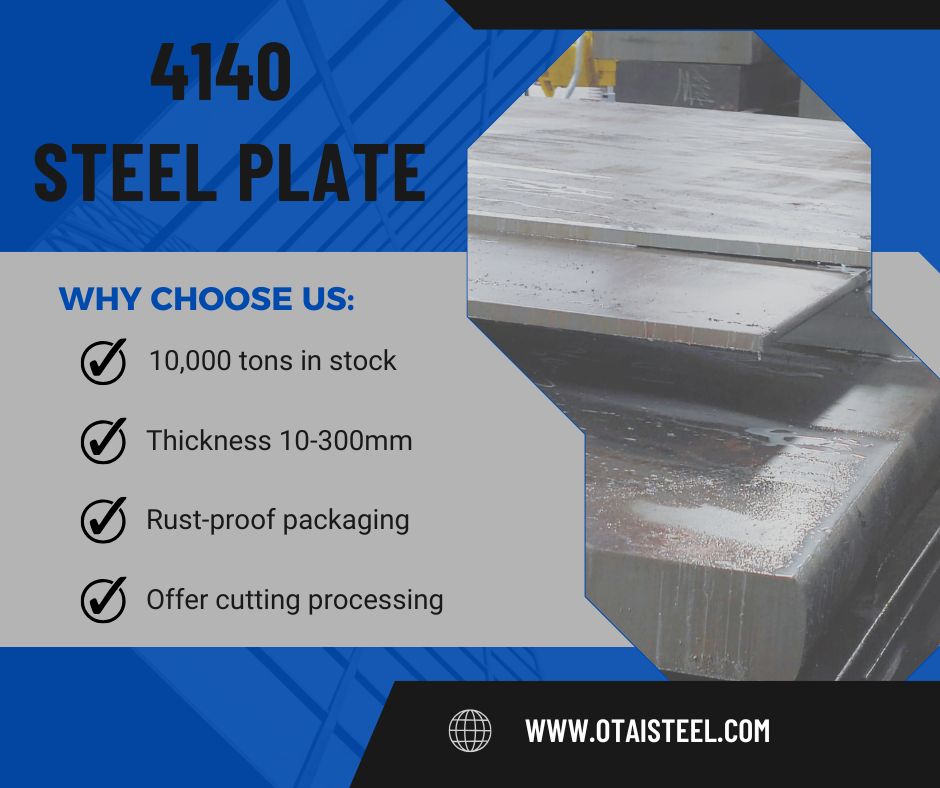
At Otai Special Steel, we supply 4140 alloy steel plates, bars, and tubes with customizable cutting, heat treatment, and ultrasonic testing services. Our stock ranges from 6mm to 300mm thickness, always ready for quick delivery.
We also support buyers with material certificates, SGS inspections, and technical guidance—including the right welding recommendations for your project. Whether you’re an end-user, supplier, or trading company, we make sure you get the right steel with no surprises.
❓ FAQ on Welding 4140 Steel
Q1: Can 4140 steel be welded without preheating?
Not recommended. Preheating prevents hydrogen cracking and ensures weld integrity.
Q2: Which filler rod is best for welding 4140 steel?
For strength: ER80S-D2. For ductility and crack resistance: ER70S-2.
Q3: Do I need PWHT after welding 4140 steel?
Yes, it’s essential for stress relief and restoring toughness.
Q4: Can 4140 be welded to mild steel?
Yes, but use a ductile filler like ER70S-2 to prevent cracking from mismatch.
Q5: Is TIG welding better for 4140 steel?
Yes, TIG allows better control over heat input, reducing risks of cracks.